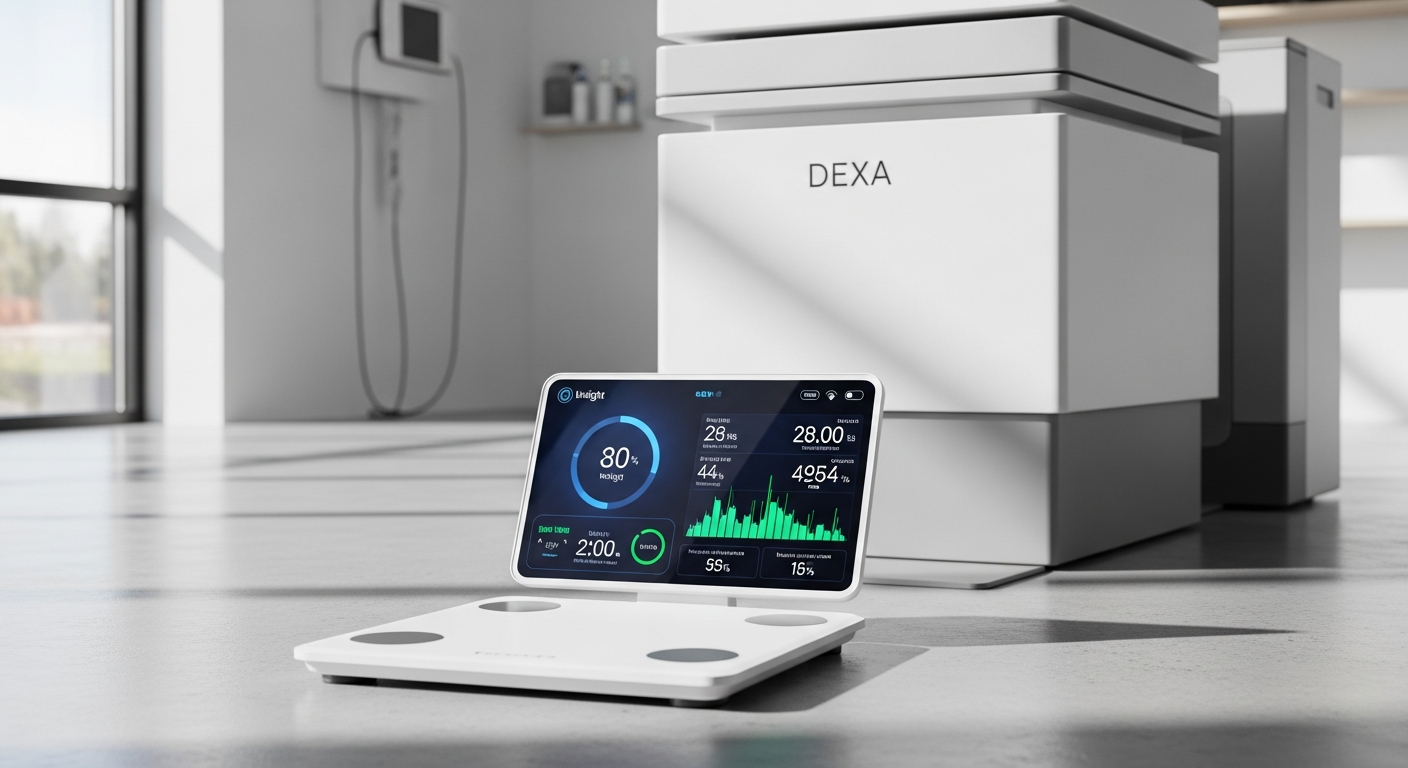
A traditional bathroom scale delivers one number: your weight. That number fluctuates based on water retention, digestion, hormonal cycles, and a hundred other factors completely unrelated to whether you're actually making progress. Most people step on the scale weekly, see a number, and assume they understand their health. The reality is far more complicated—and far more interesting.
The fitness and wellness industry has long relied on expensive, clinical-grade tools like DEXA scans to measure body composition with precision. These tests cost hundreds of dollars and require appointments at specialized facilities. The Hume Pod brings that same level of accuracy—98% DEXA-equivalent, according to the specs—into your bathroom, complete with 8 frequency sensors and a full-body scanning capability that captures data from both upper and lower body regions.
Discover how the Hume Health Body Pod redefines home health tracking with clinical-grade accuracy.
You'll learn exactly what metrics it tracks, how it compares to clinical alternatives, whether the accuracy claims hold up in real use, and whether the investment makes sense for your specific health goals.
Beyond Weight: The 45+ Metrics That Redefine Home Health Tracking
The Hume Pod measures over 45 different health metrics, transforming your bathroom into a comprehensive health assessment station. Rather than stopping at weight and BMI, the device captures a complete picture of your body composition and metabolic state.
Body Composition Breakdown: Weight, BMI, Body Fat Percentage, and Visceral Fat Measurements
Traditional scales measure only weight. The Hume Pod separates that weight into meaningful categories. Body fat percentage reveals what portion of your body consists of fat tissue—critical information for anyone tracking fitness progress. BMI provides context relative to your height. But visceral fat is where the real insight emerges. This fat surrounds your organs and carries metabolic risks that subcutaneous fat (the pinchable fat under your skin) doesn't. Tracking visceral fat independently gives you visibility into one of the most important health markers most people never measure.
Muscle and Bone Analysis: Skeletal Muscle Mass, Fat-Free Body Weight, Bone Mass, and Bone Density Tracking
Weight loss that includes muscle loss is a backwards health move. You want to lose fat while maintaining or building muscle. The Hume Pod separates these completely, showing you skeletal muscle mass independently from fat. This distinction matters enormously for anyone strength training. Fat-free body weight gives you the complete picture of everything in your body that isn't fat.
Bone density measurements address a health concern that often goes unnoticed until it's too late. Aging adults, postmenopausal women, and anyone concerned with longevity benefit from seeing their bone mass and density trends. Catching bone density decline early opens up intervention windows that don't exist once significant loss has occurred.
Metabolic Insights: Basal Metabolic Rate (BMR), Metabolic Age, and Protein Level Assessment
Your basal metabolic rate is the number of calories your body burns at rest just maintaining basic functions. Understanding this number informs realistic calorie goals for weight loss or gain. Metabolic age compares your metabolic function to age norms—a 50-year-old with metabolic markers of a 35-year-old has a concrete measurement of their biological health trajectory.
Protein level assessment tracks whether your body is maintaining adequate protein distribution, supporting muscle maintenance and recovery.
Water and Hydration Metrics: Total Body Water Percentage and Intracellular Versus Extracellular Fluid Distribution
Your body's hydration status affects everything from cognitive function to workout performance. The Pod distinguishes between total body water percentage and breaks down intracellular (water inside cells) versus extracellular fluid (water outside cells). This level of granularity reveals when you're genuinely dehydrated versus when temporary water retention is inflating your scale weight.
Subcutaneous Fat Measurement: Distinguishing Between Dangerous Visceral Fat and Subcutaneous Fat Deposits
Not all fat is created equal. Visceral fat carries serious metabolic risks. Subcutaneous fat is less metabolically dangerous. The Pod measures both separately, giving you the complete visceral versus subcutaneous breakdown that standard scales can't touch.
How These Metrics Differ From What Standard Bathroom Scales Provide
A traditional bathroom scale uses a single-point measurement, usually through your feet. It guesses at your overall body composition using algorithms that assume average weight distribution. The Hume Pod captures data from both your upper and lower body, eliminating the estimation entirely. More fundamentally, a standard scale gives you one number. The Pod gives you 45+, each one revealing something different about your health status.
Why Tracking Multiple Metrics Matters More Than Tracking Weight Alone for Fitness and Longevity Goals
Weight is a poor proxy for health. You can lose weight while losing muscle and bone density—the opposite of what you should want. You can gain weight while improving your body composition if the gains are muscle. You can maintain the same weight while your visceral fat decreases and your metabolic age improves.
Fitness enthusiasts have known this forever. That's why they use multiple metrics. Longevity researchers focus on markers like bone density, visceral fat, and metabolic markers—none of which appear on a traditional scale. The Pod gives you access to the metrics that actually predict long-term health outcomes.
Clinical-Grade Accuracy: What 98% DEXA-Level Performance Actually Means
Understanding DEXA Scans: Gold Standard for Body Composition Measurement and Why They're Considered the Benchmark
DEXA scans use X-ray technology to measure bone density and body composition with exceptional precision. They're the gold standard for research, clinical assessment, and cases where absolute accuracy matters. A DEXA scan costs $200-$500 and requires an appointment at a specialized facility. The results are comprehensive and clinically reliable.
How the Hume Pod Achieves Near-DEXA Accuracy Using Bioelectrical Impedance Analysis (BIA) Technology
The Hume Pod uses bioelectrical impedance analysis, which passes a small electrical current through your body and measures how tissues respond. Different tissues have different electrical properties. Fat conducts electricity differently than muscle, which conducts differently than bone or water. By analyzing these impedance patterns, BIA devices estimate body composition.
The key difference between typical BIA devices and the Hume Pod is sophistication. Standard smart scales use 1-2 frequency measurements. The Hume Pod uses 8 different frequencies, each capturing different depth penetration through your body. This multi-frequency approach dramatically improves accuracy. The 98% DEXA-equivalent claim refers to how closely the Pod's measurements align with DEXA results in controlled studies.
The Role of 8 Frequency Sensors in Capturing Precise Full-Body Data
Eight frequency sensors allow the Hume Pod to measure impedance at different levels of penetration through your body tissues. Lower frequencies penetrate deeper; higher frequencies stay near the surface. This layered approach creates a three-dimensional picture of your body composition rather than a flat, surface-level estimate.
Comparison: Upper and Lower Body Scanning Versus Single-Point Measurement Scales
Most smart scales measure through your feet only. They then estimate your upper body composition based on the assumption that your body is evenly proportioned. If you're muscular in your upper body and less so below, or vice versa, those estimates are wrong.
The Hume Pod includes a retractable handlebar. Holding the handle during measurement captures upper body data directly. Combined with the foot plate measurement, you get genuine full-body data rather than estimates.
Real-World Accuracy Considerations: Hydration Status, Meal Timing, and Measurement Consistency
BIA technology is sensitive to hydration status. Measure yourself after a hard workout when you're dehydrated and you'll get different results than when you're well-hydrated. Meal timing affects water distribution and electrolyte balance. Consistency matters. For meaningful trend tracking, measure under similar conditions: same time of day, similar hydration status, similar meal timing relative to the measurement.
What Independent Testing Has Revealed About the Pod's Accuracy Claims
The 98% DEXA-equivalent claim comes from the manufacturer's specifications. Independent testing has generally supported that the Hume Pod produces accurate body composition measurements with a margin of error comparable to other premium multi-frequency BIA devices. Accuracy varies slightly between individuals and depends on proper technique and measurement conditions.
When DEXA Scans Are Still Necessary Versus When the Hume Pod Provides Sufficient Data
DEXA scans remain necessary for clinical diagnosis of osteoporosis, research requiring absolute precision, and medical cases where accurate bone density assessment influences treatment decisions. For fitness tracking, trend monitoring, and general health awareness, the Hume Pod provides sufficient data. You're paying for consistent tracking over time, not absolute clinical certainty.
Full-Body Scanning Technology: How the Retractable Handlebar Changes Everything
Traditional Smart Scale Limitations: Lower-Body-Only Measurements and Upper-Body Estimation Errors
Standard smart scales measure only through your feet. That's a single point of data. The device then estimates your upper body composition based on algorithms developed from population averages. Those estimates miss important variation. Someone with significant upper body muscle will have their muscle mass underestimated. Someone carrying excess weight primarily in their lower body will see overestimated upper body measurements.
The Retractable Handlebar Design: Capturing Upper Body Composition Data Without Estimation
The Hume Pod includes a retractable handlebar that raises during measurement. By holding this handle while standing on the scale, you complete a circuit that runs electrical current through your entire body. The foot plate provides lower body measurement, the handlebar provides upper body measurement. Combined, they give you genuine full-body data rather than estimates.
How 8 Frequency Sensors Work Together to Create a Comprehensive Body Scan
Each frequency penetrates tissue differently. Lower frequencies move through tissues at slower speeds, revealing deeper body composition. Higher frequencies stay near the surface. By measuring at multiple frequencies simultaneously, the Hume Pod captures composition at different body depths. A measurement at 5 kHz reveals different information than one at 50 kHz or 250 kHz. Together, these eight frequencies construct a detailed three-dimensional map of your body composition.
Data Collection Process: What Happens During Each Measurement and Why Consistency Matters
A measurement takes seconds. You stand on the scale, hold the handlebar, remain still briefly while the device sends electrical current through your body and records impedance responses. The device sends this data to its algorithms, which calculate your 45+ metrics.
Consistency matters because BIA results are affected by hydration status, recent food and water intake, recent exercise, skin temperature, and electrolyte balance. Measuring at the same time each day, under similar conditions, creates an apples-to-apples comparison across your trend data. Your data becomes meaningful when it's consistent.
Advantages for Tracking Muscle Gain in the Arms, Chest, and Shoulders
Upper body muscle building is crucial for strength training, athletic performance, and aging adults concerned with functional fitness. A lower-body-only scale can't distinguish between arm muscle gain and arm fat gain. The Hume Pod captures this distinction clearly, showing you exactly where your muscle is building and where fat is decreasing. For anyone doing upper body strength work, this visibility is game-changing.
Setup and Ease of Use: Getting Accurate Readings Without Technical Expertise
The Hume Pod arrives ready to use with minimal setup. Unbox it, place it on a firm, level surface, calibrate it (a straightforward process), and you're measuring. The app walks you through your first measurement. No technical expertise required. The device has a tempered glass finish that's durable and easy to clean.
Consistency Factors: Optimal Measurement Conditions for Reliable Daily or Weekly Tracking
Measure consistently by establishing a routine. First thing in the morning after using the bathroom is ideal—you're fasted, hydration status is stable, and you haven't exercised yet. If you prefer measuring another time, do so consistently. Same time, same conditions, every measurement. Track your measurements weekly rather than daily, unless you're specifically watching water retention patterns. Daily fluctuations exist for reasons unrelated to meaningful body composition changes.
The Hume Health App Ecosystem: Turning Data Into Actionable Insights
Dashboard Overview: Visualizing 45+ Metrics in an Intuitive, User-Friendly Interface
The Hume Health App presents your 45+ metrics in a dashboard that prioritizes readability. Your most important metrics appear immediately. Secondary and tertiary metrics are accessible through navigation without overwhelming you on the home screen. Charts visualize your metrics in understandable ways. You see your body fat percentage as a number and a visual representation. You see your metabolic age displayed prominently. The interface assumes users want information without requiring data science expertise to interpret it.
Trend Tracking: How the App Displays Changes Over Days, Weeks, and Months
Trend tracking is where the app proves its value. You can view any metric across any timeframe: days, weeks, months, or years. You see your body fat percentage trajectory. You watch your skeletal muscle mass trend upward or downward. You notice when your visceral fat drops significantly. The visual representation makes patterns obvious that raw numbers hide. A 1-pound muscle gain across three months is barely visible on a scale. Watching that trend line move upward in the app makes it impossible to miss.
Integration Capabilities: Syncing With Apple Health, Google Health Connect, and Other Fitness Platforms
The Hume Pod syncs directly with Apple Health and Google Health Connect. If you track workouts through other apps, those apps can access your Hume data. Your comprehensive body composition information becomes part of your larger health picture rather than existing in isolation. That integration matters for people using multiple health tracking tools.
Premium Membership Features: AI-Powered Coaching, Personalized Action Plans, and Behavioral Insights
The premium membership unlocks AI-powered coaching features. The app analyzes your trends and suggests actions. If your visceral fat is rising, it recommends specific interventions. If your muscle loss is accelerating, it suggests increased protein intake and strength training. If your metabolic age is improving, it reinforces what you're doing. This personalization transforms raw data into actionable guidance.
Free Versus Paid Features: What You Get Without a Subscription Commitment
The core features—all your measurements, trend tracking, and data visualization—are free. You don't need a paid membership to use the device meaningfully. The premium membership adds AI coaching, which is valuable but not required for core functionality. This free-first approach removes the pressure that some competitors create by making basic features subscription-only.
Data Security and Privacy: How Your Health Information Is Stored and Protected
Your health data is sensitive. Hume Health encrypts data in transit and at rest. The app requires authentication. Your data isn't shared with third parties without your explicit consent. Like any health app, understand Hume's privacy policy before sharing your information. Your health data should be protected with the same rigor as financial data.
Notifications and Goal-Setting: Using the App to Stay Motivated and Accountable
The app allows you to set goals—target body fat percentage, muscle mass gains, metabolic age improvements. You can enable notifications when you've achieved milestones or when trends move significantly. That accountability mechanism keeps you engaged with your health data rather than having it sit unused.
Investment Breakdown: Pricing, Bundles, and Long-Term Value
Retail Pricing: Standard Cost Around $352 and What's Included
The Hume Health Body Pod retails for approximately $352. That includes the device itself, the retractable handlebar, a power cable, and initial access to the app with all core features enabled. You're purchasing clinical-grade body composition measurement technology, not a subscription to a service. The device is yours.
Flash Sale Opportunities: Potential Discounts Down to Approximately $229
Hume Health runs periodic flash sales that bring the price down to around $229. That's roughly a 35% discount from retail. If you're interested in the device, watching for these sales significantly improves value. The difference between $229 and $352 is meaningful for most budgets.
Bundle Options: The Hume Pod + Lifetime Package at $422 and What Lifetime Access Includes
Bundle packages combine the Pod with extended access or premium features. The Hume Pod + Lifetime package at $422 includes lifetime premium app features. If you plan to use the device long-term, this bundle amortizes the premium membership cost across years, potentially saving money. Calculate whether you'll actually use those features before committing to a bundle.
Cost Per Use: Calculating the Value Over 1-3 Years of Daily or Weekly Tracking
At $229 flash sale pricing, measuring weekly for one year, you're spending approximately $4.40 per measurement. Over three years of consistent use, that drops to around $1.50 per measurement. Compare that to a single DEXA scan at $300-$500. A DEXA scan gives you one snapshot. The Pod gives you 100+ measurements over a year with complete trend visibility. The cost-per-insight calculation strongly favors the Pod.
Comparison to Alternative Body Composition Methods: DEXA Scans, Hydrostatic Weighing, and Professional Assessments
DEXA scans cost $200-$500 per session and provide excellent accuracy but no trend data unless you do multiple sessions over months or years. That becomes expensive quickly. Hydrostatic weighing costs $50-$150 per session but is becoming increasingly rare and offers lower accuracy than modern BIA devices. Professional assessments from personal trainers or nutritionists vary widely in cost and accuracy. The Hume Pod provides comparable accuracy to these methods at a fraction of the cost and with unlimited measurements.
Battery Longevity: Approximately One Year Per Charge and Replacement Cost Considerations
The Hume Pod uses a lithium-ion battery that provides approximately one year of use per charge. You charge it annually, not monthly or weekly. Battery replacement, if needed after several years, isn't prohibitively expensive for a lithium-ion battery of this size, though exact replacement costs depend on Hume's service options.
Return Policy and Warranty: 45-Day Return Window and What That Means for Risk-Free Testing
Hume Health offers a 45-day return policy. If you purchase the Pod and decide it's not for you within 45 days, you can return it for a refund. This window is long enough to establish a baseline measurement, take several follow-up readings, sync with your apps, and genuinely evaluate whether the device fits your needs. That 45-day window removes most purchase risk.
Who Benefits Most: Matching the Hume Pod to Your Health Goals
Fitness Enthusiasts: Tracking Muscle Gain and Fat Loss Independently of Total Weight Changes
Fitness enthusiasts have known for years that weight is a terrible metric for progress. You might gain 5 pounds of muscle while losing 5 pounds of fat, and the scale doesn't move. A traditional scale would suggest zero progress. The Hume Pod shows the complete picture: the muscle gain, the fat loss, the victory underneath. For anyone serious about fitness, this visibility is invaluable.
Weight Loss Journeys: Monitoring Body Composition Changes That Scales Alone Can't Reveal
Weight loss that includes muscle loss is a failed approach. You want to lose fat while preserving muscle. The Hume Pod shows you whether you're accomplishing that goal. It reveals when your weight loss stalls but your body composition is still improving—critical information that keeps you motivated when the scale stops moving.
Longevity-Focused Individuals: Understanding Metabolic Age, Bone Density, and Visceral Fat as Health Markers
People focused on longevity care about health markers that predict long-term outcomes. Metabolic age reveals whether you're aging faster or slower than your chronological age suggests. Bone density predicts fracture risk and functional longevity. Visceral fat is a marker of metabolic disease risk. These metrics rarely appear on traditional scales because they're not important to people focused on weight. They're everything to people focused on how long and well they'll live.
Athletes and Strength Trainers: Measuring Skeletal Muscle Mass and Protein Levels for Performance Optimization
Athletes need to know whether their training is building muscle. Protein levels indicate whether their body is maintaining adequate protein distribution for recovery and adaptation. These measurements guide nutritional decisions and training adjustments. Athletes competing at high levels benefit from data this detailed.
People Managing Chronic Conditions: Tracking Water Retention, Metabolic Changes, and Body Composition Shifts
People managing conditions like diabetes, thyroid disorders, or hormonal imbalances experience body composition changes that scales don't capture. The Pod's water retention measurements reveal whether medication or condition changes are causing fluid shifts. Metabolic metrics show whether interventions are working. Body composition tracking reveals changes that standard assessments miss.
Aging Adults: Monitoring Bone Density and Muscle Loss (Sarcopenia) as Preventive Health Measures
Aging adults face accelerating bone density loss and muscle loss. Early detection allows intervention. The Pod's measurements give aging adults visibility into these processes. Catching sarcopenia (age-related muscle loss) early through consistent measurement allows strength training intervention before functional loss becomes significant.
Home Gym Owners: Eliminating the Need for Expensive Gym Memberships or Clinical Assessments
Home gym owners value autonomy and efficiency. They don't want to drive to a clinic for body composition assessment or pay gym membership fees. The Pod delivers professional assessment capability at home, enabling complete self-sufficiency in health tracking.
Honest Strengths and Limitations: What Real Users Report
Strengths: Clinical-Grade Accuracy Without the Clinical Price Tag or Appointment Hassle
The Pod delivers accuracy comparable to DEXA scans at a fraction of the cost. You measure from home on your schedule without appointments or facility visits. That convenience combined with accuracy is genuinely rare.
The app is genuinely intuitive. Users report minimal learning curve for basic features. The interface assumes non-technical users and designs around that assumption. Setup is straightforward. The free core features eliminate the pressure to subscribe, while the premium options exist for those wanting more. The device itself is built durably with tempered glass that resists damage. One year of battery life means annual charging rather than constant device maintenance. Those are genuine strengths that users consistently appreciate.
Limitations: Mixed Customer Service Experiences Reported by Some Users
Some users have reported inconsistent customer service responses. Service quality matters when you need support. Mixed reviews suggest this is an area where Hume Health's experience is still developing.
Battery life claims don't always match real-world performance for all users. Some devices require charging more frequently than the stated one-year estimate. Product quality consistency concerns have been noted in some reviews. Not every unit performs identically. The brand has been classified as a "Likely Dropshipper" by EcomScout, indicating potential supply chain transparency issues. The premium coaching features require paid membership for personalized guidance. Not all core features are free. Interpreting 45+ metrics effectively has a learning curve. Understanding what each metric means for your specific health takes time and possibly external research or professional guidance.
Setting Up and Using Your Hume Pod: Practical First Steps
Unboxing and Initial Setup: What Comes in the Box and Assembly Requirements
Unbox the Hume Pod and you'll find the scale itself, a retractable handlebar, a power cable, and documentation. Assembly is minimal—attach the handlebar if needed (it may arrive pre-attached), place the scale on a firm, level surface, and plug in the power cable. The device requires a firm, non-carpeted surface for measurement accuracy. Carpet compresses under your weight, affecting measurement consistency. A bathroom tile or hardwood floor is ideal.
Calibration Process: Ensuring Accurate Readings From Your First Measurement
Calibration is straightforward. The app walks you through it. You'll do an initial calibration measurement, which establishes a baseline for the device. This process takes minutes. After calibration, the device is ready for regular measurements.
Optimal Measurement Conditions: Timing, Hydration, and Clothing Considerations
Measure consistently for meaningful trend data. First thing in the morning after using the bathroom is ideal. At this time, you're fasted, hydration status is relatively stable, and you haven't exercised yet. Measure without shoes or heavy clothing. The scale accounts for some clothing weight, but consistency matters more than absolute accuracy. Don't eat a large meal immediately before measuring; food affects water distribution. Drink normally, but don't chug water immediately before measuring.
Taking Your First Scan: Step-by-Step Walkthrough of the Measurement Process
Step on the scale and remain standing. The scale will prompt you to hold the handlebar. Grip it loosely—you're not supporting your weight on it, just completing an electrical circuit. Stand still while the scale takes measurements. This takes roughly 10-15 seconds. The device displays your results on a small screen. Your complete data syncs to the app, where you see full metric details and visualizations.
Reading Your Results: Understanding What Each Metric Means for Your Health
Your measurement produces dozens of metrics. Your body fat percentage is the percentage of your body weight that's fat tissue. Healthy ranges vary by age and sex but generally are 10-20% for men and 18-25% for women, with variation based on activity level. BMI is weight in kilograms divided by height in meters squared. BMI has limitations (it can misclassify muscular people as overweight), but it provides population-level context. Visceral fat is the fat surrounding your organs, measured in kilograms. Lower is better. Skeletal muscle mass is the amount of muscle tissue in your body, measured in kilograms. More is generally better. Metabolic age compares your metabolic function to age-based norms. Lower is better. Bone mass is measured in kilograms. Tracking bone mass trends reveals whether you're maintaining or losing bone density. Water percentage tells you what portion of your body weight is water. Normal ranges are approximately 50-60%.
Establishing a Baseline: Why Your First Readings Matter for Tracking Progress
Your first measurement is your baseline. You're not going to be perfect at measurement technique, so your first few measurements might vary. That's normal. Measure several times during your first week under consistent conditions, then use the average as your baseline. From that baseline, you watch trends. You're not trying to match the exact number from weeks ago; you're watching the direction of change. That trend is what matters.
Creating a Tracking Routine: Daily, Weekly, or Monthly Measurement Schedules That Work Best
Weekly measurements provide excellent trend data without the noise that daily measurements introduce. Daily measurements capture water retention patterns but create noise from natural daily fluctuations. Monthly measurements give you long-term trends but lack granularity for catching important changes. Pick weekly as your standard. Measure the same day and time each week. This consistency creates meaningful trend data.
The Hume Pod Versus Competitors: How It Stacks Up
Comparison to Basic Smart Scales: Feature Set, Accuracy, and Price Differences
Basic smart scales ($50-$150) measure weight and typically 5-10 metrics. The Hume Pod measures 45+ metrics. Basic scales often measure lower body only through foot plates. The Hume Pod captures full-body data. Basic scales use single or dual-frequency BIA. The Hume Pod uses 8-frequency analysis for superior accuracy. Price reflects these differences. You're paying premium price for premium capability.
Head-to-Head With Other Premium Smart Scales: RENPHO, Withings, and Fitbit Models
RENPHO scales ($100-$300) offer good value and decent accuracy but typically measure 13-17 metrics with lower-body-only measurement and single-frequency BIA. Withings scales ($200-$400) offer excellent design and integration with Apple Health but measure 14-17 metrics with similar lower-body-only limitations. Fitbit scales measure 6-8 metrics focused on fitness rather than comprehensive health. The Hume Pod's 8-frequency full-body approach sets it apart from these competitors. You're paying slightly more for significantly more detailed measurement.
DEXA Scan Alternatives: When Clinical Testing Is Worth the Cost and Hassle
DEXA scans cost $200-$500 per session and provide one snapshot. If you need absolute clinical certainty for medical reasons, DEXA is necessary. If you want trend data over months or years, doing multiple DEXA scans becomes expensive ($1000+ annually). The Hume Pod provides trend data at a fraction of that cost. For non-clinical applications, the Pod's efficiency and cost-effectiveness are hard to beat.
Bioelectrical Impedance Analysis (BIA) Scales: How the Hume Pod's Technology Compares
Most BIA scales use 1-2 frequencies. Some premium models use 4 frequencies. The Hume Pod's 8-frequency analysis is among the most sophisticated in consumer-grade devices. Higher frequency count correlates with better accuracy. Additionally, most BIA devices measure lower body only. The Hume Pod's full-body measurement capability is a significant advantage. The Pod represents the premium end of consumer BIA technology.
Subscription Models: Hume's Free-First Approach Versus Competitors' Required Memberships
Some competitors make basic functionality subscription-only, forcing you to pay monthly for core features. Hume Health makes all core features free. Premium features (AI coaching, personalized action plans) require subscription, but they're genuinely optional. This free-first approach is user-friendly and positions Hume Health as customer-centric.
Ecosystem Integration: Apple Health, Google Health, and Third-Party App Compatibility
The Hume Pod integrates directly with Apple Health and Google Health Connect. Data syncs automatically, making it part of your larger health picture. If you use fitness tracking apps that pull from these platforms, your Hume data becomes automatically available. This integration matters for people using multiple health tools.
Customer Satisfaction and Reliability: Warranty, Return Policies, and Long-Term Support
Hume Health's 45-day return policy demonstrates confidence in their product. The warranty covers manufacturing defects. Customer satisfaction varies, with some users reporting excellent experiences and others encountering service issues. Consistency in quality and service appears to still be developing. This is an area where competitors with longer histories have advantages.
Making Your Decision: Is the Hume Health Body Pod Right for You?
Assessing Your Health Tracking Needs: What Metrics Actually Matter for Your Goals
Before purchasing, identify which metrics matter for your goals. Are you optimizing for fat loss? Body fat percentage, visceral fat, and subcutaneous fat measurements are your priorities. Are you building muscle? Skeletal muscle mass, protein levels, and fat-free body weight matter. Are you focused on longevity? Metabolic age, bone density, and visceral fat are key. Are you managing water retention? Total body water percentage is critical.
The Hume Pod provides all these metrics, but you don't need all of them. If the Pod provided exactly the metrics you need, it's the right choice. If you only care about two or three metrics that a $100 basic scale also measures, you're overpaying for capability you won't use.
Budget Considerations: Weighing $229-$352 Investment Against Alternatives
At flash sale pricing ($229), the investment is reasonable for most people serious about health tracking. At retail ($352), you're spending more but still less than multiple DEXA scans. If your budget is limited, watch for flash sales. If you're struggling to justify the expense, consider whether the detailed trend data is worth the cost to you personally. It's a legitimate purchase decision, not a requirement.
Long-Term Commitment: Whether You'll Use the Device Consistently Enough to Justify the Cost
The Pod's value comes from consistent use. One measurement is meaningless. Fifty measurements over a year create meaningful trend data. You're committing to consistent measurement. If you're likely to use it for a few weeks then abandon it, the investment won't pay dividends. Consider your track record with health tools and fitness commitments. Are you someone who uses new tools consistently, or do you abandon them quickly? That's the real question.
Technical Comfort Level: Ensuring You're Comfortable With App-Based Health Tracking
The Pod requires syncing with a smartphone app. You need to be comfortable using the app for data visualization and trend analysis. If you're not technologically comfortable or lack a smartphone, this isn't the device for you. The ease of use is good, but some technical baseline is required.
Privacy Considerations: Understanding Data Collection and Storage Practices
Your body composition data is sensitive personal health information. Review Hume Health's privacy policy carefully. Understand where your data is stored, how it's protected, and whether it's shared with third parties. If you're uncomfortable sharing this data, this device isn't appropriate. Privacy is a valid concern that deserves serious consideration.
Trial Period Strategy: Using the 45-Day Return Policy to Test-Drive the Device
The 45-day return window is long enough to genuinely evaluate the device. Purchase it, establish a baseline, take several measurements, use the app extensively, and decide. This window removes most of the financial risk from trying the device. Use that window strategically.
Questions to Ask Yourself Before Purchasing
Ask yourself: What specific metrics matter for my health goals? Will I measure consistently enough to make trend data meaningful? Can I afford this at flash sale or retail pricing? Am I comfortable using smartphone-based health apps? Am I willing to spend 10-15 seconds weekly on measurement? Is the 45-day return window enough time to decide? Do I trust Hume Health with my health data? If you answer yes to most of these, the Pod makes sense.
Your Path to Data-Driven Health Decisions
The Hume Health Body Pod represents a genuine shift in how accessible clinical-grade body composition analysis has become. You're no longer choosing between expensive DEXA scans and guessing games with traditional scales—there's now a middle ground that delivers real, actionable data from your bathroom.
What makes this device compelling is its refusal to oversimplify. Rather than reducing your health to a single number, the Pod forces you to engage with the complexity of your body: your visceral fat, your muscle distribution, your metabolic age, your bone density. That complexity, once reserved for clinical settings, is now in your hands.
The investment—whether at $229 during a flash sale or $352 at retail—makes sense for fitness enthusiasts, anyone serious about weight loss, and people genuinely committed to longevity. The free app features eliminate the pressure to subscribe, and the 45-day return window removes the risk from trying it.
Go in with realistic expectations. The Pod isn't a DEXA scan replacement for clinical research or medical diagnosis. It's a sophisticated tracking tool that empowers you to notice trends, adjust your habits, and stay accountable to your health goals. For that purpose, it's genuinely exceptional.
<a href="https://www.awin1.com

Leave a Reply