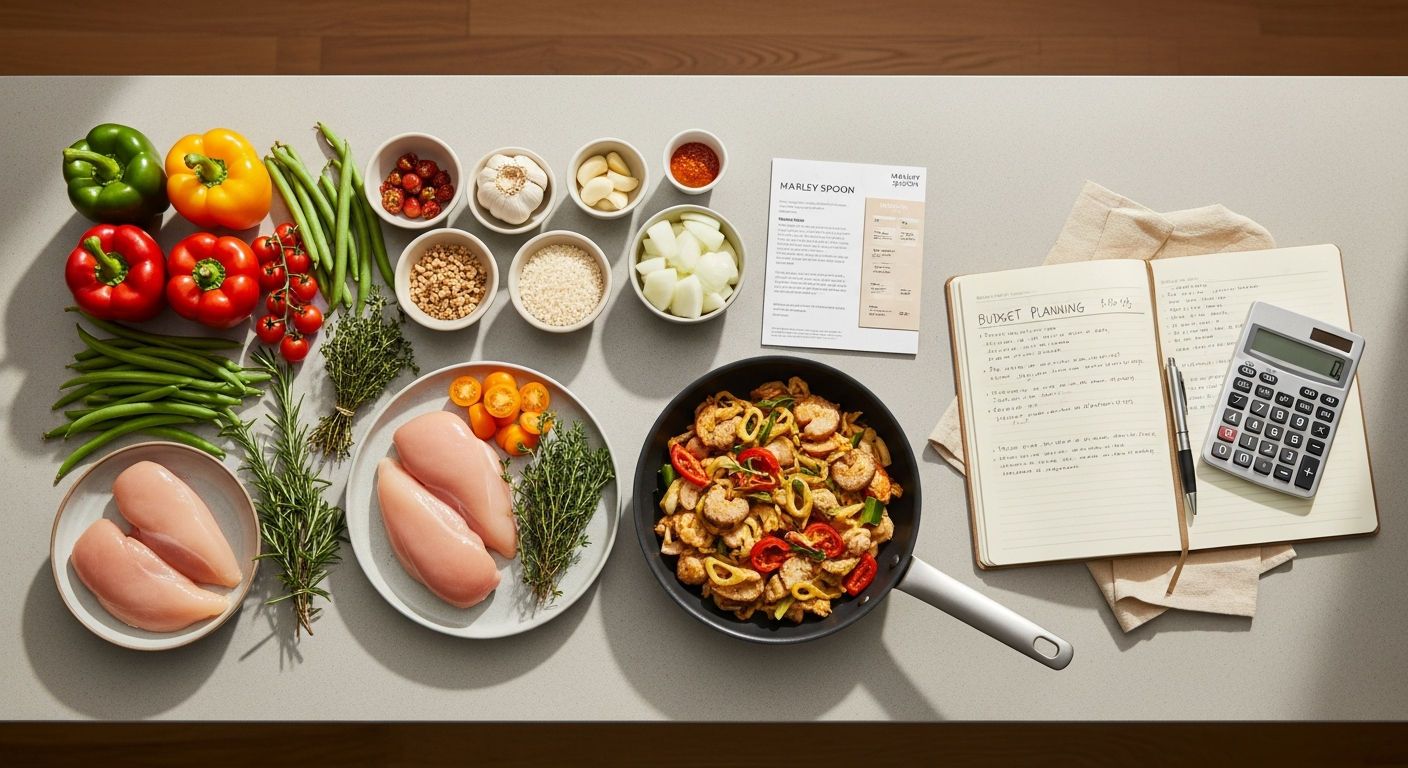
Understanding Meal Kit Economics: Is Marley Spoon Worth Your Budget?
Meal kit subscriptions have exploded in popularity, yet most families still struggle to justify the cost when groceries seem cheaper. The reality is more nuanced than price comparisons alone. The average household wastes 30% of their food purchases, and that's where meal kits shine by design.
Marley Spoon, partnered with Martha Stewart, has carved out a unique position in the meal kit market by emphasizing quality ingredients, chef-designed recipes, and genuine flexibility. The service appeals to home cooks seeking convenience without sacrificing the pleasure of cooking and eating well. This guide breaks down the real costs behind Marley Spoon's pricing structure, reveals which subscription plans deliver the best value, and shows you how to stretch your budget further.
Start your Marley Spoon journey with transparent pricing and flexible plans today.
By the end of this breakdown, you'll have a clear roadmap for making Marley Spoon work for your household budget—or determining whether a competitor is the better fit.
Understanding Marley Spoon's Pricing Architecture
Base meal costs and how they scale
Marley Spoon's pricing structure is designed to reward commitment. Per-portion costs range from $12.99 for smaller orders down to $8.69 for larger weekly commitments. The savings become apparent when comparing a 2-meal-per-week plan for two people against a 6-meal-per-week plan for four people. That difference translates to meaningful monthly savings for households that can accommodate larger orders.
Shipping fees and their impact on total cost
A consistent $10.99 shipping fee applies to all meal kit orders, while prepared meals from Balance by Marley Spoon carry an $11.99 shipping fee. This fixed expense is a crucial factor often overlooked in initial cost comparisons. A small order might have a 15% shipping surcharge, while larger orders distribute this cost more favorably across individual meals.
Plan flexibility options
Customers choose between two-person or four-person servings and select anywhere from 2 to 6 meals per week. This flexibility is valuable—you're not locked into a one-size-fits-all model. A two-person household ordering 3 meals per week pays approximately $82.93 plus shipping, while a four-person household ordering 4 meals per week invests around $136.87 plus shipping.
Price variations by recipe type
Not all recipes carry the same price tag. Standard recipes represent the baseline, while Saver recipes offer lower price points without sacrificing quality. Premium protein swaps and ingredient upgrades increase costs, giving you control over where your money goes. This tiered approach means budget-conscious cooks can still access Marley Spoon by strategically selecting recipes.
Comparison of 2024 pricing versus current rates
Pricing has shifted since earlier 2024 rates of $12.99 to $8.69 per portion. Current pricing reflects market adjustments and inflation, with the per-portion cost structure remaining relatively stable when you account for order size. Customers should expect current rates to be consistent with 2024 levels, assuming similar order configurations.
Hidden costs to factor in
Beyond base meal and shipping costs, the Market section offers add-ons like snacks, desserts, breakfast items, and extra proteins. Optional upgrades and premium selections inflate costs quickly. A realistic budget assessment includes these variables rather than assuming base pricing reflects total expenditure.
Which Marley Spoon Plans Offer the Best Value
The 6-meals-per-week plan for four people
The highest-commitment plan delivers the lowest per-portion cost at $8.69. This option suits large families and meal-prep enthusiasts who can consume six prepared meals weekly. When you factor in the $10.99 shipping spread across 24 portions (6 meals × 4 servings), the effective cost per serving becomes genuinely competitive with grocery shopping.
The 3-meals-per-week plan for two people
At approximately $82.93 plus shipping, this mid-range option balances flexibility with cost efficiency. It works well for couples or small households that want variety without overcommitting. Three meals per week provides structure for half your dinner week while leaving room for other cooking or dining options.
The 4-person plan advantage
Economies of scale make larger household plans more economical per serving. Four-person plans cost more in absolute dollars but deliver better per-portion value than two-person equivalents. Households with teenagers or regular guests justify this plan through volume.
Saver recipes as a cost-reduction strategy
Identifying and prioritizing Saver recipes is an underutilized budget hack. These recipes deliver quality meals at lower price points without compromising ingredient quality or taste. A household that selects 4 out of 6 recipes from the Saver category can reduce weekly costs by 10–15%.
Seasonal and promotional pricing
Timing matters. New customer promotions and seasonal pricing fluctuations create opportunities for maximum savings. Subscribing during promotional windows—typically around New Year or summer—can reduce initial costs significantly. Existing customers benefit from occasional discount codes and limited-time rate adjustments.
Frequency optimization
Finding the sweet spot between convenience and cost-effectiveness prevents overpaying. A household that orders every other week rather than weekly may pay slightly higher per-meal costs but avoids paying for meals during less hectic periods. The skip and pause features make this optimization possible.
How Marley Spoon Reduces Hidden Household Spending
Food waste reduction through pre-portioning
Pre-portioned ingredients address the 30% waste issue directly. You receive exactly what you need—no excess produce withering in your crisper drawer or proteins going bad before use. Over a year, this translates to hundreds of dollars in recovered grocery spending.
Eliminating impulse grocery purchases
Structured meal planning removes the temptation to overbuy at the grocery store. A household that visits the supermarket without a meal kit plan often leaves with items beyond their shopping list. Marley Spoon eliminates this variable spending through predetermined weekly menus.
Time savings translate to financial value
Reducing hours spent on meal planning and shopping translates to tangible financial value when calculated properly. If you value your time at $20 per hour and save five hours weekly through eliminated meal planning and shopping trips, that's $100 in time value weekly—a legitimate financial benefit beyond direct food costs.
Ingredient quality and freshness
Premium, sustainably sourced ingredients reduce the need for expensive specialty stores. A household buying organic produce and high-quality proteins separately often pays premium prices at specialty retailers. Marley Spoon's sourcing practices deliver this quality at competitive rates.
Learning new cooking techniques
Building culinary skills through chef-designed recipes reduces reliance on expensive takeout and restaurant meals. Households that expand their cooking repertoire naturally order less takeout, generating indirect financial savings that often exceed the meal kit subscription cost.
Meal planning efficiency
Removing decision fatigue from weekly food choices has psychological and financial benefits. Decision fatigue leads to poor choices—expensive impulse purchases and last-minute takeout orders. A predetermined menu eliminates this dynamic.
Balance by Marley Spoon: Is the Premium Option Worth It?
Ready-to-heat prepared meals overview
Balance by Marley Spoon offers single-serving prepared meals at $12.99 per serving, plus $11.99 shipping. These meals require only heating—no cooking involved. The premium reflects convenience and the elimination of prep work entirely.
When prepared meals justify the premium
During busier weeks, prepared meals supplement traditional kits without derailing budget plans. They work as occasional supplements rather than replacements. A household might use prepared meals twice monthly during high-stress periods while maintaining traditional kit meals the rest of the month.
Comparing prepared meals to takeout costs
At $12.99 per serving plus shipping, prepared meals cost significantly less than restaurant delivery (typically $18–25 per entree after fees and tips). Compared to casual dining, the prepared meal option saves money while maintaining quality. The direct comparison isn't against home-cooked meals from scratch but against dining-out alternatives.
Dietary-specific prepared options
Prepared meals accommodate vegetarian, low-carb, keto, and gluten-free preferences. A household member with specific dietary needs benefits from pre-made options that align with their restrictions without requiring separate meal planning or preparation.
Portion sizes and meal quality
Prepared meals deliver generous portions and quality ingredients comparable to traditional meal kits. The premium aligns with perceived value for households that prioritize convenience during chaotic weeks.
Strategic use to avoid subscription fatigue
Mixing prepared meals with traditional kits prevents cooking monotony. A household might order 4 traditional kits and 2 prepared meals weekly—alternating between active cooking and minimal-prep nights while maintaining flexibility.
Smart Strategies to Stretch Your Marley Spoon Budget
Prioritizing Saver recipes without sacrificing quality
Budget-friendly recipes don't mean budget-tier ingredients or simple, boring meals. Marley Spoon's Saver recipes deliver quality at lower costs through ingredient selection and recipe design. A household that selects primarily from the Saver category can reduce costs by 10–15% without compromising satisfaction.
Explore Marley Spoon's Saver recipes and discover premium quality at lower price points.
Mixing meal kits with prepared meals strategically
Combining traditional kits (which require cooking) with prepared meals (which don't) creates flexibility without forcing all-or-nothing decisions. A household might use 4 traditional meal kits and 2 prepared meals in a given week, distributing costs across cooking preference and available time.
Leveraging the Market section wisely
The Market section offers add-ons that enhance value when selected intentionally but inflate costs when purchased impulsively. Limiting Market purchases to genuine needs—extra proteins that complement recipes, breakfast items that complement the meal plan—prevents budget creep.
Skipping and pausing strategically
The subscription model's greatest advantage is flexibility. Using skip and pause features during busy months, vacation, or when your freezer is stocked prevents paying for meals you won't prepare. A household that skips 2 weeks monthly reduces annual costs by 17%.
Customizing portion sizes
Choosing between two-person and four-person plans based on household size and needs prevents overpaying. A household of three might use four-person meals (allowing for guest dinners or meal prep) or two-person meals (requiring fewer total portions). Testing both approaches reveals which works better.
Combining with other grocery shopping
Marley Spoon doesn't require exclusive commitment. Using it for dinner while shopping elsewhere for breakfast, lunch, and pantry staples creates a hybrid approach. A household might spend $150 on Marley Spoon and $100 on additional groceries weekly—achieving convenience for dinner while maintaining budget control overall.
Taking advantage of promotional offers
Timing subscriptions to capture first-time discounts and seasonal promotions can reduce initial costs by 20–30%. Existing customers receive occasional promotional codes and seasonal adjustments. Monitoring email offers ensures you capture opportunities.
Marley Spoon vs. Competitors: The Real Cost Comparison
How Marley Spoon pricing compares to HelloFresh, EveryPlate, and Factor
Per-portion pricing is similar across major competitors, ranging from $8–13 depending on order size. HelloFresh offers slightly lower base costs for larger orders, while EveryPlate emphasizes budget-friendly options. Factor specializes in prepared meals at similar price points to Balance by Marley Spoon. Shipping fees vary—some competitors include shipping in advertised prices while others charge separately like Marley Spoon.
Quality-to-price ratio across services
Marley Spoon's Martha Stewart partnership justifies premium positioning. The ingredient freshness and recipe complexity exceed some competitors, particularly in protein quality and produce variety. EveryPlate targets budget-conscious consumers with simpler recipes, while HelloFresh balances quality and cost effectively. Factor focuses on prepared meals for time-constrained customers.
Shipping fees across platforms
Marley Spoon charges $10.99–$11.99 per delivery. HelloFresh charges similar amounts depending on order size and region. EveryPlate offers lower shipping ($9.99) but with potentially fewer recipe options. Factor includes shipping in its advertised per-meal price. Transparent shipping comparisons reveal Marley Spoon's fees are competitive but not the lowest.
Recipe variety and customization
Marley Spoon offers over 100 recipes weekly with diverse dietary options. HelloFresh provides comparable variety with slightly different menu emphases. EveryPlate offers fewer weekly recipes but sufficient variety for most households. Factor provides no recipe selection—meals arrive predetermined. For households valuing choice, Marley Spoon excels.
Subscription flexibility
All major competitors allow skipping and pausing. Marley Spoon's flexibility matches industry standards. Cancellation processes are similarly straightforward across services. No competitor has a significant advantage in this category.
Brand partnerships and prestige
The Martha Stewart association elevates Marley Spoon's perceived value and appeals to consumers interested in gourmet home cooking. Competitors lack comparable partnerships, though HelloFresh invests heavily in advertising. This intangible value justifies premium positioning for brand-conscious consumers.
Best-fit scenarios for each service
Marley Spoon wins for households prioritizing recipe variety and ingredient quality. HelloFresh suits balanced needs across cost, quality, and convenience. EveryPlate fits strict budget constraints. Factor serves time-constrained individuals unwilling to cook. The "best" service depends on priorities, not objective superiority.
Real-World Budget Scenarios: Making the Numbers Work
Scenario 1 – Young couple, 3 meals/week for 2 people
Monthly cost: $82.93 × 4 weeks + $10.99 × 4 deliveries = $331.72 + $43.96 = $375.68 monthly.
Typical grocery spending for a couple: $500–700 monthly. Traditional shopping includes some waste and impulse purchases. Marley Spoon eliminates 30% waste and impulse spending, reducing traditional costs to roughly $350–490. The Marley Spoon option at $375.68 becomes competitive when factoring in time savings (5 hours weekly × $20 = $100 value monthly). Real savings: roughly $100–115 monthly through reduced waste, impulse purchases, and time value.
Scenario 2 – Family of four, 4 meals/week
Monthly cost: $136.87 × 4 weeks + $10.99 × 4 deliveries = $547.48 + $43.96 = $591.44 monthly.
A family of four typically spends $800–1200 monthly on groceries. Accounting for 30% waste and impulse purchases, realistic spending is $560–840. Marley Spoon at $591.44 sits in the middle of this range. Real savings emerge through eliminated waste (roughly $150 monthly) and time savings (8+ hours weekly × $20 = $160 value monthly). True financial benefit: approximately $150–160 monthly when factoring in waste reduction and time value.
Scenario 3 – Budget-conscious household using Saver recipes
A household that selects 5 out of 6 weekly recipes from the Saver category (versus standard recipes) reduces costs by roughly 10–12%. For the couple scenario, this saves approximately $40–45 monthly. For the family scenario, savings reach $60–70 monthly. These households sacrifice nothing in ingredient quality or meal satisfaction—only complexity or premium proteins.
Scenario 4 – Mixed approach combining kits and prepared meals
A household ordering 4 traditional kits ($82.93 × 4 = $331.72) plus 2 prepared meals ($12.99 × 2 × 2 servings = $51.96) weekly invests $383.68 plus shipping ($10.99). This hybrid approach provides cooking nights and minimal-prep nights, accommodating schedule variation. Cost is slightly higher than pure kits but justified through convenience flexibility.
Scenario 5 – Occasional user supplementing grocery shopping
A household ordering just 2 meals per week for 2 people (lowest commitment option) pays approximately $55 weekly plus shipping. This minimal approach supplements traditional grocery shopping without requiring major lifestyle shifts. Monthly cost: roughly $220–250. Value proposition: convenience for specific meal nights rather than wholesale food shopping replacement.
ROI calculations
Measuring actual savings requires honest baseline assessment. Track grocery spending for 4 weeks before subscribing. Document time spent on meal planning, shopping, and cooking. Then compare post-subscription costs and time investment. Most households discover Marley Spoon breaks even or saves 10–15% monthly when accounting for waste reduction and time value. The financial case strengthens further for households with high time value (busy professionals) or poor baseline meal planning discipline.
The Sustainability Factor: Does It Justify the Cost?
Reduced food waste and environmental impact
Pre-portioned ingredients eliminate the 30% waste generated by typical household groceries. Over a year, a four-person household wastes roughly 2,000–3,000 pounds of food. Marley Spoon's pre-portioning prevents this entirely. The environmental impact (reduced landfill burden, lower resource consumption for eliminated food) justifies premium pricing for environmentally conscious consumers.
Sustainable sourcing practices
Marley Spoon emphasizes sustainably sourced ingredients, often from local or responsible producers. This quality sourcing justifies higher per-portion costs compared to commodity grocery options. A household committed to sustainable food systems finds value alignment with premium pricing.
Packaging and recycling considerations
Marley Spoon uses recyclable packaging materials, though packaging volume is substantial weekly. The environmental cost of packaging must be weighed against the benefit of reduced food waste. For most households, prevented waste outweighs packaging impact, though environmentally conscious consumers may choose to offset packaging concerns.
Long-term health benefits from better meal choices
Chef-designed recipes emphasizing fresh ingredients lead to better nutritional outcomes. Improved diet reduces long-term healthcare costs—a benefit not immediately visible but meaningful over years. This indirect financial return on premium meal kit pricing is genuine, particularly for households transitioning from takeout and processed foods.
Community and ethical sourcing
Marley Spoon's commitment to ethical sourcing and community relationships supports producers fairly. Consumers valuing these principles view premium pricing as supporting broader good, not merely personal convenience.
Comparing environmental footprint to traditional grocery shopping
Full-cycle sustainability analysis reveals Marley Spoon's advantage. Traditional grocery shopping requires vehicle transportation for shopping trips, generates substantial food waste, and often involves packaged goods. Marley Spoon's centralized production and delivery, combined with nearly zero food waste, creates lower environmental impact despite packaging volume. The math favors meal kits for most households.
Common Pricing Pitfalls and How to Avoid Them
Forgetting to factor in shipping fees
Shipping costs ($10.99–$11.99) are often overlooked when evaluating per-meal pricing. These fixed fees make small orders disproportionately expensive. A 2-meal order might have 20% shipping overhead, while a 6-meal order distributes shipping across more servings. Always calculate total delivered cost, not base meal price alone.
Overcommitting to plans you can't maintain
Selecting a 6-meal-per-week plan when your household realistically cooks 3 meals weekly creates waste and frustration. Overcommitting leads to skipped weeks, unused ingredients, and eventual cancellation. Start conservative—a 2 or 3-meal plan—and scale up only after confirming usage patterns.
Ignoring the skip and pause features
Many subscribers fail to use skip and pause options, paying for weeks they don't need. These features exist specifically to optimize costs. Utilizing skip 2 weeks monthly reduces annual costs by approximately 17% without losing subscription benefits.
Ordering premium add-ons without need
The Market section tempts impulse purchases. Snacks, desserts, and protein upgrades inflate costs quickly. Purchasing only add-ons that directly complement meal kit recipes prevents budget creep. A household that limits Market purchases to 1–2 items monthly saves roughly $30–40 monthly compared to impulse buyers.
Not adjusting plan size seasonally
A household's meal needs fluctuate. Summer months with travel and outdoor eating might justify pausing service entirely. Winter months with more home cooking justify larger orders. Adjusting plan size seasonally prevents overpaying during lower-need periods.
Comparing only base meal costs
Comparing Marley Spoon at $8.69 per portion to grocery shopping at $5 per portion ignores waste, shopping time, and impulse purchases. Honest financial comparison includes all variables—delivered cost (including shipping), waste prevention, time value, and dietary quality. Base-price comparisons are misleading.
Dismissing Saver recipes prematurely
Some households assume Saver recipes mean reduced quality or boring meals. In reality, Saver recipes deliver comparable ingredient quality and satisfaction at lower costs through smarter ingredient selection and recipe design. Testing Saver options reveals genuine value without sacrifice.
Making the Final Decision: Is Marley Spoon Worth Your Budget?
Assessing your household's cooking habits
Marley Spoon benefits households that genuinely enjoy cooking but struggle with time and planning. A household that prefers takeout or microwaved meals won't appreciate meal kits. Conversely, households that cook regularly but dread meal planning find maximum value. Honest self-assessment prevents poor decisions.
Calculating your true hourly value
Time savings justify premium pricing only if you value your time. A professional earning $40+ hourly gains significantly from eliminating shopping and planning. A retiree with flexible time may not justify the premium. Calculate your realistic hourly value and assess whether Marley Spoon's time savings justify costs.
Evaluating dietary needs and preferences
Households with specific dietary needs—vegetarian, keto, gluten-free, low-carb—find tremendous value in Marley Spoon's variety. Those with standard preferences benefit less from extensive menu variety. A household with three members following different diets gains flexibility that justifies premium pricing.
Testing with a short-term commitment
Start with a single 3-meal plan for 2 people or 4-meal plan for 4 people. Track actual spending versus typical grocery costs over 4 weeks. Monitor time investment and satisfaction. This real-world test reveals whether Marley Spoon genuinely works for your household before long-term commitment.
Considering life stage and schedule
Marley Spoon suits different life stages differently. Busy professionals with high income benefit tremendously. Young families managing multiple schedules benefit from eliminated planning. Retirees with flexible time and lower income might prefer traditional grocery shopping. Your current life stage matters significantly.
Alternative scenarios where competitors might be better
Budget-conscious households with flexible time might prefer EveryPlate's lower base costs. Time-constrained consumers unwilling to cook should consider Factor's prepared meals instead. Households seeking the absolute lowest cost should explore bulk grocery shopping with careful planning. Marley Spoon isn't universal—honest assessment includes considering alternatives.
Creating a hybrid food strategy
Rather than replacing all grocery shopping, consider Marley Spoon supplementing existing patterns. Using Marley Spoon for dinner while shopping traditionally for breakfast and lunch balances convenience with cost. A household might invest $200 in Marley Spoon and $300 in traditional groceries—capturing convenience benefits without full-service commitment.
The Bottom Line: Smart Budgeting With Marley Spoon
Marley Spoon isn't the cheapest meal solution on the market, but when you factor in reduced food waste, eliminated impulse purchases, time savings, and the genuine pleasure of cooking quality meals, the financial picture shifts dramatically. The service rewards strategic planning—choosing larger household plans, prioritizing Saver recipes, and leveraging the skip feature transforms what seems expensive into genuine value.
The real question isn't whether Marley Spoon is affordable; it's whether the convenience, quality, and culinary experience justify your personal budget and lifestyle. A busy professional earning $50+ hourly likely finds tremendous value. A retiree with abundant time might prefer traditional shopping. An environmentally conscious consumer gains alignment beyond pure financial savings.
My recommendation is to start with a 3-meal plan for two people or a 4-meal plan for four people, test the service for 3–4 weeks, and track your actual spending on groceries beforehand. Compare real numbers—including waste, time, and shipping—rather than base per-portion costs alone. Use the Saver recipes liberally, skip weeks when life gets chaotic, and then decide whether Marley Spoon earns its place in your household budget. The answer for your household might differ from your neighbor's—and that's perfectly fine.

Leave a Reply