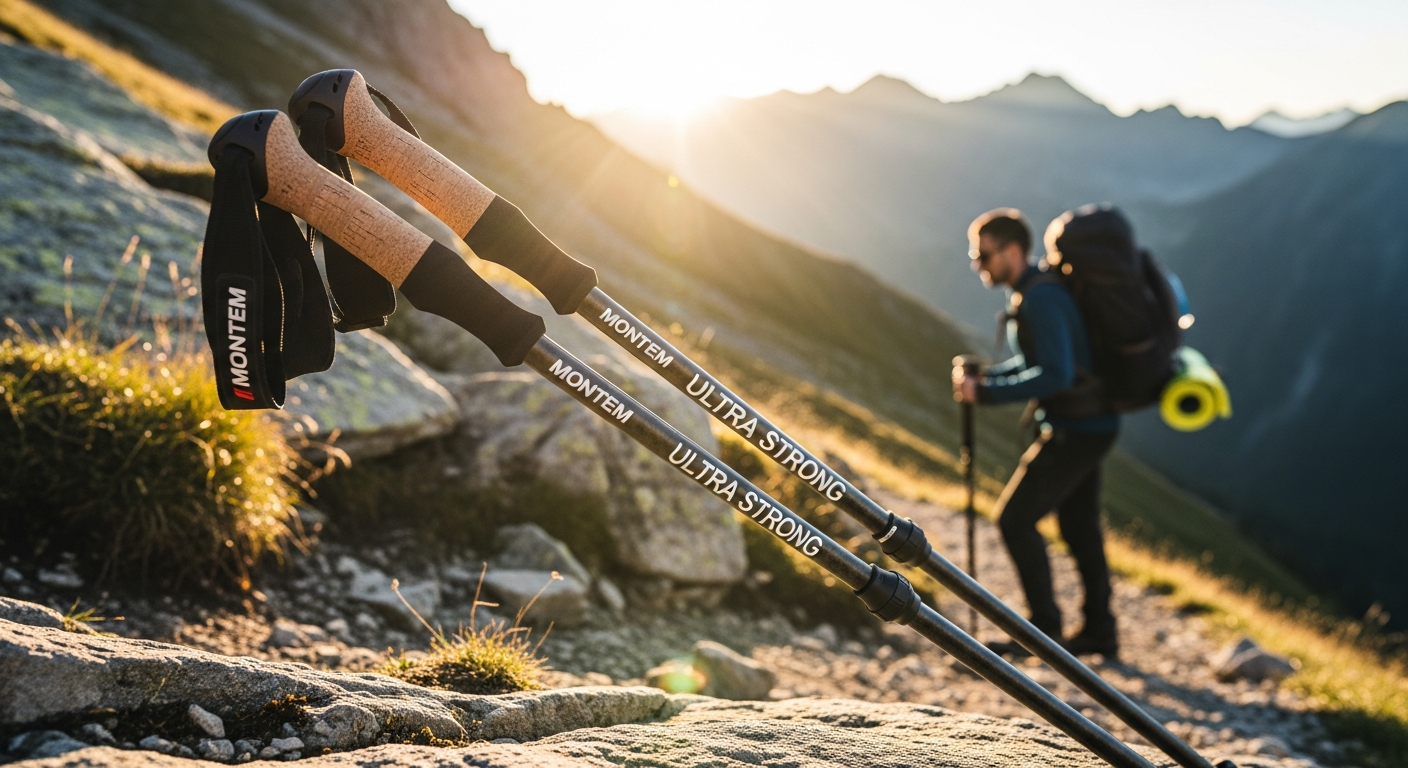
Budget trekking poles don't have to feel cheap. I've tested dozens of hiking gear options over the years, and I've watched countless beginners waste money on poles that either snap on their first trip or sit unused in a closet. Here's the thing: the Montem Ultra Strong Trekking Poles challenge everything I thought I knew about affordable outdoor gear.
Montem Outdoor Gear has built a reputation around a simple philosophy—quality equipment shouldn't require a second mortgage. The Ultra Strong poles have become one of their best-selling products, consistently appearing in hiking forums and beginner guides across the web. Their popularity isn't driven by flashy marketing or premium positioning; it's earned through genuine user satisfaction and reliable performance on real trails.
Whether you're planning your first backpacking trip or you're a casual day-hiker looking to reduce joint strain, these poles have earned recognition from actual hikers. Check out the Montem Ultra Strong Trekking Poles to see if they're the right choice for your next adventure. In this review, I'm breaking down everything that makes these poles tick—the aluminum construction, terrain performance, locking mechanism mechanics, and most importantly, whether they're genuinely worth adding to your gear collection. By the end, you'll have a clear picture of who these poles are best for and whether they match your hiking style.
What Makes 7075 Aluminum the Smart Choice for Budget Poles
Strength-to-weight ratio advantages — why this specific aluminum alloy outperforms cheaper alternatives
7075 aluminum represents a significant step up from lower-grade alloys commonly found in budget gear. This particular alloy contains zinc, magnesium, and copper, creating a material that punches well above its weight class. Unlike softer aluminum variants, 7075 resists deformation without requiring thicker walls, which keeps overall weight down. For trekking poles specifically, this means you get structural integrity without the heft of inferior materials.
Durability under real-world conditions — resistance to bending, cracking, and long-term wear
Real trails aren't kind to subpar equipment. Rocks, roots, and repeated impacts from thousands of steps test materials in ways that laboratory specifications can't fully capture. The Ultra Strong poles handle this punishment because 7075 aluminum naturally resists the progressive deformation that cheaper alloys suffer. Users report that after multiple seasons of regular use, these poles maintain their original straightness and responsiveness—a telling indicator of material quality.
How material choice impacts price — the engineering trade-offs that keep costs down without sacrificing reliability
Montem achieves its aggressive pricing by making calculated engineering decisions rather than cutting corners. They use proven manufacturing processes that have been refined over time, reducing production costs without compromising the fundamental material properties. This approach contrasts sharply with ultra-budget alternatives that rely on thinner walls or inferior alloys to hit lower price points, often resulting in failure.
Comparison to carbon fiber and other premium materials — performance gaps and when they actually matter
Carbon fiber poles exist, and yes, they're lighter and marginally stiffer than aluminum. However, the weight difference—typically 2-4 ounces for a pair—comes at a price premium that often exceeds 300%. For occasional hikers and backpackers, this trade-off makes little practical sense. Carbon fiber excels primarily for ultralight thru-hikers covering 20+ miles daily and for extreme mountaineering. For weekend trips and general hiking, aluminum delivers superior real-world value.
Longevity expectations — realistic lifespan for casual versus heavy use scenarios
A casual hiker using these poles for 20-30 days annually should expect 7-10 years of reliable service. Heavy users—those on trail 100+ days yearly—might see 4-5 years before needing replacement, primarily due to the aforementioned lock-tightening issue rather than catastrophic failure. This lifespan is entirely respectable for the price point and compares favorably to aluminum poles from brands charging triple the cost.
Telescoping Design That Actually Works: The 25-to-53-Inch Range Explained
Why three-section poles offer the best balance — collapsibility versus stability trade-offs
Three-section construction represents the sweet spot between packability and structural rigidity. Two-section poles collapse more compactly but sacrifice stability, while four-section designs increase stability but add complexity and potential failure points at joints. Three sections give you collapsibility down to 25 inches—fitting easily into backpacks—while maintaining the structural integrity you need on technical terrain.
Height accommodation across user types — how the range serves everyone from 5'0" to 6'5"
The 25-to-53-inch range accommodates virtually everyone. Users under 5'2" typically set their poles to 48-51 inches, while taller hikers find their comfort zone around 52-53 inches. The adjustment granularity is smooth enough that different arm lengths and personal preferences find their optimal height easily. This versatility means couples or family groups with height differences can share a single pair without significant adjustment penalties.
Terrain adjustability — using different lengths for descents, ascents, and flat sections
Experienced hikers shorten their poles for steep descents—reducing wrist strain and improving stability—and lengthen them for ascents to distribute effort across larger muscle groups. The flick-lock mechanism makes these adjustments quick, though on a full hiking day, most users find a single length compromise works adequately. The quick-adjust capability becomes most valuable during extended mountaineering when terrain changes dramatically.
Compact packing benefits — fitting into backpacks and luggage without bulk
At 25 inches, the collapsed poles fit alongside gear in most 50-liter packs without requiring external attachment or dedicated straps. This matters considerably for international hiking trips or complex logistics. The compact size also makes these poles practical for hikers who drive to trailheads and prefer keeping poles inside their vehicles rather than mounted externally.
Adjustment frequency on longer hikes — practical considerations for all-day use
Most hikers adjust their poles once or twice during day-long outings. Frequent micro-adjustments aren't necessary unless tackling seriously variable terrain. The flick-lock levers respond quickly when adjustments are needed, though the tightening issue I mentioned earlier becomes more noticeable during extended trips with loaded packs. Users adapting to potentially loose settings need to check periodically.
The Flick-Lock Lever System: Reliable or Problematic?
How flick-lock mechanisms work — the mechanics behind quick adjustments
Flick-lock levers use a cam-based system where rotating the lever creates friction against the pole shaft. The tighter the lever, the greater the friction. In theory, this design offers quick, tool-free adjustments without the time required for twist-locks. In practice, the system works well when properly tightened but demands regular attention.
Tightness requirements for stability — addressing the slippage under load concern
This is where honest assessment matters. Some users report that under significant downward pressure—especially with heavily loaded packs on descents—the poles gradually slide if the levers aren't cranked quite tightly. This isn't a catastrophic failure; it's more of an inconvenience requiring periodic tightening during long hikes. Many users report this never becomes an issue, while others adjust their levers to almost uncomfortable tightness to prevent any slippage. The variance suggests it depends partly on manufacturing tolerance variation between individual units.
User experience across different hand sizes — ergonomic considerations
The lever handle is reasonably comfortable for most hand sizes, though users with very small hands or arthritic conditions might find tightening slightly awkward. The lever itself has decent purchase, and most people can achieve secure tightness without excessive force. Gloved operation works fine, though you lose some tactile feedback about tightness level.
Maintenance and cleaning — keeping locks functioning smoothly on muddy trails
Flick-locks tolerate mud and grit better than twist-locks because they don't have helical threads collecting debris. Rinsing with fresh water after muddy hikes keeps them functioning well. The mechanisms rarely jam, though salt spray (coastal hiking) may eventually cause oxidation. A simple freshwater rinse at trip's end prevents most issues.
Comparison to twist-lock and cam-lock alternatives — speed versus security
Twist-locks offer proven security—you can over-tighten without the lever reaching a hard stop—but require two hands and multiple rotations for adjustment. Cam-locks provide speed without the fine-tuning capability. Flick-locks occupy the middle ground, offering quick adjustments with a single hand. The trade-off is the need for moderate attentiveness to tightness, a reasonable compromise for the speed advantage.
Grip Comfort: EVA Foam Versus Cork Options
EVA foam grip benefits — softness, moisture resistance, and temperature management
EVA foam absorbs sweat effectively and remains comfortable during long hiking days. The material doesn't absorb moisture like cork does, maintaining consistent grip texture whether wet or dry. It also stays comfortable in temperature extremes—neither becoming painfully cold in winter nor uncomfortably warm in summer sun. Most users find EVA foam pleasant for all-day use, and the material's inherent cushioning reduces hand fatigue on rocky, uneven terrain.
Cork grip advantages — traditional feel, natural insulation, and aesthetic appeal
Cork grips appeal to hikers who prefer traditional aesthetics and the natural insulation cork provides. The material feels warmer to the touch in cold weather and offers a classic hiking pole appearance. However, cork absorbs moisture, requiring occasional drying and potentially becoming slippery in sustained wet conditions. Some users develop a preference for cork's feel, though it's arguably more about personal aesthetic preference than functional superiority.
Choking up on steep terrain — how extended grip zones improve uphill control
Both grip options extend partway down the pole shaft, allowing you to grip lower during steep ascents. This positioning provides better control and balance when climbing, distributing effort differently than holding the upper grip. The extended zones on the Ultra Strong poles are generous enough that most users find them functional for this purpose, though dedicated mountaineering poles sometimes offer even longer grip extensions.
Bare-hand usability — performance without gloves in various weather conditions
EVA foam grips perform surprisingly well without gloves, maintaining decent friction even in light rain. In heavy downpours or snow, gloves become necessary regardless of grip material. The foam doesn't cause blister formation on bare skin during day hikes—a common complaint with other materials—making these poles comfortable for glove-free hiking in temperate conditions.
Durability of grip materials — wear patterns and replacement considerations
EVA foam grips eventually compress and harden with years of use, typically becoming noticeably worn after 5-7 years of regular hiking. Cork grips develop surface cracks and may require replacement sooner in heavy-use scenarios. Replacement grips exist, though most users simply accept the aging character of their poles rather than investing in new grips. The grip area is rarely the failure point that causes users to retire these poles.
Included Accessories and Compatibility: What You Get Out of the Box
Standard mud baskets — when and why you'll use them
Mud baskets come standard, which is essential. Without baskets, poles sink into soft ground, sand, and mud, creating repetitive extraction work that's exhausting on long hikes. The included baskets are adequately sized for general trail use. They won't prevent all sinking in truly boggy terrain, but they dramatically reduce it under normal conditions.
Snow basket compatibility — expanding versatility for winter hiking and mountaineering
Montem offers optional snow baskets separately, which are considerably larger than standard baskets. These become essential for winter mountaineering or extended snow travel, preventing the pole from punching through the surface with every step. The modular basket system means you can adapt the poles to specific conditions without purchasing entirely new equipment.
Basket attachment reliability — addressing the reported retention issues
One user mentioned a basket coming off too easily, which represents a legitimate concern if it occurred under normal use. However, this appears to be an isolated incident rather than a widespread defect. The baskets attach via a simple snap mechanism that's generally secure. Checking basket retention before departing on longer hikes eliminates this as a practical problem.
What's missing from the package — additional accessories worth considering
The poles ship with mud baskets, EVA grips, and a carrying bag—everything essential for immediate use. Some users appreciate adding a wrist strap if theirs didn't include one, though most modern pairs include basic straps. Replacement tips and baskets aren't included but are available separately at reasonable cost.
Upgrade pathways — how the modular design lets you customize later
The universal basket system and standard tip design mean you can upgrade components individually. Ordering snow baskets, cork grips, or aftermarket tips expands the poles' versatility without replacement. This modularity extends pole longevity and lets you adapt them to new hiking styles without starting from scratch with new equipment.
Weight and Portability: 19.2 Ounces of Practical Advantage
Why weight matters for different hiking styles — day hikes versus multi-week treks
For day hikes, pole weight is genuinely immaterial—adding a couple ounces to your kit over 8-10 miles causes no meaningful fatigue. For multi-week backpacking expeditions where you're carrying poles daily, every ounce compounds. The 19.2-ounce weight sits in a comfortable middle ground: light enough that day hikers don't notice, yet not so light that ultralight enthusiasts would specifically choose these over purpose-built ultralight alternatives.
Lightweight performance without ultra-light price tags — the value proposition
Carbon fiber poles saving 3-4 ounces typically cost $200+. These aluminum poles achieve surprising lightness at $59.99, delivering the weight benefit that matters for 95% of hiking scenarios at a fraction of the price. This represents the real value proposition: functional lightness without ultralight expense.
Packed size considerations — how they fit into typical backpack configurations
At 25 inches collapsed, the poles fit easily inside most 50-liter and larger packs when positioned alongside sleeping bags or other gear. They also compress down enough to fit in smaller daypacks designed for quick access. The relatively compact footprint means you're not sacrificing useful pack space to carry them.
Weight distribution and fatigue — how pole weight impacts arm and shoulder strain
Lighter poles reduce arm fatigue over long hiking days, particularly on steep terrain where you're holding most of the pole's weight. The difference between 19.2-ounce poles and heavier alternatives (25+ ounces) becomes noticeable after 6-8 hours of continuous use. This weight advantage contributes to the poles' appeal for casual hikers who aren't obsessing over ounces but appreciate reduced strain.
Comparison to ultralight alternatives — performance-to-weight ratios
Ultralight poles (under 15 ounces per pair) exist but command significant premiums and often sacrifice durability or comfort features. The Ultra Strong poles' weight-to-cost ratio is actually superior to ultralight alternatives when measured as ounces per dollar spent. For anyone not specifically pursuing ultralight backpacking, this represents better practical value.
Price-to-Performance Analysis: Where the Real Value Lives
The $59.99 price point in context — how it stacks against premium brands
Quality trekking poles from established premium brands typically start around $150-180 and escalate to $300+ for top-tier options. At $59.99, the Montem poles cost roughly one-third of the budget option from most major brands. This pricing gap seems impossible until you recognize that major brands carry substantial overhead costs for marketing, retail distribution, and brand positioning. Montem's direct sales model and lower operating costs allow them to undercut dramatically without proportional quality cuts.
Feature comparison at similar price ranges — what competitors offer for the money
Examining other $50-70 poles reveals fewer features: thinner aluminum, shorter adjustment ranges, heavier weights, or less refined locking mechanisms. The Ultra Strong poles bundle more capability into this price bracket than alternatives, whether checking the feature list or assessing real-world performance. For the actual price range, these are legitimately the better value.
Long-term cost of ownership — durability means fewer replacements
Budget poles often require replacement every 2-3 years due to failure or wear. The Ultra Strong poles' expected 5-10 year lifespan means you're replacing them less frequently, spreading your equipment investment across more hiking seasons. A user spending $60 once every 7 years actually spends less long-term than someone buying $40 poles every 2 years.
Beginner investment strategy — why starting here makes financial sense
New hikers shouldn't invest $200+ in poles before confirming they'll actually use them regularly. These poles offer an intelligent entry point: sufficient quality to provide genuine benefit, low enough cost that abandoning hiking as a hobby doesn't represent financial regret. Many beginner hikers who start here eventually upgrade to premium poles as their commitment deepens, having validated the value of poles generally.
Value for casual versus serious hikers — where these poles shine brightest
Casual hikers doing 10-20 outings annually rarely need premium features, making these poles ideal. They provide stability and comfort sufficient for standard trail conditions without unnecessary expense. Serious hikers doing 50+ outings yearly or specialized mountaineering might eventually notice performance limitations, but even then, the foundation is solid.
Real-World Performance Across Different Terrain Types
Day hiking on established trails — stability and comfort for moderate use
On well-maintained trails, these poles shine. The aluminum construction provides responsive feedback through rocky sections, the grips remain comfortable across an 8-10 hour day, and the adjustable length handles mild elevation changes effectively. Day hikers report significantly reduced knee strain and improved stability on root-filled descents, suggesting that these budget-friendly poles deliver the primary benefits hikers seek.
Backpacking with loaded packs — how they handle sustained weight over multiple days
Loaded packs (40+ pounds) place genuine stress on poles. The locking mechanism becomes more relevant here—the aforementioned tightening issue surfaces more readily under heavy load. However, most users report that checking tightness morning and evening prevents slippage issues. The aluminum construction holds up fine under sustained weight, and the grips remain comfortable despite the increased pressure.
Steep ascents and descents — traction, control, and joint impact reduction
Trekking poles' primary value emerges on steeper terrain. The Ultra Strong poles excel here, with good shaft feedback providing confidence on loose descents and improved propulsion on climbs. The impact reduction on knees and ankles during downhill sections is substantial—the primary reason many hikers invest in poles regardless of brand. Users consistently report this as the standout benefit.
Rocky and uneven ground — stability when footings are unpredictable
The stiff aluminum shaft resists flexing on rocky terrain, providing reliable support when foot placements are uncertain. The fixed-length option (if chosen) means you can't adjust for individual rocks, but the engineering doesn't penalize you for static height across uneven ground. Confidence on boulder fields and technical terrain improves noticeably with quality poles, and these deliver that confidence reliably.
Muddy and wet conditions — basket performance and grip reliability
The baskets prevent sinking into mud adequately for normal conditions, and the EVA foam grips maintain traction when wet. The poles don't particularly excel in these conditions compared to premium alternatives, but they handle them competently. Users report no unexpected failures or slippage issues specific to muddy conditions, suggesting the design is fundamentally sound for moisture exposure.
Who Should (and Shouldn't) Buy These Poles
Ideal users: beginners and casual hikers — why this is the sweet spot
Beginners testing whether they enjoy pole hiking shouldn't risk $200+ investment before validating their interest. These poles provide sufficient quality to deliver genuine benefits, allowing new hikers to experience the real advantages (knee impact reduction, balance improvement, uphill propulsion) without premium expense. Casual hikers doing weekend trips or occasional day hikes find these poles entirely adequate and never encounter scenarios demanding premium capabilities.
Budget-conscious adventurers — maximizing gear investment
Outdoor enthusiasts with broad interests often rotate between activities. Hikers who also trail run, camp, and kayak appreciate spreading limited budgets across multiple pursuits. These poles deliver genuine value without compromising performance enough to regret the lower cost when funds become available for other gear.
Infrequent hikers and weekend warriors — practical durability for occasional use
People hiking 5-15 times annually often perceive premium poles as unnecessary expense. The Ultra Strong poles age gracefully at this use rate, lasting through years of weekend trips without meaningful degradation. The cost-to-benefit ratio for this user segment is exceptional.
Not ideal for: ultralight thru-hikers — where performance gaps emerge
Thru-hikers targeting sub-15-pound base weights might wish for carbon fiber poles despite the cost. The 19.2-ounce weight seems light until you're carrying poles 2,000+ miles. Ultralight enthusiasts also often demand features like precision engineering and premium construction that justify premium pricing in their specific use case.
Demanding mountaineering expeditions — when premium poles become necessary
Technical mountaineering at extreme altitudes or on challenging terrain may benefit from the fine-tuning, reliability assurance, and specialized features of premium poles. However, most recreational mountaineers find these poles entirely capable. The line between "these will work fine" and "these won't quite cut it" is higher than most users realize.
Common User Concerns and Honest Answers
Flick-lock slippage under heavy loads — how significant is the issue really?
This represents the most frequently mentioned concern. Realistically, it's manageable rather than disqualifying. Users carrying 50+ pounds or descending very steep terrain with heavy loads report needing to tighten levers periodically. Users with lighter packs or moderate terrain don't mention the issue. This suggests it depends on the specific use case rather than being a universal flaw. Checking tightness morning and evening prevents practical problems.
Basket retention problems — is this a widespread defect or isolated incident?
One user's basket reportedly came loose. This doesn't appear in other reviews, suggesting an isolated incident rather than a systematic defect. Manufacturing variation could account for a single unit's different tolerance. The attachment mechanism is fundamentally sound, and most users never experience this issue.
Durability timeline — realistic expectations for pole lifespan
Casual users should expect 7-10 years. Heavy users might see 4-6 years, primarily due to lock mechanism wear rather than structural failure. The aluminum doesn't corrode in normal conditions, and the grips aging is purely aesthetic—they remain functional beyond their appearance. These poles don't abruptly fail; they gradually become worn without becoming dangerous.
Warranty and customer service — what happens if something breaks
Montem provides standard manufacturer warranties, though specific terms vary by retailer. Customer service reports are generally positive, with the company replacing defective units. This baseline protection matches what mainstream brands offer at premium prices, suggesting you're not sacrificing recourse by choosing budget options.
Return policies and satisfaction guarantees — risk mitigation for buyers
Most retailers offering these poles include standard return windows. For direct purchases through Montem's website, check their specific policy. The low price point means financial risk is minimal—even if you're dissatisfied, a $60 loss is considerably more tolerable than losing $200+ on a premium option.
The Broader Context: Why Budget Gear Deserves Respect
The democratization of outdoor recreation — quality equipment for everyone
Outdoor recreation was historically inaccessible to people without substantial disposable income. Premium gear pricing created barriers to entry, limiting hiking to affluent demographics. Companies like Montem challenging that model by delivering quality at accessible prices expand who gets to experience trail hiking. This democratization benefits the entire hiking community by bringing new perspectives and broader stewardship.
Montem's mission and brand philosophy — badass gear at reasonable prices
Montem explicitly positions itself around making outdoor adventure accessible through affordability without compromising reliability. The Ultra Strong poles embody this philosophy—they're not budget gear pretending to be premium; they're genuinely capable equipment priced for normal people. This positioning differs from premium brands defending high prices through marketing rather than genuine technical superiority.
Industry trends toward affordability — why premium pricing doesn't always mean premium value
The outdoor industry is gradually shifting. Established brands maintaining premium pricing despite increasing accessibility of manufacturing are losing market share to companies offering better value. This competitive pressure eventually benefits consumers through broader access to quality gear. The Ultra Strong poles represent this trend in action.
Sustainability angle — accessible gear reduces barrier to entry for new hikers
When quality hiking gear costs hundreds, fewer people hike, meaning fewer voices advocating for trail maintenance and conservation. Accessible pricing increases participation, building broader political support for environmental protection and outdoor access. Lower-cost quality gear paradoxically supports conservation through wider community engagement.
Community feedback and bestseller status — what consistent popularity reveals
Bestseller status isn't random. Products achieve sustained popularity through genuine user satisfaction. The Ultra Strong poles' consistent appearance on beginner guides and positive forum feedback reflects authentic experience rather than marketing dominance. This word-of-mouth validation is arguably more meaningful than premium brand positioning.
Final Verdict: Reliable Budget Poles That Deliver Real Value
Montem Ultra Strong Trekking Poles deliver exactly what they promise: reliable, comfortable support at a price that won't break your budget. These poles excel for beginners, casual hikers, and anyone testing whether trekking poles genuinely improve their experience. The 7075 aluminum construction proves durable, the telescoping range accommodates most heights, and the EVA foam grips provide surprising comfort on long hikes.
Yes, the flick-lock levers need occasional tightening, and they won't match ultra-premium poles in extreme conditions—but that's not what they're built for. If you're starting your hiking journey, planning occasional weekend trips, or simply want solid support without the premium price tag, these poles belong in your gear rotation. They've earned their bestseller status through honest performance and genuine value.
The question isn't whether they're good enough—it's whether they're the right fit for your specific hiking style. For most people exploring the outdoors casually, they absolutely are. Grab your pair of Montem Ultra Strong Trekking Poles today and start your hiking adventure with confidence.

Leave a Reply