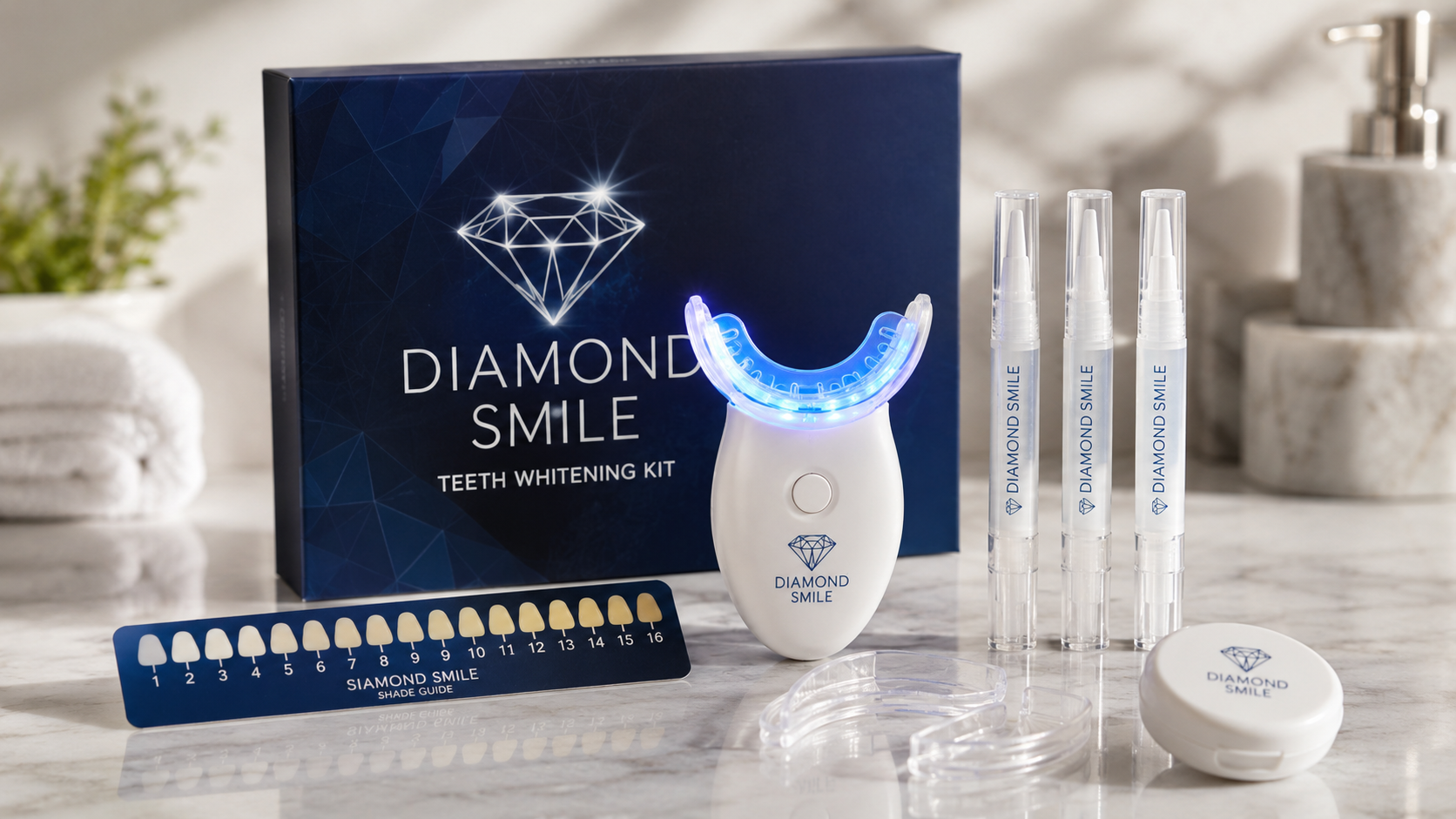
Whitening Without the Wince: The Diamond Smile Guide for Sensitive Teeth
Tooth sensitivity plagues roughly 1 in 8 adults, yet most at-home whitening kits arrive with a painful disclaimer attached. If you've sidestepped teeth whitening because you dread the sharp zingers and persistent aches, you're navigating a crowded boat—sensitivity concerns keep countless people from pursuing a brighter smile altogether. The Diamond Smile LED Teeth Whitening Kit has built its reputation on a specific promise: professional-grade whitening without the sensitivity backlash that typically follows.
Understanding whether this claim holds up for people with genuinely sensitive teeth requires moving past marketing language and examining the actual mechanics, ingredients, and user experiences. The gap between what brands promise and what sensitive-teeth users actually experience often determines success or frustration.
Discover how the Diamond Smile kit compares for sensitive teeth users.
Understanding Tooth Sensitivity and Why Whitening Scares People
Tooth sensitivity starts with a breach in your tooth's protective barriers. Your enamel—that hard outer shell—gradually erodes from acidic foods, aggressive brushing, or grinding. Once it thins, the softer dentin underneath becomes exposed, revealing microscopic tubules that connect directly to the nerve center of your tooth. Gum recession accelerates this problem, pulling protective tissue away from the tooth root and leaving more of the vulnerable surface accessible.
When whitening gel contacts exposed dentin or freshly cleaned tubules, the experience ranges from mild tingling to sharp, shooting pain that makes you wonder why you ever started. Traditional whitening methods worsen this because they combine three sensitivity triggers simultaneously: peroxide concentration (usually 10-35% in professional treatments), prolonged application time, and sometimes heat from LED devices that activate the gel.
The sensitivity spectrum isn't universal. Mild sensitivity might feel like a subtle buzzing sensation during treatment that fades within hours. Moderate sensitivity creates noticeable discomfort that lingers into the evening. Severe sensitivity triggers pain so intense that users abandon treatment entirely, no matter how promising the whitening results appear.
The Diamond Smile Formula Breakdown—What's Actually in the Gel?
Two Different Gel Formulations
Diamond Smile offers two distinct gel options, and understanding which one you're considering matters significantly for sensitivity concerns. The peroxide-free formulation contains glycerin, aqua, propylene glycol, and sodium bicarbonate—gentler ingredients that clean and brighten without the chemical punch that triggers sensitivity. These versions prioritize comfort over aggressive whitening power.
The hydrogen peroxide versions take a different approach, relying on the active bleaching agent that most professional treatments use. Hydrogen peroxide concentrations vary across Diamond Smile products, though exact percentages aren't always transparently published. This ambiguity matters because even modest peroxide concentrations (3-6%) can trigger sensitivity in susceptible users.
Gentleness Profile of Peroxide-Free Ingredients
Glycerin acts as a humectant, drawing moisture into the tooth and reducing the drying sensation that contributes to sensitivity. Propylene glycol serves a similar hydrating function while helping the gel adhere to tooth surfaces. Sodium bicarbonate gently abrades surface stains without the aggressive chemical action of peroxide. Together, these ingredients create a gentler experience, though whitening results typically develop more gradually than peroxide-based systems.
Hydrogen Peroxide Concentration and Sensitivity Risk
If your Diamond Smile gel contains hydrogen peroxide, the concentration directly impacts your sensitivity risk. Lower concentrations (under 6%) paired with shorter application times (10-15 minutes) create less sensitivity potential. Higher concentrations amplify risk significantly. The challenge lies in the fact that Diamond Smile's product labeling doesn't always specify exact peroxide percentages, leaving users guessing about what they're actually applying to their teeth.
Blue LED Technology and Its Impact on Sensitive Teeth
How Blue LED Light Activates the Whitening Process
Blue LED light wavelengths (around 460-490 nanometers) are theorized to accelerate whitening gel activation, breaking down stain molecules more efficiently. The mechanism isn't yet fully understood through independent clinical research, but the concept is straightforward: the light energizes the peroxide or whitening compounds, allowing them to penetrate tooth surface stains more effectively.
For sensitive-teeth users, this acceleration could be beneficial. Shorter activation periods mean less prolonged exposure and theoretically less cumulative irritation. The trade-off appears favorable—if the LED truly speeds the process, you might spend less total time with active whitening compounds on your teeth.
Temperature Considerations and Heat Sensitivity
One critical question for sensitive-teeth users: does the Diamond Smile LED device generate heat? Heat itself can trigger sensitivity by expanding tooth structure and drawing fluid toward the nerve. The Diamond Smile unit is marketed as cool-operating, but actual user reports vary. Some users detect no warmth whatsoever, while others describe mild warmth after extended sessions.
The distinction matters because even subtle heat can exacerbate sensitivity in people whose teeth already react to temperature changes. If you're someone who wears gloves in winter to avoid holding cold objects, heat considerations become genuinely important.
Session Duration and Sensitivity Risk
The standard 10-15 minute session length represents a calculated choice. Longer sessions increase sensitivity risk proportionally—the longer whitening compounds remain active on your teeth, the greater the opportunity for irritation. Fifteen minutes sits in the sweet spot where many users see results without severe sensitivity development.
However, that standard assumes you're following the recommended protocol exactly. Sensitive-teeth users often need to reduce even this modest timeframe, stopping at 7-10 minutes or skipping every other recommended day to manage discomfort.
Real User Experiences: What People with Sensitive Teeth Report
Customer testimonials reveal the genuine variability in Diamond Smile experiences among sensitive-teeth users. Some report surprise at how comfortable the process felt, expecting agony but experiencing only mild tingling that disappeared within hours. Others describe building sensitivity as the treatment course progressed, suggesting cumulative irritation even with peroxide-free formulations.
Before-and-after sensitivity tracking shows several patterns. A subset of users maintains identical sensitivity levels throughout treatment—the whitening happens without sensitivity changes. Another group experiences temporary sensitivity during the 2-3 week course that resolves completely once treatment stops. The concerning minority reports permanent sensitivity increase or activation of previously dormant sensitivity issues.
Timeline observations matter for sensitive-teeth users. Most discomfort appears concentrated in the first few days as teeth adjust to the whitening agent. By day 4-5, many users report adaptation. However, pushing treatment frequency or duration sometimes disrupts this adaptation period, restarting the sensitivity cycle.
The most honest testimonials come from users who abandoned the full treatment course early. Their common thread: whitening results looked promising after 3-5 sessions, but mounting sensitivity made continuing unbearable. They gained a shade or two of whitening while sacrificing comfort—a trade-off they'd reverse if given the choice.
Explore Diamond Smile's sensitivity protocols before making your purchase decision.
Diamond Smile vs. Professional Whitening for Sensitive Teeth
Cost Comparison and Accessibility
The Diamond Smile kit costs approximately $59, making professional-grade whitening accessible to budgets that might otherwise exclude cosmetic dentistry. Professional in-office whitening runs $300-1,000+, placing it completely out of reach for many people. Custom-tray whitening from dentists typically costs $200-500 for the initial setup plus ongoing gel purchases.
For financially constrained individuals, this $59 price point feels genuinely transformative—suddenly professional-grade technology becomes attainable. However, cost advantage disappears entirely if sensitivity forces abandonment after a few sessions.
Professional Dentist-Supervised Advantages
Dentists supervising whitening treatment offer multiple advantages for sensitive-teeth patients. They can assess your existing enamel thickness, identify gum recession, and flag other risk factors before starting treatment. They create custom-fitted trays that minimize contact with sensitive gum tissue, reducing one major irritation source.
Professional fluoride treatments applied before or after whitening strengthen enamel and reduce sensitivity vulnerability. Dentists have access to stronger whitening agents and numbing compounds, managing more aggressive protocols with professional oversight. They can adjust treatment intensity based on your tooth response in real time rather than following a standardized protocol that may not suit your unique sensitivity profile.
The disadvantage lies in cost and time investment. Professional treatments require appointments, take-home tray waiting periods, and ongoing follow-ups. For people already stressed about spending money on cosmetic dentistry, the professional route feels luxurious rather than accessible.
At-Home Kit Advantages for Sensitive Teeth Users
Diamond Smile kits offer genuine advantages for sensitive-teeth users willing to modify the protocol. You control application—applying gel only to visible tooth surfaces while carefully avoiding the sensitive gum line. You dictate session duration, stopping at 7 minutes instead of pushing toward 15 if you feel irritation developing. You space out treatment frequency, inserting recovery days between sessions without penalty or judgment.
This autonomy matters enormously for sensitive-teeth users. Professional treatments follow standardized protocols; at-home kits adapt to your unique teeth. If sensitivity appears, you immediately reduce intensity rather than waiting for your next dentist appointment weeks away.
Practical Strategies to Use Diamond Smile Safely with Sensitive Teeth
Pre-Whitening Preparation
Begin using desensitizing toothpaste containing potassium nitrate or strontium chloride for 1-2 weeks before starting Diamond Smile treatment. These ingredients help block the tubules in exposed dentin, reducing sensitivity potential. Simultaneously, establish a gentle oral hygiene routine—aggressive brushing within a week of whitening accelerates sensitivity by further exposing dentin.
Timing your whitening start matters as well. Avoid beginning treatment immediately after dental work, aggressive cleanings, or if your teeth already ache from recent sensitivity spikes. Your teeth need stable baseline conditions before adding whitening into the mix.
Gel Application Techniques
Apply gel precisely to the visible tooth surface while maintaining a buffer zone between the gel line and your gum tissue. The more gel contacts sensitive root surfaces and gum recession areas, the greater your sensitivity risk. Some users apply gel with a small brush rather than using the provided applicator, allowing finer control. Others reduce gel amount to half the recommended dosage for their initial sessions, testing sensitivity response before increasing.
Allow gel to dry for 10-15 seconds after application but before inserting the tray. This prevents excess gel from sliding around and contacting gum tissue during the session.
Session Spacing and Recovery
The standard protocol recommends daily or every-other-day treatments over 2-3 weeks. Sensitive-teeth users should dramatically extend this timeline. Spacing treatment sessions 2-3 days apart instead of daily gives teeth recovery time and prevents cumulative irritation. This modified approach extends your treatment course to 4-6 weeks, but the reduced sensitivity often makes completion more likely than abandoning treatment midway due to discomfort.
Some users find that skipping entire treatment days—using the kit on days 1, 3, 5, 7 rather than consecutive days—creates noticeable comfort improvement without significantly delaying results.
Shade Guide Reality Check—Results Without the Sensitivity Aftermath
Realistic Progress Tracking for Sensitive Teeth Users
Diamond Smile includes a shade guide for objective progress tracking. Your baseline shade matters tremendously for setting realistic expectations. If you start at shade C3 (yellowish-brown), a 2-3 shade improvement to shade B1-B2 represents genuinely dramatic transformation. Starting at A2 (already quite light), a 2-3 shade improvement produces subtle change that photographs noticeably but barely registers in casual conversation.
Sensitive-teeth users often achieve more modest results than the marketing suggests. Slower application frequency and reduced session duration may yield 1-2 shade improvements rather than the 5+ shade jumps highlighted in before-and-after photos. Accepting this reality from the beginning prevents disappointment and helps you evaluate whether the results justify any discomfort experienced.
Expected Timeline Variations
Standard users see noticeable improvement within 3-5 sessions. Sensitive-teeth users operating on a modified protocol might need 8-12 sessions to achieve comparable results. That extended timeline requires patience and commitment, which influences whether Diamond Smile remains a viable choice for your situation.
Realistic Shade Improvements vs. Dramatic Marketing Claims
Marketing imagery typically showcases the most impressive transformations—dramatic 5-7 shade improvements that represent outlier results achieved by users with minimal baseline sensitivity and optimal protocol compliance. More representative outcomes for sensitive-teeth users show 2-3 shade improvements that genuinely improve smile aesthetics without requiring aggressive whitening intensity.
The Missing Piece—Clinical Evidence and What We Don't Know
Absence of Independent Clinical Studies
This is where Diamond Smile's marketing narrative encounters uncomfortable reality. The brand lacks published, peer-reviewed clinical studies specifically testing its products on sensitive-teeth populations. Marketing claims rest on customer testimonials and internal testing rather than independent scientific validation.
Compare this to established professional whitening systems studied by dental researchers, where sensitivity outcomes are documented, analyzed, and published. The absence of similar research for Diamond Smile doesn't prove the product is ineffective or dangerous—it simply means we lack rigorous evidence confirming the "gentle whitening" promise.
Broader LED Whitening Research
Clinical research on LED whitening technology from other manufacturers shows mixed results. Some studies suggest LED activation provides modest acceleration of whitening results; others find minimal benefit compared to whitening gel alone. Critically, research on sensitivity outcomes varies by product and study design, meaning you cannot assume Diamond Smile's sensitivity profile matches other LED whitening kits.
Red Flags in Product Credibility
The absence of dentist partnerships or professional endorsements stands out. Established whitening brands often list dental professional advisors, compatibility with dentist-supervised protocols, or clinical support from dental institutions. Diamond Smile's marketing focuses primarily on customer testimonials rather than professional validation. This doesn't disqualify the product, but it does suggest the brand prioritizes consumer accessibility over professional credibility—a distinction that matters for sensitive-teeth users seeking reassurance.
Alternatives Worth Considering If Diamond Smile Feels Too Risky
Professional In-Office Whitening with Sensitivity Protocols
Dentists now offer whitening protocols specifically designed for sensitive teeth. These treatments use lower peroxide concentrations, shorter application times, and pre-treatment fluoride applications that dramatically reduce sensitivity risk. You pay significantly more ($300-600), but you gain professional assessment, custom treatment plans, and expert management if sensitivity develops during treatment.
This option suits people whose sensitivity is already moderate-to-severe and who value professional oversight. The cost remains higher than Diamond Smile, but the sensitivity risk decreases substantially.
Custom-Tray Whitening from Dentists
Dentists create custom-fitted trays based on your unique tooth anatomy and gum line. These trays minimize gel contact with sensitive areas while maintaining even gel distribution across visible tooth surfaces. You take the trays home and apply professional-strength gel at the dentist's recommended frequency—typically much more controlled than Diamond Smile's standard protocol.
This middle-ground option costs $200-500 initially but allows gentler, more personalized whitening than at-home kits without requiring in-office appointments.
Sensitivity-Specific Whitening Products
Brands specializing in gentle whitening formulate products specifically for sensitive teeth. These typically contain lower active ingredient concentrations, longer-chain whitening molecules that penetrate more slowly, and desensitizing compounds integrated into the formula. They produce slower results than standard whitening kits but create markedly less discomfort.
Researching these options requires reading ingredient lists and customer reviews from other sensitive-teeth users rather than relying on marketing claims.
Making Your Decision—Is Diamond Smile Right for Your Sensitive Teeth?
Honest Self-Assessment Questions
Ask yourself these questions before purchasing:
- How severe is your current sensitivity? Can you eat ice cream or drink cold water without discomfort?
- Have previous whitening attempts triggered lasting sensitivity or pain?
- Are you willing to modify the recommended protocol, extending treatment to 4-6 weeks instead of 2-3?
- Can you emotionally handle abandoning treatment midway if sensitivity becomes unbearable?
- Would you genuinely regret spending $59 if sensitivity, rather than whitening results, became your primary experience?
Honest answers to these questions reveal whether Diamond Smile fits your situation or whether alternatives deserve serious consideration.
Sensitivity Level Checklist
Mild Sensitivity (occasional tingling with very cold foods, cold air, or aggressive brushing but resolves quickly): You're a reasonable candidate for Diamond Smile with modifications. Spacing sessions further apart, reducing duration, and using desensitizing toothpaste beforehand should create manageable discomfort.
Moderate Sensitivity (regular discomfort with cold foods, temperature changes, or aggressive touch; impacts daily life occasionally): Diamond Smile becomes riskier. You might succeed with significant protocol modifications, but professional guidance or sensitivity-specific whitening products reduce risk substantially. Consider consulting a dentist before starting.
Severe Sensitivity (persistent discomfort even at rest, triggered by minimal cold exposure, affects eating and drinking significantly): Diamond Smile carries meaningful risk of exacerbating your condition. Professional whitening with sensitivity protocols or postponing whitening until your baseline sensitivity improves becomes prudent.
Budget Considerations
The $59 price point feels attractive until you consider the risk-reward balance. If spending $59 on a product you might abandon due to sensitivity causes financial stress or regret, professional options with higher success likelihood despite higher costs may serve you better. Conversely, if you have $59 to experiment with and can genuinely accept the possibility of abandoning treatment, the at-home approach lets you test whitening tolerance before investing in professional services.
The Sensitivity-Conscious Buyer's Takeaway
The Diamond Smile LED Teeth Whitening Kit genuinely delivers results for many users, and its affordability makes professional-grade whitening accessible to people on tight budgets. For those with sensitive teeth, however, the decision requires honest self-assessment rather than wishful thinking. The peroxide-free formulations and gentle LED technology offer real advantages over aggressive whitening methods, yet individual responses vary dramatically. Some sensitive-teeth users report minimal discomfort and noticeable whitening; others find the experience uncomfortable despite precautions.
Your path forward depends on three factors: your sensitivity severity, your willingness to modify the recommended protocol, and your comfort with the risk-reward trade-off. If you have mild sensitivity and can space sessions further apart, Diamond Smile might work beautifully. If your teeth already ache during cold-water brushing, professional guidance or a sensitivity-specific formula makes more sense.
Before ordering, honestly answer this: would you regret spending $59 if sensitivity became your primary concern rather than whitening results? If the answer is yes, explore professional options or sensitivity-formulated kits first. If you're willing to experiment with caution and have moderate expectations, Diamond Smile remains a reasonable choice.
The brightest smile means nothing if you're wincing every time you drink coffee. Choose the path that protects your teeth while enhancing your confidence.
Visit Diamond Smile to learn more about their sensitivity-conscious whitening options.

Leave a Reply