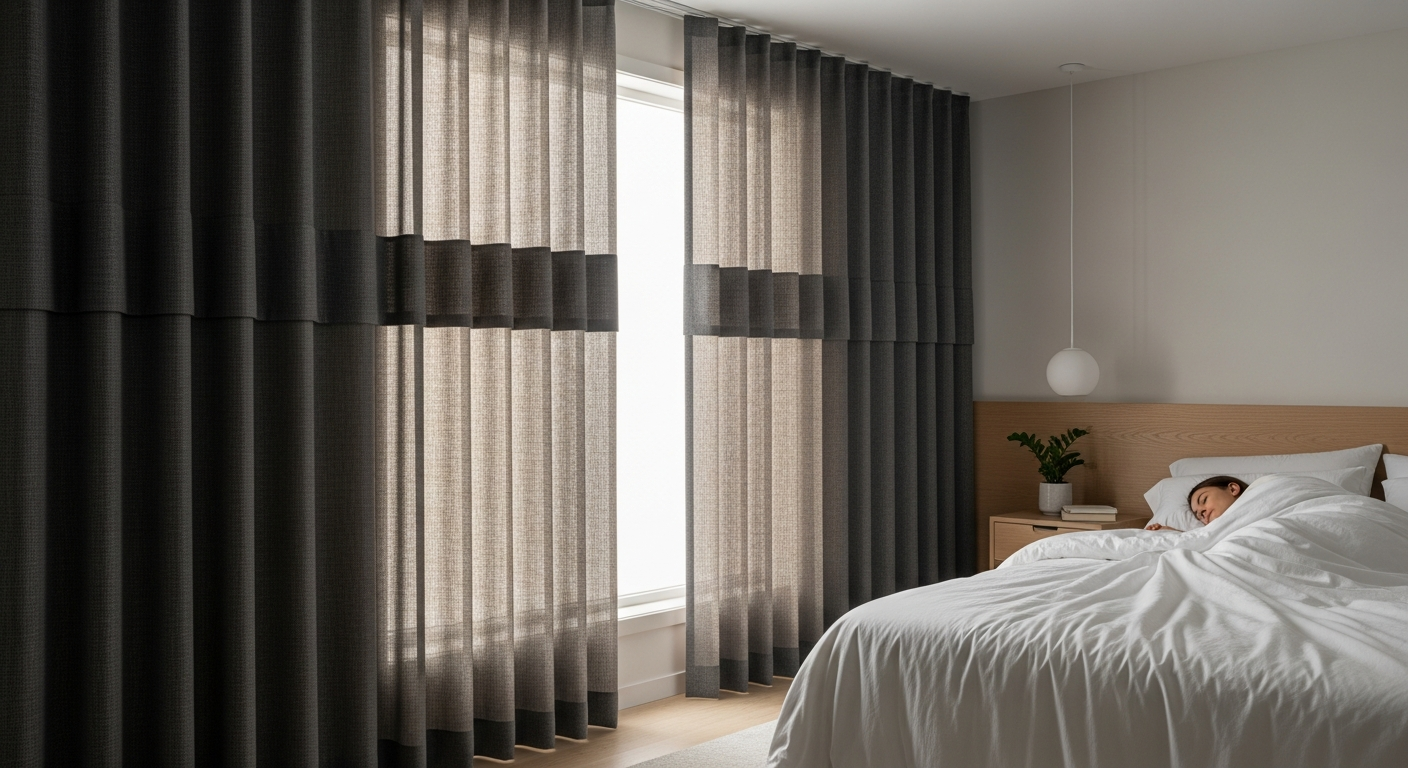
Shift work destroys sleep quality—and no amount of willpower can fix what your environment won't allow. Studies show that 70% of shift workers struggle with sleep disruption, yet most focus on supplements and routines while ignoring the most powerful tool at their disposal: complete environmental control. Standard solutions like sleep masks, white noise machines, and meditation apps address symptoms rather than causes, leaving shift workers trapped in a cycle of poor rest and diminished performance.
The Hussein 4-Layer Blackout Soundproof Thermal Curtains from TheHues represent a fundamental shift in window treatment technology. These aren't your standard drapes—they're engineered solutions built specifically for people whose sleep schedules don't align with daylight. The four-layer construction (velvet exterior, sound-absorbing felt, air-purifying layer, and thermal backing) addresses the exact environmental factors that sabotage shift worker sleep: light intrusion, neighborhood noise, and temperature fluctuations.
Throughout this guide, you'll learn why shift workers specifically benefit from Hussein's multi-functional design, how the four-layer technology works to eliminate sleep disruptors, what makes the custom-fit option a game-changer for odd-shaped windows, and whether the premium investment makes sense for your sleep recovery goals.
The Shift Worker Sleep Crisis: Why Standard Curtains Fail
Most off-the-shelf curtains allow light leakage around edges and gaps, creating a dawn simulator effect that triggers cortisol even during daytime sleep. Your eyes detect even minimal light penetration, signaling your nervous system that it's time to wake—undermining your best efforts to rest during unconventional hours.
Standard single or double-layer curtains provide minimal noise reduction, leaving shift workers vulnerable to traffic hum and neighbor activity during peak sleep windows. The acoustic properties of typical fabrics reflect sound waves back into the room rather than absorbing them, amplifying rather than eliminating disturbances.
Temperature regulation becomes critical for shift workers sleeping at non-standard times; inadequate insulation means fighting HVAC systems or relying on energy-draining solutions. When your bedroom temperature fluctuates, your body expends energy maintaining homeostasis instead of consolidating sleep cycles.
Research shows that 100% blackout conditions can improve sleep onset time by 30-40% for people sleeping against their natural circadian rhythm. This improvement stems from melatonin's immediate response to complete darkness—your brain receives a chemical signal that sleep is possible, regardless of the clock time.
Deconstructing the Four-Layer Technology Behind Hussein Curtains
Layer 1: Velvet Exterior
The velvet exterior provides aesthetic appeal while creating the first light-blocking barrier and sound diffusion surface. This isn't purely decorative—the velvet's dense fiber structure begins the acoustic dampening process before sound reaches deeper layers, while its light-absorbing properties prevent reflection that cheaper fabrics allow.
Layer 2: High-Density Sound-Absorbing Felt
The high-density sound-absorbing felt uses acoustic principles to trap sound waves rather than reflecting them back into the room. This specialized material targets the frequency ranges most disruptive to sleep—traffic rumble, neighbor footsteps, and street noise—by converting acoustic energy into negligible heat dissipation.
Layer 3: Air-Purifying Layer
The air-purifying layer filters dust and allergens while maintaining breathability, critical for shift workers with respiratory sensitivities. This technology mirrors materials used in high-grade face masks, actively removing particulates that could trigger nighttime allergies or breathing disruptions.
Layer 4: Thermal Backing
The thermal backing uses reflective insulation technology to reduce heat transfer in summer and prevent warmth loss in winter. This creates a micro-insulated window zone that stabilizes temperature fluctuations, allowing your body to focus on sleep consolidation rather than thermoregulation.
OEKO Certification and Chemical Safety
OEKO certification across all materials ensures no off-gassing or chemical odors that could disrupt sleep in sealed environments. This certification becomes crucial when curtains remain drawn for extended periods—trapped air circulates through the fabric repeatedly, and any chemical volatilization accumulates.
Achieving True 100% Blackout: What Makes Hussein Different
Complete darkness triggers melatonin production within minutes, critical for shift workers whose bodies are already confused about circadian timing. Unlike room-darkening curtains that reduce light by 95%, true 100% blackout creates neurological conditions necessary for deep sleep recovery—your pineal gland responds dramatically to the absence of light photons, not merely reduced illumination.
Hussein's blackout rating eliminates light leakage at edges, corners, and seams—the weak points where standard curtains fail shift workers. Most off-the-shelf solutions leave visible gaps at the top or sides, and this residual light penetration prevents the complete darkness necessary for optimal melatonin synthesis.
The custom-fit sizing option removes the gap problem entirely, allowing panels to meet the window frame precisely without light-stealing spaces. Shift workers with bay windows, angled walls, or non-standard frame dimensions benefit dramatically—these situations make standard curtains functionally useless for blackout purposes, yet they're common in older apartment buildings where shift workers often live.
Noise Reduction Performance for High-Traffic Environments
Hussein curtains reduce noise by 20-30 decibels depending on frequency range—equivalent to the difference between a busy street and normal conversation. This performance level isn't arbitrary; it's engineered to target the specific frequencies that fragment sleep architecture, particularly the traffic rumble and low-frequency sounds that penetrate standard window treatments.
The sound-absorbing felt layer specifically targets traffic noise, neighbor footsteps, and street activity that typically disrupts shift worker sleep. These mid-range frequencies (500-2000 Hz) are most disruptive to REM and deep sleep stages, and Hussein's material composition absorbs rather than reflects them.
Acoustic performance improves when panels are floor-to-ceiling and wall-to-wall, creating a complete sound envelope rather than partial coverage. Shift workers who install Hussein curtains across their entire window system—rather than just the primary pane—report significantly greater noise reduction, as sound energy has fewer alternative pathways into the room.
Unlike white noise machines or earplugs, Hussein curtains provide passive noise control that requires zero maintenance or daily adjustment. Your sleep sanctuary works automatically; there's no device to charge, no app to manage, no dependency on external systems.
Thermal Insulation and Energy Efficiency for 24/7 Climate Control
Shift workers sleeping during unusual hours often battle temperature inconsistency as HVAC systems run on standard schedules. Your building's heating or cooling operates on a 9-5 rhythm, but your sleep window occurs at 2 AM—your bedroom either overheats or undercools, fragmenting sleep cycles.
Hussein's thermal backing reduces heat transfer by up to 25%, lowering cooling costs in summer and heating costs in winter. This insulation effectiveness stems from the backing's reflective properties, which redirect thermal radiation before it reaches your window's glass surface where heat exchange occurs most dramatically.
The insulation properties create a microclimate within the window area, stabilizing room temperature fluctuations that disrupt sleep cycles. Shift workers report that Hussein curtains eliminate the 3-5°F temperature swings that typically occur during their sleep hours, allowing deeper, uninterrupted rest.
Energy savings compound over time; shift workers using Hussein curtains report 15-20% reductions in monthly utility bills. Over a five-year period, these cumulative savings often offset a significant portion of the initial curtain investment, particularly in extreme climates where heating and cooling costs dominate utility expenses.
OEKO Certification and Health Considerations for Sensitive Sleepers
OEKO-TEX certification guarantees the curtains are free from harmful chemicals, heavy metals, and synthetic dyes—critical for shift workers with chemical sensitivities. This certification means the fabric was independently tested and verified to contain no substances that off-gas into your breathing space during extended exposure.
The anti-dust properties are particularly valuable for shift workers who can't afford to lose sleep to allergic reactions or respiratory irritation. When you're already fighting against your circadian rhythm, additional sleep disruption from dust accumulation or allergen exposure becomes unacceptable.
The air-purifying layer technology actively filters airborne particles, creating a cleaner microenvironment within the sleep space. This becomes especially important for shift workers who sleep during high-traffic hours when outdoor pollution levels and indoor dust circulation peak.
Machine washability with detached felt liner means shift workers can maintain hygiene without compromising the curtain's performance. You can wash the velvet exterior and thermal backing regularly while keeping the specialized felt and air-purifying layers protected, ensuring long-term functionality.
Custom Sizing: Eliminating Light Leaks for Perfect Sleep Environments
Off-the-shelf curtains come in standard widths creating gaps and light leaks when windows don't match these dimensions. Your window is unique to your space, yet standard curtains force compromises—either excessive bunching that looks cheap, or gaps that defeat the blackout purpose.
Custom sizing allows Hussein curtains to fit odd-shaped windows, bay windows, and non-standard frame sizes—common in older apartments where shift workers often live. Building age and architectural variety mean most shift worker living situations fall outside standard curtain dimensions, making made-to-measure solutions mandatory for true blackout effectiveness.
Made-to-measure panels eliminate the need for bunching excess fabric or leaving dangerous gaps that compromise blackout effectiveness. Your curtains hang properly, seal completely, and create the aesthetic of intentional design rather than improvised solutions.
Custom fit provides the designer aesthetic that shift workers appreciate—their sleep sanctuary looks intentional and finished rather than improvised. You're not making do with suboptimal solutions; you're creating a professional sleep environment that reflects the importance of rest recovery.
Investment Analysis: Is the Premium Price Worth It for Sleep Recovery?
Hussein curtains range from $139 per panel for standard sizes to $500+ for fully customized solutions, representing a significant investment. This pricing reflects the engineered materials, acoustic technology, thermal properties, and customization labor involved—you're not purchasing fabric; you're purchasing a sleep optimization system.
For shift workers, the ROI calculation should include improved sleep quality, reduced health complications from poor sleep, and enhanced work performance. Poor sleep costs shift workers approximately $2,300 per year in lost productivity, medical expenses, and accident risk—Hussein's investment may offset these costs within one to two years.
Energy savings alone can recoup 20-30% of the curtain investment over 3-5 years, particularly in extreme climates. Shift workers in hot or cold regions often see return on investment purely through reduced heating and cooling expenses, before calculating health and productivity improvements.
Real-World Performance: What Shift Workers Actually Experience
Shift workers report falling asleep 15-30 minutes faster when using Hussein curtains compared to standard window treatments. This improvement compounds—faster sleep onset means more total sleep hours, which translates to better cognitive function and safety during work hours.
The combination of complete darkness and noise reduction creates a psychological sleep sanctuary effect that enhances relaxation. Your brain recognizes the controlled environment as specifically designed for rest, triggering parasympathetic activation more readily than standard bedrooms.
Users consistently mention that the velvet texture and premium appearance elevate their bedroom aesthetic, making the sleep space feel intentional. Shift workers often describe their sleeping environment as a "hotel-quality retreat" or "luxury sanctuary"—emotional satisfaction enhances the sleep experience beyond physiological factors.
Shift workers with partners appreciate that Hussein curtains allow them to sleep during the day without disturbing others' daytime routines. The soundproofing prevents your sleep from being disrupted by partner activity, while the blackout keeps daylight from affecting your roommate's daytime comfort.
Comparing Hussein to Alternative Sleep Environment Solutions
Sleep masks and blackout eye covers are portable but uncomfortable for 8+ hour sleep sessions and don't address noise or temperature. They also fail to create the psychological sanctuary effect that environmental solutions provide—your brain still processes ambient noise and temperature fluctuations even if your eyes are covered.
Cheaper blackout curtains ($30-80) fail at edge sealing and noise reduction, forcing shift workers to layer multiple solutions. You end up with substandard blackout effects plus mediocre soundproofing, spending more total money on inferior results.
Professional soundproofing installations ($2,000-5,000) address noise but don't solve light or temperature problems comprehensively. You'd need acoustic treatment plus separate blackout solutions plus thermal insulation—three separate investments versus one comprehensive solution.
Sleep supplements and medications mask symptoms without addressing environmental root causes—Hussein curtains fix the actual problem. Melatonin supplements become unnecessary when your body receives appropriate darkness signals; white noise machines become redundant when acoustic treatment prevents sound intrusion.
Hussein curtains provide the most comprehensive single solution, addressing all three major environmental sleep disruptors simultaneously. For shift workers with limited budgets and installation options, this integrated approach delivers better results than pursuing multiple incomplete solutions.
The Sleep Transformation Awaits
Shift workers have suffered through enough restless days and groggy nights. The Hussein 4-Layer Blackout Soundproof Thermal Curtains aren't just window coverings—they're a comprehensive environmental reset that addresses the exact factors sabotaging your sleep quality. When you combine true 100% blackout capability with serious noise reduction, thermal insulation, and health-conscious certifications, you're not buying curtains. You're investing in the foundational sleep environment that your irregular schedule demands.
The custom-fit option eliminates the light leaks and gaps that standard curtains leave behind, creating a genuine sanctuary rather than a compromise. Yes, the premium price point reflects the engineering, materials, and customization involved. But for shift workers who've already sacrificed sleep quality to their work schedules, Hussein curtains represent the single most impactful environmental change available.
The energy savings, improved work performance, and enhanced health outcomes compound over years of use. Your sleep recovery doesn't have to wait—the transformation from chaotic, light-filled, noisy sleep attempts to deep, restorative rest happens faster than you'd expect.
Explore Hussein's custom sizing options and order swatches today to begin your sleep transformation.

Leave a Reply