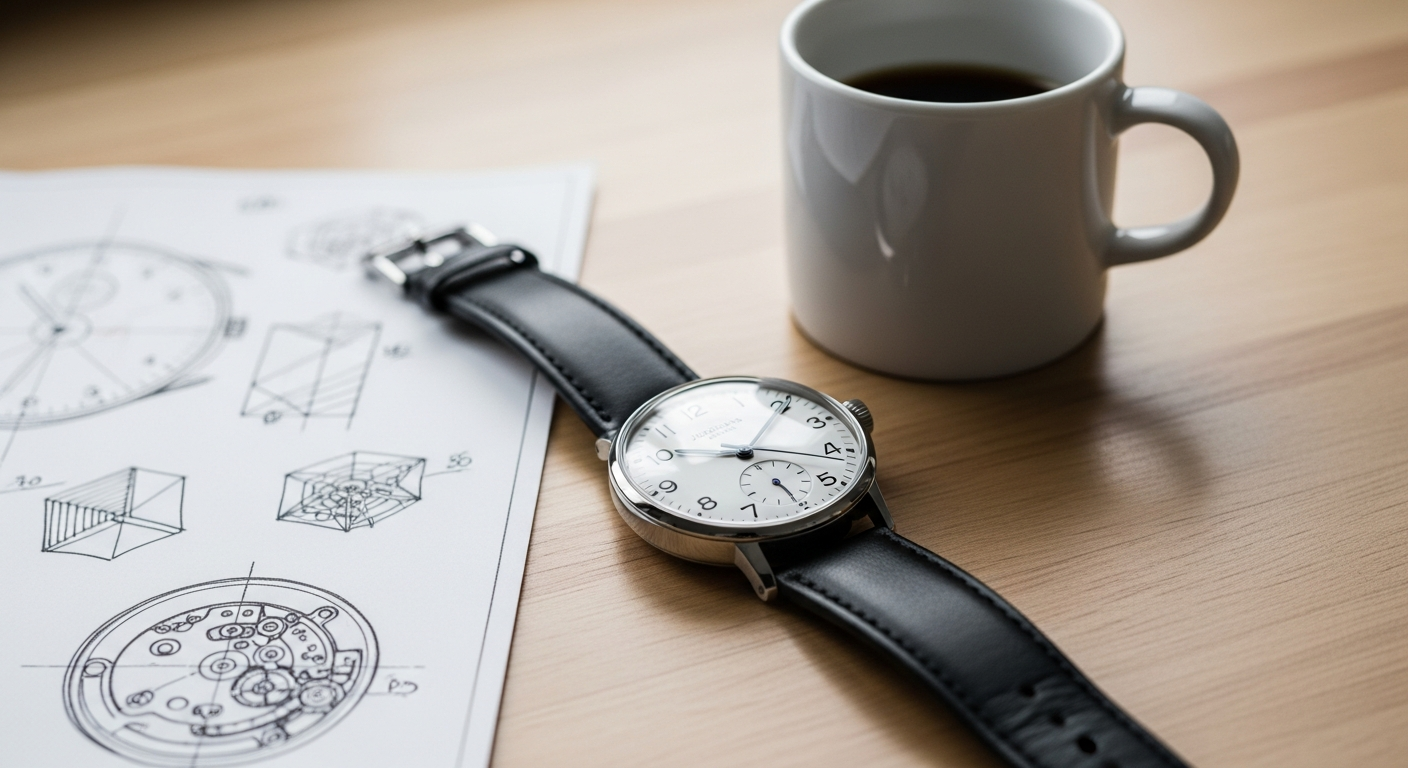
When a watch becomes more than just an instrument for telling time, when it transforms into a statement about design philosophy and craftsmanship, you're experiencing something genuinely rare. The Junghans Max Bill Handaufzug represents exactly this phenomenon—a manual-winding timepiece that has captured the hearts of design enthusiasts and horology devotees for generations. This isn't merely a functional object; it's a tangible connection to the Bauhaus movement, one of history's most revolutionary design philosophies that fundamentally changed how we think about the relationship between form and function.
The watch emerged from a collaboration between the legendary German manufacturer Junghans and Max Bill, a Swiss artist and Bauhaus alumnus whose design education shaped his approach to every detail. Born in the 1950s and 60s, this timepiece embodies a radical conviction: that a watch's beauty stems not from ornamentation or complexity, but from absolute clarity and purposeful design. Priced between $700 and $1,200, the Max Bill Handaufzug occupies a distinctive position in the watch market where serious collectors and design aficionados converge, merging German engineering precision with artistic vision.
Explore the Junghans Max Bill collection to see why this design endures.
This exploration reveals why the Max Bill Handaufzug has maintained its relevance across decades, examines the Bauhaus principles embedded in its construction, investigates the mechanical movement powering it, and helps determine whether this investment aligns with your collecting vision.
The Bauhaus Legacy Behind the Junghans Max Bill Handaufzug
Max Bill's Role as a Bauhaus Student
Max Bill arrived at the Bauhaus school during a transformative period in design history. Under the mentorship of figures like Herbert Bayer and Joost Schmidt, Bill absorbed the school's core conviction that design should serve human needs rather than appeal to vanity. His education wasn't limited to aesthetic principles—it encompassed philosophy, mathematics, and engineering. This interdisciplinary foundation became the bedrock of his design methodology, one that would later define the Max Bill watch collection.
Form Follows Function in Every Detail
The Bauhaus principle that form follows function isn't merely a slogan applied to the Max Bill Handaufzug; it's woven into every millimeter of the design. The uncluttered dial contains no unnecessary elements. The slender indices and thin pencil hands serve legibility without visual fuss. The luminescent dots at cardinal hours provide practical visibility in low light while maintaining aesthetic restraint. Each component exists because it performs a purpose, nothing more. This philosophy represents a radical departure from the ornamental watch design that dominated earlier eras.
The 1950s Partnership and Its Historical Context
Junghans recognized something valuable in Max Bill's approach and commissioned him to design watches and clocks throughout the 1950s and 60s. This partnership wasn't accidental—post-war Germany was rebuilding its industrial reputation, and the Bauhaus philosophy offered a path forward. German manufacturing could distinguish itself not through luxury embellishment, but through honest design and mechanical excellence. The Max Bill collection became proof that this approach worked commercially and aesthetically.
Bauhaus Influence on Contemporary Watch Design
The minimalist aesthetic that dominates contemporary watch design owes an immeasurable debt to Bauhaus principles. Brands across the industry now emphasize clarity, functional design, and stripped-down elegance. The Max Bill Handaufzug didn't simply follow this trend—it pioneered it. Modern watchmakers studying how to approach minimalism inevitably encounter Max Bill's work as a reference point, a benchmark for how far a design can be reduced without losing its essential character.
Mechanical Movement and Manual-Winding Excellence
The J805.1 Calibre: Specifications and Reliability
The heart of the Max Bill Handaufzug beats with the J805.1 movement, a manual-winding calibre developed specifically for this timepiece. Operating at 21,600 vibrations per hour (3 Hz), this movement balances accuracy with mechanical efficiency. The specifications reveal a movement engineered for reliability rather than flashy complications. Jewels at critical pivot points reduce friction and wear, while the balance wheel oscillates with metronomic precision. This is mechanics stripped to essentials—no chronograph function, no date window, no unnecessary complication.
The 42-Hour Power Reserve
A 42-hour power reserve offers practical advantages for daily wear. Miss winding your watch on Saturday morning, and it'll continue keeping accurate time through Sunday. This means you're not locked into a rigid winding ritual; life can interrupt without your watch stopping. For collectors, this power reserve represents sufficient capacity to maintain timekeeping through a weekend absence without requiring a trip to the watch service center. It's generous enough to be forgiving, yet modest enough to encourage the regular winding ritual that many enthusiasts cherish.
The Tactile Experience of Hand-Winding
Hand-winding creates a connection absent in automatic or quartz watches. Each morning, you hold the crown between your thumb and forefinger, feeling the mechanical resistance as the mainspring tightens. Some owners describe this as meditative; others simply call it necessary engagement. This tactile relationship aligns perfectly with Bauhaus philosophy—the user maintains direct, physical contact with the mechanism. You're not passively wearing a device; you're actively participating in its operation.
Manual-Winding Versus Alternative Movement Types
Automatic movements eliminate the winding ritual entirely, drawing energy from wrist motion instead. For those seeking convenience, this represents clear superiority. Quartz movements offer unmatched accuracy and battery simplicity. Yet enthusiasts consistently choose manual-winding movements despite these advantages. The reason stems from philosophy rather than practical necessity—mechanical movements demand engagement, reward attention, and remind the wearer that precision originates from craftsmanship, not electronics. The Max Bill refuses to compromise on this principle.
Design Elements That Define the Max Bill Aesthetic
The Clean, Uncluttered Dial
Step back and examine the dial at arm's length. Notice what's absent: no logo prominence, no redundant information, no visual hierarchy created through color or contrast. The dial presents time-telling information with surgical clarity. The background remains a neutral canvas. Applied indices mark the hours in austere simplicity. This restraint might sound boring in description, but on the wrist, the effect proves magnetic—the watch becomes invisible when you're reading time, yet impossible to ignore when you look directly at it.
Slender Indices and Thin Pencil Hands
The index markers and hands employ the thinnest possible materials that maintain legibility and structural integrity. Heavy hour markers would disrupt the visual clarity Bauhaus designers insisted upon. Instead, slender lines create an almost weightless appearance despite the mechanical substance beneath the crystal. These thin hands move smoothly across the dial, each tick of the balance wheel advancing them forward with mechanical inevitability.
Luminescent Dots and Practical Elegance
Luminescent material appears only at the cardinal hours—12, 3, 6, and 9 positions—sufficient for orientation in darkness without creating a glowing distraction in daylight. This represents functional minimalism at its finest. The dots serve a practical purpose without becoming a design feature. In a dimly lit restaurant, you can glance down and immediately orient yourself to the time. The same dots remain invisible in normal light, violating no aesthetic principle.
Polished Stainless Steel Case
The case construction employs polished stainless steel that reflects light subtly rather than aggressively. A highly polished surface would create unnecessary visual drama; a brushed finish might feel industrial. The polish level strikes precisely the right balance—refined without pretension, elegant without flash. The case geometry remains classically simple: a cylindrical sides, clean bezel, unadorned lugs. Every surface serves a structural purpose.
Practical Considerations for Potential Owners
Water Resistance at 30 Meters: Safe Activities and Limitations
The 30-meter water resistance rating means the watch can survive incidental splashes and brief immersion in shallow water. Washing your hands while wearing the Max Bill presents no concern. Light rain won't penetrate the case. However, this watch is fundamentally not a diving instrument or even a reliable swimming companion. Sustained water pressure from swimming motions or submerged wrist movements could exceed the gasket's protective capacity. Respect this limitation and you'll enjoy decades of trouble-free timekeeping; ignore it and you risk expensive service charges. The 30-meter specification reflects the watch's identity as a dress watch, not a sports instrument.
Sizing Guidance for Wrist Compatibility
The case diameter typically ranges from 34mm to 38mm depending on the specific model, accommodating various wrist sizes and aesthetic preferences. A 34mm case suits smaller wrists and those preferring dress-watch proportions even when worn casually. The 38mm option appeals to those with larger wrists or those seeking slightly more visual presence. Trying on both sizes before committing provides valuable perspective—what photographs well online might feel incongruous against your personal proportions. Visit an authorized Junghans retailer if possible; seeing the watch on your own wrist eliminates guesswork.
Comfort and Wearability Across Occasions
The Max Bill Handaufzug functions equally convincingly at a formal dinner and with weekend casual attire. The leather strap (often included with new purchases) develops character and patina with age, becoming more personalized with each wear. Those preferring metal bracelets can switch to stainless steel mesh options without sacrificing the minimalist aesthetic. The relatively slim profile means the watch doesn't overwhelm smaller wrists, while the mechanical substance beneath the crystal delivers satisfying presence and weight. Comfort during extended wear—and the Max Bill encourages extended wear—derives from balanced proportions and thoughtful engineering.
Price Point Analysis: Understanding the Investment
At $700 to $1,200, the Max Bill Handaufzug positions itself above affordable quartz dress watches yet well below haute horlogerie pricing. This range reflects several factors: German manufacturing standards, the manual-winding movement's engineering, the Bauhaus heritage commanding design premium, and Junghans' established reputation. You're not paying for precious metals or complicated mechanisms; you're paying for clarity of design, mechanical reliability, and historical significance. Compared to fashion watches at similar prices, the Max Bill delivers substantially superior engineering and longevity.
Discover current Max Bill Handaufzug pricing and availability at Bauhaus.
The Max Bill Handaufzug Versus Other Dress Watches
Comparison to Other Bauhaus-Inspired Timepieces
Several manufacturers have attempted to capture Bauhaus design principles, and some achieve respectable results. Nomos Glashütte watches embody minimalist principles with contemporary German engineering. Sternglas produces affordable Bauhaus-influenced designs. Yet the Max Bill remains singular in its direct connection to Max Bill himself and the original Bauhaus philosophy. When you wear the Max Bill, you're not wearing an interpretation or homage—you're wearing the original vision, refined through decades of production experience.
Manual-Winding Dress Watches at Similar Price Points
At the $700 to $1,200 range, you'll find several capable manual-winding dress watches. Seiko's Presage collection offers Japanese engineering and increasingly sophisticated designs. Older vintage watches from respected makers provide historical depth at lower cost. Yet none quite capture the specific intersection of Bauhaus heritage, mechanical excellence, and design clarity that defines the Max Bill. Each alternative excels at something—vintage charm, value for money, contemporary styling—but the Max Bill doesn't compromise on any dimension.
Why Collectors Prioritize the Max Bill
Collectors building curated, historically informed collections recognize the Max Bill Handaufzug as essential. It's impossible to study 20th-century design without eventually encountering Bauhaus principles, and equally impossible to understand contemporary watch design without acknowledging the Max Bill's influence. Owning one means possessing a piece of design history, something that actively shaped how contemporary watches are conceived. This historical significance carries weight that purely technical specifications can't capture.
Resale Value and Collectibility
The Max Bill Handaufzug maintains resale value substantially better than fashion watches at comparable prices. The design's timelessness means it never becomes dated, and the mechanical movement means it can be serviced indefinitely. Discontinued variations occasionally appreciate as collectors seek specific versions. While not a pure investment vehicle, the Max Bill represents a purchase unlikely to depreciate significantly if circumstances require resale. The watch retains its essential value because its fundamental appeal—clarity, craftsmanship, design integrity—proves enduring.
Who Should Invest in the Junghans Max Bill Handaufzug
Design Enthusiasts and Minimalist Advocates
If you recognize quality in restraint, if you appreciate designs that refuse embellishment, if you find beauty in purpose-driven clarity, the Max Bill speaks your language. This watch rewards scrutiny—study it closely and you'll recognize thoughtful decisions at every level. The absence of unnecessary elements becomes presence through intentionality.
Horology Purists Seeking Mechanical Appreciation
Purists who believe mechanical movements represent the pinnacle of watchmaking craftsmanship will appreciate the J805.1 calibre's elegant engineering. Hand-winding offers direct mechanical engagement impossible with automatic or quartz alternatives. The 42-hour power reserve provides practical functionality without complication. This watch prioritizes the mechanical experience over feature-set inflation.
Collectors Building Focused, Informed Collections
Rather than accumulating watches across numerous categories and styles, some collectors concentrate on specific themes—Bauhaus-influenced designs, manual-winding instruments, German engineering, or post-war industrial design. The Max Bill Handaufzug occupies a central position in several of these narratives. It's the obvious choice when building a cohesive collection based on design philosophy rather than random acquisition.
Professionals Seeking Understated Elegance
The corporate executive, the academic, the creative professional—anyone whose role demands a refined appearance without flashy jewelry—will find in the Max Bill an ideal tool. It communicates taste and discernment without demanding attention. It functions flawlessly across contexts, from boardroom to casual weekend gathering. The watch remains properly professional whether paired with a suit or visible beneath a rolled-up shirt sleeve.
The Investment Case for Owning a Max Bill Handaufzug
Long-Term Value Retention and Collectibility
Watches with strong design heritage and mechanical substance typically maintain value better than trend-driven alternatives. The Max Bill has already proven its staying power across seven decades. It's unlikely to become obsolete because its design principles transcend fashion cycles. Collectors actively seek discontinued variations, and contemporary production models show no signs of losing appeal.
How Timeless Design Protects Against Obsolescence
A watch designed around permanent principles rather than contemporary aesthetics can't become dated. The Max Bill won't look "retro" in fifteen years because it never followed trends in the first place. It looked the same in 1960, looks the same today, and will look the same in 2050. This constancy reflects supreme confidence in design fundamentals—when you stop chasing trends, you access something more durable than fashion.
Cultural and Historical Significance
The Bauhaus movement fundamentally influenced modern design across disciplines—architecture, graphic design, industrial design, photography. Owning a Max Bill Handaufzug means possessing a tangible artifact from this pivotal moment. It's not merely a watch; it's a historical object that shaped how subsequent designers approached problems. This cultural weight translates to enduring relevance regardless of market fluctuations.
Emotional ROI: The Satisfaction of Design Mastery
Beyond financial returns, the Max Bill Handaufzug delivers emotional rewards that pure monetary metrics can't capture. The daily ritual of winding it, the satisfaction of owning an object where every element serves a clear purpose, the knowledge that you're wearing a design acknowledged as influential—these intangibles matter more than depreciation rates. The watch becomes a daily reminder that beauty emerges from honesty and purpose, not decoration.
The Max Bill Handaufzug Ownership Experience
The Daily Ritual of Winding
Each morning presents an opportunity to connect with mechanical watchmaking in its most direct form. The crown yields slight resistance as the mainspring tightens, storing energy that will power the movement throughout the day. Some owners complete this winding in seconds; others savoring it as a meditative moment before daily demands commence. This ritual can't be rushed or automated—it requires presence, attention, and deliberate action. The watch insists on this engagement.
Legibility in Varied Lighting Conditions
The Max Bill Handaufzug's dial design optimizes legibility across situations. In bright daylight, the clean contrast between dial and hands facilitates instant time-reading. In dim restaurants, the luminescent dots at cardinal hours provide orientation without requiring a bright light. The thin hands move against their simple background without visual confusion. You'll never squint at this watch wondering which hand represents what; the design eliminates ambiguity through clarity.
How the Watch Feels on the Wrist
The mechanical substance feels authentic in a way quartz watches can't replicate. The weight is present but not burdensome—substantial enough to register, light enough to forget during extended wear. The leather strap (or mesh bracelet) develops character with age, becoming more personal with each wearing. The crown sits within comfortable reach for winding without excessive bulk. The domed crystal catches light beautifully, reminding you through its vintage-inspired profile that this watch references historical precedent.
Conversation-Starting Appeal
People who understand watches recognize the Max Bill immediately. Mention Bauhaus design to creative professionals and they'll note the watch with appreciation. Its understated presence means it won't dominate casual conversation, but among those versed in design history and horology, it commands respect. The watch speaks quietly but eloquently to those fluent in its language.
The Enduring Relevance of Bauhaus on Your Wrist
The Junghans Max Bill Handaufzug represents something increasingly rare in contemporary consumer culture: a product that has remained fundamentally unchanged because it achieved perfection decades ago. This watch doesn't compete through feature accumulation or technological advancement—it competes on clarity, purpose, and an unshakeable conviction that beauty emerges from eliminating everything unnecessary. When you wind this watch each morning, you're not simply maintaining its power reserve; you're actively participating in a design philosophy that refuses compromise between form and function.
What makes this timepiece particularly compelling is its honesty. The dial communicates exactly what time it is, nothing more. The mechanical movement reminds you that precision doesn't require digital displays, smartphone connectivity, or unnecessary complication. The Bauhaus principles embedded in its design have influenced countless contemporary watches, yet the original remains unsurpassed in its clarity and integrity.
Whether you're drawn to Bauhaus heritage, captivated by mechanical movements, or searching for a dress watch that transcends trends, the Max Bill Handaufzug delivers authentically on all fronts. If you value craftsmanship, design integrity, and the tactile connection between wearer and timepiece, this iconic German watch deserves consideration. The investment extends beyond acquisition of a functional object—it's alignment with a design philosophy that fundamentally shaped how we understand the relationship between purpose and beauty.

Leave a Reply