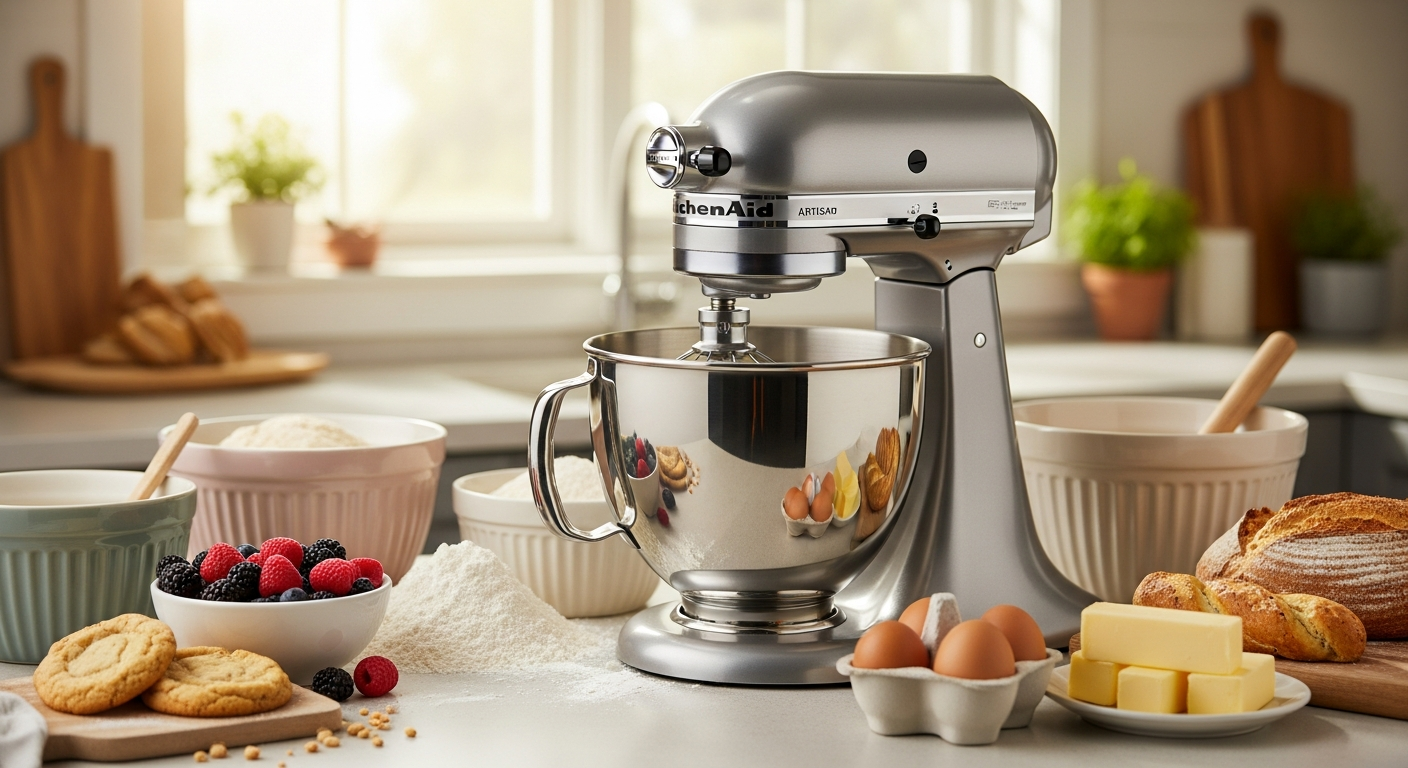
KitchenAid Artisan 5-Quart Stand Mixer with optional attachments displayed on kitchen counter

Beyond Basic Mixing: Unlocking the Full Potential of Your KitchenAid Artisan 5-Quart Stand Mixer

Most home cooks only scratch the surface of what their KitchenAid Artisan 5-Quart Stand Mixer can actually do. I've watched countless people use this powerhouse appliance for nothing more than cookie dough and bread, completely unaware that they're sitting on a multi-tasking kitchen workhorse. The truth is, the Artisan mixer can revolutionize your cooking and baking workflow—if you know how to harness its full capabilities.

The KitchenAid Artisan mixer has earned its legendary status for good reason. With its robust 325-watt motor, 10-speed precision control, and tilt-head design, this appliance has become the gold standard in home kitchens. But here's what separates casual users from true enthusiasts: understanding that the three standard attachments—the flat beater, dough hook, and wire whip—are just the beginning of what this machine can accomplish.

Discover the full potential of the KitchenAid Artisan 5-Quart Stand Mixer today.

Expanding Your Mixer's Arsenal – Optional Attachments That Change Everything

The standard configuration of your Artisan mixer is powerful on its own, but the accessory ecosystem is where this appliance truly becomes a culinary multi-tool. Each optional attachment opens new cooking possibilities and expands what you can accomplish in your kitchen.

Meat Grinder Attachment

Transform your mixer into a butcher shop with the meat grinder attachment. You'll grind fresh ground beef, pork, and poultry with superior texture and flavor control compared to pre-ground supermarket options. This attachment gives you the precision to blend custom meat blends for burgers, sausages, and meatloaf with exactly the fat content and seasoning you prefer.

Pasta-Making Accessories

Create fresh fettuccine, pappardelle, and ravioli with the pasta roller and cutter attachments. Once you experience homemade pasta, the dried supermarket varieties seem like a poor substitute. These attachments produce sheets of silky dough that your mixer has already kneaded to perfection, eliminating the manual rolling and cutting that makes pasta-making tedious.

Food Grinder for Vegetables

Shred cheese, grind nuts, and process vegetables with precision using the food grinder attachment. This opens possibilities for fresh vegetable dishes, homemade nut butters, and precisely shredded ingredients that hand tools simply can't match in consistency or speed.

Spiralizer Attachment

Create vegetable noodles, julienne cuts, and ribbon pasta alternatives. The spiralizer turns zucchini, carrots, and other vegetables into beautiful strands for fresh, low-carb pasta dishes and elegant plating.

Grain Mill Attachment

Grind whole grains into fresh flour for artisan bread baking. There's a remarkable difference between freshly milled flour and commodity flour from the shelf. The grain mill attachment lets you experiment with heritage grain varieties and create flour blends tailored to specific bread styles.

Citrus Juicer

Extract juice from lemons, limes, and oranges with minimal effort. This attachment makes fresh juice production effortless and consistent, whether you're squeezing juice for cooking or creating fresh beverages.

Sausage Stuffer

Make homemade sausages with custom seasonings and meat blends. This attachment transforms ground meat into perfectly stuffed sausages without the manual labor of filling casings by hand.

Compatibility Considerations

Understanding which attachments work with your specific Artisan model matters before investing. Some attachments are universal, while others require specific power hub configurations. Check your mixer's documentation to ensure compatibility before purchasing optional accessories.

Investment ROI

Determining which attachments offer the best value for your cooking style requires honest assessment of your kitchen goals. If you make pasta weekly, the pasta attachments pay for themselves quickly. If you've never ground meat or made fresh sausage, start with the most frequently used attachments and expand your collection as your skills and interests develop.

Storage Solutions

Organizing and storing multiple attachments for easy access prevents the frustration of having great tools you never use because they're difficult to reach. Dedicated drawer organizers, wall-mounted magnetic strips, or small appliance storage solutions keep your attachments visible and accessible.

Explore the full range of KitchenAid Artisan attachments and accessories now.

Mastering Advanced Mixing Techniques – From Dough to Delicate Emulsions

Owning a powerful stand mixer is one thing; using it effectively is another. The techniques that separate professional results from mediocre ones often involve understanding how your machine works and matching that knowledge to specific recipes.

Planetary Mixing Action Explained

The unique motion of the KitchenAid's planetary mixing action ensures thorough ingredient incorporation that hand mixing or lesser stand mixers simply cannot achieve. The attachment rotates on its own axis while also moving around the bowl, creating multiple points of contact with ingredients. This simultaneous dual-motion guarantees that every ingredient reaches the mixing attachment multiple times per rotation, eliminating the dead spots that plague other mixer designs.

Speed Settings for Different Tasks

Matching the right speed to specific recipes and ingredients transforms your results. Lower speeds (1-3) work best for initially combining ingredients and preventing splashing. Medium speeds (4-6) handle most mixing tasks for cakes, cookies, and general baking. Higher speeds (7-10) work for whipping air into batters, creaming butter with sugar, and incorporating air into egg whites for meringues.

Hydration Management

Controlling water content in bread doughs for optimal texture requires understanding how your mixer develops gluten. A dough that feels slightly sticky on your hand is usually properly hydrated. You can adjust hydration during mixing by adding water a tablespoon at a time if your dough seems too stiff, or adding flour if it's too wet.

Gluten Development

Using the dough hook to build structure in yeast breads without overworking demands attention to mixing time and dough behavior. Most bread doughs require 8-10 minutes of mixing at medium speed to develop adequate gluten structure. The dough should transition from shaggy and rough to smooth and elastic. Stop mixing when the dough clears the sides of the bowl and begins to form a ball, rather than mixing by time alone.

Whipping Techniques

Creating stable meringues, whipped cream, and mousse with the wire whip requires understanding how air incorporation works. For meringues, start with room-temperature eggs and clean, grease-free bowls. Begin whipping on medium speed, gradually increasing to medium-high as the mixture becomes frothy. Add sugar gradually once soft peaks form, continuing to whip until stiff, glossy peaks develop.

Temperature Control During Mixing

Preventing butter from melting or dough from warming excessively requires strategic planning. For creaming butter and sugar, use softened butter (around 68-70°F) that's still slightly cool to the touch. If your kitchen is hot, briefly chill your mixing bowl before starting. For bread doughs, use water at around 85-90°F to compensate for friction heat generated during mixing.

Mixing Order Significance

Why ingredient sequencing matters for consistent results often comes down to how your mixer blends components. Creaming butter and sugar first creates the structure that holds air in cakes. Mixing dry ingredients separately prevents overmixing wet ingredients once they're combined. Adding eggs gradually rather than all at once ensures proper emulsification.

Scraping and Monitoring

Techniques for ensuring even distribution without stopping the mixer involve strategic pauses to scrape the bowl sides. After the initial mixing phase, pause to scrape down the bowl and any ingredients clinging to the bottom. Resume mixing for the final 30 seconds to incorporate the scraped-down portions.

Batch Scaling

Adjusting recipes to maximize the 5-quart bowl capacity lets you make the most of your mixer's power. A single batch can mix dough for 9 dozen cookies or 4 loaves of bread. When scaling recipes upward, increase ingredients proportionally but verify that your mixture doesn't exceed three-quarters of the bowl depth.

Troubleshooting Common Mixing Problems

Addressing splashing, uneven mixing, and motor strain requires understanding what each symptom indicates. Splashing usually means your speed is too high or you've overfilled the bowl—reduce speed and refill if needed. Uneven mixing suggests you need to scrape the bowl more frequently. Motor strain sounds like the motor slowing or struggling—this indicates you've exceeded the mixer's capacity or are mixing something too dense.

Recipes That Showcase Your Mixer's True Power

The right recipes demonstrate why serious cooks invest in stand mixers. These recipes require the power and consistency that only machines like the Artisan can deliver effectively.

Artisan Bread Varieties

Sourdough, focaccia, ciabatta, and enriched doughs demand serious mixing power that hand mixing simply cannot provide. The dough hook develops gluten efficiently, creating the open crumb structure that characterizes great artisan bread. Your mixer handles sticky, wet doughs that would be impossible to knead by hand.

Complex Cake Batters

Multi-component cakes requiring precise creaming and folding techniques benefit enormously from your mixer's consistency. The planetary mixing action ensures even distribution of ingredients, creating uniform cake texture that hand mixing struggles to achieve.

Batch-baking strategies for 9 dozen cookies without multiple batches showcase your mixer's capacity and power. Mix a single large batch, portion the dough onto multiple baking sheets, and bake sequentially. Your mixer handles the large volume that would exhaust hand mixing.

Pasta Dough Mastery

Fresh egg pasta, flavored doughs, and whole-grain variations emerge from your mixer with perfectly developed gluten. The dough hook kneads pasta dough to silky smoothness in minutes, a process that takes considerable effort by hand.

Pastry Cream and Custards

Creating silky, lump-free fillings with consistent results requires thorough mixing and air incorporation. Your mixer whips these delicate preparations to the right consistency without overworking them.

Homemade Nut Butters

Grinding nuts into creamy spreads with the meat grinder attachment transforms raw nuts into smooth, rich pastes. The continuous action of the grinder attachment handles this task far more effectively than food processors.

Sausage and Forcemeat Preparation

Creating restaurant-quality charcuterie at home becomes achievable with the meat grinder attachment. Mix ground meat with seasonings and binders using the flat beater, then stuff with the sausage attachment.

Whipped Desserts

Pavlovas, mousse, and chiffon cakes requiring stable foam structures depend on the wire whip's ability to incorporate and hold air. Your mixer creates those structures reliably and consistently.

Mashed Potatoes and Vegetable Purées

Achieving perfectly smooth textures at scale for side dishes and soups showcases your mixer's power for everyday cooking beyond baking.

Cocktail Hour Applications

Whipping cream, making fresh syrups, and infusing spirits for homemade liqueurs all benefit from your mixer's capabilities. Fresh whipped cream takes minutes with the wire whip.

Comparing the KitchenAid Artisan Against Competitors – Why It Dominates

The KitchenAid Artisan stands apart from competing stand mixers across multiple dimensions, making it worth the investment for serious home cooks.

Motor Power Comparison

The 325-watt motor delivers performance versus other stand mixer brands that often fall short. Most competing stand mixers feature 250-300 watts, translating to less power for demanding tasks like kneading dense bread doughs or grinding meat.

Bowl Capacity Analysis

The 5-quart capacity against mid-range and commercial alternatives positions the Artisan as the practical choice for home use. A 5-quart bowl handles recipes for multiple people without exceeding the machine's practical capacity, unlike smaller 4-quart models that require scaling recipes down.

Speed Range and Precision

Ten-speed settings versus limited options on budget models give you control that matters. Budget stand mixers often feature only 5-6 speeds, limiting your ability to match speed to task. The Artisan's 10 speeds let you fine-tune mixing for optimal results across applications.

Attachment Ecosystem

KitchenAid's extensive accessory library versus limited third-party support means your investment in optional attachments pays off. The attachment ecosystem continues to expand, while competing brands offer limited accessory options that lock you into their proprietary systems.

Build Quality and Longevity

All-metal construction versus plastic components in competing brands determines whether your mixer becomes a decades-long investment or needs replacement within years. The Artisan's die-cast metal housing, gears, and internal components resist wear far better than plastic-heavy competitors.

Noise Level Assessment

Real-world sound comparison during various mixing tasks shows the Artisan performs respectably. While no stand mixer is silent, the Artisan's noise level remains manageable at all speed settings, unlike some competitors that become uncomfortably loud at higher speeds.

Aesthetic and Color Options

Design versatility and kitchen integration possibilities exceed most competitors. KitchenAid offers over 20 color options, from classic white and red to seasonal pastels and metallics. This range lets your mixer become a design statement rather than appliance camouflage.

Price-to-Value Proposition

Long-term investment analysis over 10+ years of use favors the Artisan. While the $300-450 initial investment seems high, the per-use cost drops dramatically over years of service. Competing stand mixers at lower price points often require replacement within 5-7 years, making the Artisan more economical over time.

Customer Satisfaction and Reliability Ratings

Warranty coverage and brand reputation consistently rank the Artisan among the highest-rated stand mixers. Most owners report satisfaction with durability and performance, with many using mixers inherited from family members.

Resale Value

Secondary market performance and generational hand-down potential make the Artisan attractive for resale. Used Artisan mixers command strong prices, reflecting their reputation for longevity and continued functionality.

Maintenance and Longevity – Keeping Your Mixer Running Strong for Decades

Proper care determines whether your Artisan mixer lasts 10 years or 30 years. The robust construction means maintenance is straightforward, but consistency matters.

Regular Cleaning Protocols

Proper care for the bowl, attachments, and exterior surfaces keeps your mixer hygienic and functioning smoothly. Wash the stainless steel bowl and all removable attachments in hot soapy water after each use. Dry thoroughly before storing to prevent water spots. Wipe the mixer's exterior with a soft, damp cloth. Avoid harsh abrasives that scratch the finish.

Motor Maintenance

Preventing overheating and strain through proper usage patterns extends motor life significantly. Never exceed the recommended mixing time for tasks—most recipes complete within 10 minutes. Allow the motor to cool for at least 15 minutes if you're mixing multiple batches consecutively. Never force the mixer to handle ingredients that exceed its capacity, as the strain will eventually damage internal components.

Lubrication Schedules

When and where to apply food-safe lubricants depends on your mixer's design. Most modern Artisan models are sealed and require no user lubrication. If yours requires maintenance, apply food-safe lubricant to the shaft where it enters the motor housing annually, following your manual's specific instructions.

Bearing and Gear Care

Understanding the internal mechanics that require attention helps you recognize when professional service is needed. The planetary mixing head contains sealed bearings that rarely require attention. If you notice any grinding sounds or unusual resistance, contact KitchenAid for service rather than attempting internal repairs.

Attachment Inspection

Identifying wear and when to replace worn components prevents damage to your mixer and the foods you're preparing. Inspect the flat beater, dough hook, and wire whip regularly for cracks or excessive wear. If the coating flakes off the beater, replace it rather than continuing to use it. Check the attachment shaft for damage that might cause it to jam.

Electrical Safety Checks

Ensuring cord integrity and proper grounding protects you and extends equipment life. Examine the electrical cord regularly for cracks, fraying, or exposed wires. If damage appears, have the cord professionally replaced rather than attempting repairs. Ensure the outlet you're using is properly grounded and doesn't have other high-demand appliances running simultaneously.

Storage Best Practices

Protecting your mixer during off-season or when not in regular use preserves its condition. Store it in a dry location where it won't be exposed to moisture or temperature extremes. Keep the bowl and attachments in a designated drawer or storage container to prevent loss. If storing for extended periods, cover the mixer loosely with a cloth to prevent dust accumulation.

Troubleshooting Common Issues

Addressing grinding noises, speed inconsistencies, or attachment problems quickly prevents minor issues from becoming major repairs. Grinding noises usually indicate debris trapped between internal components—stop immediately and contact service. Speed inconsistencies might mean the speed control is failing—test with a known recipe to confirm. Attachment jamming might indicate foreign material or improper attachment installation.

Warranty Coverage Details

Understanding what's included and how to file claims matters if problems develop. The standard warranty covers defects in materials and workmanship for one year from purchase. Extended warranties are available at additional cost. Keep your receipt and warranty documentation in an accessible location should you need to file a claim.

Generational Ownership

Stories of mixers lasting 20, 30, and 40+ years with proper care inspire confidence in your investment. The all-metal construction means a properly maintained Artisan mixer can outlast the person who purchased it, becoming a family heirloom passed to children and grandchildren.

Real-World Kitchen Integration – Making Space and Making It Count

A 26-pound appliance measuring 14 inches high, 8.75 inches wide, and 14 inches deep demands thoughtful placement in your kitchen. Strategic positioning transforms your mixer from awkward bulk to essential counter presence.

Counter Space Optimization

Strategic placement for accessibility without kitchen clutter requires identifying your mixer's ideal home. Position it on the counter where you do most of your baking and cooking work, within arm's reach of your main mixing and prep zones. Avoid placing it in high-traffic areas where people might bump it while walking past. If counter space is limited, consider a rolling cart that positions your mixer at proper working height while allowing you to move it aside when not in use.

Cord Management Solutions

Organizing cables for a clean, professional appearance prevents your kitchen from looking cluttered. Use a cable management clip to gather the power cord and attach it neatly to the back of your mixer or the underside of your countertop. Avoid draping cords across counter surfaces where they create visual clutter.

Color Selection Strategy

Choosing finishes that complement your kitchen design makes your mixer an aesthetic asset rather than an eyesore. If your kitchen features stainless steel appliances, select metallic colors like silver or brushed nickel. For warmer kitchens with wood tones, consider red, cream, or warm pastels. Neutral colors like white or black integrate with virtually any kitchen style.

Accessibility Considerations

Height and reach factors for different users ensure everyone in your household can operate the mixer safely. Position the mixer at a height where the bowl sits at approximately waist level when you're standing. This positioning reduces strain on your shoulders and back during mixing tasks. If multiple household members use the mixer, compromise on a height that works reasonably well for everyone.

Storage Alternatives

Pantry shelving, cabinet placement, and appliance garage solutions accommodate households where counter space is precious. A sturdy cabinet shelf can hold your mixer if you have upper cabinets deep enough to accommodate it without blocking visibility. Appliance garages with roll-up doors keep your mixer hidden when not in use while remaining accessible.

Workflow Efficiency

Positioning your mixer for seamless recipe execution means placing it near your ingredient storage and prep areas. Keep your most-used attachments in a drawer immediately below or adjacent to your mixer. Store your measuring implements and mixing bowls within arm's reach of your mixer to minimize movement during recipes.

Family Kitchen Dynamics

Sharing mixer access in multi-cook households requires designating your mixer's home space clearly. Establish a system for storing attachments so anyone using the mixer can locate the specific attachment they need without searching. Label storage drawers if necessary to ensure attachments return to their designated locations.

Small Kitchen Adaptations

Making the Artisan work in compact spaces challenges even experienced cooks, but solutions exist. A narrow rolling cart placed perpendicular to the counter saves space by positioning the mixer's depth along the cart rather than extending into available counter space. Wall-mounted shelving above the mixer provides vertical storage for attachments and accessories.

Display Opportunities

Showcasing your mixer as a kitchen statement piece elevates it from appliance to décor element. If your mixer is a striking color, position it prominently on your counter in a location where visitors see it when entering your kitchen. The iconic KitchenAid design photographs beautifully, making your mixer appropriate for open shelving or display on kitchen islands.

Transition Planning

Moving from hand mixing to stand mixer workflows requires adjusting your recipe habits and technique. Plan for a learning period where you experiment with your mixer's settings and timing. Don't attempt complex recipes immediately; begin with straightforward recipes while you develop familiarity with how your mixer handles various ingredients and mixes.

The Investment Case – Understanding True Cost of Ownership

The KitchenAid Artisan mixer represents a significant purchase, but assessing total cost of ownership reveals why many households consider it a worthwhile investment.

Initial Purchase Price

Current market range and seasonal sales opportunities allow you to acquire your mixer strategically. The standard retail price typically ranges from $300-450 depending on the specific model and color selected. However, seasonal sales, especially around the winter holidays and early summer, often feature discounts of 10-20%. Watching for these sales opportunities can save $30-90 on your purchase.

Cost Per Use Over Time

Breaking down the $300-450 investment across years reveals how the per-unit cost diminishes. Assume a $375 average purchase price and 15 years of ownership. If you use your mixer twice weekly for baking and cooking projects, that's roughly 1,560 uses over 15 years. The cost per use drops to approximately $0.24 per use—a negligible amount considering the quality of results and time saved.

Attachment Expenses

Budget planning for optional accessories allows you to expand functionality strategically. Popular optional attachments typically cost $50-150 each. The meat grinder attachment and pasta-making set represent popular additions priced around $100 each. Rather than purchasing all attachments immediately, identify which ones match your cooking style and budget, then gradually expand your collection.

Energy Consumption

Comparing operational costs to other kitchen appliances reveals that stand mixer usage costs very little. The 325-watt motor running for an average of 10 minutes per use consumes approximately 0.05 kilowatt-hours. At typical electricity rates of $0.12 per kilowatt-hour, each use costs roughly $0.006—essentially negligible.

Replacement Parts Availability

Long-term availability of repair components determines whether your mixer can be repaired years into ownership. KitchenAid maintains robust support for repair parts, making replacement bowls, attachments, and internal components readily available. Even older models from 15-20 years ago can often be serviced with parts specifically manufactured for those units.

Resale and Trade-In Value

Recovering investment through secondary markets provides an exit strategy if your needs change. A used Artisan mixer typically sells for 40-60% of its original purchase price, depending on age, condition, and color. Desirable colors and newer models command higher resale prices. If you purchase a $375 mixer and use it for five years before selling, you might recover $150-225, reducing your net investment to $150-225.

Comparison to Professional Alternatives

Why home bakers don't need commercial equipment becomes clear when you compare the Artisan to commercial stand mixers. Commercial units cost $2,000-5,000 and require three-phase electrical systems that most homes don't have. The Artisan delivers 90% of commercial performance at 10% of the cost, making it the obvious choice for home use.

Opportunity Cost Analysis

Time saved versus manual mixing methods justifies the investment immediately. Hand-mixing bread dough requires 15-20 minutes of sustained, exhausting effort. Your mixer accomplishes the same work in 8-10 minutes with zero physical exertion. Over a year of weekly bread baking, your mixer saves you roughly 7 hours of labor—time you can invest in other activities or enjoy more fully.

Generational Value

Passing down a working appliance to family members transforms it from a purchase into a legacy. Many cooks actively use mixers inherited from mothers and grandmothers. This generational aspect means your initial investment doesn't end with your use—it continues to deliver value for decades beyond your ownership.

Justification for Different Budgets

Making the case for various income levels requires honest assessment of your priorities and kitchen ambitions. For serious home bakers and cooks, the Artisan is non-negotiable—the investment pays for itself through time savings and superior results. For casual cooks who mix occasionally, the investment requires more careful consideration. However, even occasional users typically find that their mixing frequency increases dramatically once they experience the convenience and quality of the Artisan, making the investment worthwhile.

The Mixer Legacy: Your Kitchen's Most Valuable Player

The KitchenAid Artisan 5-Quart Stand Mixer transcends its role as a simple appliance—it's a gateway to culinary possibilities you might never have considered. Whether you're grinding fresh sausage, creating silky pasta dough, or whipping delicate meringues, this machine delivers consistent, professional-quality results that elevate your cooking and baking. The optional attachments expand its functionality exponentially, while the legendary durability means your investment today becomes a kitchen heirloom tomorrow.

What truly sets the Artisan apart is its ability to handle the demanding tasks that make you hesitate to cook. That ambitious sourdough project, the dinner party where you're making everything from scratch, the batch-cooking session that would exhaust you by hand—your mixer transforms these moments from intimidating to achievable. The 325-watt motor, planetary mixing action, and precision speed control work together seamlessly, delivering results that rival professional equipment at a fraction of the cost.

Your next step is deciding which attachments align with your cooking ambitions and then committing to experimentation. Start with recipes that showcase the mixer's power, master the techniques that separate good results from exceptional ones, and watch as this single appliance becomes indispensable to your kitchen routine. The KitchenAid Artisan isn't just a purchase—it's an investment in your culinary confidence and a tool that will serve you, and possibly your children, for decades to come.

Get your KitchenAid Artisan 5-Quart Stand Mixer and start your culinary journey today.


Comments

Leave a Reply

Your email address will not be published. Required fields are marked *