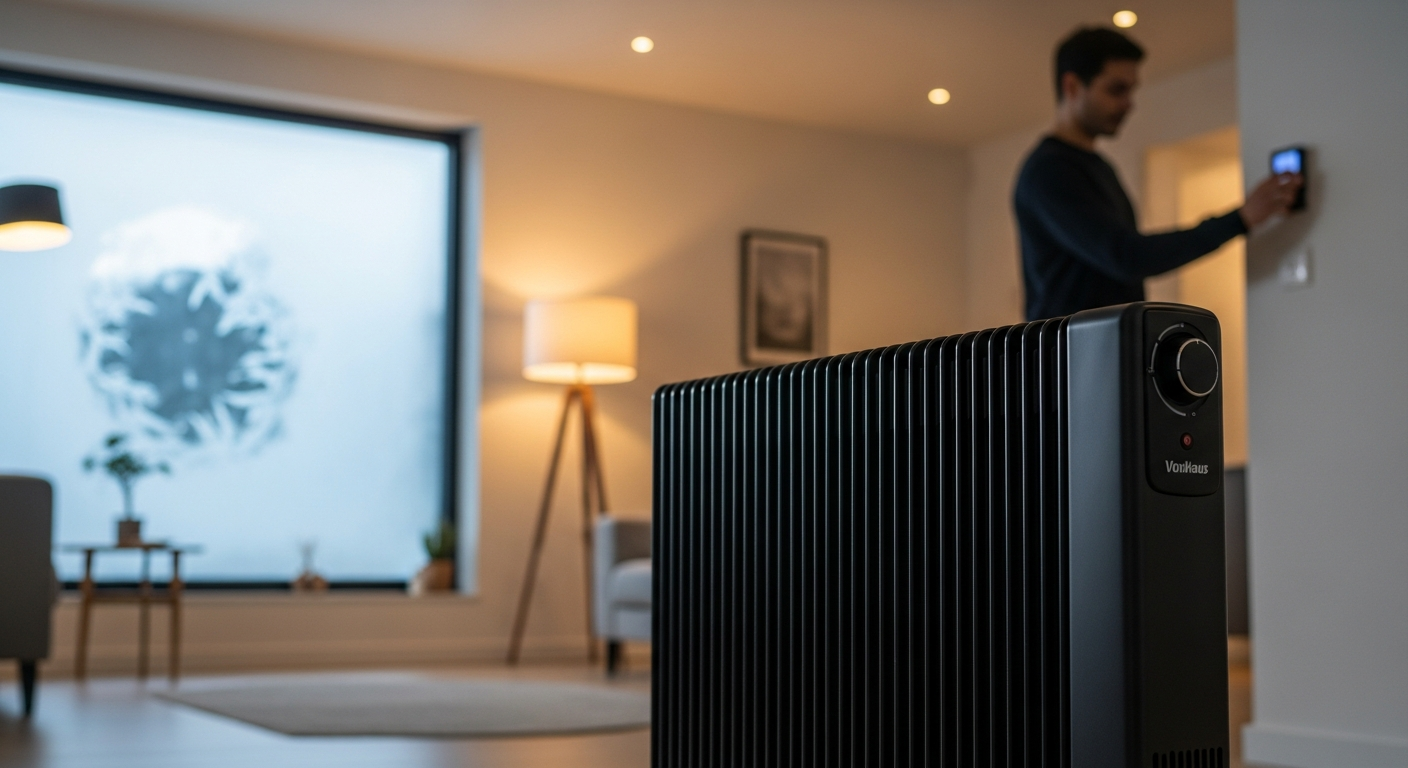
Over 40% of UK households report that heating costs have become their biggest winter expense. When thermostats start climbing and energy bills follow suit, most people assume there's little choice but to accept the financial burden. The reality tells a different story—one that's being discovered by increasingly budget-conscious homeowners across the country.
Room-by-room heating has quietly become the game-changer for those willing to think differently about how they warm their spaces. Instead of cranking up central heating for your entire property, targeted heating solutions let you warm only the spaces you actually use. This approach fundamentally shifts the economics of home comfort, turning what was once considered a luxury into a practical necessity for cost management.
The VonHaus 2000W 9-Fin Oil Filled Radiator represents a smart, practical approach to this challenge—combining efficiency with affordability in a compact, portable package. This guide walks you through everything you need to know about maximizing your heating efficiency and minimizing wasted energy. Discover how the VonHaus radiator can transform your winter comfort and reduce your energy costs.
Room-by-Room Heating: Why Energy-Conscious Homeowners Are Making the Switch
How targeted heating reduces overall energy consumption compared to whole-house heating
Central heating systems warm your entire home simultaneously, regardless of which rooms are actually occupied. A bedroom sitting empty during work hours still consumes energy to maintain temperature. A spare room used occasionally still receives heat. This inefficiency compounds throughout the day and across seasons, resulting in significant energy waste.
Targeted heating changes this equation entirely. When you heat only the spaces in active use, you eliminate waste from unoccupied areas. A 25-square-meter room can be maintained at comfortable temperatures while other spaces remain unheated. The energy savings accumulate quickly—studies show that room-by-room heating can reduce overall consumption by 10-30% depending on how many spaces you've traditionally heated.
The cost difference between heating a single room versus central heating operation
Running a central heating system costs considerably more than operating a portable electric heater in a single room. Central boilers require fuel, maintenance, and continuous operation to maintain whole-house temperatures. A typical UK household spends £150-250 monthly on heating during winter months when running central heating continuously.
A portable oil-filled radiator operating on its 2000W maximum setting costs approximately 50p per hour to run. Most users employ lower settings (800W or 1200W) and thermostat control, reducing actual hourly costs to 20-30p. This means heating a single room for 8 hours daily costs roughly £50-70 monthly—substantially less than maintaining central heating for the entire property.
Real-world scenarios where supplemental heating delivers maximum savings
Bedrooms represent the most compelling case for supplemental heating. Many households maintain lower overnight temperatures while sleeping comfortably under duvets, then use a portable heater only during morning routines. A bedroom heated from 6-8am requires far less energy than maintaining that temperature throughout the day.
Home offices have emerged as another major opportunity. Remote workers spend 8+ hours daily in a single room. Heating that specific space instead of the entire house creates immediate financial advantages. The same applies to spare rooms, studies, or hobby spaces occupied intermittently. Parents often use radiators to warm nurseries during nighttime hours while keeping other areas unheated.
The environmental impact of reducing energy waste through selective room heating
Beyond personal finances, room-by-room heating reduces your household's carbon footprint significantly. Heating accounts for approximately 40% of UK residential carbon emissions. By reducing energy consumption by 20%, a typical household eliminates roughly 1-2 tonnes of CO2 emissions annually.
When multiplied across millions of households, this approach delivers meaningful environmental impact. Choosing efficient room heating contributes to broader climate goals while simultaneously reducing your own utility bills. The VonHaus radiator embodies this dual benefit—financial savings paired with environmental responsibility.
Understanding the VonHaus 2000W 9-Fin Design: Engineering That Delivers Warmth Efficiently
The ThermoDynamic engineering behind the 9-fin configuration
The VonHaus 9-fin design isn't arbitrary—it reflects deliberate engineering focused on maximizing thermal efficiency. Each additional fin increases the surface area through which heat transfers from the oil reservoir to surrounding air. Nine fins provide substantially more contact area than basic 5 or 7-fin models.
ThermoDynamic engineering specifically refers to optimizing heat distribution patterns. The fins are spaced and configured to create natural convection currents. Warm air rises along the radiator surfaces while cooler air falls, establishing circulation patterns that distribute warmth throughout the room more effectively than stationary heat sources.
How increased surface area accelerates heat distribution and reduces warm-up time
More surface area means faster heat transfer. An oil-filled radiator with 5 fins might require 15-20 minutes to reach comfortable room temperatures. The 9-fin VonHaus typically achieves noticeable warmth within 8-12 minutes. This isn't merely convenient—it directly impacts energy efficiency.
Faster warm-up means you reach your desired temperature more quickly, then maintain it using the thermostat. The radiator doesn't need to run at maximum power settings for extended periods. This translates to practical energy savings that accumulate daily.
The three power settings (800W, 1200W, 2000W) and when to use each one
The VonHaus offers three distinct power levels, each suited to different scenarios. The 800W setting functions well for gentle background heating or pre-warming a space before extended occupancy. This setting uses minimal energy while maintaining baseline temperature.
The 1200W setting represents the optimal balance point for most situations. It provides substantive warmth without maximum energy consumption, making it suitable for maintaining comfort throughout a workday or evening. Most users find this setting covers their typical heating needs.
The 2000W maximum setting kicks in when rapid temperature increase is desired—during cold mornings or when a room hasn't been heated recently. Users typically run at this level for 30-60 minutes until reaching their target temperature, then reduce to 1200W or 800W for maintenance.
Why oil-filled radiators maintain warmth longer than other electric heater types
Oil-filled radiators operate on thermal inertia principles. The internal oil reservoir absorbs heat from electrical elements and holds it. Even after powering down, the radiator continues releasing stored warmth for extended periods. This characteristic fundamentally differs from fan heaters, which produce immediate heat but release it instantly when switched off.
This extended heat release means room temperatures don't plummet the moment the thermostat reaches its target and the radiator powers down. The space maintains warmth longer, reducing how frequently the heater cycles on and off. Fewer on-off cycles translate directly to lower energy consumption.
Smart Temperature Control: Achieving Comfort Without Wasting Energy
How the adjustable thermostat dial prevents overheating and unnecessary power consumption
The VonHaus thermostat functions as your energy management tool. Rather than running continuously at maximum power, the thermostat monitors room temperature and cycles the heater on and off automatically. When room temperature drops below your set point, the radiator activates. When temperature reaches your target, it powers down.
This automatic cycling prevents overheating—a common energy waste where spaces become uncomfortably warm because the heating simply won't stop. Overheated rooms force users to open windows, literally throwing warmth (and money) outside. The thermostat prevents this scenario by maintaining precise temperature ranges.
Setting optimal temperature ranges for different times of day and seasons
Temperature needs fluctuate throughout the day. Morning routines might require 19-20°C, workday periods might be comfortable at 17-18°C, and evening relaxation often calls for 20-21°C. Instead of maintaining one temperature continuously, you can adjust the thermostat dial as your needs change.
Nighttime heating requires lower settings—many people sleep comfortably at 16-17°C under duvets. This means overnight heating can run at 800W with thermostat set lower, consuming minimal energy while preventing bedroom chill. Seasonal adjustments work similarly. Spring and autumn require less heating than deepest winter, so lowering thermostat settings during milder periods reduces consumption further.
The role of automatic overheat protection in preventing energy waste
The VonHaus incorporates automatic overheat protection—a thermal cut-out that disconnects power if internal components exceed safe temperatures. This safety feature simultaneously prevents energy waste. If a malfunction caused overheating, it would consume energy indefinitely while potentially creating hazards.
The thermal cut-out stops this scenario cold. The radiator shuts down before unsafe temperatures develop, protecting both your home and your electricity bill. This represents safety and efficiency working in concert.
Pairing the VonHaus with smart scheduling for maximum efficiency gains
Modern users increasingly recognize that combining portable heaters with scheduling strategies maximizes savings. Setting the radiator to activate an hour before morning routines means your room reaches comfortable temperature exactly when needed, rather than warming empty space throughout the night.
Evening adjustments work similarly. A timer set to power down an hour after bedtime means you're not heating an unoccupied room all night. These scheduling approaches require minimal effort but deliver noticeable savings across heating seasons. Take control of your energy consumption with the VonHaus 2000W Oil Filled Radiator and smart temperature management.
Safety Features That Protect Your Home and Family
How the automatic tip-over switch prevents accidents with children and pets
Households with young children or curious pets face risks from traditional heaters. The VonHaus includes an automatic tip-over switch that immediately disconnects power if the radiator is knocked over or tilted beyond its safe operating angle. This means a playful toddler or rambunctious pet can't accidentally tip the heater and create fire hazards.
The tip-over switch operates independently of user awareness. You don't need to monitor constantly or rush to respond to accidents. The mechanical safety mechanism handles the situation instantaneously. For families, this transforms a portable heater from potential liability into genuinely safe equipment.
Understanding thermal cut-out protection and why it matters for long-term safety
Thermal cut-out protection represents a critical safety redundancy. The heater's internal components generate substantial heat during operation. If cooling systems fail or blockages develop, temperatures could rise dangerously high. The thermal cut-out detects this dangerous scenario and disconnects power automatically.
This protection matters beyond immediate fire prevention. Overheating components can degrade significantly if allowed to continue operating, leading to electrical failures or component damage. The thermal cut-out prevents these scenarios, extending the radiator's operational lifespan while preventing hazards.
Built-in safeguards that prevent fire hazards and electrical failures
The VonHaus incorporates multiple layers of protection beyond the primary safety switches. Electrical components are properly insulated and rated for continuous operation. The heating elements are designed with safety margins preventing them from reaching dangerous temperatures under normal circumstances.
The oil reservoir itself serves a safety function. Unlike exposed heating coils in fan heaters, the VonHaus oil-filled design means hot components aren't accessible to accidental contact. Users can't burn themselves on exposed heating elements because they don't exist in this design. The entire external surface reaches warm but manageable temperatures, not dangerously hot levels.
Industry standards and certifications that back the VonHaus safety design
The VonHaus 2000W radiator meets established electrical safety standards required for consumer products throughout Europe. These certifications verify that the heater has been independently tested and confirmed to meet rigorous safety benchmarks. Manufacturing processes, materials, and electrical systems all undergo detailed evaluation.
These certifications represent more than regulatory compliance. They indicate that the design team prioritized safety throughout development. Independent testing organizations wouldn't approve the radiator if any significant hazards existed. For consumers, certifications provide confidence that the equipment functions safely even during extended operation.
Your Path to Warmer Winters and Lower Energy Bills
The VonHaus 2000W 9-Fin Oil Filled Radiator Heater stands out because it tackles the real problem: heating your entire home when you only need warmth in one or two rooms. This simple shift in approach transforms energy bills from a source of stress into something genuinely manageable.
The combination of efficient 9-fin design, intelligent thermostat control, and robust safety features creates a heater that works as hard as your family does to keep costs down. Whether you're heating a bedroom, home office, or spare room, this radiator delivers consistent warmth without the noise or dryness of fan heaters. The portability means you're never locked into one solution—move it where it's needed most.
The financial case for room-by-room heating has only strengthened as energy costs continue rising. Rather than accepting ever-climbing heating bills as inevitable, you can take concrete action through targeted solutions. The VonHaus represents an investment that actually pays for itself through reduced energy consumption, typically recovering its purchase cost within a single heating season.
Ready to reclaim control over your heating costs? Start your journey to warmer winters with the VonHaus 2000W 9-Fin Oil Filled Radiator today.

Leave a Reply