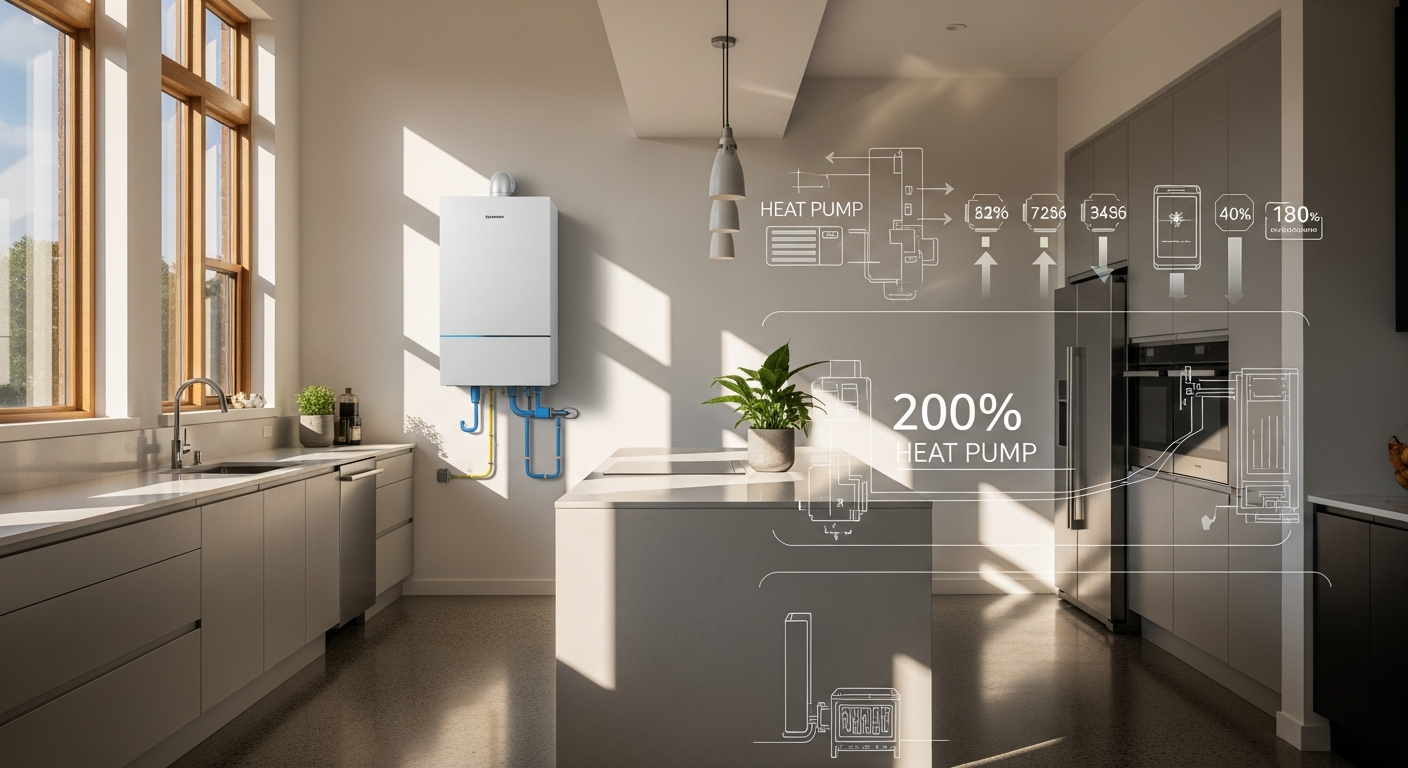
Replacing an entire home heating system isn’t always necessary when you want to reduce your reliance on gas. A hybrid system offers another approach by combining an electric heat pump with an existing boiler.
Feenstra hybrid heat pump systems are designed around this concept. The heat pump can handle part of your home’s heating demand, while the boiler remains available when additional heating is required.
For homeowners considering an upgrade, understanding how the two systems work together is an important first step.
Understand How Hybrid Heating Works
A hybrid system uses an air-source heat pump to collect heat from the outside air and transfer it into your home’s heating system.
The heat pump generally takes priority when operating conditions are suitable. When additional heating is required, the boiler can supplement the system.
Automatic controls coordinate the two heating sources, reducing the need for you to switch between them manually.
The exact balance between heat pump and boiler operation depends on factors such as outdoor temperature, system settings, your home’s heat demand, and the equipment installed.
Check Your Existing Heating System
One attraction of hybrid heating is its ability to work alongside existing equipment.
However, that doesn’t mean every home or boiler is automatically compatible. Your current system should be assessed before deciding on an upgrade.
A professional evaluation may consider:
- Boiler type and condition
- Existing radiators or other heat emitters
- Pipework
- Home size and layout
- Insulation
- Available outdoor space
- Household heating habits
These factors can influence both system sizing and expected performance.
Choose the Appropriate Heat Pump Size
Bigger isn’t automatically better when selecting a heat pump.
A system should be sized around the heating requirements of the property. An undersized unit may rely more heavily on the boiler, while unnecessary capacity could increase the initial investment without providing a corresponding benefit.
Feenstra offers different system configurations, so a home assessment can help determine which option is appropriate.
Insulation deserves particular attention. A home that retains heat effectively generally places different demands on a heating system than a poorly insulated property.
Plan for the Outdoor Unit
An air-source heat pump requires an outdoor unit, making placement an important part of installation planning.
You’ll need enough space around the equipment for airflow and servicing. Noise should also be considered when selecting its position, particularly when neighboring properties are close.
Installation requirements differ between homes, so don’t assume that a system can simply be placed wherever space appears available.
Professional guidance can help identify an appropriate location.
Understand What Happens to Energy Use
A hybrid heat pump changes how your household consumes energy rather than eliminating energy use.
Because the heat pump runs on electricity, your electricity consumption may increase. At the same time, your gas consumption may decrease because the boiler has less heating work to perform.
The overall financial result depends on several variables, including:
- Current gas and electricity prices
- Insulation quality
- Household temperature settings
- Property size
- Weather conditions
- Heat pump efficiency
- How frequently the boiler is needed
For this reason, estimated savings should be treated as household-specific rather than guaranteed.
Check Current Costs and Subsidies
The cost of installing a hybrid heat pump can vary according to equipment, capacity, installation complexity, and any additional work required.
Government incentives may also change over time.
Before making a decision, request a current quotation and check which Dutch subsidy programs are presently available. Confirm eligibility requirements rather than assuming that a particular incentive or amount will automatically apply to your property.
This gives you a more realistic picture of your potential out-of-pocket investment.
Compare Hybrid and Fully Electric Heating
A hybrid system can be useful when you want to reduce gas use without immediately removing your boiler.
However, it doesn’t make a home completely gas-free. If eliminating natural gas is your main objective, a fully electric heat pump may deserve consideration.
The better option depends on your home’s insulation, heating system, available space, budget, and long-term renovation plans.
Ask the Right Questions Before Installation
Before committing to a Feenstra hybrid heat pump, ask for clear information about:
- Recommended system capacity
- Boiler compatibility
- Expected electricity and gas consumption
- Outdoor-unit placement
- Installation requirements
- Maintenance
- Warranty coverage
- Current subsidy eligibility
A personalized assessment is more useful than relying on generalized savings estimates.
Take a Practical Approach to Heating Upgrades
A Feenstra hybrid heat pump system can provide a gradual way to change how your home is heated while retaining an existing boiler as part of the setup.
Its suitability ultimately depends on your property rather than the technology alone.
Assess your insulation, current boiler, heating requirements, available installation space, costs, and current incentives before proceeding. With those details in hand, you can compare hybrid heating with other options and decide which approach makes the most sense for your home.
Leave a Reply