Facility managers across the UK are hemorrhaging money on lighting systems that haven't evolved in decades. Outdated incandescent and CFL technologies consume massive amounts of electricity, require constant maintenance, and fail without warning—often at the worst possible moment. The financial drain is real, measurable, and entirely preventable.
Modern commercial spaces demand lighting solutions that match their operational intensity. High-traffic warehouses, manufacturing floors, kitchens, and assembly lines need broad, consistent illumination that reaches every corner without creating dead zones. Traditional bulbs simply can't deliver this level of performance, which is why facility managers increasingly turn to purpose-built alternatives.
The JUNO LED 27W E27 4000K Corn Lamp addresses these challenges head-on. Its omnidirectional design, exceptional energy efficiency, and extended lifespan fundamentally change how facilities approach lighting budgets. This guide examines its technical advantages, calculates your actual return on investment, and shows why it's becoming the standard choice across commercial environments.
Explore the JUNO LED 27W E27 4000K Corn Lamp specifications and pricing today.
How Corn Lamp Technology Delivers Superior Light Distribution
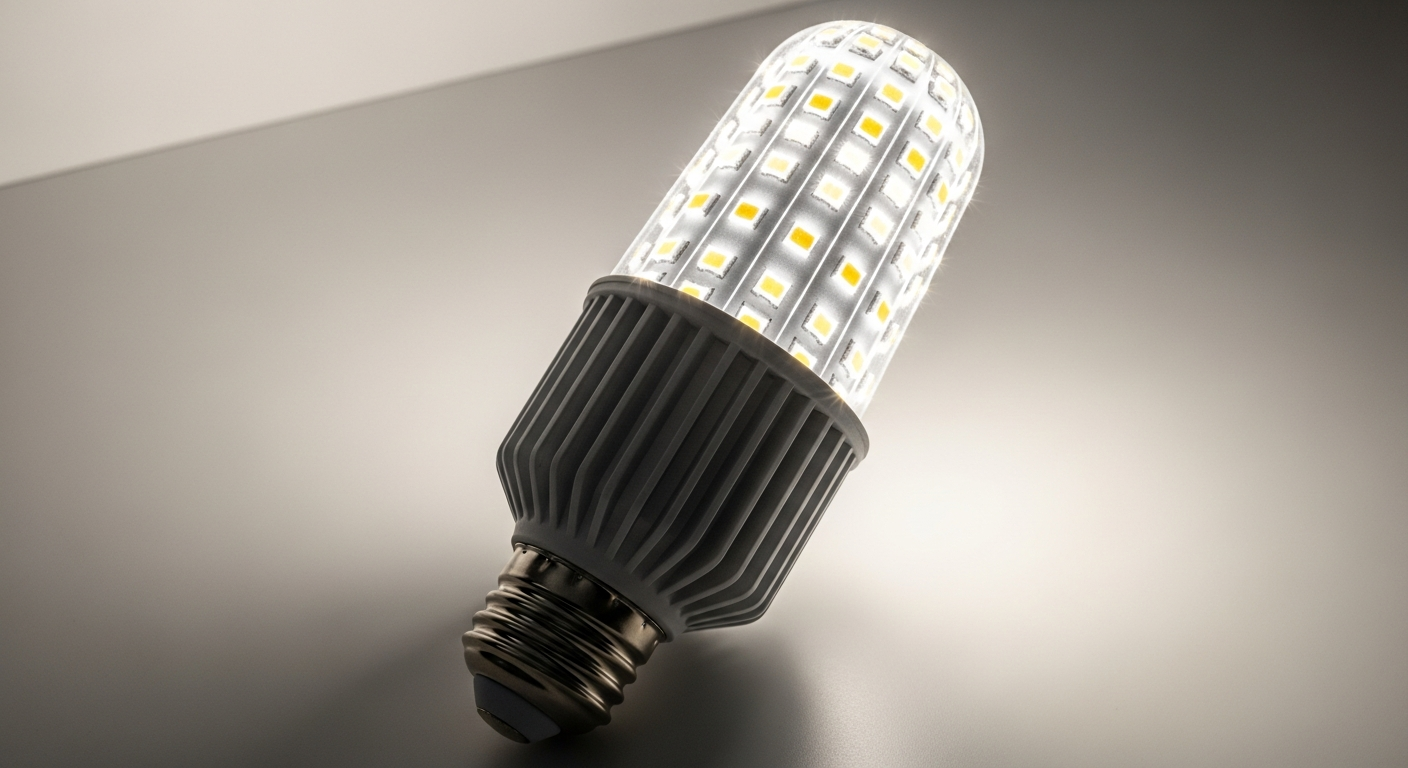
Omnidirectional LED emitter arrangement mimics corn cob structure for 360-degree light spread
The corn lamp design isn't arbitrary—it's engineered geometry. Small LED emitters cluster densely across the bulb's surface, mimicking a corn cob's structure. This arrangement radiates light in all directions simultaneously, creating comprehensive coverage that standard A-shaped bulbs cannot match. A single corn lamp illuminates spaces that previously required multiple traditional fixtures.
Eliminates dark spots and shadows in open-plan spaces without requiring multiple fixtures
Open-plan facilities present a particular challenge for conventional lighting. Shadows collect in corners and under equipment, creating visual hazards and reducing operational efficiency. The corn lamp's 360-degree output eliminates these problem areas entirely. Workers gain consistent visibility across their entire workspace, and facilities reduce the fixture density required to achieve adequate illumination.
Covers significantly larger areas than traditional A-shaped bulbs with equivalent wattage
A 27W corn lamp outperforms 150-200W incandescent bulbs in terms of light distribution and brightness. The difference lies in how the light is generated and dispersed. While traditional bulbs concentrate their output downward through a reflective cap, corn lamps distribute light uniformly across all angles, covering substantially larger floor areas with a single installation.
Reduces the need for additional lighting infrastructure in warehouses, factories, and commercial kitchens
Infrastructure costs represent a major barrier to facility upgrades. Retrofitting a warehouse with new fixtures means electrical work, labor expenses, and potential operational disruption. The corn lamp's superior coverage reduces the total number of fixtures required, lowering both immediate installation costs and long-term maintenance burden. Many facilities discover they can achieve better lighting with fewer total bulbs.
Understanding the 4000K Color Temperature for Task-Focused Environments
Neutral white light (4000K) enhances visual clarity and concentration in work settings
Color temperature profoundly affects human perception and performance. The 4000K specification positions the JUNO lamp in the neutral white range—neither warm nor excessively cool. This temperature enhances color accuracy and visual sharpness, making it ideal for environments where workers identify defects, assemble components, or prepare food. The light feels natural yet invigorating, supporting sustained focus during long shifts.
Reduces eye strain during prolonged tasks compared to warm 2700K or cool 6500K alternatives
Warm 2700K lighting relaxes the eye but reduces clarity, while extremely cool 6500K can feel harsh and fatiguing over extended periods. The 4000K middle ground provides optimal balance. Workers report less fatigue during quality control inspections, assembly work, and detailed tasks. This practical advantage translates to fewer errors, better productivity, and improved workplace safety—benefits that compound across an entire facility.
Preferred standard in commercial kitchens, assembly lines, and quality control areas
Industry standards exist for good reason. Commercial kitchens, automotive assembly facilities, and electronics quality control centers predominantly specify 4000K lighting. This consensus reflects decades of operational data. When you choose 4000K, you're aligning with proven best practices in high-performance environments.
Real-World Energy Consumption & Cost Savings Analysis
27W LED output replaces 150-200W incandescent or 60-80W CFL bulbs with superior brightness
The efficiency gap is staggering. A 27W LED corn lamp produces more usable light than a 150-200W incandescent bulb. CFL bulbs rated at 60-80W cannot match its performance either. This isn't theoretical—it reflects the fundamental physics of LED technology versus older light generation methods. LEDs convert electrical energy directly into light with minimal heat waste, while incandescent bulbs waste roughly 90% of their input as thermal energy.
Consumes up to 90% less electricity than traditional lighting technologies
A facility running 50 fixtures continuously consumes vastly different amounts of power depending on bulb type. Fifty 150W incandescent bulbs draw 7,500 watts continuously. Fifty 27W LED corn lamps draw only 1,350 watts—a reduction of over 6,000 watts. Over a year of continuous operation, this differential translates to tens of thousands of kilowatt-hours of reduced consumption.
Calculate facility-wide savings: swap 50 bulbs, save £2,000-3,500 annually on electricity alone
Real numbers clarify the impact. A facility replacing 50 incandescent fixtures with LED corn lamps typically reduces annual electricity costs by £2,000-3,500, depending on local rates and usage patterns. At current UK rates averaging £0.28 per kilowatt-hour, a facility running 50 bulbs continuously saves approximately £1,543 annually just from the 6,150 kWh reduction. Add in reduced HVAC costs from decreased heat generation, and total savings exceed £2,000 easily.
Check current pricing and order your JUNO LED 27W E27 4000K Corn Lamps now.
Lifespan Advantages: Why 50,000 Hours Changes Your Maintenance Budget
Extended operational life (10,000-50,000 hours) eliminates frequent bulb replacement cycles
Traditional incandescent bulbs last 1,000 hours. CFL bulbs manage 8,000-10,000 hours. The JUNO corn lamp operates for 10,000-50,000 hours depending on usage patterns and environmental conditions. This represents a tenfold improvement over older technologies. A facility accustomed to replacing bulbs monthly suddenly operates for years between replacements.
Single bulb lasts 5-10 years with continuous 24/7 operation or 10-20 years with standard use
Consider a warehouse operating lights 16 hours daily. A 50,000-hour lifespan equates to roughly 8.6 years of operation. For standard commercial use of 8-10 hours daily, a single bulb lasts 14-17 years. In facilities operating normal business hours (8 hours daily), expect 17-20 years per bulb. This longevity fundamentally transforms maintenance planning.
Reduces labor costs associated with ladder work, inventory management, and bulb disposal
The hidden costs of frequent replacements compound rapidly. Each bulb swap requires a ladder, worker time, inventory tracking, and disposal logistics. A facility replacing 50 bulbs quarterly spends hundreds of hours annually on maintenance. Reducing replacement frequency to once every 5-10 years frees labor for higher-value activities. Safety improves as well—fewer ladder deployments mean fewer fall risks.
E27 Base Compatibility: Retrofitting Existing Fixtures Without Rewiring
Standard E27 screw base fits 99% of commercial and residential light sockets
The E27 base is the global standard for general lighting. Nearly every commercial fixture, warehouse mount, and industrial socket accommodates E27 bulbs. This universal compatibility means the JUNO corn lamp integrates into existing infrastructure without adapter plates or modifications. Facility managers can confidently order replacements knowing they'll fit.
Enables immediate upgrades to existing infrastructure without electrical modifications
Retrofitting typically requires electricians, rewiring, and downtime. The E27 compatibility eliminates this barrier. A facility manager simply screws in the new bulbs—no rewiring, no electrical work, no disruption to operations. The upgrade can happen during standard maintenance windows or even while facilities operate, depending on fixture design.
Eliminates costly rewiring projects or fixture replacements in older buildings
Legacy buildings present particular challenges. Older electrical systems and fixture designs often require expensive modifications before modern lighting can be installed. The corn lamp's E27 base renders these concerns moot. Buildings constructed decades ago can upgrade to current technology without infrastructure overhauls, preserving budgets for other critical improvements.
Making the Switch: Why Facility Managers Are Choosing JUNO 27W Corn Lamps Today
The case for upgrading extends beyond simple bulb replacement. The JUNO LED 27W E27 4000K Corn Lamp represents a strategic shift toward operational excellence, cost discipline, and worker safety. Facilities that have made the transition report measurable improvements in energy efficiency, maintenance budgets, and workplace lighting quality.
The financial mathematics favor early adoption. At £35.90 per bulb, the investment recovers within 12-18 months through electricity savings and eliminated replacement cycles. For a 50-bulb facility, the initial investment of approximately £1,795 generates £2,000-3,500 in annual savings—a payback period most capital projects cannot match. After payback, the facility operates for years at minimal ongoing cost.
Compatibility removes technical barriers. The E27 base fits existing fixtures without rewiring. Facility managers can pilot the upgrade with a single bulb in the highest-usage fixture, monitor performance over 90 days, then confidently scale across the entire operation. This phased approach minimizes risk while building internal confidence.
The operational advantages compound over time. Better lighting reduces errors and improves safety. Lower energy consumption decreases utility costs. Extended lifespan eliminates maintenance disruption. Worker satisfaction increases when lighting quality improves. These benefits accumulate across every department and shift.
Start with your highest-usage fixture. Track energy consumption over the next quarter. Document maintenance labor savings and lighting quality improvements. The data will guide your full-facility strategy. Most managers find the business case compelling enough to justify immediate, comprehensive adoption.
Purchase the JUNO LED 27W E27 4000K Corn Lamp and transform your facility's lighting today.
Leave a Reply