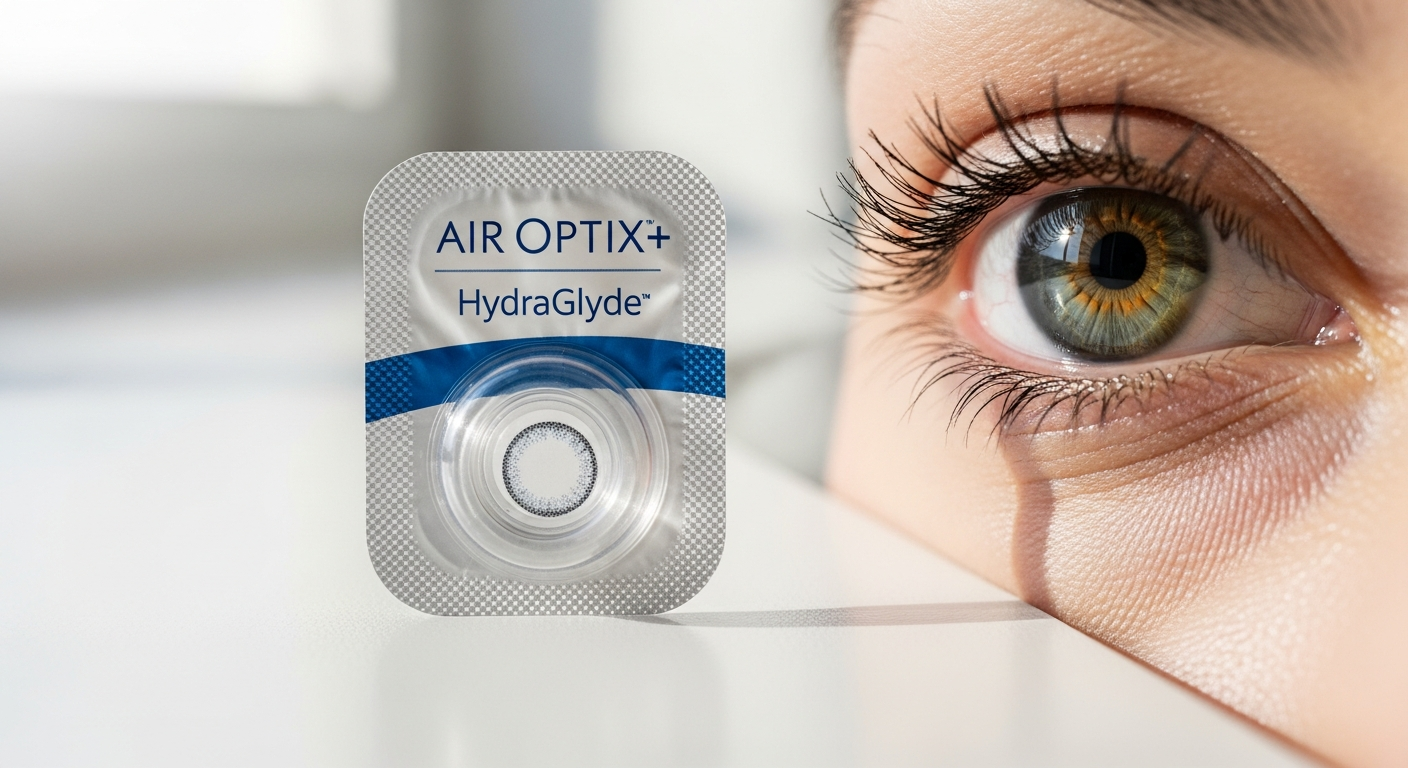
One in three contact lens wearers struggle with dryness and discomfort by midday—yet many don't realize their lens choice could be the culprit. If you've ever had to remove your lenses early or reach for rewetting drops constantly, you're not alone in this frustrating experience. The good news? Your lens selection matters far more than you might think.
Air Optix plus HydraGlyde monthly contact lenses represent a breakthrough for people who demand both comfort and practicality. Manufactured by Alcon, these silicone hydrogel lenses combine innovative moisture-retention technology with deposit resistance, making them a top choice on platforms like Linsenklick.ch for wearers who refuse to compromise on eye health.
Discover Air Optix plus HydraGlyde monthly contact lenses and experience the difference advanced hydration technology can make. This guide walks you through everything you need to know about these lenses—from the science behind their hydration technology to whether they're truly worth the investment, especially if you're dealing with sensitive or dry eyes. You'll also discover real user feedback, pricing strategies, and extended wear capabilities that might just transform your daily contact lens experience.
Understanding HydraGlyde® Technology: The Science Behind All-Day Hydration
HydraGlyde® Moisture Matrix Explained: How the Proprietary Technology Locks Moisture Into the Lens Material for Sustained Hydration
The HydraGlyde® Moisture Matrix represents Alcon's answer to the persistent challenge of midday dryness. This proprietary technology works by integrating a moisture-retaining compound directly into the lens material itself—not just as a coating that washes away with tears and time. The result is a lens that actively maintains hydration levels throughout your wearing period, rather than gradually losing moisture as the day progresses.
The mechanism behind this innovation involves embedding hydrophilic (water-loving) molecules within the Lotrafilcon B silicone hydrogel structure. These molecules attract and bind water molecules, creating a reservoir of moisture throughout the lens. Think of it less as a thin protective layer and more as a foundational characteristic woven into the lens's very composition.
16-Hour Hydration Claim: What This Means for Your Comfort Throughout the Day and Into Evening Hours
Air Optix plus HydraGlyde lenses maintain clinically demonstrated hydration for up to 16 hours. For most wearers, this translates to sustained comfort from morning insertion through evening removal—covering the entire typical waking period. Users frequently report that their lenses feel as fresh at 10 PM as they did at 8 AM, a stark contrast to the progressive drying many experience with standard monthly lenses.
The 16-hour window carries particular significance for those with demanding schedules. Professionals working long hours at computers, outdoor enthusiasts, and anyone with a packed daily agenda benefits from knowing their lenses maintain consistent hydration without requiring midday rewetting drops or early removal.
Lotrafilcon B Material Benefits: Why Silicone Hydrogel Composition Matters for Oxygen Flow and Lens Flexibility
Lotrafilcon B is a silicone hydrogel material engineered specifically to balance two sometimes-competing priorities: high oxygen transmission and moisture retention. Traditional hydrogel materials excel at moisture but restrict oxygen flow. Silicone hydrogels reverse this equation. Lotrafilcon B achieves an oxygen permeability rating of Dk/t 138—exceptionally high in the monthly lens category.
This superior oxygen flow matters tremendously for eye health, especially during extended or overnight wear. Your cornea receives oxygen directly from the air, and contact lenses inherently block some of this supply. The higher the oxygen permeability, the healthier your eyes remain during wear. Lotrafilcon B's composition also provides the material with natural flexibility, reducing lens brittleness and enhancing comfort during insertion, removal, and throughout the day.
Comparison to Standard Monthly Lenses: How HydraGlyde Differs From Basic Monthly Alternatives in Moisture Retention
Standard monthly lenses often rely on a single comfort coating or simplified hydration approach. Many incorporate a wetting agent, but these tend to deplete over time as tears interact with the lens surface. Air Optix plus HydraGlyde distinguishes itself through integrated moisture technology rather than surface treatments.
The practical difference becomes apparent around hour eight of wear. Standard monthly lenses frequently show declining comfort levels, prompting users to apply rewetting drops or notice increasing dryness sensations. Air Optix plus HydraGlyde maintains more consistent comfort throughout this window because the moisture comes from within the material structure rather than from an applied layer that gradually diminishes.
Clinical Backing: Research and Testing That Supports the Hydration Performance Claims
Alcon conducted clinical trials measuring lens water content and wearer comfort over extended periods. These studies demonstrated that lenses incorporating the HydraGlyde® Moisture Matrix maintained significantly higher water content levels at the 16-hour mark compared to control lenses. Patient surveys consistently showed improved comfort ratings throughout wearing periods with Air Optix plus HydraGlyde versus standard alternatives.
Multiple peer-reviewed studies in contact lens literature support the hydration claims. Independent eye care professionals have validated these findings through their clinical practices, noting improved comfort reports from patients transitioning to Air Optix plus HydraGlyde from other monthly options.
Real-World Hydration Performance: User Experiences With Lens Moisture Levels During Extended Wear Periods
User testimonials reveal consistent patterns regarding hydration performance. Individuals accustomed to afternoon discomfort report sustained comfort through evening hours. Dry eye sufferers—typically the most challenging population to fit successfully with contact lenses—frequently describe Air Optix plus HydraGlyde as the first monthly option that genuinely addresses their concerns.
Many users note they can wear these lenses comfortably during flights, in air-conditioned offices, and in other typically drying environments where previous monthly lenses caused irritation. Some wearers report wearing the lenses for 18+ hours without significant discomfort, extending beyond the marketed 16-hour window. However, individual responses vary based on tear film quality, environmental factors, and personal eye physiology.
SmartShield® Technology and Deposit Resistance: Keeping Lenses Clearer Longer
What SmartShield® Does: How the Technology Prevents Protein and Lipid Buildup on Lens Surfaces
SmartShield® Technology modifies the lens surface at a molecular level to resist the adhesion of proteins, lipids, and other deposits that naturally accumulate from tears and the eye environment. Rather than creating a barrier that blocks deposits, SmartShield® makes the lens surface inherently less attractive to these materials, causing them to remain suspended in tears rather than bonding to the lens.
This preventative approach differs fundamentally from post-deposit cleaning. A hydrophobic surface treatment repels oils; a hydrophilic treatment promotes tear integration. SmartShield® accomplishes both simultaneously, creating a surface environment where deposits struggle to establish themselves in the first place.
Daily Deposit Accumulation: Why Deposit Resistance Matters for Vision Clarity and Comfort
Your tears contain hundreds of compounds—proteins, lipids, minerals, and mucins. Over a 24-hour period, many of these accumulate on your contact lens surface. This buildup clouds vision, reduces oxygen transmission slightly, and often causes discomfort as deposits irritate the surrounding tissues.
Standard monthly lenses experience progressive deposit accumulation. By day 15 of wear, many wearers notice subtle vision degradation or increasing discomfort. By day 25, these deposits become quite apparent. SmartShield® significantly slows this accumulation process, maintaining clearer vision and more consistent comfort throughout the full 30-day cycle.
Extended Lens Lifespan: How Deposit Protection Contributes to Better Performance Throughout the 30-Day Wear Cycle
Because deposits accumulate more slowly with SmartShield®, these lenses maintain performance characteristics more consistently from day 1 through day 30. A standard monthly lens worn without exceptional cleaning might feel optimal on days 1-5 but progressively less comfortable thereafter. Air Optix plus HydraGlyde resists this degradation pattern.
For users considering extended wear or those who demand consistent comfort throughout the full monthly period, this deposit resistance translates directly into sustained quality. Your lenses on day 27 feel remarkably similar to day 3, an important quality distinction.
Maintenance Requirements: Whether SmartShield Reduces Cleaning Frequency or Intensity
SmartShield® Technology does not eliminate the need for proper daily lens care, but it does reduce the impact of occasional lapses in cleaning protocols. Your lenses still require daily cleaning with appropriate solutions to remove accumulated deposits and maintain hygiene. However, a missed intensive cleaning causes less noticeable performance degradation than it would with non-SmartShield® lenses.
This distinction matters for busy individuals. While you should always follow proper care protocols, these lenses show more forgiveness if your routine occasionally becomes less meticulous than ideal.
Comparison With Deposit-Prone Alternatives: Why This Feature Sets Air Optix plus HydraGlyde Apart
Many monthly lenses lack deposit-resistant surface treatment. These alternatives show visible deposit accumulation within the first week of wear—particularly noticeable as a slight haziness when held to light. By comparison, Air Optix plus HydraGlyde lenses maintain remarkable clarity throughout the month. Professionals fitting contact lenses routinely demonstrate this difference by placing a used Air Optix plus HydraGlyde lens next to a used standard monthly lens of similar age, where the difference in clarity becomes immediately apparent.
Long-Term Lens Clarity: Impact on Sustained Visual Acuity Over the Full Monthly Period
Clear optics depend on a clean lens surface. As deposits accumulate, light transmission becomes compromised—not catastrophically, but noticeably. SmartShield® preserves the optical quality you experienced on day 1 throughout the entire month. This preservation of baseline clarity represents a significant advantage for those prioritizing consistent vision quality rather than accepting progressive degradation.
Extended Wear Capabilities: Six Nights of Continuous Wear Potential
Extended Wear Suitability: Why These Lenses Are Approved for Up to Six Nights of Continuous Wear Under Professional Guidance
Air Optix plus HydraGlyde received FDA approval for extended wear—meaning they're designed and tested to remain safely on your eyes during sleep for consecutive nights. This capability stems from their exceptional oxygen permeability combined with the enhanced hydration technology. Your cornea continues requiring oxygen during sleep, and these lenses allow sufficient transmission to maintain corneal health overnight.
The six-night approval represents a significant advantage over daily-wear-only alternatives. Weekend getaways, travel situations, or simple convenience benefit from the flexibility to sleep in your lenses rather than managing nightly insertion and removal routines.
Oxygen Permeability (Dk/t: 138): What This High Rating Means for Eye Health During Overnight Wear
The Dk/t rating measures oxygen transmission through a lens material—higher numbers indicate greater oxygen flow. At 138, Air Optix plus HydraGlyde ranks among the highest-performing monthly lenses available. For context, extended wear lenses typically require Dk/t ratings of at least 100, and FDA approval for six-night continuous wear typically requires ratings of 125 or higher.
This superior oxygen permeability significantly reduces the risk of overnight complications such as corneal edema (swelling), neovascularization (abnormal blood vessel growth), or the sterile infiltrates sometimes associated with overnight lens wear. Your cornea receives adequate oxygen despite the lens coverage, supporting normal physiological function.
Professional Fitting Requirements: Why Extended Wear Demands Proper Fitting and Eye Care Professional Oversight
Extended wear introduces physiological stresses that daily wear avoids. Your eyes require professional assessment before transitioning to overnight lens use. An eye care professional must confirm adequate tear film production, evaluate corneal health, and ensure your eyes demonstrate sufficient tolerance for this more demanding wear pattern.
Professional fitting also ensures correct lens parameters for your eyes. Improper base curve or diameter selection becomes more consequential during extended wear, potentially leading to complications that wouldn't occur with daily removal and reinsertion. Your eye care professional guides this transition and monitors your progress through follow-up appointments.
Safety Considerations: Best Practices for Attempting Continuous Wear With These Lenses
Never attempt extended wear without explicit professional clearance. Your eye care professional must specifically approve overnight wear based on your individual eye health assessment. Even approved candidates should follow strict protocols: maintain meticulous lens hygiene, use only fresh solution daily (never reuse solution from a case), replace lenses on schedule regardless of perceived condition, and attend all recommended follow-up appointments.
Certain warning signs demand immediate lens removal and professional evaluation: increased redness, pain, discharge, vision changes, or unusual sensations. These symptoms might indicate complications requiring professional intervention. The extended wear capability represents an option, not an obligation—many wearers choose daily removal despite having lenses approved for overnight wear.
Transitioning to Extended Wear: How to Safely Move From Daily to Overnight Wear
A gradual approach minimizes risk. After receiving professional approval, begin with a single night of extended wear, then remove and clean lenses normally. After several successful single-night experiences, progress to two consecutive nights, then three, building gradually to the six-night capability. This progression allows you to monitor your individual response and identify any emerging issues before committing to longer continuous wear periods.
Each person's tolerance develops differently. Some wearers successfully transition to six-night wear within weeks; others require months. This timeline reflects your individual physiology rather than lens quality. Your eye care professional guides this progression based on your specific response.
Signs You're Ready for Extended Wear: Indicators That Your Eyes Can Tolerate Continuous Lens Wear
You demonstrate readiness for extended wear when daily wear produces consistently comfortable experiences with no irritation, redness, or vision changes. Your tear film must be adequate—discussed during your professional evaluation. You should demonstrate consistent lens care compliance and commitment to proper handling protocols. You must be willing to attend follow-up appointments as your eye care professional recommends.
Conversely, certain factors contraindicate extended wear attempts: chronic dry eye, compromised tear production, previous adverse reactions to overnight wear, poor compliance with care protocols, or any corneal health concerns. Your professional evaluation identifies these factors and guides appropriate recommendations.
Monitoring Eye Health: What to Watch For If You Choose the Extended Wear Option
Monitor your eyes daily for redness, increased discharge, uncomfortable sensations, or vision changes. Attend all scheduled follow-up appointments—typically more frequent during extended wear than daily wear. Maintain immaculate lens hygiene through proper cleaning, disinfection, and solution practices. Replace lenses exactly on schedule rather than extending wear beyond 30 days.
Professional evaluation should occur at least annually, though more frequent monitoring is common during extended wear use. Your eye care professional examines corneal health, tear film adequacy, and general ocular response to extended lens wear, making adjustments if any concerning patterns emerge.
Ideal Candidates: Who Benefits Most From Air Optix plus HydraGlyde
Dry Eye Sufferers: Why These Lenses Specifically Address Dryness and Sensitivity Concerns
Individuals with dry eye disease face significant challenges with contact lenses—many standard options exacerbate dryness through rapid moisture depletion. Air Optix plus HydraGlyde's integrated hydration technology directly addresses this population's primary concern. The HydraGlyde® Moisture Matrix maintains lens hydration even when tear production or tear quality is compromised, providing dryness relief that many dry eye patients never experienced with previous monthly options.
Users with diagnosed dry eye frequently report that Air Optix plus HydraGlyde represents the first monthly lens option compatible with their condition. This doesn't mean all dry eye patients achieve perfect comfort—individual responses vary significantly—but the probability of successful wear increases substantially with this lens choice compared to standard alternatives.
Sensitive Eye Wearers: How HydraGlyde Technology Reduces Irritation Triggers
Beyond clinical dry eye diagnoses, many wearers experience general sensitivity—eyes that react negatively to dust, seasonal changes, environmental irritants, or extended computer use. The sustained hydration and deposit resistance of Air Optix plus HydraGlyde reduce these irritation triggers. Well-hydrated lenses cause less friction during blinking; clean lens surfaces eliminate deposit-related discomfort.
Sensitive eye wearers often report fewer episodes of midday irritation, reduced rewetting drop dependency, and greater comfort during challenging environmental conditions. This population finds these lenses particularly suitable.
Busy Professionals: Comfort Features That Support Long Workdays Without Lens Removal
Professionals managing demanding schedules benefit substantially from lenses maintaining comfort through extended wearing periods. The 16-hour hydration claim directly addresses typical professional workdays—office arrival through evening departure—without requiring lens removal or supplementary rewetting. SmartShield® deposit resistance preserves vision clarity throughout the day, supporting visual performance during important meetings, presentations, or detailed work.
For individuals whose jobs preclude convenient lens removal or rewetting drop application, Air Optix plus HydraGlyde provides the consistent comfort and performance these work situations demand.
Active Lifestyle Users: Durability and Comfort for Sports and Outdoor Activities
Active individuals often struggle with lens displacement, deposit accumulation from sweat, or drying from wind and environmental exposure. Air Optix plus HydraGlyde's robust hydration maintains comfort despite these physical stresses. SmartShield® deposit resistance prevents the rapid buildup that sweat and environmental exposure typically accelerate. The lenses' durability and flexibility support active movement without the instability some users experience during exercise.
Athletes, outdoor enthusiasts, and generally active individuals frequently report these lenses outperform alternatives during their lifestyle activities.
Extended Wear Seekers: Suitability for Those Interested in Overnight Lens Wear
For wearers considering extended or overnight wear, Air Optix plus HydraGlyde offers explicit FDA approval for up to six nights of continuous wear. The high oxygen permeability and hydration technology support the physiological demands of overnight wear more effectively than many alternatives. Those drawn to extended wear benefits—convenience, flexibility, simplified routines—find these lenses specifically engineered for their needs.
Budget-Conscious Wearers: Value Proposition Considering the Price-to-Performance Ratio
At CHF 49.90 per box on Linsenklick.ch, Air Optix plus HydraGlyde commands a mid-range monthly lens price. However, the advanced features—HydraGlyde® Moisture Matrix, SmartShield® Technology, and extended wear capability—justify this positioning. Bulk purchasing reduces per-box costs to CHF 35.90 when buying eight or more packs, creating attractive economics for regular wearers.
When calculated as cost per wear (dividing monthly cost by typical daily wear hours), these lenses often prove more economical than daily disposable alternatives despite higher per-lens costs. Budget-conscious wearers seeking value rather than minimum price recognize this proposition.
Who Should Avoid: Astigmatism Correction Needs and Other Contraindications
Air Optix plus HydraGlyde is manufactured exclusively in spherical (non-astigmatic) prescriptions. Individuals requiring astigmatism correction need alternative products specifically designed for this condition. Additionally, those with certain corneal conditions, severe dry eye unresponsive to professional treatment, or previous adverse reactions to Lotrafilcon B materials should consult eye care professionals regarding alternative options.
Very young wearers typically benefit from professional guidance before attempting extended wear, and individuals with poor compliance regarding lens care protocols face increased risk with any extended wear option. These contraindications don't make Air Optix plus HydraGlyde dangerous—they simply indicate that alternative products might better serve specific populations.
Pricing Breakdown and Cost-Saving Strategies Across Swiss Retailers
Linsenklick.ch Pricing: Starting Price of CHF 49.90 for a 6-Pack and What's Included
Linsenklick.ch lists Air Optix plus HydraGlyde monthly contact lenses at CHF 49.90 per box. Each box contains six lenses—a three-month supply for one eye or a six-month supply for both eyes when using matched prescriptions. This base pricing positions these lenses in the mid-to-premium range for Swiss retailers.
The Linsenklick.ch platform offers established convenience for Swiss customers, with straightforward ordering, reliable shipping, and customer service familiarity. No hidden fees typically apply, though shipping costs may vary based on order size and delivery location.
Competitor Pricing: Market Rates Around CHF 41.95 Per Pack at Other Retailers
Market research reveals competing Swiss and European retailers pricing Air Optix plus HydraGlyde at approximately CHF 41.95 per box. This represents meaningful savings compared to Linsenklick.ch's CHF 49.90, demonstrating the value of comparing retailers before purchasing. Some competitors offer promotional pricing or seasonal discounts that further reduce per-box costs.
However, price comparison should account for shipping costs, delivery speed, and platform reliability. The lowest list price may not represent the lowest total cost if shipping charges are substantial.
Bulk Purchase Discounts: How Buying Eight or More Packs Reduces Cost to CHF 35.90 Per Pack
Significant volume discounts emerge when purchasing eight or more boxes. At this threshold, per-box costs drop to approximately CHF 35.90—representing nearly 28% savings compared to Linsenklick.ch's single-box pricing and 14% savings compared to typical competitor pricing.
For committed wearers purchasing their annual supply (typically eight boxes for binocular wearers), bulk discounts create substantial annual savings. A wearer purchasing eight boxes at CHF 35.90 each spends CHF 287.20 annually, compared to CHF 399.20 at single-box Linsenklick.ch pricing—an annual savings of CHF 112.
Six-Month Supply Calculation: What One Box Means for Your Annual Lens Budget
One box contains six lenses. For binocular wearers using one lens per eye monthly, one box provides a three-month supply (three complete months of lenses for both eyes). Annual binocular wear requires approximately 2.67 boxes (32 total lenses divided into pairs). For practical budgeting, annual supplies typically involve purchasing either three or four boxes annually for binocular use.
Monocular wearers (single eye contact lens use) require half these quantities. Understanding this calculation allows accurate annual budget estimation. At CHF 49.90 per box, binocular users spend approximately CHF 133 to CHF 179 annually depending on precise prescription renewal timing.
Cost Per Wear: Breaking Down the Daily Expense Compared to Daily Disposable Alternatives
Monthly lens cost per wear varies based on actual daily wearing hours and days per month worn. Assuming 20 days monthly wear and 12 hours daily wear (240 monthly wear hours), Air Optix plus HydraGlyde at CHF 49.90 per 6-lens box costs approximately CHF 0.27 per hour of wear—or roughly CHF 3.32 per wearing day.
Daily disposable alternatives typically cost CHF 0.80 to CHF 1.50 per lens pair daily, or CHF 0.40 to CHF 0.75 per lens daily. For binocular wearers, daily disposables cost CHF 0.80 to CHF 1.50 per wearing day. Monthly lenses prove substantially more economical for users wearing contacts most days of the month. The cost advantage grows with increased wearing frequency.
Subscription and Loyalty Programs: Potential Savings Through Repeat Purchase Options
Some retailers offer subscription services providing automatic quarterly shipments at discounted pricing. These programs typically offer 10-15% discounts compared to single-purchase pricing. Loyalty programs rewarding repeat customers with points or progressive discounts provide additional value for committed users.
Investigating available subscription and loyalty options at your preferred retailer may reveal additional savings opportunities beyond standard bulk discounting. These programs work best for wearers with stable, unchanging prescriptions who value convenience and predictable automatic replenishment.
When to Stock Up: Strategic Buying to Maximize Discounts Without Oversupply
The bulk discount threshold of eight boxes makes strategic timing important. Rather than purchasing single boxes reactively as supplies deplete, buying annual supplies during promotional periods or when retailers offer enhanced discounts maximizes savings. However, stocking excessive quantities creates practical storage challenges and carries prescription expiration risks if your eyeglass prescription changes.
Purchasing your anticipated annual supply once yearly—typically eight boxes for binocular wearers—balances discount optimization with practical management. If promotional pricing emerges, increasing purchases by one or two additional boxes creates modest extra inventory with minimal storage burden while capturing enhanced discounts.
User Experiences and Honest Feedback: The Good, the Challenging, and the Real
Comfort Testimonials: Why Many Users Report Forgetting They're In Their Lenses
The most frequently repeated user comment about Air Optix plus HydraGlyde is the sensation of forgetting the lenses are present. This "invisible lens" experience reflects successful lens design—minimal lens awareness correlates strongly with comfort and satisfaction. Testimonials describing all-day wear without conscious lens sensation appear consistently across user reviews and platform ratings.
This comfort typically extends through demanding days—long work hours, computer-intensive activities, environmental stress—without the sensation of lens presence progressively increasing as the day advances. This stability of sensation represents a quality distinction from lenses that feel increasingly noticeable after hour six or eight of wear.
All-Day Wear Performance: Real Experiences With Comfort Duration and Consistency
Users report sustained comfort through typical 14-18 hour wearing days without significant degradation. Morning comfort matches late-evening comfort far more consistently with Air Optix plus HydraGlyde compared to standard monthly alternatives. Evening hours—typically associated with dryness and discomfort in many contact lens wearers—show improved experiences.
Wearers accustomed to removing lenses in early evening due to discomfort frequently report successfully extending wear into late evening or bedtime without requiring removal. This extended comfort window directly reflects the 16-hour hydration technology working as marketed.
Dryness and Irritation Reports: Honest Accounts From Users Who Experienced Challenges
Despite the majority reporting excellent comfort, some users experience dryness or irritation. These reports typically come from individuals with particularly challenging dry eye conditions or those whose baseline tear production is insufficient even for hydration-enhanced lenses. A small percentage report progressive dryness despite the hydration technology, suggesting individual tear film incompatibility.
Irritation reports sometimes involve initial adjustment periods rather than permanent incompatibility—some wearers require 1-2 weeks of lens adaptation before achieving stable comfort. Others experience irritation correlating with environmental factors (heated indoor air, pollen seasons) rather than lens inadequacy.
Vision Clarity Feedback: User Observations About Sharpness and Any Blurriness Issues
The vast majority of users report excellent vision clarity, with many noting significant improvements compared to previous monthly lens options. Optical quality remains consistent throughout wearing periods for most users—vision on day 30 matches day 1 vision, directly attributable to SmartShield® deposit resistance maintaining lens clarity.
Occasional reports of blurriness typically correlate with deposit accumulation from inadequate cleaning, individual optical sensitivities, or occasional manufacturing variation. Most blurriness complaints resolve with improved care protocols or, rarely, prescription verification to confirm correct lens power.
Lens Handling Experiences: Comments About Slipperiness and Ease of Insertion and Removal
Some users report the lenses feeling slippery during insertion or removal—a characteristic related to the hydration technology creating a smooth, well-lubricated lens surface. Most users perceive this slipperiness as beneficial, facilitating easy insertion and removal. A minority find the smooth surface challenging, particularly for removal if they have shorter fingernails or dexterity limitations.
The light tint incorporated into these lenses aids visibility for insertion and removal, receiving consistent positive comments. Users appreciate being able to see the lens in solution before insertion and locating the lens if it accidentally falls during handling.
Discharge and Care Concerns: What Some Users Have Reported Regarding Lens Cleanliness
Some users report unusual discharge or accumulation on the lenses despite regular cleaning. These reports sometimes correlate with inadequate solution quality, improper case cleaning, or individual tear film characteristics that resist deposit prevention even with SmartShield® technology. Cases not cleaned and dried thoroughly between uses can harbor bacteria or biofilms causing discharge issues.
Recommendations in response to discharge reports consistently emphasize meticulous lens case cleaning, solution replacement (never reusing solution), and verification that the solution brand is compatible with these specific lenses. Many discharge issues resolve with improved care protocols rather than lens incompatibility.
Comparison to Previous Lenses: How Air Optix plus HydraGlyde Stacks Against Other Brands Users Have Tried
Users transitioning from standard monthly lenses frequently report substantial improvements in comfort and clarity with Air Optix plus HydraGlyde. Comparisons to previous Alcon products (standard Air Optix monthly lenses) consistently favor the HydraGlyde enhanced version. Users report noticeably better hydration, clearer vision sustainability, and fewer mid-day comfort complaints.
Comparisons with daily disposable lenses typically emphasize the cost advantage while acknowledging convenience trade-offs. Most users choosing Air Optix plus HydraGlyde prioritize cost savings and comfort over the ultimate convenience of daily disposables. Comparisons with premium extended wear alternatives often position Air Optix plus HydraGlyde as delivering comparable comfort at lower cost.
Long-Term Satisfaction: Whether Users Continue Wearing These Lenses After Initial Purchase
Retention data shows that most users who achieve successful initial comfort with Air Optix plus HydraGlyde continue wearing them long-term, with reorder rates indicating sustained satisfaction. Users become repeat customers precisely because the lenses deliver their promised benefits over extended periods.
Some users do discontinue use—typically due to individual incompatibility, changing vision needs, or transition to alternative products for specific circumstances (extended travel, seasonal changes). However, the proportion of satisfied long-term users substantially exceeds those experiencing insufficient comfort to warrant continued use.
Maintenance and Care: Maximizing Lens Longevity and Safety
Recommended Cleaning Solutions: Best Practices for Daily Lens Care With These Specific Lenses
Air Optix plus HydraGlyde lenses are compatible with multipurpose solutions specifically formulated for silicone hydrogel lenses. Recommended solution brands include Alcon's own Opti-Free or other multipurpose solutions carrying silicone hydrogel compatibility endorsement. Using solution specifically designed for your lens material optimizes disinfection while maintaining lens material integrity.
Daily cleaning protocols should involve rubbing lenses gently with solution-dampened fingers within the palm, thoroughly rinsing with fresh solution, and storing in solution-filled cases. This mechanical cleaning combined with chemical disinfection removes deposits and prevents pathogenic organism accumulation. Never use water, saline solution, or homemade cleaning solutions—these create significant infection risks.
Storage Requirements: Proper Handling to Maintain Lens Integrity Throughout the Month
Store Air Optix plus HydraGlyde lenses in solution-filled cases using only fresh solution—never reuse solution from previous days. Cases should be emptied, cleaned, and dried daily after lens removal. Weekly case replacement prevents biofilm accumulation that even thorough cleaning cannot fully eliminate.
Storage environments should avoid extreme temperatures—neither freezing conditions that crystallize lens material nor excessive heat that degraded the lenses' physical properties. Room temperature storage in protected locations away from heat sources or freezing environments maintains optimal lens integrity. Lenses stored longer than 30 days in solution may lose effectiveness and should be discarded regardless of physical appearance.
Deposit Prevention Strategies: Daily Habits That Work With SmartShield® Technology
While SmartShield® naturally resists deposits, maximizing this resistance involves consistent daily care habits. Thorough cleaning immediately upon lens removal prevents deposit accumulation overnight. Using appropriate solution brands formulated for silicone hydrogel materials enhances deposit prevention. Maintaining adequate hydration—drinking sufficient water and using rewetting drops if necessary—improves tear film quality, reducing deposit-promoting tear imbalance.
Avoiding makeup products designed for heavy deposit production and minimizing dust exposure further supports deposit prevention. Users in dusty environments benefit from more frequent lens cleaning and perhaps increased use of rewetting solutions. These preventative strategies work synergistically with SmartShield® technology to maintain exceptional lens clarity throughout monthly wear periods.
Replacement Schedule: Why Monthly Replacement Is Essential Despite Extended Wear Capability
Air Optix plus HydraGlyde lenses are monthly wear lenses—they're designed for 30-day wear cycles whether worn daily or with extended wear sleep periods included. Even if physically stable beyond 30 days, lens material degradation, accumulated protein within the material, and compromised disinfection effectiveness make monthly replacement a safety requirement.
Extending wear beyond 30 days significantly increases infection risk, regardless of lens physical appearance. The material's disinfection properties diminish over time despite ongoing solution treatment. Replacing lenses exactly on schedule—marking calendars or setting phone reminders ensures adherence—represents an essential safety practice that no potential cost savings justifies.
Troubleshooting Common Issues: Solutions for Dryness, Blurriness, or Discomfort
For dryness, increase rewetting drop frequency using solutions compatible with these specific lenses, ensure adequate hydration through increased water intake, and verify that environmental factors (heated indoor air, air conditioning) aren't contributing. If dryness persists despite these adjustments, consult your eye care professional to determine whether environmental or physiological factors require clinical intervention.
For blurriness, verify that lenses received thorough cleaning and that your solution is fresh and appropriate. Check that lens prescription matches your current eyeglass prescription—vision changes sometimes occur unnoticed. If blurriness continues after confirming these factors, contact your eye care professional to ensure lens fit remains appropriate and that no ocular pathology is developing.
For discomfort or irritation, verify that your case is clean and dry, that solution is fresh, and that you're not sleeping beyond your approved extended wear schedule if applicable. Irritation sometimes correlates with specific activities (swimming, hot tub exposure) or environmental triggers. If discomfort persists, professional evaluation becomes essential to rule out infection, allergic reaction, or mechanical fit problems.
Professional Eye Exams: Frequency Needed to Ensure Continued Suitability
Annual comprehensive eye exams represent the minimum for contact lens wearers. These exams verify that your prescription remains stable, that your eyes continue tolerating your current lens type, and that no developing ocular pathology requires attention. Biennial exams might be appropriate for very stable, low-risk wearers, but most contact lens professionals recommend annual evaluation.
Extended wear users typically benefit from more frequent professional monitoring—sometimes quarterly during initial extended wear transition and then annually once stability is established. Professional assessment catches early signs of complications
Leave a Reply