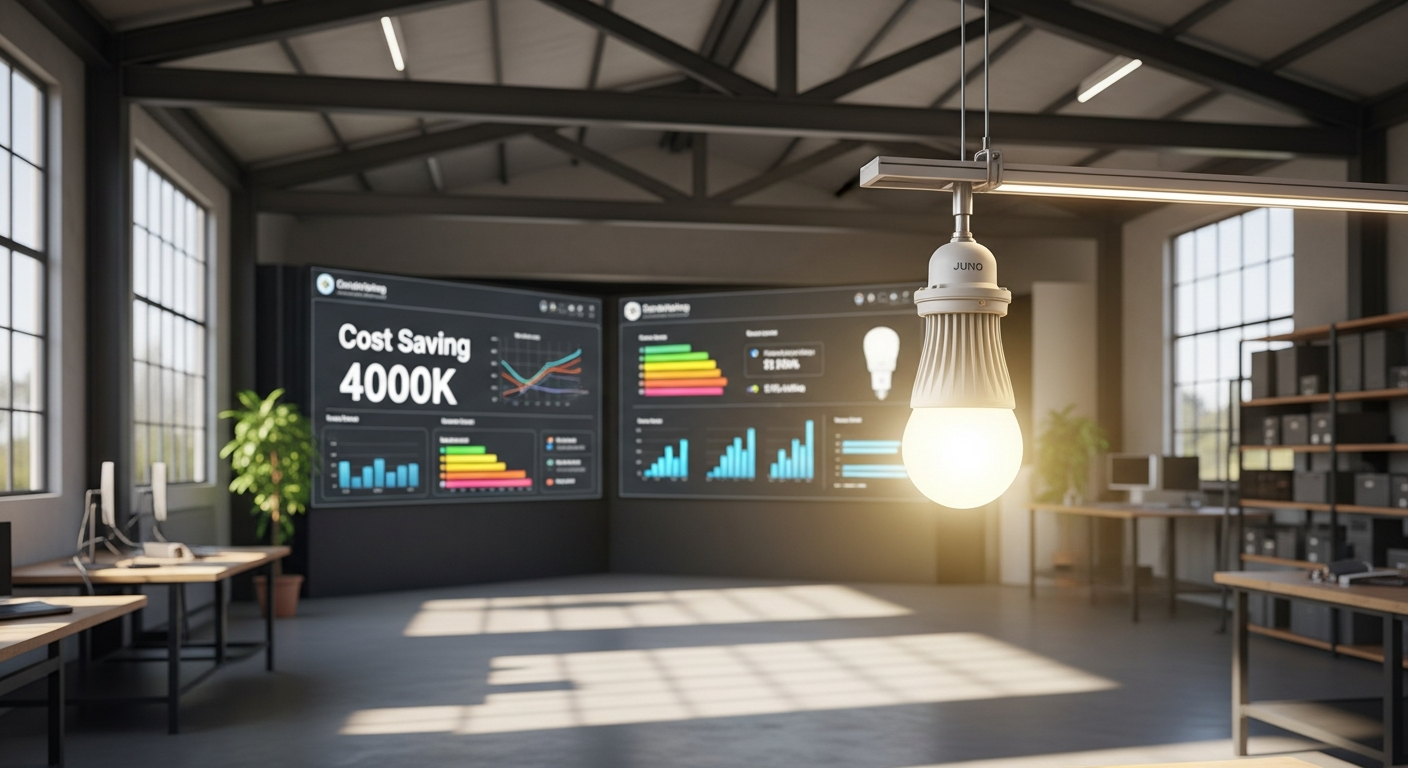
Why Industrial Facilities Are Ditching Metal Halide for LED Corn Lamps
The hidden costs of metal halide technology
Metal halide lamps have dominated industrial lighting for decades, but their reign is ending. These fixtures consume enormous amounts of electricity while delivering surprisingly modest performance. Beyond raw energy waste, they require frequent ballast replacements, generate excessive heat, and demand constant maintenance cycles that pull technicians away from productive work. A single ballast failure in a large facility can cascade across multiple fixtures, creating operational disruptions that compound the financial damage.
How LED corn lamp technology has evolved
The engineering breakthrough behind modern LED corn lamps lies in their ability to match or exceed traditional output using a fraction of the power. The Juno 27W E27 4000K delivers 3874-4050 lumens—comparable to much more powerful metal halide systems—while consuming just 27 watts. This isn't theoretical efficiency; it's measurable, real-world performance that facility managers can verify immediately upon installation.
The 4000K colour temperature advantage
Industrial environments demand clear, accurate lighting. The 4000K colour temperature produces a crisp cool white output that enhances visibility for precision work, safety inspections, and quality control. Combined with a CRI above 80, colours render accurately without the harsh, washed-out appearance of cheaper alternatives. This visibility translates directly into fewer errors, improved safety outcomes, and better worker productivity.
Regulatory pressure and sustainability goals
Environmental regulations increasingly penalize energy waste, while corporate sustainability commitments drive the switch to efficient lighting. Switching to LED corn lamps isn't just financially smart—it demonstrates genuine commitment to reducing your facility's carbon footprint. Regulatory compliance becomes simpler when your lighting systems meet modern efficiency standards.
Total cost of ownership comparison
Over 5-10 years, the financial case for LED is overwhelming. Factor in electricity consumption, replacement bulbs, ballast repairs, and labour costs. Metal halide systems typically cost 3-4 times more to operate than LED alternatives. A 100-fixture warehouse switching to the Juno 27W E27 4000K will recover its investment within months and enjoy years of dramatically reduced operating expenses.
Breaking Down the Juno 27W E27 Specifications and Performance Metrics
Power consumption and lumen output
27 watts delivering 3874-4050 lumens means each watt generates approximately 143-150 lumens—exceptional efficiency for industrial applications. To contextualize: a traditional 70W metal halide lamp produces roughly 5,600-6,000 lumens, consuming 2.6 times more power for only 40-50% more light. The Juno achieves superior efficiency ratios by eliminating the wasted heat and inefficient ballast losses inherent to older technology.
Colour temperature and colour rendering
The 4000K specification places this lamp in the cool white range, preferred across manufacturing, warehousing, and retail environments. The CRI rating above 80 ensures colours appear natural and distinct, critical for quality control, merchandise presentation, and safety applications where accurate colour differentiation matters.
E27 cap compatibility and voltage range
The standard E27 socket means direct compatibility with existing fixtures across most industrial facilities globally. Voltage compatibility spanning 85-265V eliminates concerns about power supply variations, making it suitable for installations with unstable grid power or facilities operating across multiple countries.
Lifespan comparison
Rated for 50,000 hours, the Juno lamp outlasts traditional alternatives by 3-5 times. That translates to roughly 17 years of continuous operation, or decades of standard use. Compare this to metal halide lamps typically lasting 10,000-15,000 hours, and the maintenance cost advantage becomes staggering across any substantial facility.
IP64 rating and environmental protection
The IP64 rating provides dust and moisture protection suitable for warehouses, manufacturing floors, and outdoor industrial spaces. This durability reduces failure rates in challenging conditions and ensures consistent performance even in less-than-ideal environments.
Built-in driver and heat sink technology
Advanced heat sink design manages thermal output passively, eliminating the need for internal fans that plague cheaper alternatives. This design principle means fewer failure points, longer operational life, and superior reliability in demanding applications.
Instant-on capability
Unlike some technologies requiring warm-up periods, the Juno delivers full light output instantly. For facilities requiring immediate illumination upon activation, this eliminates the productivity loss and safety concerns associated with gradual brightness ramp-up.
Calculating Your Energy Savings and ROI
Baseline comparison of power consumption
A typical 70W metal halide lamp costs approximately £0.15-0.18 per day to operate (at £0.12 per kWh electricity rate). The Juno 27W E27 4000K costs roughly £0.06-0.07 per day for equivalent or superior brightness. That's a daily saving of £0.09 per fixture, translating to £32-33 annually per bulb. A 100-fixture installation saves £3,200-3,300 yearly in electricity alone.
Maintenance cost savings
Beyond electricity, factor in replacement bulbs, ballast repairs, and labour. Metal halide systems require replacement every 1-2 years for typical 24/7 operations. At £20-30 per bulb plus £50-100 labour per installation, maintenance costs typically reach £70-130 per fixture annually. The Juno's 50,000-hour lifespan reduces replacement frequency to once every 5-7 years, slashing maintenance budgets dramatically.
Payback period analysis
At £35.90 per unit, the payback period depends on operating hours and electricity rates. In a typical 24/7 warehouse scenario, payback occurs within 3-6 months. Even in standard operating facilities running 16 hours daily, most installations achieve full cost recovery within one year. Beyond that point, every month of operation represents pure savings.
Long-term operational expense reduction
Over a 5-year warranty period, a single Juno fixture saves £160-165 in electricity plus £350-500 in maintenance versus metal halide alternatives. Multiply this across 50, 100, or 500+ fixtures, and facility-wide savings reach tens of thousands annually.
Environmental impact
Each Juno bulb reduces carbon emissions by approximately 150-180 kg over its lifespan compared to metal halide alternatives. A 100-fixture facility prevents 15-18 tonnes of CO₂ emissions, equivalent to removing several vehicles from roads annually. Sustainability commitments become tangible through these measurable reductions.
Scalability of savings
The financial advantage multiplies across larger installations. A 500-fixture facility moving from metal halide to Juno generates annual savings exceeding £16,000-16,500 in electricity alone, plus substantial additional savings through reduced maintenance. These figures justify significant upfront investment and often qualify for utility rebate programs designed to incentivize energy-efficient upgrades.
Installation Considerations and Compatibility Questions
E27 socket compatibility
Most industrial fixtures manufactured in the past two decades use E27 sockets, ensuring broad compatibility. However, verify socket type before bulk ordering. Some specialized fixtures may use different bases, requiring adapter rings or fixture replacement.
Ballast removal and bypass requirements
When replacing metal halide systems, the internal ballast must be removed or bypassed. This requires basic electrical work—disconnecting the ballast and wiring the bulb directly to power. Most facilities can complete this modification in minutes per fixture, though hiring a qualified electrician ensures safety compliance.
Fixture size considerations
Corn lamp designs are physically larger than traditional bulbs. Verify that existing fixtures accommodate the lamp's dimensions before installation. Some compact or enclosed fixtures may require assessment or modification.
Voltage compatibility advantages
The 85-265V range handles most global power supplies and facilities with variable voltage conditions. This versatility simplifies installation across multiple sites or facilities with inconsistent power delivery.
Non-dimmable design implications
The Juno is not dimmable, meaning it won't work with standard dimmer switches. For facilities requiring dimming control, either select specific dimmable fixtures or implement alternative lighting solutions for areas requiring brightness adjustment. Most industrial applications benefit from consistent full-brightness output, making this limitation minor for typical warehouse and factory installations.
Direct replacement process
Installation typically involves mounting the lamp in the fixture and wiring it to power (after ballast removal). Minimal re-wiring is needed, reducing installation downtime and labour costs compared to comprehensive fixture replacements.
Safety certifications and compliance
The Juno meets standard industrial lighting compliance requirements. Verify that your specific jurisdiction and facility insurance policies recognize LED corn lamp installations as compliant alternatives to legacy systems.
Juno 27W E27 4000K vs. Alternative LED Corn Lamp Solutions
Comparison with other A++ rated alternatives
Several manufacturers produce 27W LED corn lamps with A++ ratings. The Juno distinguishes itself through lumen output (3874-4050 lumens), advanced heat sink design, and competitive pricing at £35.90. Comparable alternatives often cost £40-50 per unit with similar or inferior specifications.
Brightness and efficiency across competitors
Lumens-per-watt efficiency varies marginally across quality LED corn lamps. The Juno achieves approximately 143-150 lumens per watt, matching or exceeding most competitor offerings. Cheaper alternatives sometimes sacrifice brightness for lower cost, resulting in inadequate illumination for industrial applications.
Lifespan and warranty differences
While many competitors claim 30,000-40,000 hour lifespans, the Juno's rated 50,000-hour potential provides meaningful advantage over typical 5-year operating cycles. The 5-year manufacturer warranty offers confidence that isn't universal across all brands.
Price-to-performance ratio
At £35.90, the Juno delivers exceptional value. Price-per-lumen calculations typically favour the Juno versus mid-range alternatives. Budget alternatives sometimes cost £25-30 per unit but deliver 20-30% lower brightness, ultimately requiring more fixtures to achieve equivalent illumination.
Brand reputation and customer support
Lightbulbs Direct maintains strong reputation for customer service, competitive pricing, and reliable delivery. This support network matters when scaling installations across multiple facilities—having responsive supplier relationships prevents project delays.
Unique features setting Juno apart
The passive heat sink design and advanced internal driver technology distinguish the Juno from basic competitors. These engineering choices translate into superior reliability and extended operational life, justifying the price premium over budget alternatives.
When alternative solutions might be better suited
For specialized applications requiring dimming capability, alternative dimmable LED corn lamps may be necessary despite higher cost. Facilities with unique socket configurations or non-standard voltage supplies might require specialized alternatives. However, for standard industrial installations, the Juno 27W E27 4000K delivers superior value and performance.
Real-World Applications and Industry Use Cases
Warehouse and logistics facility lighting
Distribution centres and warehouses benefit tremendously from the Juno's 4000K output and instant-on capability. Improved visibility reduces picking errors, enhances safety during movement of goods, and supports security camera systems requiring adequate illumination. A 50,000-unit warehouse can reduce lighting costs by £8,000-10,000 annually.
Manufacturing floor illumination
Precision manufacturing demands accurate colour rendering. The Juno's CRI above 80 ensures workers see colours accurately during quality control and assembly operations. Consistent 4000K lighting supports both machine vision systems and human inspection processes.
Retail and showroom applications
While industrial-focused, the Juno's 4000K output works well in showrooms where crisp, professional lighting enhances product presentation. It's particularly effective for automotive dealerships, equipment showrooms, and commercial displays where lighting quality influences purchasing decisions.
Outdoor industrial spaces and covered storage
The IP64 rating handles dust, moisture, and environmental exposure. Outdoor loading docks, covered storage areas, and exposed manufacturing zones benefit from this durability. The lamp maintains performance where traditional alternatives would corrode or fail.
High-bay and low-bay fixture compatibility
From warehouse ceilings mounted 40 feet high to manufacturing areas at 15-foot heights, the Juno's brightness and efficiency work across diverse mounting configurations. High-bay fixtures benefit from the reduced heat output compared to metal halide alternatives, improving cooling efficiency in the facility.
Cold storage and temperature-sensitive environments
Freezer warehouses and temperature-controlled spaces present challenges for many lighting systems. The Juno's robust design handles extreme temperatures without performance degradation, making it ideal for food distribution, pharmaceutical storage, and climate-controlled manufacturing.
24/7 operational facilities
Continuous operation facilities demand reliability. The extended lifespan and low maintenance requirements make the Juno ideal for operations running round-the-clock. Reduced replacement cycles mean fewer service interruptions and consistent illumination regardless of shift or season.
Addressing Common Concerns and Limitations
Size and fixture compatibility
Corn lamp designs are larger than traditional bulbs. Before bulk installation, physically verify that 2-3 sample lamps fit existing fixtures. Some compact or sealed fixtures may need modification or may be incompatible. Planning this assessment prevents costly installation delays.
Initial cost versus long-term savings
The upfront investment is higher than budget alternatives, but ROI calculations consistently demonstrate payback within 3-12 months depending on operating hours. Present these calculations to decision-makers using your facility's specific electricity rates and operating schedule.
Non-dimmable functionality
For facilities requiring dimming control, consider alternative dimmable LED solutions for those specific areas, or implement switching systems that activate fixtures in stages rather than using traditional dimmers. Most industrial facilities operate at full brightness continuously, making this limitation negligible.
Heat management in enclosed fixtures
While the passive heat sink is superior to fan-based alternatives, severely enclosed fixtures may trap heat. Assess ventilation around fixtures and provide airflow where possible. The Juno operates safely in most standard industrial fixtures without modification.
Colour consistency across bulk purchases
Batch variations can cause subtle colour shifts across large installations. When purchasing 100+ units, request confirmation that all bulbs come from the same manufacturing batch, or accept minor colour temperature variations (typically within ±200K) across the facility.
Warranty coverage and replacement procedures
The 5-year warranty covers manufacturing defects and premature failure. Register purchases with Lightbulbs Direct and maintain documentation for warranty claims. Replacement procedures are straightforward, typically involving return shipping and credit toward replacement units.
Performance in extreme temperature conditions
The Juno performs reliably across wide temperature ranges, though extreme cold (below -20°C) or heat (above 50°C) may slightly reduce lifespan. For facilities operating in these conditions, review specifications with Lightbulbs Direct to confirm suitability.
Transform Your Facility's Lighting—And Your Bottom Line
The Juno LED Corn Lamp 27W E27 4000K isn't simply a lighting upgrade—it's a strategic investment in operational efficiency and long-term cost reduction. The A++ energy rating delivers exceptional brightness of 3874-4050 lumens while cutting energy consumption dramatically compared to metal halide alternatives. The 50,000-hour extended lifespan virtually eliminates maintenance burdens, while the 5-year warranty, IP64 durability rating, and advanced heat sink technology combine to create a solution built for demanding industrial environments.
Whether you're managing a sprawling warehouse, optimizing a manufacturing floor, or reducing your facility's carbon footprint, the numbers speak clearly. At £35.90 per unit, the payback period is measured in months, not years. The real question isn't whether you can afford to make the switch—it's whether you can afford to delay it while outdated lighting continues draining your budget.
Ready to calculate your specific savings? Start by auditing your current fixture count and wattage consumption, then use the ROI framework outlined in this article to project your returns. Contact Lightbulbs Direct to discuss bulk pricing options and explore whether the Juno 27W E27 4000K is the right fit for your facility's unique requirements.
Leave a Reply