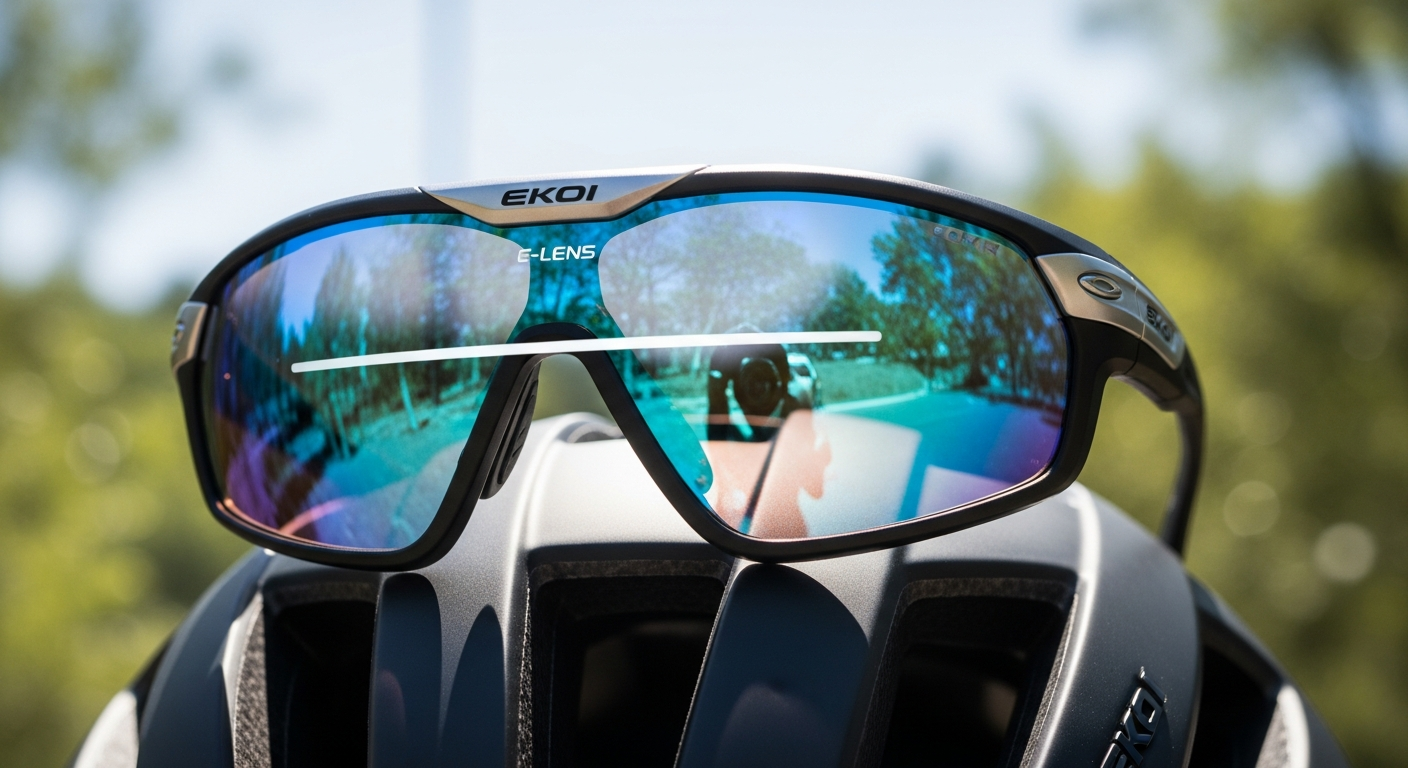
Imagine riding through a tunnel into blinding sunlight without squinting or fumbling with spare lenses. That moment of perfect clarity happens in milliseconds with the Ekoi E-LENS, trusted by professional cyclists racing at WorldTour level. The cycling eyewear market has been dominated by static tinted lenses for decades, forcing riders to choose between sun protection and visibility.
Ekoi changed that equation entirely by engineering the world's fastest electronic LCD cycling glasses featuring solar-powered operation that eliminates battery anxiety. The gap between traditional eyewear and this technology represents a fundamental shift in how cyclists can manage variable lighting conditions during rides. What once required carrying multiple lens options or accepting compromised vision now happens automatically and invisibly.
Discover how the Ekoi E-LENS can transform your cycling experience.
The Technology Behind Instantaneous Lens Adaptation
How the 0.01-second transition works at the molecular level
The Ekoi E-LENS achieves its remarkable speed through advanced electronic LCD technology integrated directly into the lens material. When light sensors detect changing brightness levels, electrical current activates liquid crystal molecules that shift from transparent to opaque states almost instantaneously. This molecular-level transformation happens 1,500 times faster than traditional photochromic lenses, creating a transition so rapid that your eye never experiences the adjustment.
Comparison to traditional photochromic lenses which take 15-30 seconds
Conventional photochromic lenses rely on chemical reactions triggered by UV exposure, a process that requires 15 to 30 seconds to complete. During that window, cyclists navigating sudden lighting changes—entering a tunnel or emerging from shade—face a period of compromised vision. The Ekoi E-LENS eliminates this vulnerability entirely, adapting instantly without any perceptible moment of darkness or brightness adjustment.
The difference between Category 2 light and Category 3 dark lens ratings
Category 2 lenses transmit 18-43% of light and suit variable brightness conditions, while Category 3 lenses transmit 8-18% of light for intense sun exposure. The Ekoi E-LENS transitions seamlessly between these categories, providing Category 2 protection in moderate conditions and shifting to Category 3 when brightness intensifies. This dual-category capability eliminates the need to carry multiple pairs of glasses.
Why imperceptible transitions matter for cyclist safety and comfort
When lens adaptation occurs in 0.01 seconds, your vision remains continuous and uninterrupted. This matters because cycling safety depends on consistent visual clarity—sudden darkening or brightening creates disorientation and can cause dangerous moments where hazards become invisible. The imperceptible transition preserves situational awareness while protecting your eyes from optical shock.
Real-world scenarios where rapid adaptation prevents vision loss in tunnels and tree-lined roads
Consider a cyclist descending a mountain road bordered by dense trees. Rapid transitions between sunlight and shadow occur constantly. With traditional lenses, each shadow creates a momentary dark spot in your vision. On tree-lined routes in urban cycling, the same problem compounds. The Ekoi E-LENS handles these scenarios flawlessly, maintaining consistent visibility whether you're riding through alternating sun and shadow or navigating busy city streets with variable building shade.
Solar Power as a Game-Changer for Cycling Eyewear
Why solar charging eliminates the burden of battery management
Battery-powered electronic glasses introduce an additional maintenance burden. Riders must monitor charge levels, remember to charge before rides, and carry fully charged backup glasses for longer outings. Solar-powered technology removes this friction entirely. The integrated solar cells continuously charge during daylight rides, eliminating anxiety about power depletion and the need for pre-ride charging rituals.
How integrated solar cells capture light energy during rides
The Ekoi E-LENS features solar cells engineered into the frame and lens structure that capture photons during daylight hours. These cells convert light energy into electrical power that operates the electronic lens system and maintains charge reserves. This approach means the glasses literally power themselves through the activity they're designed for—cycling in daylight.
The advantage of ready to use operation without pre-ride charging rituals
Traditional electronic eyewear requires charging time and planning. Solar-powered glasses eliminate this step. Grab them and ride. No charger needed, no planning required. This simplicity matters for casual riders and serious athletes alike, removing barriers to consistent use and eliminating the frustration of dead batteries at the trailhead.
Comparison to battery-powered electronic glasses regarding weight maintenance and reliability
Battery systems add weight and require periodic replacement, which increases long-term costs. Solar charging systems integrate seamlessly into the frame without added weight burden. Regarding reliability, solar technology requires no replaceable components, meaning fewer points of failure and more consistent performance across hundreds of rides.
Performance in low-light conditions during dawn dusk rides and cloudy weather
This is the critical question for solar-powered eyewear. The Ekoi E-LENS handles dawn and dusk rides effectively because sufficient light exists to maintain solar charge. Cloudy conditions present more challenge, but the integrated solar technology still captures sufficient diffuse light for continuous operation. For rides in genuinely low-light conditions—night riding—these glasses function as standard electric lenses without solar replenishment, maintaining their charge from previous daylight exposure.
Experience the freedom of solar-powered cycling glasses with no charging required.
Swiss Engineering Meets Ultralight Design
The 37-gram weight specification and what it means for all-day comfort
Thirty-seven grams is exceptionally light for electronic eyewear. To contextualize: most cycling glasses weigh 25-35 grams, and adding electronic components typically adds 10-15 grams. The Ekoi E-LENS achieves its ultralight status through precision manufacturing and material optimization. This weight means virtually no fatigue during extended rides, even on century-distance cycling events.
Swiss-made lens quality and precision manufacturing standards
Swiss manufacturing carries specific implications for optical precision and quality control. Swiss lens makers follow exacting standards for optical clarity, ensuring minimal distortion and aberration. The Ekoi E-LENS benefits from these standards, delivering sharp, undistorted vision that doesn't degrade peripheral awareness.
Screwed hinges versus riveted hinges durability comparison
Most cycling glasses use riveted hinges that, once damaged, require complete hinge replacement. The Ekoi E-LENS features screwed hinges that allow component replacement without replacing the entire hinge assembly. This design choice extends lifespan and enables maintenance rather than forced replacement, improving long-term durability and value retention.
Adjustable leg tips for custom fit across different head shapes
Adjustable leg tips accommodate different head geometries and accommodate wearing positions over helmets or hair styles. This flexibility ensures the glasses fit securely without over-tightening, which reduces fatigue during long rides and accommodates riders who may want different positioning for different conditions.
How ultralight design doesn't compromise structural integrity
The glasses maintain screwed hinges and solid frame construction despite their light weight. Engineers achieved ultralight status through material selection and manufacturing precision rather than using thinner, weaker materials. This means the 37-gram glasses are durable, not fragile.
Comprehensive UV Protection and Lens Clarity
100% UVA and UVB protection explained and why it's critical
UVA rays penetrate deeply into eye tissue and accumulate over years, contributing to cataracts and macular degeneration. UVB rays cause acute damage and snow blindness. One hundred percent UV protection blocks both wavelengths completely, preventing both short-term discomfort and long-term eye damage. For cyclists spending hours in bright conditions, this protection prevents cumulative damage that compounds across a cycling lifetime.
Long-term eye health benefits of complete UV blocking
Eyes exposed to UV radiation without protection face increased risk of pterygium (tissue growth on the eye surface), cataracts, and age-related macular degeneration. Complete UV blocking prevents these conditions, preserving vision quality into older age. Serious cyclists benefit substantially from comprehensive UV protection across decades of riding.
How electronic lenses maintain optical clarity despite LCD technology
LCD technology integrated into lens material might theoretically degrade optical clarity. However, Swiss engineering ensures the electronic components don't introduce optical distortion. The result is clear, undistorted vision that matches or exceeds traditional lens clarity while providing dynamic light adaptation.
Swiss lens manufacturing and optical precision standards
Swiss optical manufacturing applies standards that minimize optical aberrations and distortions. These standards apply to curvature precision, material homogeneity, and surface quality. The Ekoi E-LENS benefits from these exacting standards, delivering optical quality that supports peripheral vision and accurate depth perception essential for cycling safety.
Anti-reflective coatings and their role in reducing glare
Anti-reflective coatings reduce light reflection from lens surfaces, which improves light transmission and reduces glare. These coatings become particularly valuable when using electronic lenses because the LCD elements might otherwise create internal reflections. The anti-reflective coating ensures maximum light transmission and minimum internal glare.
Waterproof Performance Across Weather Conditions
Waterproof rating and what it means for rain rides
Waterproof construction means electronic components resist water penetration during rain exposure. This matters because electronic cycling glasses represent a significant investment—waterproof design protects that investment and ensures consistent performance regardless of weather. Rain rides remain viable without worrying about moisture damaging internal components.
How moisture doesn't interfere with electronic components
Waterproof sealing isolates electronic circuits and batteries from moisture exposure. This isolation prevents corrosion, short circuits, and electrical failure from rain or sweat. The sealed design maintains performance through wet conditions without degradation.
Durability during wet cleaning and maintenance
After muddy rides, cyclists need to clean eyewear without fear of water damage. Waterproof construction allows aggressive cleaning with water and brushes without worrying about damaging electronic systems. This durability extends maintenance flexibility and keeps glasses looking clear across hundreds of rides.
Performance in humid conditions and fog resistance
High humidity and fog create challenging conditions for any eyewear. Waterproof construction prevents humidity from penetrating lens interiors. Some electronic cycling glasses incorporate anti-fog coatings on internal lens surfaces, further preventing visibility loss in humid conditions.
Salt spray resistance for coastal cycling and sweat management
Coastal cycling exposes eyewear to salt spray that corrodes standard materials. The Ekoi E-LENS construction resists salt corrosion, maintaining functionality across seasons of coastal riding. Additionally, the waterproof design manages sweat without allowing it to damage electronic components, important for intense efforts during climbing or interval training.
Professional Endorsement and Real-World Race Testing
Development partnership with Lotto Soudal Cofidis and Euskaltel Euskadi
The Ekoi E-LENS was developed with input from professional cyclists on WorldTour teams including Lotto Soudal, Cofidis, and Euskaltel Euskadi. These teams compete at the highest levels of professional cycling, where equipment must perform flawlessly under extreme conditions. Their participation in development meant the glasses were tested and refined through genuine racing scenarios.
How professional riders tested and validated the technology
Professional cyclists logged thousands of kilometers in all conditions while testing the technology. They provided feedback on optical quality, comfort, transition speed, and reliability. This real-world testing identified edge cases and optimized performance beyond what laboratory testing alone could achieve. Feedback from professional racers accelerated the development timeline and improved final product quality.
Real-world performance data from competitive cycling environments
Race conditions present extreme demands: temperature fluctuations during stage racing, variable lighting in mountain terrain, extended duration requiring comfort and reliability. The Ekoi E-LENS met these demands repeatedly across racing seasons, demonstrating genuine competitive viability.
Endorsement from elite athletes as a reliability indicator
Professional cyclists won't use equipment that compromises performance. Their choice to race with the Ekoi E-LENS signals confidence in reliability and functionality. This endorsement carries more weight than marketing claims because professionals have alternatives and won't sacrifice performance for any equipment, regardless of sponsorship.
Competitive advantage gained by professional riders using this eyewear
Professional cyclists gained competitive advantage through superior vision management. Faster lens adaptation meant maintaining optimal vision through variable lighting without manual adjustment. Solar charging meant no battery anxiety across multi-week stage races. These factors contributed to professional adoption and continued use across multiple racing seasons.
The Investment Question—Is the Premium Price Worth It?
Breakdown of what drives the premium pricing structure
The premium price reflects several factors: Swiss lens manufacturing, electronic LCD technology, solar cell integration, and professional-grade components. Developing electronic eyewear required engineering investment and testing across racing conditions. The manufacturing precision necessary for 37-gram ultralight construction without compromising durability adds cost. Small production volumes compared to standard eyewear mean higher per-unit costs. These factors compound into a premium price point substantially higher than traditional cycling glasses.
Cost per year of use over a 5-10 year lifespan
If the Ekoi E-LENS costs significantly more than traditional glasses but lasts 5-10 years without degradation, the annualized cost becomes more reasonable. A cyclist using them 200 days annually over 7 years spreads the investment across 1,400 rides. When calculated this way, the per-ride cost approaches that of replacing multiple pairs of traditional glasses over the same period.
Comparison to mid-range and budget electronic cycling glasses
Budget electronic glasses might cost half as much but often feature slower transition times (1-2 seconds rather than 0.01 seconds), battery-dependent operation, and durability concerns. Mid-range electronic glasses improve transition speed and reliability but rarely match Swiss engineering standards or solar-powered convenience. The Ekoi E-LENS premium reflects the gap between entry-level electronic eyewear and race-proven professional equipment.
Resale value and durability justifying the upfront cost
Quality cycling equipment maintains resale value better than budget alternatives. The Ekoi E-LENS's professional reputation and durability mean used pairs retain significant value. A cyclist who purchases, uses, and later sells the glasses might recover 50-70% of the original investment, effectively reducing actual cost significantly.
Hidden costs avoided including no battery replacements or spare lenses needed
Budget analysis must include costs avoided. Traditional glasses require replacement when coatings degrade or lenses scratch. Electronic glasses with batteries require periodic battery replacement (potentially $50-100 per replacement). The Ekoi E-LENS eliminates battery costs and solves variable lighting without carrying spare lenses. Over 7 years, these avoided costs might total $200-400, reducing the net investment substantially.
Practical Considerations Before You Buy
Sizing and fit considerations for different face shapes
Like any eyewear, fit matters significantly. The Ekoi E-LENS comes in sizing options to accommodate different face shapes. Testing fit before purchasing is essential—even premium eyewear that doesn't fit properly becomes uncomfortable during long rides. Many retailers offer try-on periods or fitting guidance to ensure proper sizing.
Compatibility with helmets and helmet ventilation systems
Cycling glasses must coexist with helmets without creating hot spots or pressure points. The adjustable leg tips help accommodate helmet contact, but compatibility varies by helmet model. Riders who switch helmets frequently should test compatibility across their helmet collection to ensure the glasses work with current equipment.
Transition time from traditional lenses to electronic glasses
Cyclists accustomed to static lenses might experience a psychological adjustment period even though the technical adjustment is instant. The dynamic lens behavior requires mental recalibration as lighting conditions shift automatically rather than forcing manual selection. Most riders adapt within a few rides, appreciating the convenience once accustomed to automatic adjustment.
Maintenance requirements and cleaning recommendations
Waterproof construction simplifies maintenance. Gentle cleaning with soft cloths and water is sufficient. Avoid harsh chemicals that might damage anti-reflective coatings. Store in protective cases when not in use to prevent scratches and impact damage. Regular maintenance preserves optical clarity and extends lifespan indefinitely.
Warranty coverage customer support and break-in period
Manufacturer warranty typically covers defects and malfunctions for specified periods (often 1-2 years). Customer support quality matters when troubleshooting issues. A break-in period of several rides allows adjustment to the glasses before committing to extended use. Understanding warranty terms and support options before purchase prevents frustration if issues arise.
The Future of Cycling Vision Is Here—And It's Solar-Powered
The Ekoi E-LENS Electronic Cycling Glasses represent more than incremental improvement to cycling eyewear—they're a technological leap forward addressing a genuine problem every cyclist faces. That 0.01-second lens transition might sound like a minor detail, but when navigating variable light conditions at speed, it's the difference between clear vision and dangerous blind spots. The solar-powered design removes friction from using electronic eyewear, making these glasses genuinely practical for daily rides, not just weekend adventures.
The price tag is substantial, reflecting Swiss engineering, race-proven reliability, and technology that simply didn't exist five years ago. For serious cyclists spending significant time on the road, this investment pays dividends in safety, comfort, and the elimination of eyewear-related compromises. The combination of instantaneous adaptation, zero-maintenance solar power, and ultralight durability addresses every frustration cyclists experience with traditional eyewear.
If static lenses have frustrated you or you've been intrigued by what professional cyclists use in competition, the Ekoi E-LENS deserves your attention. The technology is mature, tested across racing seasons, and refined through feedback from elite athletes. This isn't experimental equipment—it's battle-tested gear proven to perform when performance matters most.
Invest in the future of cycling vision—explore the Ekoi E-LENS today.
Leave a Reply