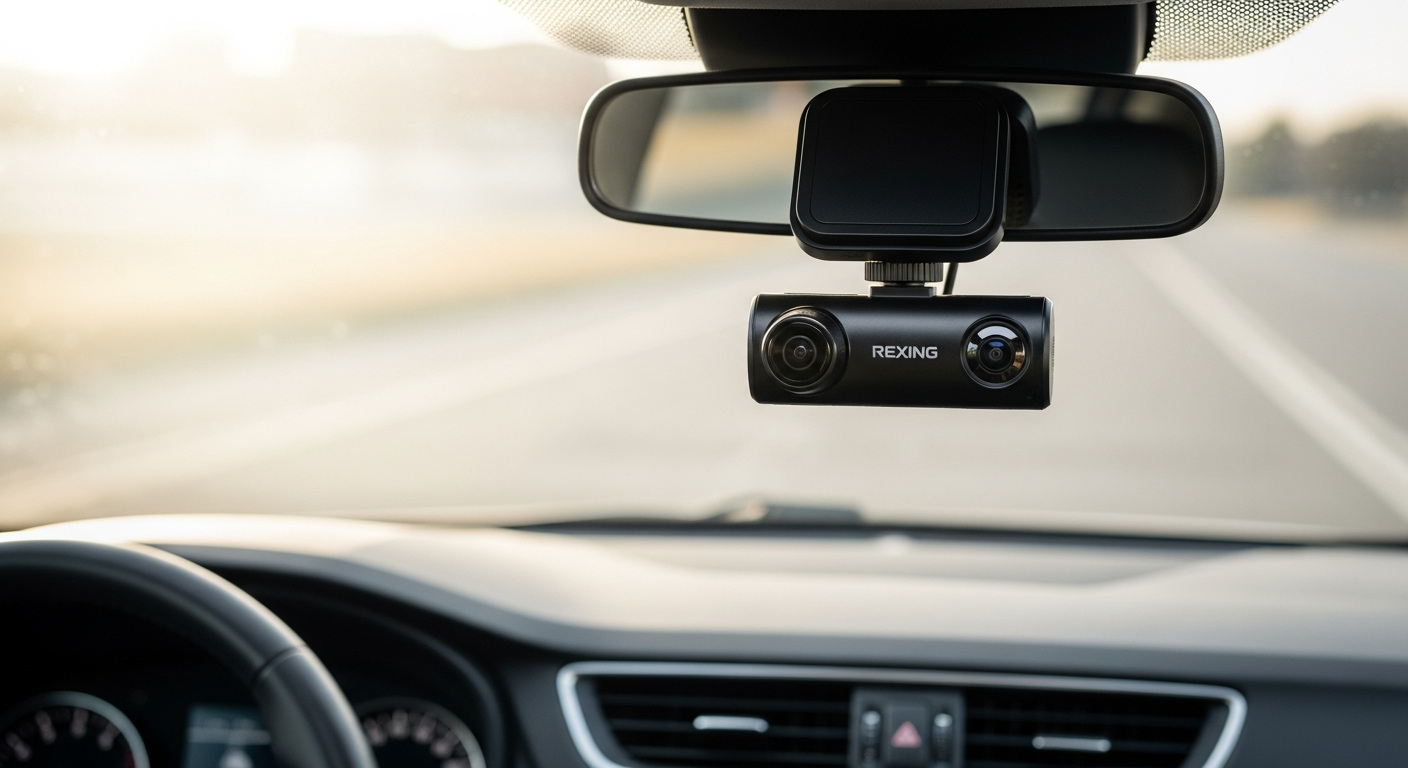
Rideshare drivers and commercial fleet operators face unique liability challenges—one fender bender or passenger dispute can spiral into costly legal battles. The Rexing V1P Pro Dual Dash Cam has become the go-to choice for professional drivers who need both front and rear coverage without breaking the bank. Unlike consumer-grade dash cams, this system delivers simultaneous dual-channel recording, integrated GPS tracking, and smartphone access—features that commercial operations depend on.
At $150-$200, it strikes the sweet spot between affordability and professional-grade functionality. In this guide, I'm breaking down how the V1P Pro performs in real-world commercial driving scenarios, from installation through daily operation. You'll discover which features matter most for protecting your income, how to maximize its dual-camera setup, and whether the supercapacitor design truly holds up under constant use.
Check the Rexing V1P Pro Dual Dash Cam today to secure your professional driving protection.
Why Commercial Drivers Need Dual-Channel Dash Cam Coverage
Rear camera protection against hit-and-run incidents and false liability claims represents one of the strongest arguments for dual-channel systems. A single front-facing camera leaves your vehicle's rear exposed—precisely where rideshare passengers exit and where other drivers make unseen contact. The rear unit documents everything behind you, creating an insurance claim advantage that standalone front cameras simply cannot match.
Front camera documentation captures road hazards, traffic violations, and passenger behavior with equal importance. Whether a pedestrian steps into traffic or a passenger becomes disruptive, you have visual evidence of what actually happened. Simultaneous recording eliminates those dangerous gaps in coverage during critical moments. If your front camera is focused on the road ahead, it cannot simultaneously monitor your blind spots or rear quarter panels. The V1P Pro solves this by recording both angles at the same time.
Legal admissibility of dual footage in insurance disputes and court proceedings carries serious weight. Insurance adjusters and judges recognize dual-camera documentation as more credible than single-angle accounts. When liability falls into a gray area, that second camera angle often determines whether you win or lose the claim.
Dual Recording Capabilities: What the V1P Pro Actually Delivers
The front camera operates at 1080p resolution at 30 frames per second when running in dual mode, capturing clear vehicle details, license plates, and road conditions simultaneously with the rear unit. When you disable the rear camera and run front-only mode, resolution climbs to 4K at 24 frames per second or 1440p at 30 frames per second, offering significantly sharper single-angle footage.
The rear camera maintains 1080p at 30 frames per second synchronized perfectly with the front unit. This synchronization matters tremendously in incident analysis—you can reference exact timestamps across both angles to establish sequence of events without guesswork. Both units feature 170-degree ultra-wide-angle lenses that minimize blind spots and capture surrounding traffic you'd otherwise miss with standard focal lengths.
Simultaneous recording ensures no missed moments during incidents. Unlike dash cams that toggle between front and rear, the V1P Pro never forces you to choose which direction to monitor. Every second you spend on the road gets documented from both perspectives.
GPS Tracking and Data Logging for Fleet Management
The built-in GPS logger records location, speed, time, and date directly onto every video frame. This embedded metadata becomes invaluable when disputes arise—you can prove your actual speed at the moment of incident, verify whether you were within posted speed limits, and confirm your precise location.
Speed data embedded in footage helps dispute false speeding accusations that passengers or other drivers might lodge. When someone claims you were driving recklessly, you have timestamped visual proof showing your actual velocity. Location tracking creates accountability for route compliance and service area boundaries, making it particularly valuable for fleet managers overseeing multiple drivers.
Fleet managers gain the ability to review driving patterns and identify high-risk routes where collisions cluster or aggressive driving occurs. This data enables proactive route adjustments and targeted driver coaching before incidents happen rather than after.
Wi-Fi Connectivity and Mobile App Integration for On-the-Go Access
Wireless footage transfer eliminates the need to remove microSD cards at the end of every shift. You can transfer incident footage directly from your vehicle to your smartphone while parked between rides, preserving evidence without fumbling with card readers and cables. The smartphone app allows quick review of incidents without returning to your vehicle—critical when you're handling passenger disputes that need immediate attention.
Real-time sharing capability for insurance companies and fleet dispatchers accelerates claim processing. You email footage directly to your insurance adjuster from the road rather than waiting until you return to an office. This responsiveness often influences how quickly claims get resolved.
Explore the V1P Pro's connectivity features and transform how you manage incident documentation.
App limitations and occasional connectivity issues require realistic expectations. Some users report the mobile app can feel clunky or experience connectivity problems in areas with weak Wi-Fi signals. These aren't dealbreakers for most commercial drivers, but they're worth acknowledging when planning your workflow around the system.
Supercapacitor Advantage: Why Temperature Resilience Matters for Commercial Use
The supercapacitor design replaces traditional lithium-ion batteries, a critical distinction for vehicles operating in extreme conditions. Lithium-ion batteries degrade rapidly in intense heat—dashboard temperatures in parked vehicles exceed 160°F during summer months, slowly degrading battery capacity with each cycle. The supercapacitor withstands this thermal stress without capacity loss, maintaining consistent performance across years of operation.
Enhanced durability in extreme heat particularly benefits drivers in desert routes, sunny parking lots, and regions with brutal summers. Your dash cam won't experience the battery deterioration that compromises other systems after 18-24 months of heavy use.
Superior cold-weather performance matters equally for winter deliveries and early morning shifts when vehicles sit in freezing temperatures. Lithium batteries struggle to function when cold, sometimes failing to power on until the cabin warms. Supercapacitors deliver reliable startup even in subzero conditions.
Longer operational lifespan reduces replacement costs for fleet operators managing dozens of vehicles. If standard dash cams last 2-3 years before battery degradation becomes noticeable, supercapacitor units routinely exceed 4-5 years of reliable performance with minimal maintenance.
Real-World Performance: Daytime vs. Nighttime Recording Quality
Daytime clarity excels across both camera units. Vehicle identification, license plate readability, and road condition documentation all capture with excellent detail under normal lighting. Colors render naturally, and the wide-angle lenses provide sufficient context to understand traffic situations completely.
Wide Dynamic Range (WDR) technology handles bright sunlight and shadows effectively, preventing overexposed blown-out skies or underexposed areas where details disappear into darkness. This matters tremendously when sunlight streams through car windows or when you're transitioning between shaded and sunny areas.
Night recording delivers acceptable performance with reduced license plate legibility at distance. The rear camera particularly shows this limitation—plates on vehicles several car lengths behind you may not read clearly enough for identification purposes. The front camera performs better at night than the rear, but neither matches daytime clarity.
Practical workarounds for improving low-light footage quality include strategic camera positioning to maximize available light, ensuring your windshield and camera lenses stay clean (dirt dramatically reduces night performance), and considering supplementary interior or exterior lighting if nighttime recording proves critical for your routes.
Installation and Mounting for Maximum Coverage in Commercial Vehicles
The discrete wedge-shaped design fits behind the rearview mirror without obstruction, maintaining visibility while keeping the camera largely invisible to passengers—an important consideration for rideshare drivers who prefer unobtrusive monitoring.
Cable routing best practices require running wires along vehicle headliners and down A-pillars rather than across the windshield where passengers notice them. This routing prevents tampering and maintains the professional appearance your commercial operation requires. Hardwiring options enable continuous recording during parked periods when you're not actively driving, catching parking lot damage or overnight incidents.
Accessibility for regular maintenance and microSD card swaps should factor into your mounting decisions. Mount the unit where you can reach it easily during your break between shifts, avoiding awkward overhead reaches that waste time.
Incident Detection and Video Locking: Protecting Evidence Automatically
The G-sensor automatically detects collisions and hard braking events, triggering immediate video locking that prevents overwriting of critical footage. When impact occurs, the system flags those files as protected, preserving evidence even as loop recording continues elsewhere on the card.
Automatic video locking operates seamlessly in the background—you don't need to remember which incidents require protection. The sensor handles it for you. Manual locking capability allows drivers to flag suspicious events they've identified, like aggressive horn blasts or aggressive lane changes that might escalate into incidents.
Integration with fleet management systems enables real-time incident alerts sent to dispatchers the moment a collision or hard braking occurs. Dispatchers can immediately reach out to drivers for situational updates and incident reporting.
Storage Solutions and MicroSD Card Management for Heavy Recording
The system supports microSD cards up to 256GB, providing extended recording capacity for commercial drivers running 12+ hour shifts. Recording duration calculations depend on your resolution settings—dual 1080p recording consumes roughly 1.2GB per hour, meaning a 256GB card stores approximately 200+ hours of dual footage before requiring replacement.
Loop recording prevents storage overflow and ensures continuous protection by automatically overwriting oldest footage once the card fills. Unless files are locked by the G-sensor or manually protected, new recordings overwrite old ones, eliminating the need to monitor remaining storage constantly.
Backup strategies for preserving critical incident footage should include regular uploads to cloud storage or external hard drives. Don't rely solely on the microSD card—accidents happen, cards get corrupted, and theft occurs. Maintain redundant copies of high-value incident footage.
Cost-Benefit Analysis for Rideshare and Delivery Operations
The $150-$200 price point delivers remarkable value compared to competing dual-camera systems that often exceed $300-$400. You're not paying for enterprise features you don't need or unnecessary complexity.
ROI calculation based on insurance claim reductions turns this into a no-brainer for high-risk operators. A single prevented false liability claim—where the other driver or a passenger tries to blame you for an incident you didn't cause—can save $5,000-$25,000 in legal fees, increased premiums, and claim payouts. One or two successful claim defenses recover your entire investment.
Potential savings from liability dispute prevention compound over years. Rideshare drivers averaging 60+ trips weekly face incident exposure constantly. Having documented evidence reduces your insurance claim frequency, which directly impacts premium increases and deductible payments.
Warranty coverage and support considerations matter for professional equipment. Rexing provides reasonable warranties, and customer support responsiveness factors into long-term satisfaction.
Limitations to Consider Before Purchasing for Commercial Use
Night vision performance gaps may require supplementary solutions depending on your routes. If 30% or more of your driving occurs after sunset, you should test footage samples in actual lighting conditions before committing to the V1P Pro as your sole protection strategy.
Mobile app functionality issues reported by some commercial users suggest building your workflow around direct microSD card transfers rather than depending entirely on wireless access. The app works fine for quick reviews, but treating it as your backup recovery method sets you up for frustration.
License plate readability limitations in dual-channel 1080p mode at distance present genuine challenges for identifying vehicles several car lengths away. This matters less for collision documentation and more for identifying hit-and-run vehicles that don't impact you but cause damage.
Wi-Fi connectivity inconsistencies in areas with poor signal occasionally prevent smooth footage transfers. Urban drivers experience fewer issues; rural operators might struggle with dead zones.
Maximizing Your Investment: Setup Tips and Best Practices
Optimal camera positioning for rideshare passenger monitoring requires balancing passenger comfort with evidence documentation. The rear-facing interior camera should capture the backseat without creating an obvious surveillance environment that makes riders uncomfortable.
Regular firmware updates maintain performance and security, protecting against software vulnerabilities and ensuring compatibility with new smartphone operating systems. Check for updates monthly and apply them during your regular maintenance cycle.
MicroSD card maintenance schedules should include replacement every 12-18 months of heavy use, even if no physical failures occur. Card degradation happens gradually—sudden failures become more likely as cards age. Rotating out aging cards prevents data loss from unexpected failures.
Integration with fleet management dashboards and telematics systems maximizes the V1P Pro's value for multi-vehicle operations. Some fleet software platforms accept GPS data feeds from dash cams, consolidating driver behavior analysis into unified platforms.
The Bottom Line for Professional Drivers and Fleet Operators
The Rexing V1P Pro Dual Dash Cam delivers exactly what commercial drivers need: simultaneous front and rear protection, GPS accountability, and smartphone convenience—all without the premium price tag of enterprise-level systems. Its supercapacitor design proves its durability matters when your vehicle runs 12+ hours daily, and the dual 1080p recording setup covers the liability gaps that cost rideshare and delivery drivers thousands annually.
I recommend this system to any commercial driver operating in competitive markets where passenger disputes and liability claims are routine. The peace of mind alone—knowing you have documented evidence from two angles—justifies the investment. If night recording is critical for your routes, budget for supplementary lighting or position cameras strategically. If you're managing a fleet, the V1P Pro scales efficiently across multiple vehicles without requiring expensive monthly subscriptions or complex backend infrastructure.
Ready to protect your income and reputation? Start by assessing your specific needs and make an informed decision that prioritizes your protection on the road. Get your Rexing V1P Pro Dual Dash Cam now and take control of your commercial driving protection.
Leave a Reply