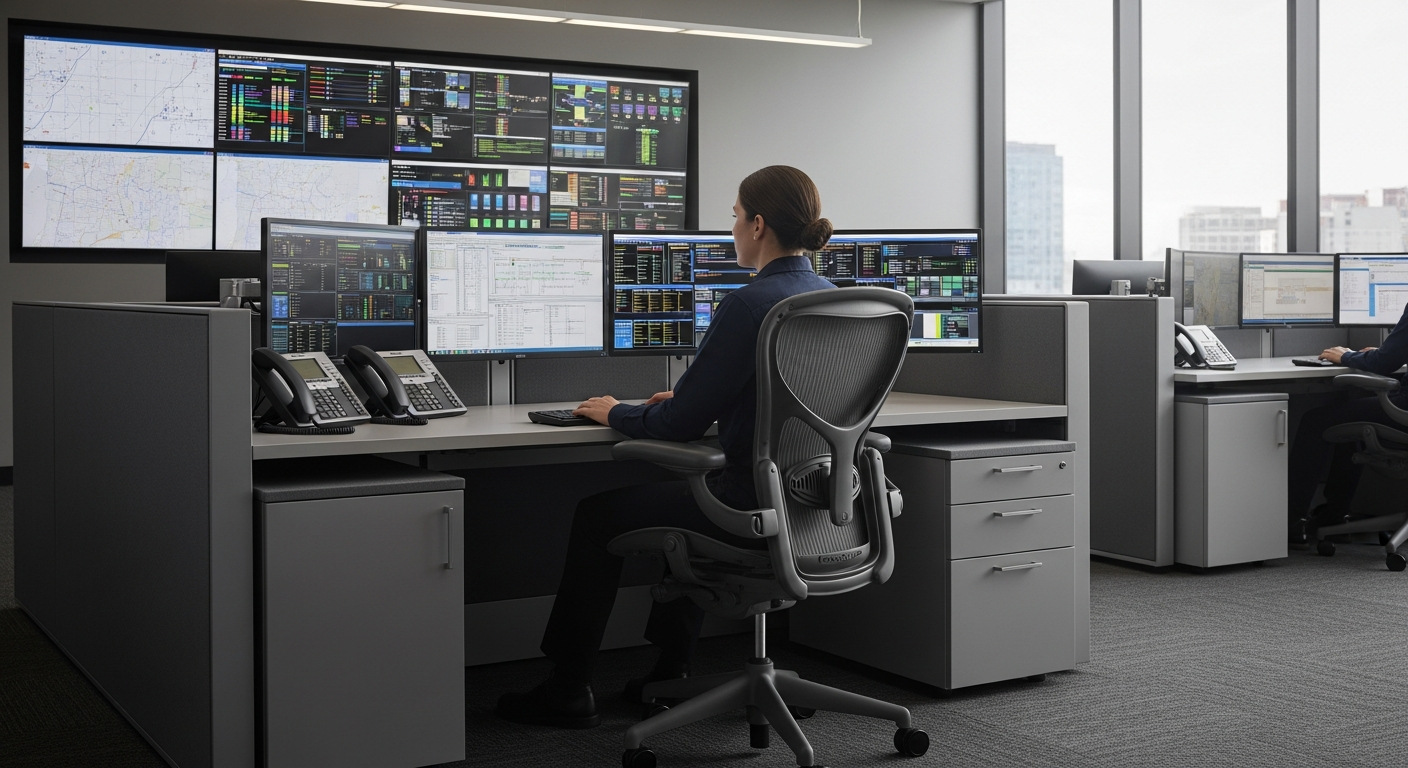
Why Dispatch Centers and Emergency Services Demand Heavy-Duty Task Seating
More than 80% of dispatch center operators report chronic back pain after their shifts—yet most facilities are still furnishing workstations with standard office chairs designed for a completely different purpose. The difference between a chair built for an 8-hour office job and one engineered for 24-hour continuous operations isn’t subtle; it’s the difference between discomfort and disability.
Dispatch centers, hospitals, and emergency call facilities operate in a fundamentally different paradigm than traditional offices. When an operator sits for 12, 16, or even 24 hours straight monitoring emergency calls, tracking incidents, or coordinating emergency response, their body experiences cumulative stress that standard seating simply wasn’t designed to handle. The weight distribution, lumbar support, and pressure point management required for marathon shifts demand engineering specifically built for those conditions.
The OFM 247 Series wasn’t designed in a corporate office but was built by professionals who understand what happens when humans push their bodies to the limit in high-stakes environments. This guide reveals exactly why dispatch managers and facility directors choose the OFM 247 over cheaper alternatives, including its 400-pound weight capacity, antimicrobial upholstery advantage, 11 adjustable components, and whether the $419 investment genuinely delivers the value OFM claims.
Explore the OFM 247 Series and find your ideal configuration today.
The Physical Toll of Extended Shifts on Standard Office Chairs
Standard office chairs fail in environments requiring continuous occupancy because they’re optimized for moderate use over predictable timeframes. A typical office task chair assumes 8-hour daily use with breaks, lunch periods, and recovery time. When an operator sits for 16 consecutive hours without standing, the accumulated pressure on the sacrum, lumbar spine, and hip joints becomes a medical issue rather than a comfort preference.
Worker compensation claims in dispatch centers routinely cite musculoskeletal disorders as the leading injury category. Facilities using budget office chairs often see claims for chronic back pain, sciatica, and herniated discs that cost thousands per incident. The financial impact extends beyond direct medical costs—operators taking medical leave create staffing gaps in environments where continuity is critical.
How 24/7 Operations Differ from Traditional 8-Hour Ergonomic Requirements
The ergonomic principles governing an 8-hour office environment become insufficient in a 24/7 operation. Operators in police dispatch centers or hospital command centers may work shifts lasting 12, 16, or even 24 hours. During these extended periods, lumbar support must remain consistent, seat cushioning must resist compression, and adjustability must accommodate minor position shifts without requiring the operator to stand.
A chair engineered for 24-hour use builds in thicker padding—the OFM 247 uses 3-inch cushioning designed to resist the compression that occurs over marathon sessions. The adjustment mechanisms are calibrated for fine-tuning rather than major repositioning, allowing operators to make micro-adjustments without leaving their post.
The Connection Between Proper Seating and Operator Accuracy
Comfort and cognitive performance are directly linked, particularly in high-pressure environments. Research in occupational ergonomics consistently shows that physical discomfort impairs decision-making, slows response times, and increases error rates. A police dispatcher managing multiple incidents simultaneously while experiencing back pain operates at a disadvantage—attention diverts from the task to pain management.
Facilities upgrading from budget chairs to purpose-built solutions like the OFM 247 report measurable improvements in operator focus and incident response accuracy. When physical discomfort is eliminated, cognitive resources dedicated to pain management become available for the actual work.
Why Facilities Upgrading See Immediate Staff Retention Improvements
Operator burnout in dispatch centers correlates strongly with physical discomfort. Many experienced dispatchers leave the profession citing chronic pain and physical fatigue as primary factors. Facilities that invest in proper seating report higher retention rates among veteran operators—they stay because the job becomes sustainable rather than punishing.
The financial impact of replacing an experienced operator extends far beyond the hiring process. Training, productivity ramp-up, and institutional knowledge loss create costs that quickly exceed the price difference between budget seating and purpose-built solutions.
Decoding the OFM 247’s 11-Point Customization System
The OFM 247 distinguishes itself through an extensive adjustment system that goes far beyond the basic height and tilt controls found on standard office chairs. With 11 distinct customization points, this chair accommodates the specific anatomy and preference variations that exist across any diverse workforce.
Pneumatic Gas Lift Seat Height Adjustment (19–23 Inches)
The seat height range of 19 to 23 inches accommodates users from shorter operators to tall individuals, ensuring feet rest firmly on the floor or footrest at any setting. This seemingly simple adjustment has profound implications—when feet don’t reach the ground, operators experience pressure on the backs of their thighs, circulation issues, and postural compensation that creates secondary pain points. The pneumatic gas lift mechanism allows smooth, fingertip adjustment without requiring tools or significant effort.
Seat Depth and Back Height Controls
Seat depth adjustment prevents the front edge of the cushion from pressing into the operator’s knees—a pressure point that builds throughout a long shift. Back height adjustment allows operators to position lumbar support at the exact level where their spine curves, which varies significantly between individuals. Some operators benefit from support at the mid-back, while others require lower lumbar positioning.
Back Depth and Back Pitch Adjustments
Back depth controls how far the backrest extends away from the operator’s spine. Some individuals prefer firm contact along most of their back, while others find a shallower backrest more comfortable. Back pitch adjustment allows the backrest to angle forward or backward, supporting natural spinal curves for different body types. These refinements enable near-universal accommodation across diverse operator populations.
Configure your OFM 247 with the perfect ergonomic settings for your facility.
The 400-Pound Weight Capacity Advantage for Big & Tall Users
A 400-pound weight capacity places the OFM 247 in the category of commercial heavy-duty seating rather than standard office furniture. This specification addresses a real gap in workplace seating options—the majority of office chairs cap out at 250 pounds, effectively excluding larger individuals from purpose-built seating.
Why Standard Office Chairs Fail Users Above 250 Pounds
Standard office chair frames use materials and welding techniques calculated for the loads they’re designed to carry. Exceeding those specifications creates structural stress that manifests as creaking, shifting, or catastrophic failure. Beyond safety concerns, larger individuals using standard chairs experience inadequate support because the cushioning and base geometry weren’t engineered for their weight distribution.
The structural engineering behind the OFM 247’s 400-pound capacity involves reinforced materials throughout the frame, heavier-gauge steel in critical joints, and a pneumatic cylinder rated for the full load. The chair doesn’t simply accommodate heavier users—it performs optimally across the entire weight spectrum.
The 27-Inch 5-Star Base Design and Weight Distribution
The 27-inch five-point base provides stability geometry that distributes weight evenly across five casters rather than the four-point bases common in lighter-duty chairs. This design prevents the tipping risk that can occur when heavier users shift their weight or lean back. The geometric spacing of the five points creates a wider footprint that resists overturning even when the chair tilts at extreme angles.
Reinforced Frame Construction and Material Specifications
The OFM 247’s frame uses heavier-gauge steel in the spine, seat frame, and base connections. Welding specifications call for full penetration welds at high-stress joints rather than the spot welds adequate for lighter loads. Material selection prioritizes strength and fatigue resistance—the chair must maintain structural integrity through years of continuous use with operators at the upper weight range.
Antimicrobial Vinyl vs. Commercial-Grade Fabric: Which Upholstery Wins for Your Facility?
The OFM 247 offers a choice between antimicrobial vinyl and commercial-grade stain-resistant fabric, each serving different facility requirements and operational priorities.
Antimicrobial/Antibacterial Vinyl for Healthcare and Shared Dispatch Spaces
Hospitals, healthcare facilities, and shared dispatch environments benefit significantly from antimicrobial vinyl upholstery. This material resists bacterial growth, fungal colonization, and viral transmission on the chair surface—critical considerations in healthcare settings where infection control directly impacts patient outcomes. The vinyl cleans easily with standard hospital-grade disinfectants and resists staining from blood, bodily fluids, or other biological materials common in emergency settings.
Police dispatch centers and emergency call facilities operating with multiple operators across shifts also benefit from antimicrobial properties, particularly when operator illness is a concern for continuity.
Commercial-Grade Stain-Resistant Fabric for General Office Environments
Stain-resistant fabric offers superior comfort properties for facilities without biological contamination concerns. The fabric breathes better than vinyl, reducing heat buildup during long shifts and providing a more comfortable tactile experience. Stain resistance handles spilled coffee, ink, or food residue effectively while maintaining the softer feel operators prefer for extended occupancy.
General dispatch centers, administrative offices, and non-healthcare facilities typically find fabric upholstery provides better overall comfort balance when infection control isn’t a primary concern.
The 3-Inch Padding Thickness and Sustained Comfort
The 3-inch cushion thickness on the OFM 247 resists compression far more effectively than the 1 to 1.5-inch padding found on standard office chairs. Compression happens gradually over a long shift as foam breaks down and loses its supportive properties. Thicker, high-density foam maintains its cushioning properties across 12, 16, and 24-hour shifts, preventing the “bottoming out” sensation where operators feel the chair frame beneath them.
The 10-Year Warranty Breakdown and What It Actually Covers
OFM backs the OFM 247 with a comprehensive warranty structure that reflects the company’s confidence in the chair’s durability:
Lifetime Warranty on the Chair Frame
The structural frame—including the seat base, backrest structure, and primary welds—carries a lifetime warranty against manufacturing defects. This coverage provides genuine peace of mind that the core structure won’t develop cracks, breaks, or stress failures during the chair’s operational life.
7-Year Cylinder Warranty
The pneumatic lift mechanism receives 7-year coverage, protecting against premature failure of the gas cylinder that controls seat height adjustment. This timeframe aligns with the typical service life of pneumatic components in continuous-use environments.
2-Year Upholstery Warranty
Fabric and vinyl receive 2-year coverage against manufacturing defects, seam separation, and material degradation. This timeframe acknowledges that upholstery experiences normal wear in busy facilities while still protecting against manufacturing quality issues.
The $419 Investment: Total Cost of Ownership for Dispatch Centers
The base price of $419 for the fabric version provides a starting point for cost analysis, but true cost of ownership includes several additional factors.
Base Chair Cost and Vinyl Pricing
The fabric version runs approximately $419, with the antimicrobial vinyl option typically priced within a similar range. Facilities requiring the infection control properties of vinyl should budget accordingly, though the price difference often proves negligible in the context of total facility costs.
Hidden Costs: Assembly, Shipping, and Installation Labor
Assembly is required but generally straightforward, though some users note minor instruction discrepancies. Facilities should budget staff time for assembly or outsource to installation services. Shipping costs vary by location and order size, with bulk orders to single facilities typically receiving volume pricing. Installation labor—securing the chair, testing adjustments, and training operators—represents an additional cost that shouldn’t be overlooked.
ROI Calculation: Worker Compensation Claims and Staff Retention
The financial return becomes compelling when compared against worker compensation costs and operator turnover. A single musculoskeletal disorder claim in a dispatch center easily exceeds the chair’s cost. Retaining an experienced operator rather than replacing them—including recruiting, hiring, and training costs—typically justifies the OFM 247 investment within 12 to 18 months.
Facilities upgrading entire dispatch centers from budget seating report measurable reductions in claims, absenteeism, and turnover that dwarf the equipment investment.
Real-World Performance in Hospitals, Police Dispatch, and Emergency Services
The OFM 247’s popularity stems from validated performance in actual high-demand environments rather than marketing claims alone.
Operator Feedback on Comfort During Extended Shifts
Dispatch operators using the OFM 247 consistently report significant comfort improvements compared to standard office chairs during 12, 16, and 24-hour shifts. Operators specifically cite the adjustable lumbar support and seat depth as game-changers for marathon sessions. Police dispatchers in departments using the OFM 247 report reduced back pain even during the longest shifts.
Hospital command centers and emergency departments have documented operator satisfaction scores improving measurably after deployment of the OFM 247, with operators specifically noting reduced fatigue during 24-hour coverage periods.
Durability Reports After Continuous Use
Multi-year deployments show the OFM 247 performing reliably under the continuous-use conditions it was designed for. After one year of 24/7 operation in busy dispatch centers, chairs show minimal wear beyond normal cosmetic marks. Three and five-year reports from facilities with sufficient equipment age show the chairs maintaining structural integrity and functional adjustments without significant degradation.
The pneumatic lift mechanism—often the first component to fail in office chairs—remains reliable across reported continuous-use periods, validating the 7-year cylinder warranty.
Making the Decision: Is the OFM 247 Right for Your Facility?
Determining whether the OFM 247 merits investment requires honest assessment of your facility’s specific requirements.
Assessment Questions Regarding Shift Length, Operator Count, and Facility Type
Start by defining your operational parameters: Do operators work 8-hour shifts or longer? How many personnel rotate through each station? Is your facility healthcare, emergency services, administrative, or another environment? Does your operator population include individuals requiring higher weight capacity? Will antimicrobial properties benefit your facility’s infection control priorities?
Facilities with operators working 12+ hour shifts or continuous 24-hour coverage clearly benefit from purpose-built heavy-duty seating. Emergency services and healthcare facilities gain additional advantages from antimicrobial options and robust durability. Administrative offices with standard 8-hour schedules may find adequate value in lighter-duty alternatives, though the OFM 247 remains viable if budget permits.
Pilot Program Approach
Testing the chair in one or two stations before full deployment provides valuable feedback without committing to a large purchase. Pilot programs allow operators to experience the ergonomic adjustments firsthand and provide input on which upholstery option and caster type best serves your facility. This approach also reveals any assembly or installation issues before scaling to facility-wide deployment.
Customization Checklist
Document your facility’s requirements for upholstery (antimicrobial vinyl vs. stain-resistant fabric), caster type (standard, hard floor, or glides), and any special configuration needs. The OFM 247’s extensive adjustability accommodates diverse operator needs, but confirming these specifications before ordering prevents delays and ensures you receive the exact configuration your facility requires.
The Bottom Line: Heavy-Duty Seating That Delivers on Its Promises
The OFM 247 Heavy Duty Ergonomic Task Chair occupies a rare space in the seating market—it’s genuinely engineered for the environments where it’s deployed, not retrofitted from a generic office design. For $419, you’re getting a purpose-built solution that dispatch managers, hospital administrators, and emergency services directors have already validated through real-world deployment across hospitals, police departments, and emergency call centers.
The 10-year frame warranty, consistent durability reports across multiple years of continuous use, and documented staff retention improvements tell a compelling story that budget alternatives simply can’t match. The 400-pound weight capacity ensures inclusive seating for diverse operator populations, while the 11-point customization system accommodates the unique ergonomic needs of individual users. Antimicrobial options serve healthcare facilities effectively, and stain-resistant fabric provides comfort advantages for general environments.
If your facility operates continuous shifts, serves users of varying sizes, or needs reliable seating that won’t require replacement every few years, the OFM 247 deserves serious consideration. Start by identifying your specific requirements—shift length, operator count, facility type, and upholstery priorities—and comparing the total cost of ownership against your current seating strategy. The financial math typically favors the OFM 247 within 18 months when you factor in reduced worker compensation claims, lower turnover costs, and improved operator retention.
Visit OFM Office today to configure your OFM 247 and transform your facility’s seating strategy.
Leave a Reply