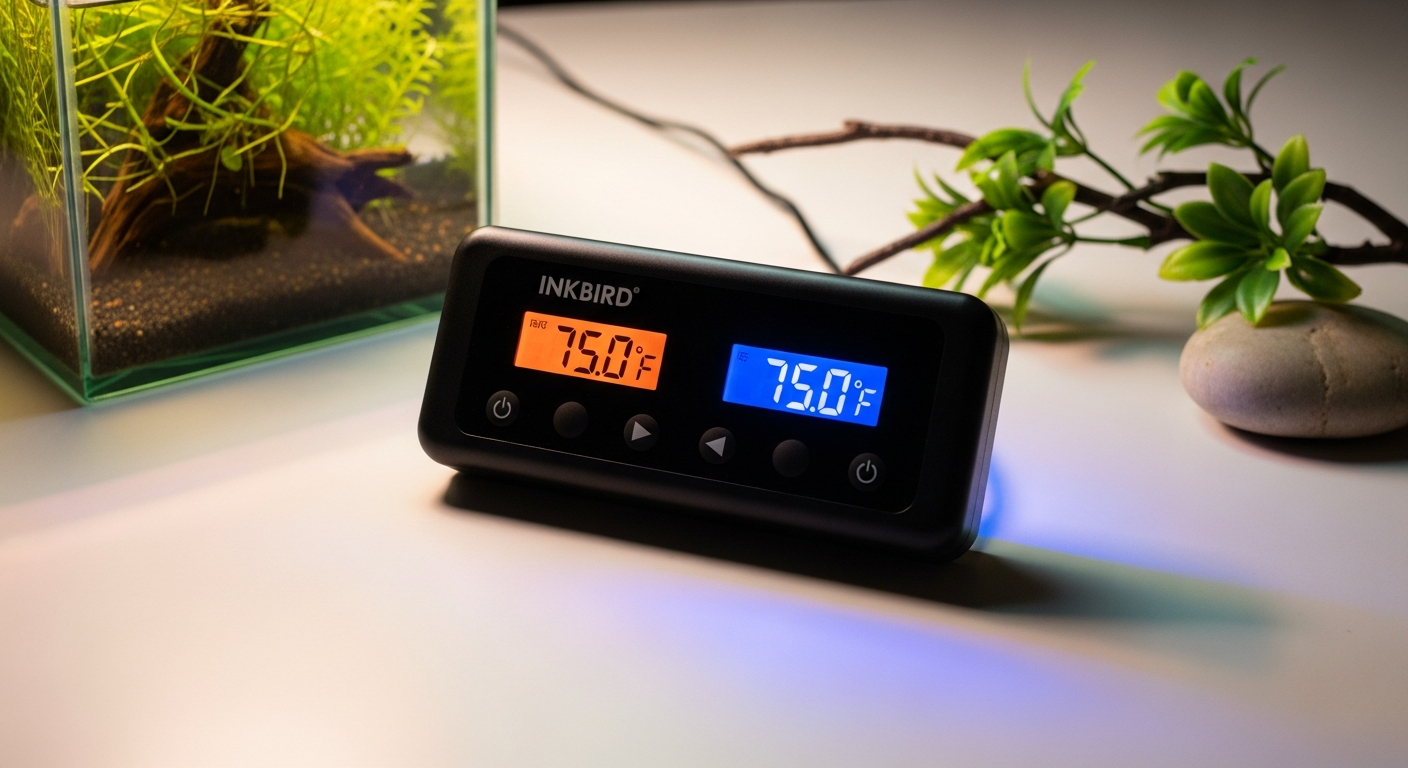
Temperature swings of just a few degrees can spell disaster for aquatic ecosystems and reptile habitats. Whether you're nurturing a thriving planted tank, managing a sensitive bearded dragon enclosure, or maintaining a python's precise thermal gradient, the margin for error is razor-thin. The Inkbird ITC-308 has emerged as a game-changing solution in the temperature control space, sitting at the sweet spot between affordability and functionality at $35-$50.
This dual-stage digital controller's plug-and-play design eliminates the intimidation factor that keeps many people from automating their environments. No complex wiring. No technical background required. Just straightforward functionality that works from day one.
Discover the Inkbird ITC-308 and transform your temperature control setup today.
This guide reveals how its dual relay system maintains stable conditions, explores real-world applications beyond the basics, walks through the setup process, and identifies whether this controller fits your specific needs. By the end, you'll have the knowledge to make a confident purchasing decision.
How the Dual-Stage Temperature Control System Actually Works
The ITC-308's core strength lies in its dual relay output, which enables simultaneous control of both heating and cooling devices. This means the unit can maintain a precise temperature range by activating a heater when conditions drop below a set point and a cooler when they rise above another. Unlike single-stage controllers that manage only heating or only cooling, this dual capability creates genuine environmental stability.
Temperature set points function as your system's boundaries. You define an upper threshold and a lower threshold, and the controller automatically switches between heating and cooling modes based on real-time measurements. The device continuously compares the measured temperature against your target temperature, adjusting outputs instantaneously to prevent overshoot and maintain equilibrium.
The dual display window shows both the measured temperature and the set target temperature simultaneously, eliminating guesswork during operation. You can switch between Celsius and Fahrenheit readings depending on your preference or regional standards.
Compressor delay protection is a feature often overlooked but genuinely valuable for cooling equipment. When your cooler cycles off, the system prevents immediate restart, protecting the compressor from stress that shortens its lifespan. This passive protection keeps refrigeration units running smoothly across thousands of cycles.
The ITC-308 handles a maximum output load of 10 Amps or 1100W at 110V, making it suitable for standard aquarium heaters, reptile heating pads, and small cooling units. Understanding your equipment's power draw ensures you stay within safe operating limits.
Automatic switching between heating and cooling modes happens without user intervention. The device detects temperature deviations and activates the appropriate relay instantly. This responsiveness prevents the temperature fluctuations that stress animals and compromise sensitive biological processes.
Setup and Installation for Different Aquarium Setups
Plug-and-play wiring means minimal fuss during installation. Standard aquarium heaters and chillers connect directly to the ITC-308's output sockets. The sensor connects to the temperature input, and you're ready to calibrate set points. No soldering required. No advanced electrical knowledge necessary.
Sensor placement determines reading accuracy. Position the probe in the area where your animals spend the most time or where temperature variations matter most. For aquariums, mid-water placement in the tank avoids false readings from water near the heater or chiller intake. For reptile enclosures, place the sensor in the basking zone you want to maintain.
Connecting multiple heating elements requires creative solutions since the standard ITC-308 has single heating and cooling sockets. External relay modules can expand your capacity, splitting the load across multiple devices while the controller manages a single output. This workaround maintains the unit's simplicity while accommodating complex setups.
Temperature calibration happens during initial setup. The device allows fine-tuning to match your preferred reference temperature. Unit switching between Celsius and Fahrenheit is straightforward—a few button presses change the display without affecting the controller's core function.
Safety considerations matter when connecting high-wattage equipment. Keep the ITC-308 away from water sources, ensure proper grounding, and verify that your circuit breaker can handle the total amperage draw. Use properly rated cables and outlets to prevent fire hazards.
Common setup mistakes include placing the sensor too close to the heat source, failing to test the system before introducing animals, and miscalibrating set points too wide apart. Review your setup configuration before powering on for the first time.
Testing the system before introducing animals or sensitive organisms prevents disaster. Run the controller through a full heating and cooling cycle, confirm temperature readings match external thermometers, and verify alarm functionality. This brief validation period catches issues before they affect living systems.
Get your Inkbird ITC-308 now and experience hassle-free temperature management.
Reptile Enclosure Climate Control: Beyond Basic Heating
Creating thermal gradients in ball python and corn snake enclosures requires precise hot and cool zones. The ITC-308 maintains the warm side at your target temperature while the cool side stays naturally cooler. This natural gradient allows snakes to thermoregulate by moving between zones, mimicking their wild behavior.
Temperature-sensitive species like bearded dragons and leopard geckos demand accuracy within 2-3 degrees Fahrenheit. The ITC-308's reliable readings and stable control deliver the consistency these animals need for proper digestion and activity cycles. Fluctuating temperatures stress these species and suppress feeding responses.
Humidity control integration works alongside the heating and cooling systems. While the ITC-308 doesn't directly control humidity, maintaining stable temperatures prevents the humidity swings that occur with uneven heating. A stable warm environment allows you to manage moisture levels independently through substrate choice and water bowls.
Night-time temperature cycling for species requiring it is manageable through the ITC-308's set point adjustments. Manually lowering your target temperature during night hours mimics natural conditions. More advanced users program multiple set points, though the standard unit requires manual adjustments for each cycle change.
Managing multiple heating zones within a single enclosure requires external switching solutions. Each zone connects through a separate relay module controlled by one ITC-308, enabling independent temperature maintenance across different areas of a larger enclosure.
Addressing the single-socket limitation with external relay solutions expands your capabilities without replacing the controller. A basic relay module splits one ITC-308 output into multiple heating elements, maintaining proportional control across your setup.
Safety protocols prevent burns and equipment failures. Use thermostats with heating pads to prevent localized overheating. Inspect all wiring regularly for damage. Use GFCI outlets to interrupt power instantly if water contacts electrical connections. Regular maintenance keeps your system safe and your animals secure.
Alarm Systems and Safety Features That Protect Your Investment
High and low-temperature alarm thresholds protect your setup around the clock. You set boundaries beyond your normal operating range, and the ITC-308 alerts you when conditions exceed those limits. An alarm at 30°F might catch a heater failure, while another at 95°F indicates a cooling malfunction.
The sensor fault alarm triggers when the temperature probe fails or disconnects. This critical feature prevents the controller from operating blind—you're immediately notified that your monitoring system requires attention. Without this alarm, you wouldn't know your readings became invalid.
Audio and visual alert mechanisms during temperature deviations ensure you notice problems quickly. Most units include an audible beep and LED indicator, giving you immediate feedback without requiring constant visual monitoring.
Alarms prevent equipment damage and protect living organisms. A heater failure that raises tank temperature to lethal levels would normally cause irreversible damage. The alarm alerts you before that happens, giving you time to diagnose and fix the problem.
Compressor delay protection and refrigeration equipment longevity work hand-in-hand. Repeated rapid cycling destroys coolers. The built-in delay extends your equipment's functional life by decades.
Manual override capabilities during system failures let you maintain emergency control if the electronics malfunction. Basic knobs allow direct switching to heating or cooling mode, keeping your environment stable while you troubleshoot the issue.
Integration with monitoring routines and daily checks turns alarms into part of your regular maintenance. Spend 30 seconds each morning verifying that current temperature matches your set point. This quick visual check catches creeping problems before they become emergencies.
Display Features and Real-Time Monitoring Advantages
The dual display window shows current and target temperatures simultaneously, eliminating the need to cycle through menu screens. You glance at the controller and instantly know whether your system is performing correctly. This at-a-glance capability reduces guesswork and human error.
Why at-a-glance monitoring matters becomes obvious after a few weeks of operation. Experienced users develop an intuitive sense for their system's normal state. When the display shows something out of place, they investigate immediately rather than waiting for a problem to cascade into a crisis.
Temperature reading accuracy and consistency praised by users reflects the quality of the internal sensors. The ITC-308 maintains stable readings across weeks of operation without the drift that plagues cheaper controllers. You can trust the displayed temperature reflects actual conditions.
Unit conversion flexibility means switching between Celsius and Fahrenheit without losing any functionality. Scientists and hobbyists from different regions can operate the same controller using their preferred temperature scale.
Display brightness and readability in various lighting conditions matters during early morning checks and evening maintenance. The screen remains visible whether your room is brightly lit or dimly illuminated.
Information retention regarding what data the device tracks varies by model. Standard units don't store historical data, while Wi-Fi models may log temperature readings for later analysis. For most applications, real-time monitoring suffices without needing historical records.
Comparison to controllers with single-display or app-only monitoring reveals the advantage of dedicated hardware. A controller that requires opening an app to check temperature is less convenient than one with an always-visible display. Hardware-based monitoring works regardless of connectivity issues or software problems.
Wi-Fi Connectivity Options and Remote Monitoring Capabilities
The standard ITC-308 operates completely offline, requiring you to check conditions through on-site observation. This limitation matters most when you travel or manage multiple setups across different locations. The Wi-Fi-enabled model adds remote functionality without changing the core controller operation.
The Inkbird app functionality for remote temperature checks provides real-time monitoring from anywhere. Open the app, and you instantly see current temperature, target temperature, and alarm status. This capability gives peace of mind when you're away from your setup for extended periods.
Remote notifications and alerts sent to your smartphone eliminate the need for constant manual checks. If something goes wrong, you're notified immediately rather than discovering problems during your next in-person visit.
Limitations of the standard model include no remote access, no app integration, and no cloud connectivity. For simple single-tank setups where you're present daily, these limitations barely matter. For complex operations or frequent travel, they become genuine friction points.
Setup process for Wi-Fi-enabled versions requires connecting the controller to your network, a process that typically takes minutes rather than hours. The Inkbird app walks you through connection steps with clear prompts.
Reliability of cloud connectivity and data security considerations matter for those storing temperature history in the cloud. Inkbird's infrastructure has proven stable across thousands of users, though cloud dependence introduces a small element of external risk compared to completely offline operation.
Cost-benefit analysis of upgrading to the Wi-Fi model depends on your situation. If you manage multiple setups or travel frequently, the extra cost is justified. If you're present daily and managing a single enclosure, the standard model delivers everything you need.
Real-World Applications Beyond Aquariums and Reptiles
Homebrewing fermentation temperature control and precision requirements benefit enormously from the ITC-308's accuracy. Yeast performance varies dramatically with temperature changes of just 5 degrees. The controller maintains optimal fermentation temperature, directly improving beer quality.
Plant cultivation environments and seedling propagation thrive under stable warmth. Seedlings demand consistent soil temperature for proper root development. The ITC-308 maintains ideal conditions throughout the germination period without constant manual adjustment.
Mushroom growing operations balance humidity and temperature in ways that demand precision. The controller keeps your fruiting chamber at optimal temperature while you manage moisture independently. This separation of concerns simplifies complex environmental management.
Wine and kombucha fermentation at optimal temperatures accelerates fermentation and improves final product quality. These cultures thrive within narrow temperature bands. Automatic control removes the guesswork and delivers superior results.
Aquaponics systems combining fish and plant cultivation require compromising on temperature preferences between species. The ITC-308 maintains a temperature favorable to both fish and plants, optimizing overall system productivity.
Laboratory and scientific applications requiring precise conditions depend on controllers like the ITC-308 to maintain experimental integrity. Temperature stability prevents variables from confounding your results.
Incubation projects and egg hatching temperature management absolutely depend on precise control. Bird and reptile eggs have specific temperature requirements, and even small deviations reduce hatch rates. The ITC-308's accuracy directly improves your breeding success.
Addressing the Instruction Manual Gap and Finding Reliable Resources
Common confusion points in the included documentation stem from translation and overly compressed explanations. Features are clearly present but not always clearly explained. Don't let initial confusion discourage you—help is readily available.
YouTube tutorial recommendations for visual learners abound. Search "Inkbird ITC-308 setup," and you'll find step-by-step videos showing actual wiring and calibration. Watching someone else complete the setup clarifies things the manual leaves ambiguous.
Online community forums and user experiences on Reddit, dedicated hobby forums, and Facebook groups provide peer support from experienced users. Someone has solved nearly every setup question or concern you might encounter.
Troubleshooting guides from experienced users address common problems like incorrect temperature readings, alarm false positives, and relay testing. These guides cut through confusion and get your system running within minutes.
Contacting Inkbird support for technical questions provides manufacturer perspective when community answers conflict. Their support responds to emails and provides straightforward technical guidance.
Building your own reference guide based on your specific setup creates documentation tailored to your situation. Photos of your wiring, your set points, and your alarm thresholds become invaluable reference material for future troubleshooting.
Creating a setup checklist before powering on the device ensures nothing gets overlooked. Sensor connection, heater wiring, cooler wiring, calibration, set point entry, alarm configuration—breaking the process into individual items prevents skipping crucial steps.
Weighing the Pros and Cons for Your Specific Situation
Affordability advantage and value-for-money comparison position the ITC-308 firmly in the budget category without feeling cheap. Spending $35-$50 delivers functionality that once required $200+ controllers. This democratization of temperature control matters immensely for hobbyists.
Ease of use versus learning curve for beginners shows a gentle slope rather than a cliff. The initial setup takes 15-30 minutes for most people. Within a week of regular operation, you'll navigate menus confidently and understand the system thoroughly.
Dual control capability and its impact on environment stability represents the ITC-308's defining strength. Simultaneous heating and cooling control prevents temperature swings that plague single-stage systems. Your animals and plants experience the stability they demand.
Reliability track record and user satisfaction ratings from thousands of users worldwide show consistent positive results. Failure rates remain low, and users report years of dependable operation. This track record matters more than manufacturer promises.
Versatility across multiple hobby applications means your initial investment works across different projects. Start with an aquarium, expand to a reptile enclosure, then use it for fermentation projects. One controller serves many purposes.
Socket limitations and workaround solutions exist but require additional equipment. If your needs exceed single heating and cooling sockets, expect to invest in relay modules or upgrade to the Wi-Fi model with better expansion options.
When the standard model suffices versus when Wi-Fi becomes necessary depends on your monitoring needs. Local presence and simple setups work fine offline. Frequent travel or complex multi-zone management justify the Wi-Fi upgrade.
Comparing the ITC-308 to Other Temperature Controllers in Its Price Range
Feature parity with competing budget controllers shows the ITC-308 matching or exceeding most alternatives. Competitors at similar price points often offer single-stage control, inferior displays, or less reliable sensors.
Unique advantages of the Inkbird brand reputation stem from years of consistent product quality and reliable customer service. The brand has built trust across tens of thousands of users, and that reputation directly translates to customer confidence.
Dual-stage capability as a differentiator sets the ITC-308 apart from single-stage budget competitors. Having heating and cooling simultaneously controlled by one device simplifies complex setups and improves stability. This feature alone justifies choosing the ITC-308 over alternatives.
User experience and customer support quality from Inkbird consistently rates higher than competitors. Support responds promptly, replacement procedures are straightforward, and the community actively shares knowledge.
Long-term reliability and warranty considerations favor the ITC-308. Most units include a one-year warranty, though users report many controllers operating trouble-free for five years or longer. This longevity rarely appears in competitors' track records.
Scalability—growing your setup without replacing the controller—remains possible with the ITC-308 through relay expansion. Other budget controllers lack this flexibility, forcing replacement when your needs grow.
Total cost of ownership including sensors and additional equipment matters across the lifespan of your system. While the ITC-308 itself costs $35-$50, you'll need a compatible temperature probe. Most users budget $50-$70 total for a complete system, a price point unbeaten by alternatives offering equivalent performance.
Making Your Temperature Control Decision
The Inkbird ITC-308 represents a turning point for hobbyists tired of manual temperature management. Its dual-stage architecture, affordable price tag, and straightforward operation make it genuinely difficult to beat at this price point. Across aquariums, reptile enclosures, and fermentation projects, this controller consistently delivers the precision that living systems demand.
Your specific situation matters, though. Managing a single heating source in a stable environment might make dual-stage capability feel like overkill. Running multiple heating elements simultaneously will push you toward creative workarounds or the Wi-Fi model. The instruction manual gap is real, but the online community has filled that void so thoroughly that it's barely a friction point anymore.
The real question isn't whether the ITC-308 is good—it clearly is. The question is whether it's right for your particular application. Walk through your temperature control needs, assess your setup complexity, and consider whether remote monitoring matters to you. Once you've answered those questions, you'll know exactly whether this controller deserves a spot in your equipment lineup.
Start your temperature control journey with the Inkbird ITC-308 today.
Leave a Reply