Precise temperature control can mean the difference between a thriving fermentation and a ruined batch—or between a healthy reptile and a stressed one. Yet most people assume that achieving this level of accuracy requires expensive, complicated equipment. The reality is far more accessible.
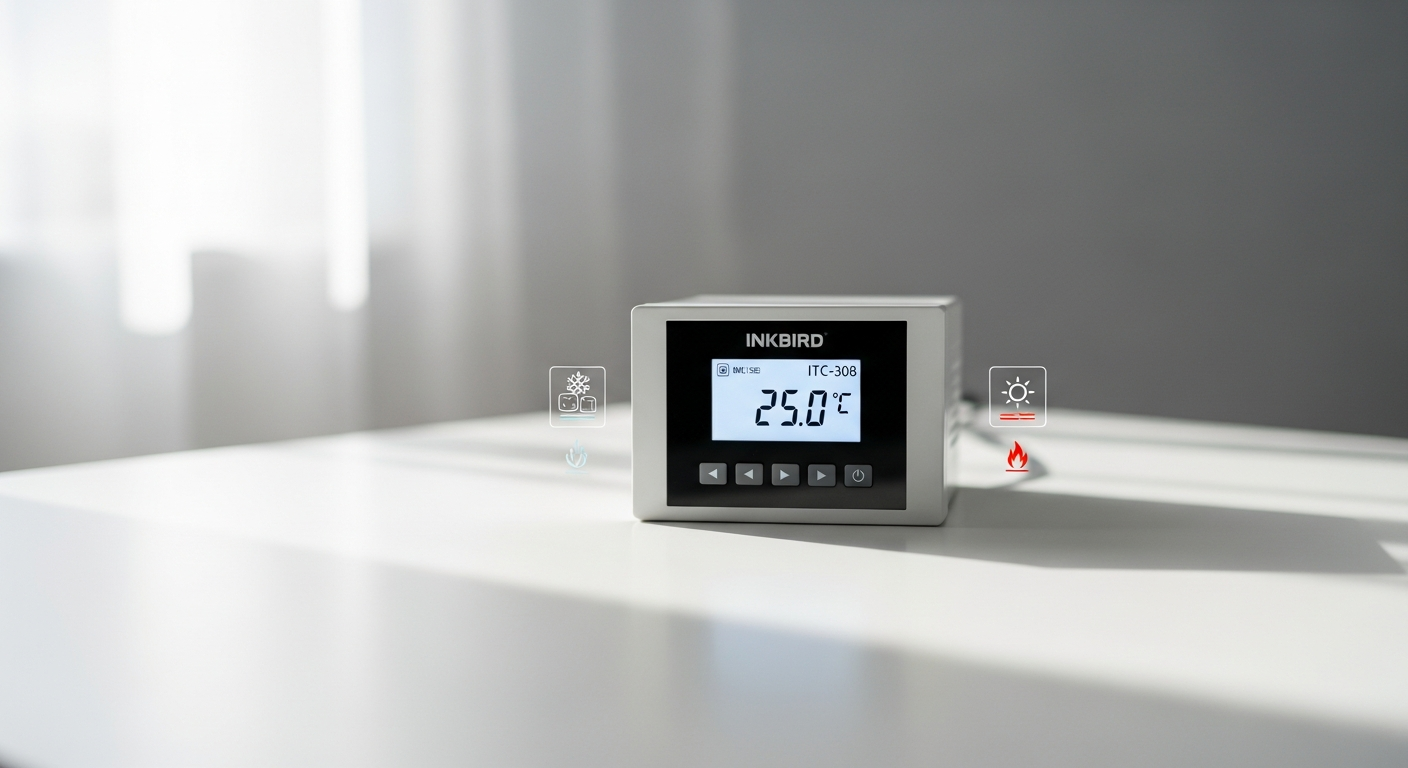
The Inkbird ITC-308 has earned its reputation as Inkbird's best-selling temperature controller for good reason. This dual-output device manages both heating and cooling simultaneously, delivering the precision and reliability that homebrewers, plant enthusiasts, reptile keepers, and incubation specialists demand.
Check the current price and availability of the Inkbird ITC-308 today.
This review breaks down everything you need to know to choose the right ITC-308 model for your specific use case. You'll learn how the standard and WiFi versions compare, understand the technical specifications that matter most, see real-world performance insights, and discover which applications benefit most from this controller. By the end, you'll have clarity on whether this is the investment your setup needs.
Understanding the Inkbird ITC-308 Product Lineup
Overview of the ITC-308 and ITC-308S Models
The Inkbird ITC-308 series consists of the standard ITC-308 and the ITC-308S, both representing Inkbird's flagship temperature control solution. These models share the same core functionality and specifications, with the primary distinction being the availability of WiFi-enabled variants for remote monitoring and control capabilities.
Standard vs. WiFi-Enabled Versions: Key Differences
The standard ITC-308 operates as a standalone device with local control only—no app, no remote access, just straightforward temperature management. The ITC-308-WiFi version adds connectivity to the Inkbird app, allowing users to monitor and adjust temperatures from a smartphone or tablet. For applications requiring on-site presence, the standard model delivers identical temperature precision at a lower price point. For those managing multiple setups or preferring remote convenience, the WiFi version justifies its cost premium.
Why This Controller Dominates Inkbird's Sales Rankings
The ITC-308 has achieved best-seller status because it solves real problems without unnecessary complexity. It combines affordable pricing with rock-solid reliability, making it the go-to choice for hobbyists who need professional-grade temperature control without professional-grade costs. Its consistent positive reviews across retailers and community forums underscore genuine user satisfaction rather than marketing momentum.
Ideal Use Cases for Each Model Variant
The standard ITC-308 suits fermentation chambers, plant growth tents, and incubation projects where the device sits in a fixed location. The WiFi version excels for distributed setups—multiple fermentation vessels in different rooms, remote aquaculture systems, or laboratory environments where real-time monitoring from a distance adds operational confidence.
Plug-and-Play Design Philosophy Explained
Unlike industrial controllers requiring professional installation, the ITC-308 follows a philosophy of accessibility. Unbox it, plug it in, set your target temperature, and it begins working. No firmware updates, no complex calibration requirements, no technical degree needed. This simplicity makes it genuinely usable for first-time temperature controller owners.
Build Quality and Construction Materials
The device features a robust plastic housing with durable internal components rated for consistent operation. The dual display windows are clear and legible, the button layout is tactile and responsive, and the overall construction reflects reliability priorities over aesthetic flourishes. Users report devices operating reliably for years through regular use in demanding applications.
Warranty and Manufacturer Support Overview
Inkbird typically offers standard manufacturer warranty coverage on the ITC-308, with responsive customer support for troubleshooting and replacement procedures. Community forums and online documentation provide additional resources, and many retailers offer satisfaction guarantees that extend protection beyond the manufacturer's warranty period.
Technical Specifications That Actually Matter
Temperature Control Range: -50 to 99°C (-58 to 210°F) Breakdown
This range covers the vast majority of hobbyist and professional applications. Fermentation occurs between 18-25°C depending on yeast type, plant growth favors 20-25°C, reptiles require 25-35°C depending on species, and incubation typically runs 37-39°C. The lower range extends into cold-storage applications and scientific experiments. Very few practical applications fall outside these boundaries.
Resolution Accuracy: 0.1°C/°F Precision Explained
The controller displays and controls temperature increments of 0.1°C or 0.1°F, providing granular precision without unnecessary decimal places. This resolution delivers stability without the overkill of industrial-grade systems that might control to 0.01°C—a level of precision most applications don't require or benefit from.
Sensor Accuracy: ±1°C Performance in Real-World Conditions
The ±1°C accuracy specification represents the typical variance between the actual temperature and what the sensor reports. In real-world testing across diverse applications, this performance holds consistently. For most uses, staying within ±1°C of your target temperature is far superior to the ±3-5°C variance of uncontrolled environments.
Dual Relay Output System and Simultaneous Heating/Cooling Capability
The ITC-308 includes two independent relay outputs, allowing connection of both a heating device and a cooling device simultaneously. The controller activates heating when temperature drops below your set point and activates cooling when temperature rises above it. This dual functionality maintains tight ranges impossible for single-output controllers.
Maximum Output Load Capacity: 1100W at 110V
The 1100W capacity accommodates most common heating and cooling devices—from aquarium heaters to fermentation chamber coolers. While insufficient for industrial-scale operations, this capacity handles typical hobbyist setups with margin for future expansion.
Power Requirements: 100-240VAC Compatibility Across Regions
The universal input voltage makes the ITC-308 truly portable across regions. Whether your outlet supplies 110V (North America) or 240V (Europe, Asia), the device operates without modification or additional transformers. The 50Hz/60Hz frequency compatibility adds further flexibility.
Cable Length Specifications and Setup Flexibility
The 1.5m (5ft) input power cable provides reasonable reach from wall outlets, while the 30cm (1ft) output cables connect to connected devices. For setups requiring greater distances, standard extension cables work reliably without affecting functionality.
Temperature Calibration Features for Custom Adjustments
The ITC-308 allows calibration adjustments to account for sensor variance or environmental factors. If your sensor reads 0.5°C high, calibration brings readings into alignment with actual conditions, ensuring accuracy across your specific setup.
Dual Heating & Cooling: How It Outperforms Single-Output Controllers
Why Simultaneous Heating and Cooling Matters for Stability
Single-output controllers force a choice: heat or cool, but not both. A fermentation chamber might use only heating, leading to temperature swings when ambient conditions shift. The ITC-308's dual outputs mean heating activates during cold periods while cooling handles warm periods, smoothing fluctuations that otherwise destabilize your application.
Compressor Delay Protection for Refrigeration Equipment
Refrigeration compressors require rest periods between cycles to avoid damage. The ITC-308 includes compressor delay protection, preventing rapid on-off cycling that would shorten equipment lifespan and waste energy. This feature alone justifies the controller's cost for users managing fermentation chambers with refrigeration systems.
Maintaining Tight Temperature Ranges Without Overshooting
Overshooting occurs when a heating or cooling device doesn't stop quickly enough, overshooting the target before reversing course. The ITC-308's intelligent relay switching minimizes overshoot, keeping your temperature tighter than less sophisticated controllers. For yeast and plants, those tight margins make measurable differences in results.
Preventing Temperature Swings in Sensitive Applications
Sensitive organisms like specific yeast strains, delicate plant seedlings, and reptiles near critical thermal thresholds suffer from temperature swings. The dual-output stabilization the ITC-308 provides prevents stress that would otherwise compromise health or development.
Real-World Examples: Fermentation, Plant Growth, Reptile Habitats
In homebrewing, maintaining 19°C for ale yeast or 12°C for lager prevents off-flavors that develop during temperature excursions. For plants, consistent 22°C root zone temperature maximizes nutrient uptake and growth rate. Reptiles require species-specific ranges maintained within narrow tolerances—ball pythons at 28-30°C, crested geckos at 20-25°C—where the ITC-308's dual outputs prevent the stress of fluctuation.
Comparison to Single-Output Controllers and Their Limitations
Single-output controllers handle heating or cooling effectively when only one is needed. Yet most real-world environments experience both day-night temperature swings and seasonal changes. The moment your application needs both heating and cooling, single-output controllers become inadequate. The ITC-308's dual outputs eliminate this limitation entirely.
Cost-Benefit Analysis of Dual-Output Functionality
The price premium for dual-output capability versus single-output controllers is modest—typically $10-20 more. The benefits include broader application compatibility, tighter temperature control, protection for expensive equipment, and future flexibility if your application evolves. This return on minimal additional investment makes the dual-output design a clear winner.
Display, Interface & User Experience
Dual Display Windows Showing Current vs. Set Temperature
Two separate displays occupy the front panel: one showing your target temperature, the other showing the actual current temperature. This layout eliminates confusion and provides immediate feedback on controller status. A quick glance tells you whether your heating or cooling is actively working to close any temperature gap.
Intuitive Button Layout for Temperature Adjustments
Four buttons handle all functions—up, down, mode, and set. Pressing and holding the set button enters adjustment mode, then up and down arrows change your target temperature. The interface requires no manual memorization; it responds logically to button presses, making adjustments intuitive even for users unfamiliar with digital controllers.
Audible Alarm System for High/Low Temperature Deviations
When temperature deviates outside safe bounds, an audible alarm alerts you—a beeping sound that demands attention. This active notification prevents the situation where a failed heating element or cooler malfunction goes unnoticed until damage occurs. The alarm provides critical early warning for time-sensitive applications.
Sensor Fault Detection and Alert Mechanisms
If the temperature sensor becomes disconnected or fails, the ITC-308 detects this condition and triggers an alert. Rather than displaying incorrect temperatures or failing silently, the device forces awareness of sensor issues, preventing potentially catastrophic outcomes from operating with bad data.
Menu Navigation Without Requiring Technical Expertise
The controller avoids deep menu hierarchies or confusing parameter screens. Essential functions remain accessible through simple button combinations, while advanced features like calibration exist but don't clutter the primary interface. Someone using the device for the first time can achieve baseline operation within minutes.
Visual Feedback Through Indicator Lights
LEDs indicate heating and cooling relay status—red when heating is active, blue when cooling is active. This visual feedback confirms that your connected devices are actually receiving power when you expect them to, adding transparency to controller operation.
Setup Time for First-Time Users
Initial setup typically requires 5-10 minutes: plugging in the device, connecting your sensor, connecting your heating and cooling devices, and setting your target temperature. Within that brief window, you're actively controlling temperature. No app installations, no network configuration, no firmware updates stand between you and functionality.
WiFi Connectivity & Remote Monitoring (ITC-308-WiFi Model)
Inkbird App Functionality and Device Compatibility
The Inkbird app connects to WiFi-enabled models, displaying current temperature, set point, and relay status from your smartphone. The app supports iOS and Android, providing cross-platform compatibility. Connection requires your 2.4GHz WiFi network (5GHz is not supported) and the Inkbird app downloaded to your device.
Remote Temperature Monitoring From Anywhere
The WiFi model's primary advantage is monitoring your setup from any location with internet access. Check fermentation temperature while at work, verify your plant growth tent conditions while traveling, confirm reptile enclosure stability from another room—all without physical proximity to the device.
Real-Time Alerts and Notifications on Your Smartphone
When temperature deviates outside your configured bounds, the app sends push notifications to your device. This active notification system replaces the need for audible alarms in some scenarios—you receive alerts instantly regardless of your location, enabling faster response to temperature emergencies.
Scheduling and Automation Capabilities
The app supports scheduling features, allowing different target temperatures at different times. This functionality suits applications with daily schedules—reptile enclosures programmed for day/night cycles, plant growth chambers shifting from vegetative to flowering temperature profiles, incubation projects with temperature ramps.
Cloud Storage for Temperature Data Logging
The WiFi model logs historical temperature data to cloud storage, creating records of your environment's thermal history. This data supports troubleshooting (identifying when temperature problems occurred), optimization (discovering which hours experience the most drift), and documentation (providing temperature records for professional or competitive applications).
Comparison: WiFi Model vs. Standard Non-WiFi Version
The standard ITC-308 delivers identical temperature control accuracy and dual-output functionality at approximately 50% of the WiFi model's cost. The non-WiFi version is perfectly suited for fixed installations where remote monitoring provides no practical value. The WiFi version justifies its premium only if you genuinely benefit from app access and remote alerts.
Additional Cost Considerations for Smart Home Integration
Beyond the higher purchase price of the WiFi model, consider ongoing reliability expectations. WiFi-enabled devices depend on network connectivity; if your network experiences outages, monitoring capability disappears temporarily. The standard model requires zero network infrastructure, providing an advantage in reliability-critical applications.
Reliability of Wireless Connection and App Stability
User reports indicate solid WiFi reliability on the ITC-308-WiFi, with stable connections and responsive app performance. Occasional connection drops occur during network transitions (typical WiFi behavior), but these don't affect local temperature control—the device continues regulating temperature regardless of app connectivity status.
Explore the WiFi and standard ITC-308 options to find your perfect fit.
Real-World Performance Across Popular Applications
Homebrewing & Fermentation: Temperature Stability for Ale and Lager Yeast
Temperature control defines fermentation outcomes. Ale yeasts perform optimally at 18-25°C; temperatures above this range produce undesirable esters and fusel alcohols. Lager yeasts require 10-15°C, where even small fluctuations create off-flavors. The ITC-308's ±1°C accuracy keeps fermentation within ideal bounds, directly improving beer quality. Homebrewers consistently report superior results when switching from passive temperature management to ITC-308-controlled fermentation chambers.
Plant Growth & Hydroponics: Maintaining Optimal Root Zone Temperatures
Plant roots absorb nutrients most efficiently at 18-22°C; cooler temperatures slow growth while warmer temperatures encourage root disease. Hydroponic systems amplify temperature sensitivity since there's no soil buffering. The ITC-308 maintains root zone temperatures within optimal ranges, accelerating growth and preventing diseases that temperature stress would otherwise trigger.
Reptile and Terrarium Management: Creating Species-Specific Environments
Reptile species require precise temperature ranges for proper digestion, activity, and reproduction. Ball pythons need 28-30°C on the warm side, creating a thermal gradient. Crested geckos prefer 20-25°C. The ITC-308's capability to maintain these ranges—sometimes with both heating and cooling—enables habitat conditions that support reptile health and natural behaviors.
Incubation Projects: Consistent Heat for Eggs and Sensitive Organisms
Egg incubation requires unwavering temperature control; fluctuations above or below optimal ranges reduce hatch rates or cause embryonic damage. Whether incubating poultry, reptile, or exotic bird eggs, the ITC-308 maintains the precise conditions necessary for successful development. The consistency it provides transforms incubation from unpredictable to reliable.
Aquaculture: Water Temperature Precision for Fish and Aquatic Life
Fish species occupy specific thermal niches; goldfish prefer cool water (18-20°C), tropical fish require warm water (24-28°C), and certain species tolerate narrow ranges only. The ITC-308 maintains these conditions, preventing stress and disease that temperature instability would cause. For aquaponics systems combining fish and plants, temperature control becomes even more critical.
Mushroom Cultivation: Humidity and Temperature Co-Management
Mushroom fruiting requires both specific humidity and temperature ranges—often 15-20°C at 85-95% humidity. While the ITC-308 handles temperature exclusively, users combine it with separate humidity controllers to maintain the dual conditions mushroom cultivation demands. Its role in the system is equally important as the humidity control.
Laboratory and Scientific Applications: Reliability in Controlled Settings
Scientific protocols often mandate environmental conditions—specific temperatures for chemical reactions, bacterial cultures, or biological experiments. The ITC-308's reliability and precision make it suitable for non-industrial laboratory settings where commercial-grade equipment carries unnecessary cost while still delivering required accuracy.
Strengths That Justify the Investment
Exceptional Reliability and Long-Term Durability
Across user reviews and community reports, reliability emerges as the ITC-308's signature strength. Devices operate for years through intensive use in demanding applications, with failure rates far below industry norms. This durability means your initial investment remains functional, generating value over extended timescales.
Straightforward Operation Reduces Learning Curve
Unlike controllers requiring manual consultation or YouTube tutorials, the ITC-308 communicates its operation through intuitive design. Users without technical backgrounds achieve stable temperature control immediately. This accessibility removes barriers preventing many people from adopting temperature control entirely.
Robust Construction Withstands Frequent Use
The internal components endure repeated relay cycling, temperature fluctuations, and varied environmental conditions. The housing protects internal electronics without requiring special environmental conditions for the controller itself. Users report continued reliable operation in harsh conditions—damp basements, temperature-varying garages, vibration-prone locations.
Accurate Temperature Regulation Within ±1°C Tolerance
The specified ±1°C accuracy represents genuine, verified performance. This precision suffices for applications where ±5°C would be inadequate—fermentation control, sensitive plant cultivation, precise reptile environments. You're paying for accuracy that meaningfully impacts your results.
Affordability Compared to Industrial-Grade Controllers
Industrial temperature controllers cost hundreds or thousands of dollars, targeting commercial applications where cost is secondary to features and precision levels. The ITC-308 delivers professional-level temperature accuracy at a fraction of this cost. It represents exceptional value without sacrificing essential functionality.
Widespread Positive Reviews Across Multiple Platforms
The ITC-308 consistently earns 4.5-5.0 star ratings across retailers, community forums, and enthusiast communities. This consistent positive feedback across diverse platforms and users suggests genuine satisfaction rather than isolated positive reviews. People who use it repeatedly, in demanding applications, genuinely recommend it.
Peace of Mind Through Consistent, Predictable Performance
Knowing your fermentation chamber maintains 19°C, your plant growth tent stays at 22°C, or your reptile enclosure remains at 28°C provides comfort. You can focus on the biological or chemical processes happening within your controlled environment rather than worrying about temperature stability.
Excellent Customer Support and Troubleshooting Resources
Inkbird provides responsive support channels, and extensive online documentation and community resources exist. If problems arise, help is readily available. This support infrastructure adds confidence beyond the product itself.
Honest Limitations and Considerations
Non-WiFi Models Lack Smart Home App Integration
If you value smart home ecosystem integration where your temperature controller communicates with other devices through platforms like Home Assistant or other automation systems, the standard ITC-308 won't participate. The WiFi version offers limited integration compared to premium smart home systems, but it's more capable than the non-WiFi version.
Aesthetic Preferences: Cooling Indicator Light Color Options
Some users noted preference for different colors of the indicator lights—a subjective aesthetic point rather than functional limitation. The cooling indicator's color choice won't affect performance but may matter if the controller occupies visible space where aesthetics influence your environment's appearance.
Setup Space Requirements for Mounting and Cable Routing
The device requires mounting space—whether on a shelf, mounted to a wall, or placed beside your application. Its power and output cables also require routing; in compact spaces, cable management becomes slightly more complex. None of this prevents installation, but planning space allocation beforehand prevents surprises.
Sensor Cable Length May Require Extensions for Larger Setups
The included sensor cable is typically adequate for most installations, but particularly large enclosures might benefit from extension cables. Standard temperature sensor extension cables work reliably with the ITC-308, so this limitation is easily addressed.
WiFi Model Pricing Premium Over Standard Version
The WiFi version costs approximately 50-100% more than the standard model. This premium is justified only if remote monitoring and app control provide genuine value in your application. For fixed installations or situations where on-site monitoring suffices, this premium represents unnecessary expense.
Learning Curve for Advanced Calibration Features
While basic operation requires no learning, advanced features like temperature calibration, compressor delay settings, or alarm configurations require consulting documentation. Most users never access these features, relying on default settings that work adequately. Those requiring advanced configuration need patience and documentation reading.
Limited Customization Options for Specific Niche Applications
The ITC-308 optimizes for general-purpose temperature control across diverse applications. Specialized fields with very particular requirements (industrial-scale operations, cutting-edge research) might outgrow its capabilities. For the vast majority of hobbyist and semi-professional applications, this limitation never becomes apparent.
Pricing, Models & Where to Buy
Standard ITC-308 Pricing Around $35.99
The basic non-WiFi ITC-308 typically lists near $35.99, making it exceptionally affordable for precise temperature control. Sales and promotions occasionally reduce this further, while some retailers charge slightly higher markups. This entry-level pricing makes adoption accessible for people skeptical about investing in temperature control.
WiFi-Enabled ITC-308-WiFi Pricing Around $69.99
The WiFi-enabled variant typically costs approximately double the standard model, reflecting the additional hardware and cloud infrastructure required. While $69.99 remains affordable in absolute terms, it represents meaningful additional expense compared to the standard version.
Price Variations Based on Retailer and Promotional Periods
Authorized retailers occasionally discount ITC-308 models during promotional periods, holiday sales, or clearance events. Price comparison across retailers before purchasing often reveals savings of $5-15. Seasonal demand (spring for plant growers, fall for brewers) can influence pricing and availability.
Best Places to Purchase With Warranty Protection
Authorized Inkbird retailers, major online marketplaces, and specialty retailers catering to homebrewing or hydroponics communities typically stock the ITC-308. Purchases from authorized sources include manufacturer warranty protection, while third-party sellers might offer limited or no warranty. Buying from established retailers ensures protection if defects emerge.
Comparison Shopping Across Major Online Retailers
Before purchasing, checking prices across several retailers typically reveals optimal deals. Price differences between vendors can range from $5-20, making comparison worthwhile. Factoring in shipping costs and return policies adds complexity to comparison, but eventually, one vendor typically offers the best overall value.
Bundle Deals and Seasonal Discounts
Retailers sometimes bundle the ITC-308 with related products—extension cables, mounting hardware, sensor probes—at bundled discounts. Seasonal sales around brewing season (fall) or growing season (spring) create opportunities for better pricing. Subscribing to retailer email lists alerts you to upcoming promotions.
Return Policies and Satisfaction Guarantees
Most retailers offer 30-day return policies, allowing you to purchase confidently knowing you can return the device if it doesn't meet expectations. Some vendors extend satisfaction guarantees beyond standard return windows, adding protection. Understanding these policies reduces risk and purchase hesitation.
Long-Term Value Calculation Based on Application Lifespan
Evaluating price requires considering application lifespan. A homebrewer using the ITC-308 for 10 years of fermentation amortizes the $35.99 cost to $3.60 annually—negligible compared to ingredient costs. Similarly, a plant cultivator operating the device year-round for years achieves exceptional cost-per-hour of operation. While absolute purchase price matters, cost-per-use often proves more meaningful.
ITC-308 vs. Competing Temperature Controllers
How It Stacks Against Other Inkbird Models
Inkbird manufactures various temperature controllers across price and capability ranges. The ITC-308 occupies the sweet spot for general-purpose applications—more affordable than premium models, more capable than basic options, and better supported than discontinued lines. For most users, it represents Inkbird's optimal recommendation.
Comparison to Generic Temperature Controllers
Unbranded or lesser-known temperature controllers cost significantly less but sacrifice reliability and accuracy. These controllers often exhibit wider temperature swings, less reliable relays, and minimal customer support. The ITC-308's modest premium over these options provides substantial improvements in real-world performance and peace of mind.
Price-to-Performance Ratio Analysis
Comparing price against specification and real-world performance, the ITC-308 delivers exceptional value. Controllers matching its specifications from premium manufacturers cost 3-5 times more. Budget controllers costing similar amounts sacrifice either accuracy or reliability. The ITC-308's positioning—premium performance at accessible pricing—creates compelling value.
Feature Parity With More Expensive Alternatives
Many controllers costing two or three times more than the ITC-308 offer additional features (programmable ramps, networked communication, touchscreen interfaces) that most users never utilize. Core temperature control—the fundamental requirement—matches between premium and mid-range devices. Paying significantly more often buys features rather than improved performance where it matters.
Why Hobbyists Choose ITC-308 Over Premium Options
Hobbyists recognize that temperature control is the core requirement, not interface sophistication or advanced scheduling. The ITC-308 excels at this core function at a price point that makes sense for hobby applications where equipment represents a portion rather than majority of total project cost. This practical evaluation leads repeatedly to ITC-308 selection.
Situations Where Upgrading to Higher-End Models Makes Sense
Higher-end controllers become justified when controlling numerous independent zones simultaneously, when demanding specifications exceed ±1°C tolerance, when integration with broader automation systems becomes essential, or when applications scale to commercial or industrial magnitude. Most hobbyist applications never reach these thresholds.
Market Positioning and Competitive Advantages
The ITC-308 owns the "reliable, affordable, capable" position in the temperature controller market. It avoids competing on premium features (where industrial controllers win) or absolute lowest cost (where budget Asian imports undercut). Instead, it competes on value—offering more capability than basic options at substantially lower cost than premium alternatives.
Setup, Installation & Getting Started
Unboxing and Included Components Checklist
The ITC-308 box contains the controller unit, power cable, temperature sensor probe with cable, and basic documentation. No included heating or cooling devices—you supply these separately based on your application. The minimal packaging approach keeps costs down while providing everything required for standalone operation.
Power Requirements and Outlet Considerations
The 100-240V input accommodates standard outlets virtually anywhere globally. You need a single standard outlet near your application—no special wiring or higher-amperage circuits required. The device draws minimal power itself (consuming far less than the heating or cooling devices it controls), so outlet sharing with other devices causes no concern.
Sensor Placement Best Practices
Temperature sensor placement dramatically affects measurement accuracy and controller response. Mount the sensor in the location you're actually trying to control—the fermentation vessel's liquid, the plant pot's root zone, the reptile enclosure's basking spot. Avoid placing sensors where external heat sources or cold drafts misrepresent true environmental temperature. Sensor placement matters more than sensor quality; invest effort here.
Connecting Heating and Cooling Devices to Relay Outputs
The ITC-308's output cables connect to your heating and cooling devices through standard outlets or hardwired connections. Each relay output accepts a standard North American outlet, allowing you to plug devices directly. For hardwired connections, consult device documentation for proper terminal connections. The relay switches power to connected devices—nothing more complex than that.
Initial Temperature Calibration Steps
Default factory calibration suffices for most applications. If you require custom calibration (adjusting for sensor quirks or environmental factors), the calibration menu allows offsetting readings. Document your ambient conditions before making calibration adjustments—calibration should compensate for known sensor variance, not environmental drift.
Testing the System Before Critical Applications
Before committing to critical applications (fermentation, incubation), run the controller for several hours with temporary loads—a light bulb as heating, a fan as cooling—observing that relays switch appropriately and temperature readings make sense. This testing prevents discovering problems during time-sensitive applications where failures carry real consequences.
Troubleshooting Common First-Time Setup Issues
Most setup issues trace to sensor connection problems (loose connections causing "sensor fault" errors) or misunderstanding which relay controls which device. Consulting documentation and reconnecting all cables usually resolves issues immediately. Rare electrical problems appear as complete non-functionality—suggesting a power issue rather than controller malfunction.
Safety Considerations and Proper Grounding
The ITC-308 is a low-voltage controller; safety risks are minimal. Ensure power outlet grounding is proper (three-prong grounding in North America, proper earth grounding elsewhere). Don't expose the device to liquids or extreme moisture beyond normal humidity levels. These basic electrical safety practices prevent any concerns.
Maintenance, Longevity & Customer Experiences
Routine Maintenance Requirements
The ITC-308 requires minimal maintenance—essentially none beyond occasional visual inspection. If dust accumulates around ventilation areas, gentle cleaning prevents overheating. The sensor probe might require periodic cleaning if it contacts dirty water or soil; mild rinsing restores accuracy.
Cleaning and Care for Sensor Probes
Temperature sensors endure contact with liquids, soils, and organic materials depending on application. Gently rinsing with water restores accuracy if contamination accumulates. Avoid harsh chemicals or aggressive scrubbing that might damage the sensing element. Replacing sensor probes costs $10-20 if damage occurs—not prohibitively expensive.
Expected Lifespan Based on User Reports
User reports consistently indicate ITC-308 devices remaining functional for 5-10+ years of continuous or frequent operation. Some units continue operation beyond this timeline. Relay contacts eventually wear (switches fail after millions of cycles), but even in heavy-use applications, this represents extended service life.
Common Failure Points and How to Avoid Them
Relay failure represents the most common eventual failure point—not a defect, but normal wear from countless switching cycles. Operating devices above their rated wattage stresses relays prematurely. Oversizing devices (choosing 500W capacity when you need 200W load) reduces relay stress, extending lifespan. This choice occurs during setup and remains relevant throughout the device's life.
Warranty Coverage and Replacement Procedures
Inkbird provides manufacturer warranty coverage against defects. If failure occurs within the warranty period, contact the retailer or Inkbird directly for replacement or repair. Warranty terms vary by retailer; confirm details during purchase. Most failures occur outside warranty periods, at which point replacement cost ($35-70) becomes your responsibility.
Real Customer Reviews and Long-Term Satisfaction
Long-term user testimonials consistently praise reliability and value. People operating devices for years report continued satisfaction and recommend them to friends. Reviews rarely mention buyer's remorse—suggesting most users feel their purchase was worthwhile after extended experience.
Community Feedback From Brewing and Hobbyist Forums
Homebrewing communities, hydroponics forums, and terrarium groups consistently recommend the ITC-308. New members asking about temperature control recommendations typically receive overwhelmingly positive ITC-308 endorsements. This community consensus—developed through years of shared real-world experience—validates its reputation.
Reliability Data From Heavy-Use Applications
Commercial breweries and commercial plant operations occasionally employ ITC-308 units in production settings. These heavy-use scenarios subject devices to continuous operation and frequent relay cycling far exceeding hobbyist usage. Even in these demanding situations, reliability remains high, with failure rates substantially below alternative controllers.
Making Your Decision: Is the ITC-308 Right for Your Setup?
The Inkbird ITC-308 isn't flashy or feature-laden—it's deliberate. This controller solves a fundamental problem with remarkable consistency: maintaining the exact temperature your application demands, whether that's a fermentation chamber, plant growth tent, or reptile enclosure. The dual heating and cooling outputs handle what single-output devices can't, the accuracy stays within ±1°C, and the price point makes it accessible rather than prohibitive.
Your choice between the standard and WiFi models comes down to one question: do you need remote monitoring? If you're managing multiple setups or prefer the convenience of smartphone alerts, the WiFi version justifies its higher cost. If you're setting it and checking it occasionally, the standard model delivers identical temperature control at nearly half the price. Either way, you're investing in proven reliability that's earned its best-seller status through consistent real-world performance, not marketing hype.
The controller excels across diverse applications precisely because it refuses complexity. No learning curve, no frequent updates, no cloud-dependency for basic operation—just straightforward, dependable temperature control. The feedback from homebrewers, plant enthusiasts, reptile keepers, and incubation specialists consistently validates this approach. When your results depend on temperature precision, you stop wanting features and start wanting reliability.
Ready to stabilize your temperatures? Start by identifying your specific application, checking the temperature range requirements, and deciding whether WiFi convenience matters for your workflow. The ITC-308 is waiting to deliver the precision control that transforms your setup from unpredictable to dependable.
Get your Inkbird ITC-308 and experience precision temperature control for yourself.
Leave a Reply