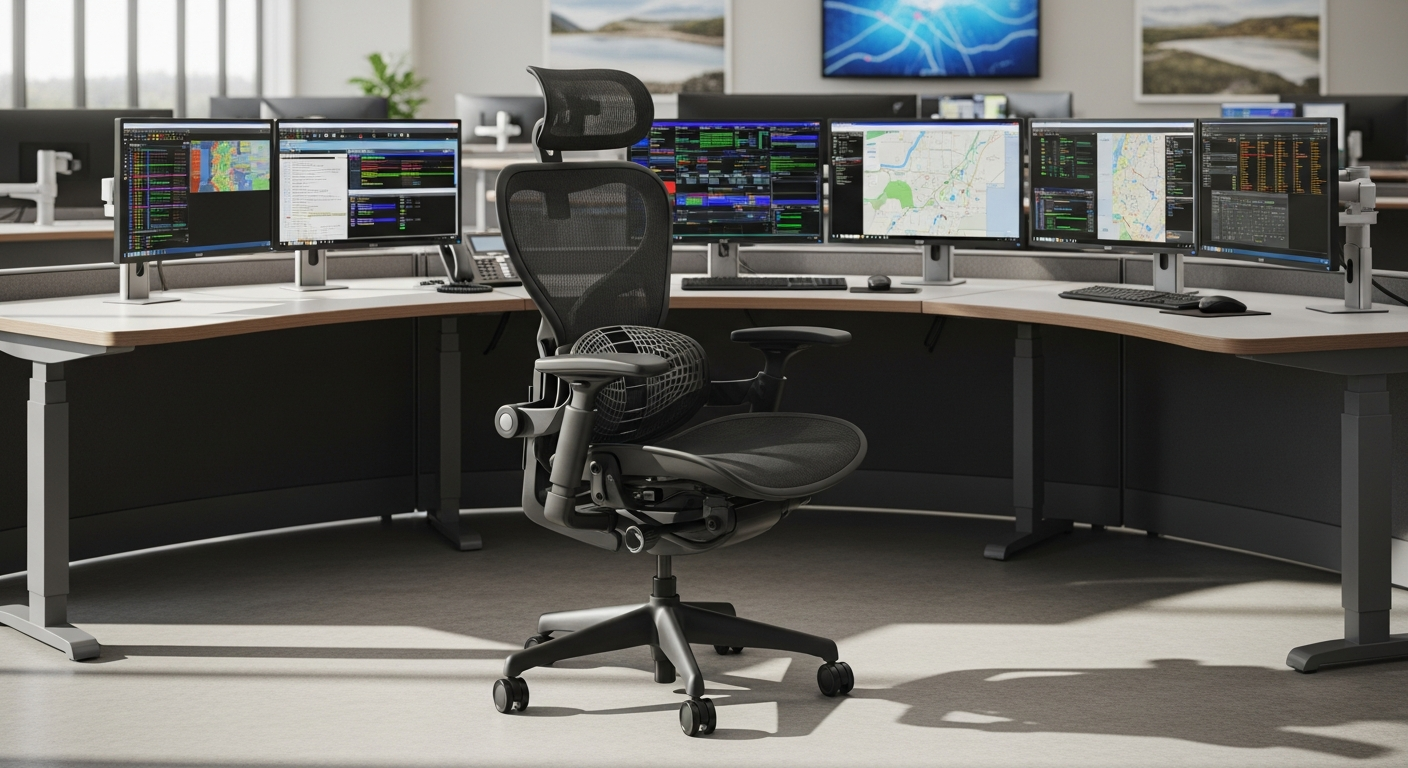
Dispatch centers, emergency rooms, and police stations operate around the clock—and their chairs need to keep pace. The reality? Standard office seating fails spectacularly in these high-intensity environments, leaving operators fatigued, uncomfortable, and at risk of injury after just a few shifts. Choosing the right chair for 24/7 operations isn’t a luxury; it’s a critical operational decision that directly impacts both employee wellness and workplace efficiency.
The OFM 247 Big & Tall Ergonomic Task Chair—often called the “24/7 Heavy Duty Dispatch Chair”—was engineered specifically for these demanding scenarios. Unlike generic task chairs, this model combines industrial-grade durability with extensive ergonomic customization, supporting users up to 400 lbs through continuous, intensive use. It’s become the benchmark for organizations that can’t afford downtime or compromised comfort.
Built for Non-Stop Operations: The 24/7 Durability Advantage
A heavy-duty chrome finish base engineered to withstand constant movement and daily wear forms the foundation of this chair’s reliability. Commercial-grade materials resist degradation from extended, multi-shift use in ways that standard office furniture simply cannot match. The supportive foam construction maintains structural integrity and comfort over months of continuous operation, refusing to compress or flatten despite relentless daily demands.
The molded polypropylene outer back shell doesn’t crack or warp under the intensive daily stress that dispatch centers, hospitals, and police stations impose. Traditional office chairs fail spectacularly in these environments because they’re designed for occasional use by occasional users. A typical task chair might support one person for eight hours daily, but dispatch operations demand something fundamentally different—multiple operators cycling through shifts, each requiring a chair that performs identically during the night shift as it did during morning briefing.
Real-world performance in 24/7 staffing environments reveals the OFM 247’s competitive advantage. Operators transition rapidly between stations, and the chair must accommodate sudden movements without wobbling, squeaking, or losing adjustments. The heavy-duty construction translates directly into long-term cost savings through reduced replacement cycles and minimal maintenance needs. Organizations that calculate total cost of ownership consistently find that investing in this industrial-grade seating pays dividends compared to purchasing cheaper alternatives every 18 months.
Customizable Comfort for Every Body Type: Adjustability That Actually Works
The 360-degree swivel base provides unrestricted movement and quick repositioning during emergencies—critical when dispatch operators need to access multiple screens or pivot toward colleagues without leaving their seat. Pneumatic seat height adjustment enables seamless transitions between different operator heights, accommodating the reality that dispatch centers employ staff across the full spectrum of physical dimensions.
Independent seat tilt controls with tension adjustment let operators personalize support preferences rather than forcing everyone into a one-size-fits-all configuration. The sliding seat depth feature accommodates both tall and compact frames, ensuring that thigh support works properly regardless of leg length. Dual seat and back pitch adjustments allow operators to find the optimal recline position for their specific body mechanics and shift duration.
Fine-tunable back height and depth controls target the lumbar region support precisely, addressing one of the most common pain points during extended shifts. T-shaped armrest height and width adjustments prevent shoulder strain during the repetitive movements that characterize dispatch work. Built-in lumbar support actively reduces lower back fatigue during 12+ hour shifts when operators must maintain alertness and focus despite physical stress.
These adjustments directly reduce operator fatigue and improve alertness during critical work. A fatigued dispatcher makes slower decisions, misses important details, and experiences stress that undermines team morale. When the chair supports the body properly, operators remain alert and responsive throughout their shift.
Visit OFM Office Furniture to see how the 247 model’s adjustability improves operator performance.
The 400-Pound Weight Capacity: Inclusive Design for Big & Tall Users
The substantial weight capacity accommodates users across the full spectrum of body sizes, a feature that distinguishes this chair from consumer-grade alternatives with artificially low weight limits. Reinforced frame construction maintains stability and comfort without compromise, whether supporting a 150-lb operator or a 400-lb user. The weight capacity matters beyond just physical accommodation—it signals durability and longevity to anyone evaluating the chair’s overall construction quality.
Inclusive workplace design ensures all team members have access to proper ergonomic support. When a facility provides seating that doesn’t accommodate larger staff members, it sends a clear message about who belongs in that workspace. The OFM 247 eliminates this problem entirely, creating an environment where every dispatcher, every nurse, and every emergency room coordinator can find a chair that supports them properly.
Undersized chairs create liability and discomfort in high-stress environments. A chair that fails structurally under normal use exposes the organization to injury claims and worker compensation costs that far exceed the savings from choosing cheaper seating. Beyond liability, the psychological benefit of inclusive seating in team-based dispatch operations shouldn’t be underestimated—when everyone feels supported, team cohesion strengthens.
Upholstery and Hygiene: Commercial-Grade Materials for High-Traffic Environments
Commercial-grade, stain-resistant fabric provides a practical option for standard operational settings where environmental contamination isn’t a primary concern. Anti-microbial and anti-bacterial vinyl upholstery becomes essential for healthcare and sanitation-critical facilities where dispatch centers operate adjacent to patient care areas or handle medical emergencies.
Easy-to-clean surfaces maintain hygiene standards without frequent deep cleaning sessions that take chairs offline and disrupt operations. The durability of upholstery materials under constant contact and shift changes prevents the degradation that occurs when cheaper materials encounter daily use. Vinyl upholstery proves particularly valuable in hospitals, emergency rooms, and medical dispatch centers where exposure to bodily fluids and cleaning chemicals is inevitable.
Resistance to spills, bodily fluids, and cleaning chemicals ensures the chair maintains its protective barrier without degradation. A fabric option might absorb contaminants; vinyl simply repels them, making hospital environments safer for all staff members sharing the same equipment.
Mobility Options: Casters and Glides Tailored to Your Floor Type
Standard wheel casters work effectively on carpeted or uneven surfaces where smooth rolling is the priority. Soft wheel casters are specifically designed for hard floors (tile, concrete, linoleum), preventing the scratching and floor damage that regular casters inflict on facility infrastructure. Glide options prevent rolling while maintaining smooth repositioning capability for operators who need stability more than mobility.
Choosing the right mobility solution prevents floor damage and unwanted chair drift. A dispatch center with concrete flooring and regular wheel casters will show visible wear patterns within months; soft casters preserve the floor while maintaining the functionality operators need. In high-stress environments where sudden movement is dangerous, the difference between a chair that glides on command and one that drifts unexpectedly can affect performance and safety.
Customization options align with facility maintenance standards and floor types, ensuring that the seating choice complements rather than conflicts with existing infrastructure.
Investment Value: Understanding the $300–$400 Price Point
Competitive pricing for industrial-grade seating designed for 24/7 operations positions the OFM 247 as an accessible investment for both individual facilities and large organizations. The cost-per-use analysis reveals how durability justifies the upfront investment—a chair that lasts three years under continuous use costs less per day than a cheaper alternative requiring replacement annually.
Comparison with cheaper alternatives illustrates the false economy of budget seating. A $150 task chair might seem attractive until it requires replacement after 18 months of dispatch center use, while the OFM 247 continues performing reliably for years. The total cost of ownership—including reduced maintenance and extended lifespan—significantly favors industrial-grade seating.
Bulk purchasing options benefit facilities outfitting entire dispatch centers or departments, with volume discounts making per-unit costs even more favorable. ROI calculation for organizations evaluating chair replacement programs shows rapid payback when comparing replacement frequency, disposal costs, and operator downtime associated with chair failures.
Real-World Performance: Where the OFM 247 Excels (and Minor Trade-Offs)
Proven track record in dispatch centers, police stations, and hospital emergency departments demonstrates that this chair performs reliably in the exact environments where it’s needed most. User praise for supportive foam and heavy-duty component longevity comes from operators who spend their careers in these chairs, not reviewers testing furniture for a few hours.
Handling of continuous, intensive use without performance degradation separates this model from consumer-grade alternatives. The chair performs during the night shift with the same consistency it demonstrates during morning briefing, shift after shift, year after year.
Minor considerations exist—arm swivel mechanics can feel slightly stiff to some users, and seat foam firmness varies by individual preference. Aesthetic limitations in high-end executive environments aren’t a concern for operational facilities where function always supersedes appearance. The honest assessment reveals that this chair excels precisely where it was engineered to excel: 24/7 operations requiring durability, comfort, and reliability above all else.
Specification Details: The Numbers Behind the Design
A seat height of 19.5 inches (with variant options available) accommodates a broad range of operator heights while integrating with standard dispatch center workstations. Seat depth of 23 inches provides optimal thigh support and comfort, preventing the edge pressure that occurs when seat depth is insufficient. Overall dimensions fit within standard workstations, ensuring the chair integrates seamlessly into existing facilities without requiring infrastructure modifications.
Weight and footprint considerations matter for space-constrained facilities where every square foot has operational significance. Adjustment range specifications accommodate different body types and preferences, with the pneumatic height system covering the full spectrum of operator heights commonly found in dispatch operations. Technical specifications distinguish this model from consumer-grade alternatives in ways that matter during months two through thirty-six of continuous use, when industrial construction either proves its value or begins revealing its inadequacies.
The Bottom Line: Why Dispatch Centers Choose the OFM 247
The OFM 247 Big & Tall Ergonomic Chair isn’t just another office seat—it’s purpose-built infrastructure for organizations that operate continuously and can’t compromise on employee comfort or durability. Its 400-lb weight capacity, extensive ergonomic adjustability, and industrial-grade construction create a rare combination: a chair that accommodates diverse body types while withstanding the relentless demands of 24/7 operations. Whether outfitting a dispatch center, emergency room, or police station, this chair delivers measurable benefits through reduced operator fatigue, improved alertness, and extended equipment lifespan.
The investment of $300–$400 per unit pays dividends quickly when calculating the cost of frequent replacements and the hidden expenses of operator discomfort affecting performance. Evaluating the OFM 247 makes sense if a facility requires reliable, customizable seating for continuous operations. Requesting samples for the team, testing the adjustability features with actual operators, and comparing the total cost of ownership against cheaper alternatives reveals that this specialized design aligns perfectly with operational needs and budget.
Leave a Reply