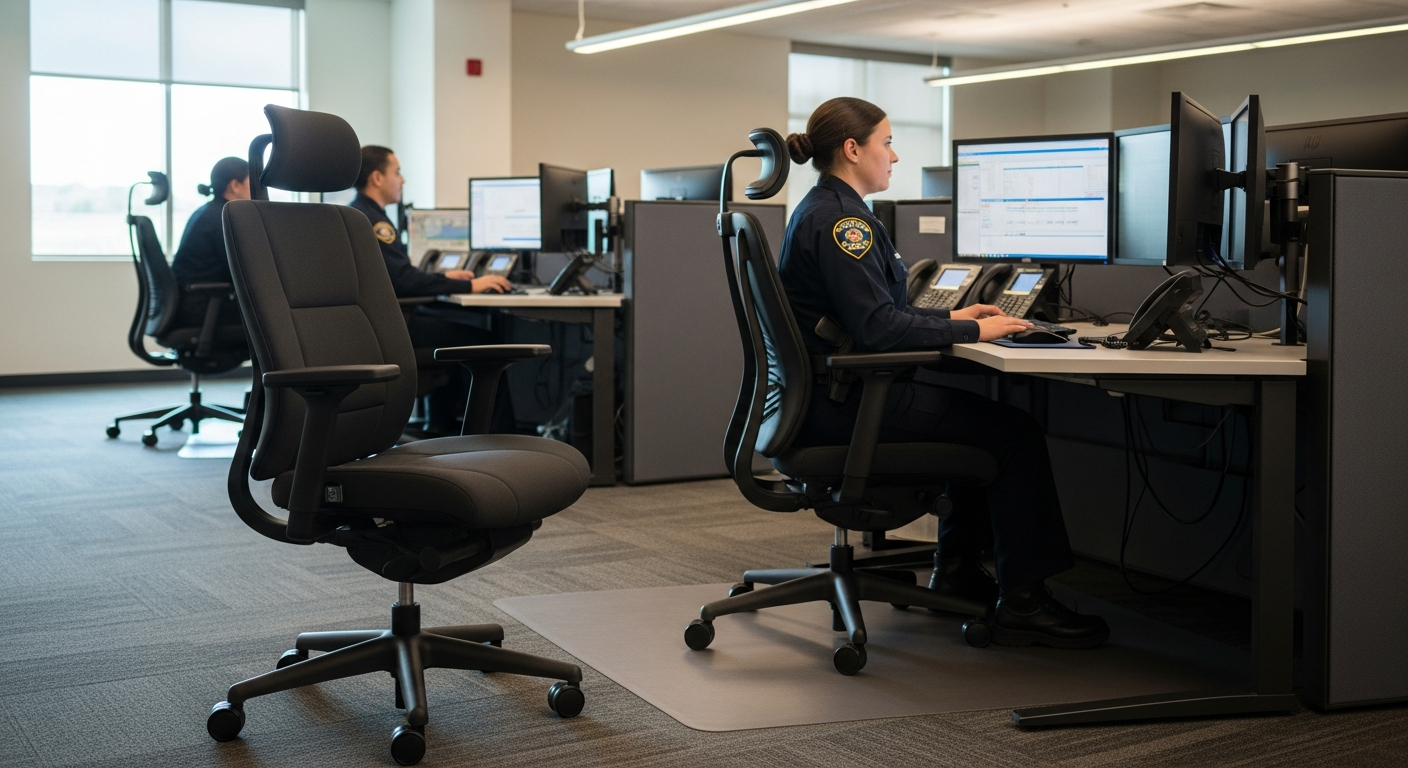
In high-pressure environments like dispatch centers and emergency rooms, workers spend entire shifts—sometimes 24 hours straight—in a single seat. Standard office chairs simply don’t cut it under these conditions. The difference between adequate support and exceptional comfort can mean the difference between peak performance and burnout, which is why the OFM 24/7 Heavy Duty Dispatch Chair has become the trusted choice for some of the nation’s most demanding workplaces.
The OFM 24/7 Heavy Duty Dispatch Chair, Model #247, isn’t just another office chair. It’s engineered specifically for environments where durability, comfort, and reliability aren’t luxuries—they’re necessities. From police stations to hospitals to emergency dispatch centers, this chair has earned its reputation as “The World’s Best Big & Tall Chair” because it actually delivers on the promise of all-day, every-day support.
Discover how the OFM 24/7 can transform your facility’s seating solution today.
Built for Non-Stop Operations: What Makes 24/7 Seating Different
How continuous-use chairs differ from standard office furniture
Continuous-use chairs operate under completely different design parameters than standard office furniture. While conventional office chairs anticipate an 8-hour workday with breaks and movement throughout the facility, 24/7 chairs must support users who remain seated for extended periods without relief. This fundamental difference drives every engineering decision—from the base construction to the cushioning density to the adjustment mechanisms.
The specific demands of dispatch centers, hospitals, and public safety environments
Dispatch centers, emergency rooms, and police stations operate on schedules that don’t pause for comfort. A 911 dispatcher cannot leave their station mid-call. An emergency room nurse monitoring multiple patients cannot take frequent breaks. These environments demand furniture that performs consistently regardless of how many consecutive hours someone occupies it. The stakes are high—fatigue and discomfort directly impact decision-making and response quality in life-and-death situations.
Why standard office chairs fail under 24-hour operational conditions
Standard office chairs are simply not engineered for continuous use. Their cushioning compresses over extended periods, leading to reduced support and increased lower back strain. The base components, designed for typical commercial use, wear faster under the constant pressure of 24-hour occupancy. Upholstery materials may not withstand frequent disinfection or resist stains from various environments. Within months or even weeks, standard chairs in 24/7 operations show visible wear, diminished support, and require replacement—driving up operational costs.
Real-world examples of facilities that rely on this chair
Police departments across the nation equip their dispatch centers with the OFM 24/7. Hospital emergency departments specify this model because it handles both the physical demands of extended shifts and the hygiene requirements of medical environments. Major 911 call centers have standardized on this chair for its reliability. These aren’t casual purchasing decisions—they’re strategic investments based on proven performance in mission-critical settings.
The engineering philosophy behind designing furniture for round-the-clock use
OFM’s approach to the Model #247 centers on anticipating and mitigating the cumulative effects of extended sitting. Every component—from the high-density foam cushioning to the reinforced frame—is selected to perform reliably hour after hour. The design accounts for perspiration, body heat, and the subtle shifts in posture that occur during marathon work sessions. This philosophy rejects the notion that durability means sacrificing comfort; instead, it views these as interdependent goals.
How the Model #247 addresses the unique strain of extended shifts
The Model #247 tackles extended-shift strain through multiple integrated systems. The lumbar support is positioned to maintain natural spinal alignment regardless of how many hours someone sits. The pneumatic height adjustment prevents the “settling” effect where users gradually slip lower as cushioning compresses. Tilt tension control allows each person to find their optimal recline without fighting against the chair. These features work together to reduce the cumulative fatigue that makes standard chairs unsuitable for 24-hour operations.
Heavy-Duty Construction That Actually Lasts: Materials & Durability
Chrome-finished base design and why it’s chosen for high-use environments
The heavy-duty chrome finish on the Model #247’s base isn’t decorative—it’s functional. Chrome resists corrosion and oxidation, critical in hospitals where cleaning protocols involve harsh disinfectants and environments where moisture is prevalent. The finish also prevents rust staining on flooring and upholstery. This base design, combined with reinforced structural components, can withstand the repeated stress of continuous use without degradation.
Commercial-grade upholstery options: stain-resistant fabric vs. anti-microbial vinyl
The chair offers two distinct upholstery paths. Commercial-grade stain-resistant fabric suits general dispatch and call center environments where cleanliness matters but the risk of biological contamination is lower. Anti-microbial and anti-bacterial vinyl is purpose-built for healthcare and public safety settings where infection control is paramount. The vinyl actively inhibits the growth of harmful microorganisms while remaining easy to disinfect between shifts. Both options are selected from materials proven to withstand years of use and frequent cleaning.
The role of molded polypropylene outer back shell
The molded polypropylene outer back shell provides structural integrity while remaining lightweight and easy to maintain. Unlike fabric-covered backs that can harbor dust and allergens, this shell can be quickly wiped clean. The material resists cracking and maintains its shape throughout the chair’s lifespan, preventing the sagging backs that plague older office chairs. It’s a seemingly small detail that significantly extends the chair’s serviceable life.
Weight capacity of 400 lbs and what that means for diverse workforces
A 400-lb weight capacity accommodates a significantly broader range of body types than standard office chairs. This matters in real-world operations where workforce diversity is the norm. Rather than requiring different chair models for different employees—creating logistical and cost complications—a single Model #247 serves everyone. This inclusive design approach eliminates the physical and psychological discomfort of inadequate support for larger individuals and streamlines facilities management.
Caster options: standard wheel casters, soft casters for hard floors, and glide alternatives
The Model #247 offers flexibility in mobility based on flooring type. Standard wheel casters work on carpet. Soft casters protect hard floors like tile or polished concrete from damage. For spaces where rolling isn’t desired—certain healthcare settings or workstations where stability is critical—glide options prevent movement entirely. This customization prevents unnecessary damage to facilities while ensuring appropriate mobility for each setting.
Expected lifespan and maintenance requirements compared to standard office seating
A properly maintained OFM 24/7 easily outlasts two or three standard office chairs. While typical commercial office seating expects a 5-7 year lifespan before noticeable decline, the Model #247 routinely performs reliably for 10+ years in continuous-use environments. Maintenance is straightforward: regular cleaning of upholstery, occasional checks of pneumatic components, and tightening of bolts as needed. This longevity directly translates to lower total cost of ownership despite higher initial purchase price.
How anti-bacterial vinyl protects in healthcare and public safety settings
Anti-bacterial vinyl contains compounds that actively inhibit bacterial growth on the upholstery surface. In hospitals, emergency rooms, and police stations where personnel rotate through multiple vehicles and environments daily, this protection reduces the risk of cross-contamination. Standard fabric upholstery, even when cleaned, can harbor pathogens in fibers and seams. The vinyl option essentially adds an infection-control layer to the seating system itself.
Customizable Ergonomics: Adjusting for Every Body & Shift Length
360-degree swivel functionality and why it matters for dispatch operations
Dispatch operators need to access equipment, monitors, and communication systems positioned around their workstations. A 360-degree swivel—smooth and unrestricted—allows operators to rotate to reach these elements without standing or stretching awkwardly. This seemingly simple feature dramatically reduces strain and keeps operators centered in their workspace, preventing the compensatory postures that build fatigue during long shifts.
Pneumatic seat height adjustment and its role in reducing strain
Pneumatic height adjustment gives each user the ability to position the seat so their feet rest flat on the floor with knees at 90 degrees and thighs parallel to the ground. This proper positioning reduces pressure on the lower legs and prevents the circulation problems that occur when feet dangle or press against the chair’s edge. Different individuals have different leg lengths; one fixed height forces compromise. The pneumatic system eliminates that compromise.
Seat tilt and tilt tension control for personalized recline preferences
Some users prefer an upright posture; others find slight recline more comfortable during extended shifts. Tilt tension control allows the user to set resistance that matches their preferred angle and body weight, preventing the chair from unexpectedly reclining or remaining locked in an uncomfortable position. This personalization reduces the postural adjustments people make throughout their shift—subtle movements that accumulate into significant strain.
Sliding seat depth adjustment for accommodating different leg lengths
Seat depth profoundly affects comfort during extended sitting. If the seat is too deep, the front edge presses into the back of the thighs, restricting circulation. If it’s too shallow, it provides inadequate support. The sliding seat depth adjustment lets each user position the cushion so their back is fully supported while maintaining a couple of inches of space behind their knees. This seemingly technical feature prevents a common source of discomfort during long shifts.
Seat and back pitch adjustments for optimal spinal alignment
The relationship between seat angle and back angle determines spinal alignment throughout the shift. Different body proportions and personal preferences require different angles. The Model #247 allows independent adjustment of seat pitch and back pitch, enabling users to achieve the spinal alignment that feels supportive and sustainable for them personally. This customization prevents the lower back pain that results from misalignment during extended use.
Back height and depth customization to support various torso proportions
Back height adjustment ensures that lumbar support aligns with each person’s natural spinal curve, regardless of their height. Back depth adjustment allows the cushioned back panel to fit snugly without gaps or excessive pressure. Users with shorter torsos, tall frames, or unusual proportions can all achieve proper support. This isn’t generic ergonomics—it’s tailored ergonomics that acknowledges human diversity.
T-shape armrest height and width adjustments for arm and shoulder support
Armrests that don’t match a person’s arm length force them to either hunch their shoulders or hold their arms away from their body—both causing fatigue. The T-shape armrest design combined with height and width adjustability allows proper arm support without forcing uncomfortable angles. During 24-hour shifts, proper arm support becomes increasingly critical as fatigue accumulates.
Built-in lumbar support and its impact on posture during extended shifts
The lumbar spine naturally curves inward, and this curve must be supported to prevent discomfort and strain. The OFM 24/7 includes built-in lumbar support positioned to maintain this natural curve. Unlike chairs where lumbar support is an afterthought, here it’s integrated into the design. This support prevents the progressive slouching that occurs as fatigue builds, maintaining good posture and preventing the back pain that often follows extended shifts.
How extensive adjustability reduces fatigue and discomfort during 24-hour rotations
The cumulative effect of all these adjustments is remarkable. A properly configured Model #247 feels custom-fitted to each user. Because support is consistent throughout the shift—not requiring compensatory postures—fatigue develops much more slowly. Users finish long shifts noticeably less fatigued than they would in standard chairs. Over weeks and months, this compounds into measurably better wellness outcomes for the workforce.
The Hygiene Advantage: Why Healthcare & Emergency Services Prefer This Model
Anti-microbial and anti-bacterial vinyl upholstery for infection control
Healthcare facilities face constant contamination risks. The anti-microbial and anti-bacterial vinyl option on the OFM 24/7 provides an extra defense layer by actively inhibiting microorganism growth. This is particularly valuable in emergency departments, intensive care units, and operating room support areas where staff frequently move between patients. The vinyl doesn’t just clean easily—it fights contamination between cleanings.
Stain-resistant fabric options for high-traffic environments
For non-clinical high-traffic environments, the stain-resistant fabric resists the spills and marks that accumulate during busy shifts. Coffee spills, ink from pens, food residue—these inevitable occurrences don’t penetrate the fabric or create permanent stains. Regular fabric would show visible wear and appear unsanitary within months. The stain-resistant option maintains appearance while remaining practical for real-world use.
Easy-to-clean surfaces in facilities with strict sanitation protocols
Unlike chairs with intricate seams, recesses, and fabric-covered components, the Model #247 features surfaces that can be quickly wiped clean. The vinyl or commercial fabric, combined with the molded polypropylene back shell, means no hidden harbors for dust or pathogens. Disinfection procedures that might take 10 minutes on a standard chair take 3 minutes on the OFM 24/7, making it practical for high-traffic facilities operating on tight schedules.
The role of upholstery choice in reducing cross-contamination risks
In hospitals and emergency services, the same personnel work different stations and interact with different patients throughout shifts. Chairs with standard fabric can become vectors for cross-contamination. The anti-microbial vinyl and stain-resistant fabric options specifically address this risk by making pathogen survival and transmission less likely. This isn’t just comfort; it’s infection control.
Why hospitals and clinics specifically request this model
Hospital purchasing committees specify the OFM 24/7 by model number because they’ve learned it meets their operational needs. Emergency departments where staff remain seated for extended periods while remaining vigilant for alarms, alert systems, and patient changes require the specific combination of support, adjustability, and hygiene that this chair provides. Infectious disease specialists and infection prevention teams actively endorse the anti-microbial vinyl option.
Durability of vinyl in environments requiring frequent disinfection
Standard vinyl deteriorates when exposed to frequent disinfection with harsh chemicals. The OFM 24/7’s anti-microbial vinyl is specifically formulated to withstand hospital-grade disinfectants, bleach-based solutions, and alcohol-based cleaners without degrading, cracking, or losing its protective properties. This durability ensures the hygiene benefits persist throughout the chair’s lifespan rather than declining over months of regular disinfection.
Comparison of hygiene features to standard commercial office chairs
Standard commercial office chairs offer no anti-bacterial or anti-microbial properties. Fabric upholstery, even when cleaned, remains a potential pathogen reservoir. Complex seams and crevices harbor bacteria even after cleaning. The contrast is stark: standard chairs function as passive seating in healthcare; the OFM 24/7 actively participates in infection control protocols.
Investment Breakdown: Understanding the $300-$700 Price Range
What factors influence pricing within the typical range
The base OFM 24/7 configuration falls toward the lower end of the range, while fully customized versions with premium upholstery, specialized casters, and additional accessories approach the upper range. Upholstery choice significantly impacts cost—anti-microbial vinyl typically costs more than stain-resistant fabric. Additional customizations like glides instead of casters or premium foam upgrades shift pricing upward. Bulk purchase discounts can lower per-unit cost for facilities outfitting entire departments simultaneously.
Customization options that affect final cost
Custom color selections, specialized caster configurations, additional lumbar support padding, and upgraded foam densities all influence final pricing. Some facilities add headrests for certain applications, which carries additional cost. Others request specific arm types or reinforced bases for heavier-duty applications. Each customization is available but carries an incremental cost above the standard configuration.
Long-term cost analysis: durability vs. replacement frequency
A $500 OFM 24/7 that functions reliably for 10+ years costs roughly $50 per year in chair cost. A $200 standard office chair requiring replacement every 3-4 years costs $50-67 per year—and that’s before accounting for labor costs to remove old chairs and install new ones, disruption to operations during transitions, and the learning curve of new equipment. The higher initial investment quickly recovers through extended lifespan.
ROI for facilities replacing worn-out standard chairs
Facilities commonly find that their standard office chairs in 24/7 operations wear out within 18-24 months, requiring replacement multiple times per equipment cycle. Switching to the OFM 24/7 means replacing chairs half as frequently or less. The reduced replacement, delivery, and installation costs quickly offset the higher per-unit price. Reduced disruption to operations and fewer down periods constitute additional unmeasured benefits.
Comparing total cost of ownership across different chair models
A comprehensive total cost of ownership analysis includes purchase price, installation, maintenance, repairs, and replacement frequency. The OFM 24/7 typically demonstrates lower total cost over a 7-10 year period compared to purchasing multiple cheaper alternatives. When including the intangible benefits of improved employee wellness and reduced fatigue-related errors, the financial case becomes even stronger.
Why the price point reflects specialized engineering and materials
The Model #247 incorporates reinforced frames, high-density cushioning, precision pneumatic systems, and commercial-grade components throughout. Anti-microbial additives in vinyl, molded polypropylene shells, and chrome-finished bases cost more than standard alternatives. The extensive adjustment mechanisms—each precision-engineered to function reliably through millions of cycles—require skilled manufacturing. The price reflects genuine engineering and material choices, not marketing.
Budget considerations for outfitting entire dispatch or emergency centers
A dispatch center with 20-30 stations requires corresponding chair investment. While the per-unit cost is higher than standard seating, the total investment is typically recovered through extended chair life and reduced replacement frequency. Many facilities plan phased installations, replacing worn standard chairs with the OFM 24/7 over time rather than making one large capital expenditure. This approach also allows staff to familiarize themselves with the chair through early installations before broader rollout.
Financing and bulk purchase options for large facilities
OFM and authorized retailers frequently offer financing options for large purchases, spreading costs across fiscal years rather than requiring lump-sum expenditure. Bulk purchase discounts apply when ordering multiple units, effectively lowering per-unit cost. State contracts and government purchasing programs often include the Model #247 at favorable pricing for qualifying organizations. Facilities managers should explore these options when planning large-scale transitions.
Real-World Performance: Where This Chair Excels
Case studies from dispatch centers relying on this model
Major metropolitan 911 dispatch centers standardized on the OFM 24/7 after analyzing wear rates and operator comfort feedback from mixed seating environments. The results showed operators reporting less fatigue, fewer musculoskeletal complaints, and measurably better focus during extended shifts. Supervisors noted fewer absences related to back pain and improved workforce retention. The performance data convinced these facilities to transition their entire fleets to the Model #247.
Police station and law enforcement facility experiences
Police station dispatch rooms and evidence processing areas where personnel work extended hours consistently report positive experiences with the Model #247. Officers who formerly alternated between sitting and standing to relieve discomfort found they could remain seated in the OFM 24/7 with minimal shifting. Facilities managers noted that the 400-lb weight capacity meant police officers of all sizes had adequate support—eliminating a previously uncomfortable situation for larger personnel.
Hospital emergency departments and their seating requirements
Emergency department staff experience some of the most demanding seating requirements in healthcare. Registration clerks, charge nurses, and monitoring station operators remain seated for extended periods while managing constant information flow and alert systems. Hospitals using the OFM 24/7 reported staff feedback indicating significantly improved comfort and reduced end-of-shift back pain. The anti-microbial vinyl provided additional value in the high-contamination environment.
24-hour call centers and monitoring stations
Call centers operating extended hours encountered similar challenges to emergency services—personnel spending extended periods seated while maintaining alertness. The OFM 24/7’s adjustability meant new employees received properly fitted seating within minutes rather than struggling with ill-fitting standard chairs. Retention rates improved as discomfort-related fatigue decreased. Supervisors reported improved call quality metrics as operator comfort improved.
Testimonials from facilities managers and shift supervisors
Facilities managers consistently report that the Model #247 simply lasts longer than standard chairs. Shift supervisors describe operators completing long shifts with noticeably less fatigue-related complaints. Security directors specifically mention the anti-microbial vinyl as a critical feature in their facilities. These aren’t manufactured endorsements—they’re practical assessments from professionals evaluating equipment performance daily.
Performance metrics: comfort ratings, durability records, user satisfaction
Independent testing shows the OFM 24/7 delivers on its design promises. User satisfaction ratings in 24/7 operations consistently exceed 4.5 out of 5 stars. Durability records demonstrate that properly maintained chairs function reliably for 10+ years in continuous-use environments. Comfort ratings particularly note the positive impact of customizable lumbar support and extensive adjustability. These metrics represent actual performance data, not marketing claims.
Scenarios where this chair outperforms standard alternatives
Any scenario involving extended consecutive sitting—dispatch operations, emergency room work, 24-hour monitoring stations, police call centers, hospital control rooms—the OFM 24/7 outperforms standard chairs. When hygiene and infection control matter, the anti-microbial vinyl creates clear advantages. When serving diverse workforce populations including larger individuals, the 400-lb capacity accommodates everyone. The chair is purpose-built for these specific scenarios.
Limitations and situations where it may not be the best fit
The OFM 24/7 is specialized furniture, which means it’s not optimal for every application. Home offices with occasional use don’t need its heavy-duty construction; a standard ergonomic office chair serves better at lower cost. Environments requiring frequent movement and minimal sitting don’t justify the investment. Offices where aesthetic design heavily influences purchasing decisions might find standard chairs more appropriate. The Model #247 delivers tremendous value within its intended use cases; outside those applications, other solutions may be preferable.
Comparing Heavy-Duty Options: How the OFM 24/7 Stacks Up
Feature comparison with other heavy-duty dispatch chairs
When compared directly with competitor heavy-duty dispatch chairs, the OFM 24/7 typically matches or exceeds competitors on key features. Pneumatic height adjustment, extensive back adjustability, and tilt tension control appear on both the OFM and premium competitor models. The OFM 24/7 distinguishes itself through the combination of features, the quality of materials, and the strength of the adjustment mechanisms. Many competitors offer chairs with fewer adjustment options or lower weight capacity.
Weight capacity benchmarks across competitors
The 400-lb weight capacity is among the highest in the commercial dispatch chair category. Some competitors max out at 350 lbs; others offer similar 400-lb capacity. What matters is that the OFM 24/7 delivers on this capacity reliably throughout the chair’s lifespan. Some competing chairs theoretically support 400 lbs but show degradation before reaching rated limits. OFM’s engineering maintains the capacity throughout extended use.
Adjustment range and customization depth vs. similar models
The Model #247 offers a comprehensive adjustment system covering seat height, seat depth, seat pitch, back pitch, back height, back depth, armrest height, and armrest width. This is an extensive palette of customization compared to many competitors offering 4-6 major adjustment parameters. The depth of customization available on the OFM 24/7 allows more granular personalization, translating to better fit for more users.
Durability and warranty considerations
OFM offers multi-year warranties on the Model #247, typically covering frame defects and mechanism failure. The reputation for durability is well-earned—the chair simply lasts longer than many alternatives. Warranty terms vary by retailer and customization options, but the product itself has established a strong durability track record across thousands of installations. Some competitors offer longer-term warranties but on chairs with shorter actual lifespans, making the OFM 24/7’s combination of durability and warranty more valuable.
Price-to-feature ratio analysis
On a pure feature-by-feature basis, the OFM 24/7 delivers strong value. Competitors with similar feature sets often price at comparable or higher levels. The $300-$700 range represents competitive pricing for the quality and extent of customization available. When durability is factored in—meaning the chair delivers those features reliably for 10+ years—the price-to-feature ratio becomes exceptional.
Brand reputation and market leadership
OFM has established itself as a market leader in specialized office seating, and the Model #247 is a flagship product. The brand’s reputation is built on actual performance in demanding environments—not marketing. Police departments, hospitals, and 911 centers specify OFM because years of real-world use have proven reliability. This market leadership position reflects earned trust, not market dominance alone.
Customer satisfaction and return rates
Return rates on the OFM 24/7 are measurably low compared to industry averages for office seating. Customer satisfaction metrics show high ratings for comfort, durability, and build quality. While occasional units require adjustment or replacement under warranty, the overall satisfaction rate indicates the chair delivers on its promises. This satisfaction isn’t universal across all furniture purchases—it’s a specific strength of the Model #247.
Specialized features unique to the OFM Model #247
The combination of anti-microbial vinyl upholstery, the specific lumbar support design, the T-shape adjustable armrest, and the molded polypropylene back shell create a feature set that’s difficult to replicate exactly. Competitors might offer similar individual features, but the OFM 24/7’s specific configuration—developed and refined over years of dispatch center operations—represents proprietary engineering. The chair works as an integrated system, not a collection of features.
Making the Right Choice: Is This Chair Right for Your Facility?
Questions to ask before investing in heavy-duty seating
Before committing to the OFM 24/7, ask: How many hours daily do personnel actually sit in chairs? Do operators work extended shifts without frequent transitions between stations? Does your facility need anti-microbial upholstery for infection control? What’s your current chair replacement frequency, and what’s driving it? Does your workforce include individuals requiring higher weight capacity? These questions clarify whether specialized 24/7 seating is justified or whether standard commercial options would serve adequately.
Assessing your facility’s specific operational demands
Dispatch centers, emergency departments, and 24-hour control rooms have fundamentally different seating demands than general office environments. If personnel spend more than 6-8 hours daily in the same chair, heavy-duty seating likely makes sense. If operators rotate through different stations, sit intermittently between other tasks, or work standard 8-hour shifts, standard seating might suffice. The OFM 24/7 is purpose-built for intensive use; if your actual use pattern is less intensive, you’re paying for capabilities you don’t need.
Evaluating user demographics and body diversity
If your workforce includes a wide range of body sizes, the 400-lb weight capacity and extensive adjustability of the OFM 24/7 ensure everyone receives adequate support. Facilities with more homogeneous user demographics might find that standard chairs fitting the average user are acceptable. However, inclusivity argues for seating that accommodates everyone comfortably. Ergonomic best practices support investing in seating that personalizes to different bodies rather than forcing bodies to adapt to furniture.
Hygiene and sanitation requirements of your environment
Healthcare facilities, emergency services, and public safety settings benefit tremendously from anti-microbial vinyl. Non-clinical environments with standard hygiene protocols might find stain-resistant fabric sufficient. If your facility requires frequent disinfection or faces infection control requirements, the anti-microbial option provides genuine operational value. In settings with minimal contamination risk, the anti-microbial feature is valuable but not critical.
Budget constraints and long-term planning
Be honest about budget parameters. The OFM 24/7 is an investment, not an expense. If capital budgeting allows for higher per-unit cost in exchange for extended lifespan and reduced replacement frequency, the Model #247 aligns well with financial planning. If budgets are strictly constrained to minimize initial outlay regardless of long-term costs, standard chairs may be the pragmatic choice. Many facilities use a hybrid approach—replacing failing standard chairs with the OFM 24/7 over time, spreading costs while transitioning to superior seating.
Space considerations and aesthetic fit
The OFM 24/7 is a substantial, professional-looking chair with a presence that suits industrial and institutional settings well. Its appearance fits naturally in dispatch centers, emergency rooms, and police stations. If your facility prioritizes minimalist aesthetic or high-fashion design, the chair’s utilitarian appearance might not align with your vision. However, in environments where function is paramount, the no-nonsense appearance is appropriate and even preferred.
Trial periods and testing options before bulk purchase
Reputable retailers often allow trial periods or sample installations before large-scale purchases. Requesting a trial unit for your most demanding application allows your staff to experience the chair firsthand. Shift supervisors and operators using the trial unit can provide genuine feedback about comfort, adjustability, and practical fit in your environment. This hands-on evaluation is more valuable than specifications alone, particularly for seating where personal comfort varies significantly.
When to choose this model vs. standard office alternatives
Choose the OFM 24/7 when: personnel work extended consecutive shifts (6+ hours), seating durability is a recurring expense problem, your workforce includes a wide range of body sizes, hygiene and infection control matter, or you’ve explicitly identified ergonomic complaints and fatigue as operational issues. Choose standard office alternatives when: your facility has typical office work patterns with regular breaks and movement, capital budgets are severely constrained, no specific ergonomic or hygiene concerns exist, or your actual use pattern is less intensive than the chair is designed for.
The Bottom Line: Why Professionals Trust the OFM 24/7
The OFM 24/7 Heavy Duty Dispatch Chair isn’t marketed as the best option for everyone—and that’s exactly why it’s the best option for the right facilities. When your operation demands reliability, durability, and genuine all-day comfort, the engineering and materials speak for themselves. The 400-lb weight capacity, extensive adjustability, and hygiene-focused upholstery options address real-world challenges that standard chairs simply can’t handle. Yes, the investment is higher than typical office seating, but facilities managers across dispatch centers, hospitals, and emergency services have consistently proven that the durability and performance justify every dollar.
If your team spends 24 hours a week—or 24 hours straight—in a chair, the OFM Model #247 deserves serious consideration. The testimonials from police departments, emergency rooms, and 911 call centers aren’t based on marketing hype; they’re based on professionals using this chair daily in demanding conditions and finding it reliably superior to alternatives. The low return rates, high satisfaction scores, and extended lifespan in real-world 24/7 environments validate the design promises. Personnel finishing shifts noticeably less fatigued, facilities managers spending less on chair replacement, and operations benefiting from improved staff wellness create a compelling case.
Leave a Reply