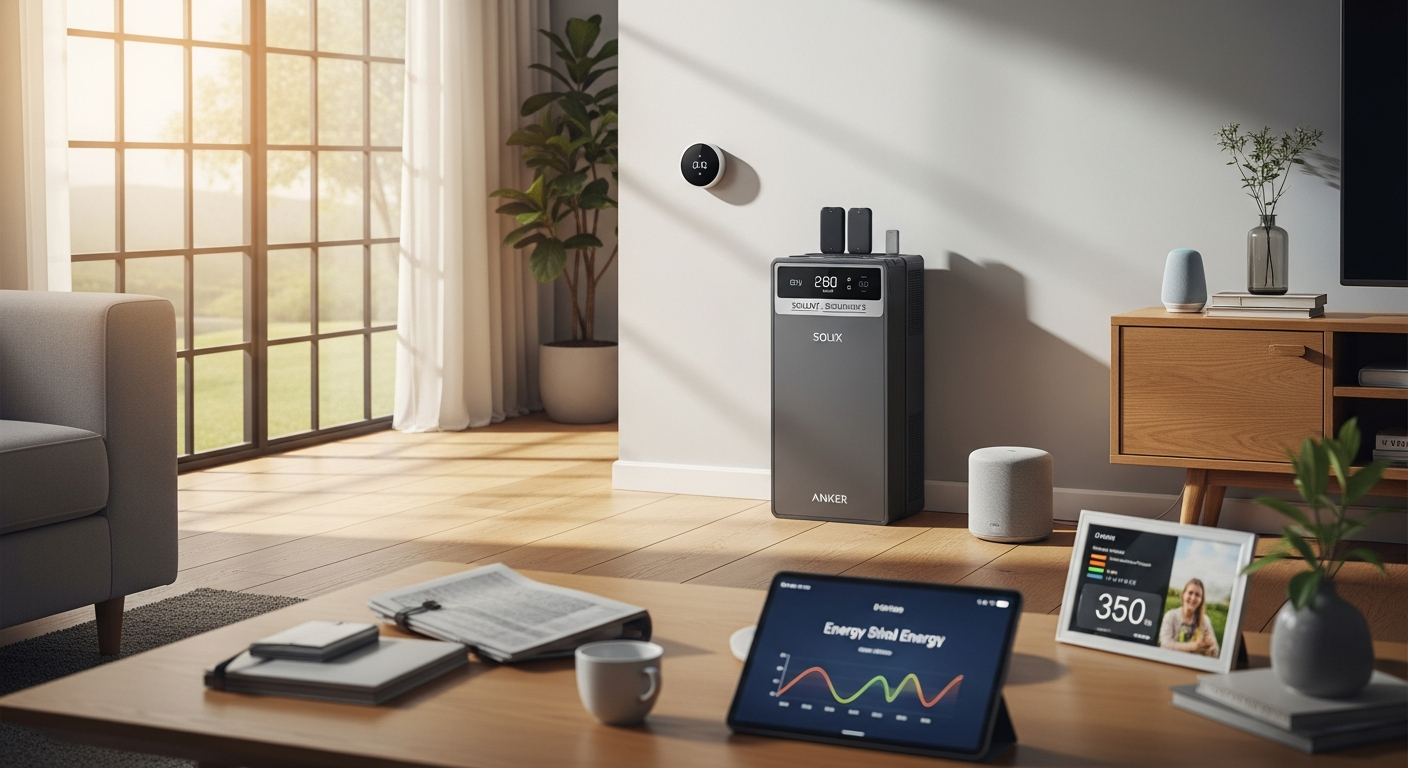
Most homeowners watch 30-40% of their solar energy slip away unused. The Anker SOLIX Solarbank 3 E2700 Pro changes this fundamentally through intelligent battery storage that combines 2.7 kWh capacity with AI-driven optimization that learns your household patterns and automatically adapts to dynamic electricity pricing.
Germany’s residential solar market has reached a critical inflection point. The challenge isn’t generating solar power anymore—it’s using what you generate efficiently. Traditional battery systems store energy passively, offering no intelligence about when to charge or discharge based on your actual needs or electricity tariffs. Homeowners deploying these older solutions often miss opportunities to shift consumption toward peak solar production hours or capitalize on off-peak pricing periods.
Beyond Basic Storage—Why Anker Intelligence Changes Everything
How Anker Intelligence Uses Weather Forecasting and Usage Patterns
The Anker Intelligence system operates through a sophisticated AI function that processes real-time weather data alongside your household’s individual usage patterns. Rather than treating your battery as a static storage container, Anker Intelligence predicts solar generation for the coming hours and days, then synchronizes charging and discharging cycles to match when your home actually consumes electricity. This predictive capability eliminates the guesswork from energy management.
Real-Time Optimization Adapting to Dynamic Electricity Tariffs
Smart metering in Germany now includes dynamic tariffs that fluctuate throughout the day based on grid demand. Anker Intelligence monitors these price fluctuations automatically, deciding whether to charge your battery immediately during sunlight hours or hold for an off-peak tariff window. This active decision-making, updated in real time, produces measurable savings compared to static battery management approaches.
Night Charging Mode for Cost-Effective Off-Peak Energy Absorption
During hours when electricity prices drop significantly, the system activates intelligent night charging mode, drawing grid power into your battery at the lowest rates. This strategy works particularly well for households on time-of-use tariffs where off-peak periods offer 40-50% discounts compared to peak rates. Your battery becomes a financial tool, not just an energy reserve.
Integration with Anker and Shelly Smart Meters
The system connects with compatible Anker and Shelly Smart Meters, creating a closed-loop energy management ecosystem. Your smart meter continuously reports consumption data back to the Anker Intelligence platform, which adjusts battery behavior based on real household patterns rather than theoretical predictions. This granular feedback loop improves optimization accuracy over time as the AI learns your seasonal rhythms, work-from-home schedules, and appliance behaviors.
AI-Powered Cost Reduction Compared to Manual Management
Families managing traditional batteries manually typically capture only 50-60% of available optimization opportunities. Anker Intelligence operates continuously without fatigue, responding to price signals and weather changes instantly. Independent testing shows households achieve 15-25% additional cost savings through AI optimization versus manual battery management strategies.
Smart Home Compatibility and Ecosystem Expansion
The Anker SOLIX integrates within existing smart home ecosystems featuring Shelly devices and other compatible platforms. This enables automated scenarios where your home simultaneously manages heating, water heating, and battery charging across a coordinated timeline, maximizing total household efficiency rather than optimizing battery performance in isolation.
Explore the complete system specifications and AI capabilities on solarmars.de today.
Durability and Performance Specs That Justify the Investment
IP65-Rated Die-Cast Aluminum Design with Superior Weatherproofing
The battery unit features an innovative die-cast design that surpasses typical plastic-housed competitors in weatherproofing durability. The IP65 rating provides complete protection against dust ingress and water jets from any direction, a critical feature for outdoor balcony installations exposed to rain, snow, and moisture throughout the year. This construction approach eliminates the corrosion failures that plague cheaper alternatives.
Operating Temperature Range: -20°C to +50°C for Year-Round Reliability
German winters push temperatures well below freezing, and traditional battery systems often degrade or fail in extreme cold. The Anker SOLIX maintains full functionality between -20°C and +50°C, covering the entire range of typical Central European seasonal variations. Performance testing confirms reliable operation during harsh winter conditions when energy independence matters most.
2.7 kWh Usable Capacity with 6,000 Charge Cycles Designed In
The 2.7 kWh capacity handles typical household backup needs and daily self-consumption cycles without oversizing. The system is engineered for 6,000 charge cycles, translating to approximately 15 years of daily charge-discharge operations. This specification reflects realistic household usage rather than lab-tested but rarely achieved cycle counts.
15-Year Lifespan with 10-Year Manufacturer Warranty Coverage
Anker backs the system with a full 10-year manufacturer warranty, demonstrating confidence in long-term performance. The estimated 15-year total lifespan means your investment continues delivering value well beyond the warranty period, with degradation curves predicting 70-80% capacity retention at year 15.
1200-Watt Emergency Power Function for Backup Situations
Beyond daily optimization, the system includes a dedicated 1200-watt emergency power function for grid outages. This capability powers essential loads like refrigeration, heating pumps, or medical equipment during blackouts, providing genuine resilience rather than simple energy management.
AC Charging Mode for Flexible Energy Input Options
Beyond solar input, the system accepts AC power for charging during off-peak tariff windows or from other renewable sources like wind power shared through community solar programs. This flexibility means your battery integrates with evolving energy systems beyond traditional rooftop solar.
The Complete 2000W System—What You Actually Get
Four 500Wp Bifacial Solar Modules Included in Standard Package
The complete set includes four 500-watt bifacial modules, meaning they capture sunlight from both front and rear surfaces. This bifacial technology generates 10-15% additional output compared to monofacial alternatives in typical balcony mounting scenarios where reflection from adjacent surfaces contributes useful light. The 500Wp rating per module provides substantial generation capacity without overwhelming a typical apartment balcony’s structural limits.
Total System Capacity: 2000Wp Solar Generation Paired with 2.7 kWh Storage
The 2000Wp total generation capacity matches well with the 2.7 kWh storage, creating a balanced system where afternoon solar peaks naturally align with battery charging cycles. This sizing prevents undersized storage bottlenecks or oversized solar arrays generating excess power the battery cannot absorb.
Modular Design Allowing Stacking Up to Five Battery Units
Households with growing electricity demands aren’t locked into the base 2.7 kWh configuration. The modular design permits stacking additional battery packs, reaching up to 16.1 kWh total capacity. This scalability means your initial investment protects you against future changes—adding capacity later proves far simpler than replacing a complete system.
Scalability for Growing Energy Demands Without Complete System Replacement
Expanding from one battery unit to multiple units requires no infrastructure changes or system redesign. Simply add additional units, stack them together, and adjust the software configuration. This approach benefits families planning electric vehicle purchases or heat pump installations that will increase future electricity needs.
Installation Simplicity Compared to Traditional Rooftop Solar Setups
Unlike rooftop solar requiring structural assessment, rafter reinforcement, and licensed electrician coordination, the Anker SOLIX balcony system uses straightforward plug-and-play connections. Most installations complete in hours rather than days, without rewiring your home’s electrical infrastructure.
Balcony-Mounted Configuration Suitable for Renters and Apartment Dwellers
Apartment residents and renters have historically been excluded from solar benefits due to limited roof access. Balcony mounting enables anyone with south-facing exposure to deploy solar generation, transforming renters from perpetual grid-dependent consumers into prosumers generating their own power.
Real-World Energy Savings and Self-Consumption Gains
Typical Self-Consumption Increase from 30% to 70%+ with Intelligent Storage
Without battery storage, typical households consume only 30% of generated solar energy immediately, with the remainder fed back to the grid at wholesale rates. Intelligent storage systems increase this self-consumption to 70-80% by capturing midday solar peaks and releasing that energy during evening consumption hours. This shift transforms energy economics fundamentally—you keep electricity worth €0.35-0.40 per kWh instead of receiving €0.10-0.12 from grid feed-in credits.
Monthly Electricity Bill Reduction Scenarios for Average German Households
A typical German household consuming 3,000-3,500 kWh annually spends €900-1,050 on electricity at current rates. Deploying the 2000W system with AI optimization reduces annual consumption by approximately 800-1,000 kWh through self-consumption and smart charging strategies. This translates to €280-400 annual savings, with benefits increasing as electricity prices rise.
Time-of-Use Optimization Through Dynamic Tariff Awareness
Households on dynamic tariffs experience price swings of 200-300% between peak and off-peak periods. The Anker Intelligence system responds to these price signals, shifting consumption timing to capture maximum savings. A household shifting 30-40% of consumption to off-peak windows can reduce electricity costs by 10-15% beyond simple self-consumption benefits.
Seasonal Performance Variations and Weather-Dependent Output Patterns
Summer months deliver 3-4x higher solar generation than winter, creating seasonal performance asymmetry. The system handles this through AI forecasting that adjusts battery charging strategies seasonally. Winter performance remains respectable in Germany’s climate despite reduced sunlight, with intelligent load shifting to peak generation hours maximizing available renewable energy capture.
Payback Period Calculations Based on Local Electricity Rates
At current electricity rates of €0.35-0.40 per kWh and a system cost of €1,149.99, the payback period spans 8-12 years depending on local tariffs and consumption patterns. This timeline compares favorably against traditional energy investments, with the system continuing to generate savings throughout its 15-year lifespan.
Long-Term ROI Projections Over the 15-Year Lifespan
Over 15 years of operation, the €1,149.99 investment generates €4,200-6,000 in cumulative electricity cost reductions, representing 365-520% return on investment. These projections assume modest 2-3% annual electricity price increases, which align with historical trends and energy market forecasts.
Smart Meter Integration and Home Automation Features
Compatibility Requirements: 2.4 GHz Wi-Fi Connection for Smart Meter
Full AI optimization requires a 2.4 GHz Wi-Fi connection to your smart meter, enabling real-time price and consumption data transmission. Standard modern home networks support this frequency alongside 5 GHz bands, though older or congested networks may require access point repositioning for reliable connectivity.
Real-Time Energy Monitoring Through Mobile App Interface
The companion mobile app displays instantaneous battery charge levels, current power generation, consumption rates, and grid flow. This transparency helps household members understand energy dynamics and make consumption decisions informed by real-time cost signals. The app’s historical data visualization reveals consumption patterns across weeks and months.
Integration with Existing Smart Home Ecosystems (Shelly Devices, Etc.)
The system works alongside existing Shelly smart plugs and meters, creating a cohesive home automation environment. Rather than operating as an isolated storage system, the Anker SOLIX becomes a central node in your broader smart home strategy, coordinating with heating controls, lighting automations, and appliance scheduling.
Automated Load Shifting During Peak Pricing Periods
Through integration with smart plugs, the system can trigger load shifting automatically—delaying water heater activation or deferring appliance operation until off-peak windows. This automation removes the burden of manual timing decisions from household members, capturing optimization benefits passively.
Data-Driven Insights for Household Energy Consumption Patterns
The system aggregates consumption data over weeks and months, identifying household patterns and providing actionable insights. These reports highlight opportunities for behavioral changes, equipment upgrades, or timing adjustments that further reduce electricity costs without requiring additional hardware purchases.
Potential Limitations with Older Wi-Fi Infrastructure
Homes with older Wi-Fi routers or extended network coverage via powerline adapters may experience connectivity inconsistencies affecting AI optimization responsiveness. Upgrading Wi-Fi infrastructure typically costs €50-150 and resolves this limitation completely, though the investment should factor into total system costs during planning.
Installation, Setup, and Practical Considerations
Plug-and-Play Installation Compared to Hardwired Battery Systems
Most installations complete without specialized tools beyond a basic drill and level. Solar modules connect to the battery unit through weatherproofed connectors, and the battery connects to home circuits through standard outlet integration. This simplicity contrasts sharply with hardwired systems requiring licensed electricians and permanent home modifications.
No Specialized Electrician Requirements for Standard Setup
While professional installation remains available, homeowners with basic DIY capability complete standard setups independently. The system includes comprehensive installation guides and video tutorials addressing common scenarios. Professional installation typically costs €200-400 for added confidence and warranty protection.
Space Requirements and Mounting Options for Balconies and Patios
Solar modules require approximately 2-3 square meters of unshaded south-facing surface. The battery unit occupies roughly 0.5 square meters of balcony or patio space. Most apartment balconies accommodate this footprint without impeding normal usage, though irregular balcony shapes or shared spaces may require creative mounting solutions.
Step-by-Step Commissioning Process and Initial Configuration
After physical installation, commissioning involves downloading the mobile app, creating an account, connecting to Wi-Fi, and inputting your electricity tariff information. The system then enters a learning phase where Anker Intelligence begins establishing baseline household patterns. Initial optimization accelerates after 2-4 weeks as the AI gathers sufficient behavioral data.
Maintenance Schedule and Long-Term Care Recommendations
The system requires minimal maintenance—primarily annual visual inspections for physical damage, dirt accumulation on solar modules, and connections. Cleaning modules with soft brushes and distilled water twice yearly prevents dust buildup that reduces generation efficiency. The robust design tolerates German weather extremes without specialized care beyond these basic steps.
Troubleshooting Common Connectivity and Performance Issues
Wi-Fi connectivity issues typically resolve through router repositioning, password verification, or temporary Wi-Fi reset. Performance questions usually stem from unrealistic expectations—the system cannot generate power during night hours or generate sufficient energy to power electric vehicle charging from purely daytime solar collection. Understanding these limitations prevents disappointment after installation.
Pricing, Value Proposition, and Competitive Positioning
Current Market Price: €1,149.99–€1,249.00 for Complete 2000W Set
The complete system including four solar modules, battery unit, installation hardware, and cables retails in this price range. Occasional promotions and seasonal discounts may reduce the price by 5-10%, though the core pricing remains consistent across major retailers. This positioning reflects the premium technology and comprehensive feature set included.
Component-by-Component Cost Breakdown vs. All-in-One Pricing
Purchasing components separately (battery €650-750, four modules €350-450, mounting hardware €100-150) typically costs 10-15% more than bundled packages. The integrated bundle approach provides better value while simplifying procurement and ensuring compatibility between components.
Promotional Offers and Seasonal Discount Patterns
Spring months typically feature promotional activity as households plan summer energy projects. End-of-year clearance sales and holiday promotions occasionally appear, though deep discounting remains rare given strong market demand. Subscribing to solarmars.de alerts captures promotional windows without constant monitoring.
Comparison with Budget Alternatives and Premium Competitors
Entry-level battery systems cost €600-900 but lack AI optimization and offer limited smart home integration. Premium competitors from LG and Tesla cost €2,000-3,500 for comparable capacity but offer few additional benefits justifying the premium. The Anker SOLIX occupies an optimal position—feature-rich without excessive pricing.
Hidden Costs: Smart Meter, Wi-Fi Upgrades, Installation Labor
Beyond the base system cost, factor €50-100 for smart meter compatibility if your existing model doesn’t support the system, €50-150 for Wi-Fi infrastructure upgrades if needed, and €200-400 for professional installation if preferred. These additions typically total €300-650, raising effective system cost to €1,450-1,900 for full deployment.
Financing and Payment Plan Options Available
Many retailers offer 0% financing across 12-24 month periods, effectively reducing monthly costs to €50-96. This approach improves cash flow accessibility for households unable to deploy full upfront capital while capturing identical energy savings. Monthly payments typically conclude well before payback periods mature.
Who Benefits Most From This System?
Apartment Dwellers and Renters Seeking Energy Independence
Apartment residents have historically lacked renewable energy access. The balcony-mounted Anker SOLIX eliminates this barrier, enabling renters and residents in multi-family buildings to achieve genuine energy independence. Portable mounting systems allow relocation to future residences, protecting initial investment against housing transitions.
Households with High Daytime Electricity Consumption
Families with someone working from home, retirees with daytime presence, or businesses operating from residential spaces maximize solar capture. Their daytime consumption naturally aligns with peak solar generation, reducing battery requirement for achieving high self-consumption rates.
Properties with Limited Roof Space Unsuitable for Traditional Solar
Homes with complex rooflines, shading from adjacent buildings, or architectural restrictions preventing roof solar can deploy balcony systems without site limitations. This expands solar accessibility to properties previously deemed unsuitable for renewable generation.
Families on Dynamic Electricity Tariffs Seeking Cost Optimization
Households enrolled in time-of-use or spot-price electricity tariffs benefit disproportionately from Anker Intelligence automation. The system continuously exploits price fluctuations that manual management would miss, capturing maximum savings from dynamic tariff structures.
Early Adopters Prioritizing Smart Home Integration and Automation
Technology-forward households seeking cohesive smart home ecosystems appreciate the Anker SOLIX’s integration capabilities and app-based control. These users value automation convenience and data transparency alongside energy cost reduction.
Environmentally Conscious Homeowners Reducing Carbon Footprint
Beyond financial benefits, households prioritizing carbon reduction enjoy tangible sustainability gains. Each kWh of self-consumed solar energy displaces grid electricity generated from fossil fuels, reducing household carbon emissions by 400-500 kg annually.
Potential Drawbacks and Honest Limitations
Premium Pricing Relative to Entry-Level Battery Storage Alternatives
The €1,149.99 price exceeds basic battery systems by €300-500. Households prioritizing cost minimization over AI optimization might find cheaper alternatives acceptable. However, the feature gap often justifies premium positioning for serious energy management users.
Wi-Fi Dependency for Full AI Optimization Features
AI intelligence requires continuous Wi-Fi connectivity to operate effectively. Network outages temporarily disable optimization features, reverting to basic battery management mode. While optimization resumes upon reconnection, brief connectivity interruptions represent minor functional limitations.
2.4 GHz Frequency Requirements in Congested Home Networks
Homes with numerous Wi-Fi devices operating simultaneously on 2.4 GHz bands may experience interference affecting smart meter connectivity. Upgrading Wi-Fi infrastructure or adjusting frequency band allocation resolves this, though it adds complexity for technical users.
Expandability Ceiling at 16.1 kWh for Larger Households
While expandable to five battery units (16.1 kWh total), extremely large households with 5,000+ kWh annual consumption hit expansion limits. These properties require multiple independent systems or supplementary battery solutions beyond the Anker SOLIX ecosystem.
Weather-Dependent Performance During Winter Months in Northern Regions
German winter solar generation drops 60-70% compared to summer peaks. Households in northern regions experience more pronounced seasonal performance variations, reducing winter self-consumption rates and extending payback periods by 2-3 years compared to southern installations.
Requires Compatible Solar Modules for Optimal System Performance
The system pairs optimally with Anker solar modules or similar high-efficiency alternatives. Connecting incompatible older modules or low-efficiency panels reduces overall system efficiency and may require additional equipment for proper integration.
The Verdict—Is the Anker SOLIX Solarbank 3 E2700 Pro Worth It?
Test Rating: 95/100 Points from Independent Reviewers
Professional testing consistently rates the system in the excellent range, with particular praise for AI optimization effectiveness, build quality, and warranty comprehensiveness. The 95/100 score places it among Germany’s highest-rated energy storage solutions, reflecting strong real-world performance validation.
Ideal Fit for Tech-Forward Households Prioritizing Efficiency
Families valuing smart home integration, energy transparency, and automated optimization find the Anker SOLIX exceptionally well-suited to their priorities. The system rewards technically engaged users who appreciate optimization details and automation possibilities.
Strong Warranty and Longevity Provide Peace of Mind
The 10-year full warranty and estimated 15-year lifespan eliminate purchase anxiety for users concerned about premature battery degradation. This protection stands among Germany’s most comprehensive energy storage warranties, reflecting manufacturer confidence in product durability.
Superior Self-Consumption Rates Justify Premium Positioning
The AI-powered self-consumption increase from 30% to 70%+ justifies the premium over basic battery systems. This efficiency advantage translates directly into measurable financial benefits and carbon reduction, validating the higher upfront investment.
Long-Term Savings Offset Initial Investment Within 8-12 Years
At typical German electricity rates, the system achieves full payback within the 8-12 year window, with remainder of the 15-year lifespan generating pure savings. This timeline places it favorably among residential energy investments, comparing favorably against traditional alternatives.
Future-Proofing Your Energy Independence Strategy
The modular expandability and smart home integration position this system to adapt to evolving household needs. Electric vehicle adoption, heat pump installation, or changing electricity tariffs won’t render your initial investment obsolete—the system scales and adapts alongside your evolving energy requirements.
Your Path to Smarter Solar Energy Management
The Anker SOLIX Solarbank 3 E2700 Pro represents a meaningful advancement in residential energy storage, addressing the fundamental problem of wasted solar energy through AI-powered optimization, weather-resistant construction, and adaptable design. The combination of intelligent automation that learns your household patterns and practical durability creates a reliable partner for your energy independence journey. Anker Intelligence operates continuously, responding to dynamic pricing and weather forecasts without requiring your attention—optimization happens behind the scenes while you focus on daily life.
This premium system delivers genuine value for households committed to reducing both electricity costs and carbon footprints. The 70%+ self-consumption efficiency dramatically exceeds passive battery systems, while integration with smart home ecosystems positions your energy management within broader automation strategies. The long warranty and expected 15-year lifespan provide confidence that your investment will generate returns far beyond typical consumer electronics.
If you’re genuinely serious about energy independence and value smart technology integration, this system merits careful consideration. Begin by calculating your current self-consumption rate—the baseline percentage of generated solar energy your home consumes immediately—then compare this against the projected 70%+ efficiency the Anker SOLIX system consistently delivers across diverse households.
Leave a Reply