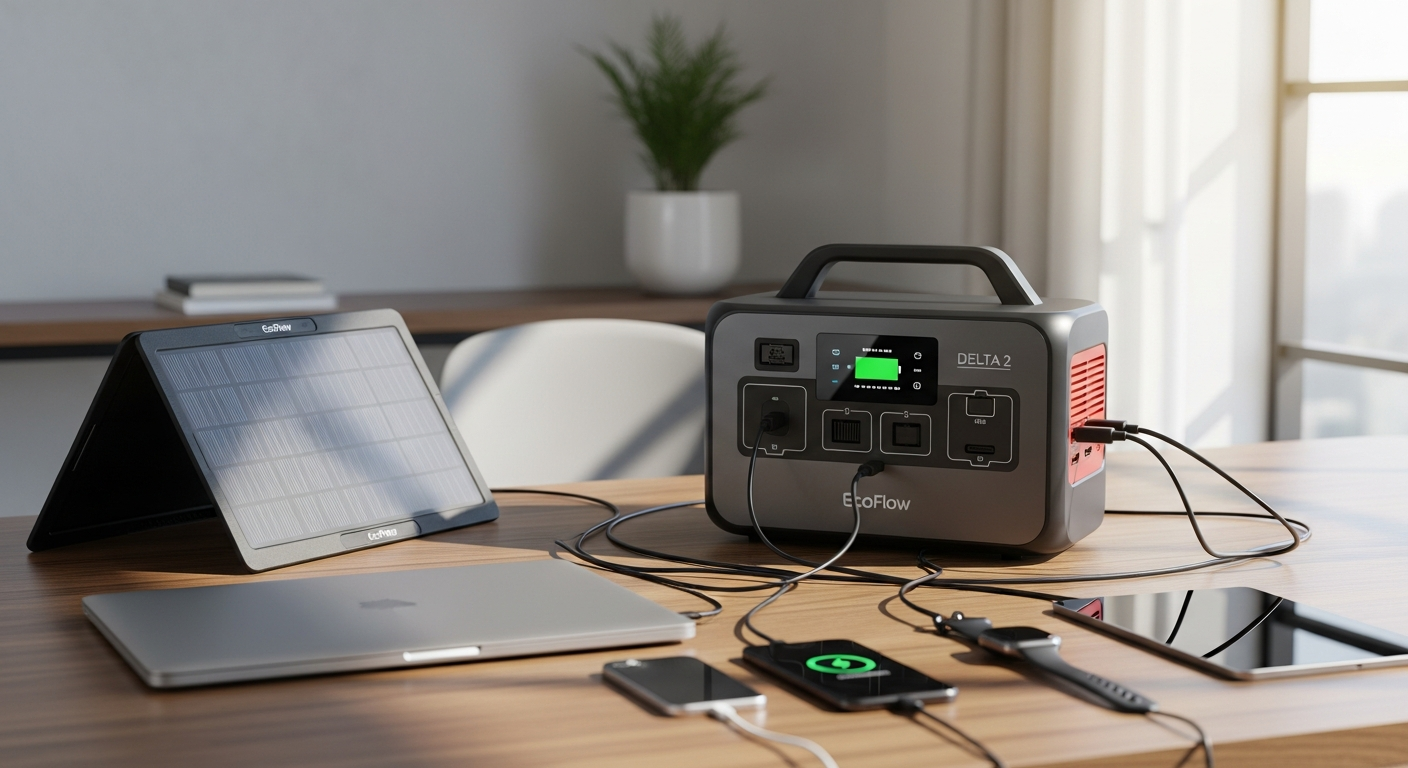
When the grid goes down, you need power you can count on. The EcoFlow DELTA 2 Portable Power Station has become the go-to choice for adventurers, remote workers, and homeowners seeking reliable backup power. What makes it stand out? It charges from zero to 80% in just 50 minutes—faster than most competitors can even get halfway there. I’ve spent considerable time researching portable power stations, and the DELTA 2 consistently ranks as the best overall option for good reason. It’s about striking that sweet spot where capacity meets speed, where portability meets raw power, and where smart features meet real-world reliability. Whether you’re powering your campsite, running essential home appliances during an outage, or keeping your content creation gear charged, this unit delivers. In this guide, I’ll break down everything you need to know about the EcoFlow DELTA 2—from its impressive specifications to its real-world performance, honest limitations, and whether it’s the right investment for your needs.
What Makes the EcoFlow DELTA 2 Stand Out in the Portable Power Market
The EcoFlow DELTA 2 has earned its reputation as a best-seller for good reason. It delivers a compelling combination of capacity, performance, and price that appeals to a remarkably diverse user base. Whether you’re an outdoor enthusiast, content creator, or homeowner preparing for emergencies, this power station addresses real-world needs without requiring a premium investment.
In the mid-range portable power station segment, the DELTA 2 occupies a sweet spot that competitors struggle to match. At $899-$999, you’re getting high-end features typically found in more expensive units. The continuous 1800W AC output handles most household appliances and professional tools, while the expandable battery system means you’re not locked into a single capacity level. This modularity is crucial—it means your initial purchase can grow with your requirements rather than becoming obsolete as your power needs increase.
What resonates most with customers is the practical balance this unit achieves. It’s portable enough for camping and outdoor adventures at 27 lbs, yet powerful enough to serve as genuine home backup during outages. Check the EcoFlow DELTA 2 on their official site to see how it compares to alternatives in your price range. The unit appeals to overlanders who need reliable power in remote locations, content creators requiring multiple simultaneous device charges, and families seeking emergency preparedness without excessive complexity.
The market positioning reflects genuine performance rather than marketing hype. Industry reviews consistently rank it as the top overall choice because it delivers measurable advantages across multiple dimensions—not just capacity, but charging speed, output flexibility, and real-world usability.
Lightning-Fast Charging: The Game-Changing Feature You Need to Know About
Charging speed separates the DELTA 2 from conventional portable power stations in a way that dramatically impacts real-world utility. Most competitors require 5-10 hours to fully recharge via standard AC outlets. The DELTA 2 reaches 80% capacity in roughly 50 minutes and completes a full charge in 80 minutes. This isn’t a minor convenience—it’s genuinely transformative for users with limited grid access windows.
Consider practical scenarios where this speed matters. A camper with unreliable solar and occasional access to shore power needs to maximize charging during those brief connected periods. A homeowner facing extended outages wants to restore the battery before the next weather event. A content creator traveling between locations can’t afford multi-hour charging delays between shoots. For these use cases and dozens of others, traditional charging speeds are genuinely problematic.
The DELTA 2 addresses this through its engineering approach to power input. The unit accepts multiple charging methods, each delivering substantial power transfer rates. AC wall outlet charging provides the primary rapid-charge option through its optimized power delivery. Get the DELTA 2 here and you can also utilize solar input and 12V car charging simultaneously, creating flexibility that matter when you’re away from traditional power infrastructure.
The practical advantage extends beyond simple speed metrics. Rapid charging during brief grid-available windows means emergency backup stays viable even in households with limited access windows. Road-trippers can recharge overnight while parked with hookups rather than spending entire days waiting for power restoration. This capability transforms the DELTA 2 from a “nice to have” into an essential practical tool for active lifestyles.
Expandable Battery Capacity: From 1024Wh to 3072Wh
The base 1024Wh capacity addresses most everyday power scenarios. This energy level sustains laptops, cameras, refrigerators, and typical household devices for meaningful timeframes. A single day of light usage—charging phones, running a laptop, and powering lighting—requires only a fraction of this capacity, extending operational time significantly.
However, portable power requirements expand as your activities scale. A multi-day camping trip with multiple people, continuous content creation requiring several devices simultaneously, or whole-home backup for extended outages demands greater capacity. Traditional solutions force you to purchase an entirely larger unit, discarding your original investment.
The DELTA 2’s modular approach eliminates this problem. One additional battery module expands capacity to 2048Wh—effectively doubling your available energy. A second additional battery brings total capacity to 3072Wh. This flexibility means your initial 1024Wh purchase becomes the foundation of a scalable system rather than a capacity ceiling.
The expansion strategy is economically intelligent. You purchase only the capacity you currently need, adding modules as requirements grow. Early adopters aren’t penalized with oversized, expensive units they don’t immediately require. Long-term users scale naturally without replacing functioning equipment. Buy the DELTA 2 with expansion options available to future-proof your portable power investment. This modular design architecture means your decision today doesn’t eliminate options tomorrow—a genuinely forward-thinking approach to product planning.
Power Output and Performance: What Can You Actually Run?
Raw capacity numbers matter less than what you can actually power. The DELTA 2 delivers continuous AC output of 1800W through standard outlets. This handles refrigerators, microwave ovens, power tools, air compressors, and most household appliances. Simultaneous operation of multiple devices remains feasible—charge a laptop while running a refrigerator and powering lighting without strain.
Demanding devices requiring momentary power surges present the traditional challenge for portable power. Motor-driven equipment like air compressors, refrigerators with compressors, and power tools experience startup current spikes exceeding normal running power. The DELTA 2 addresses this through X-Boost mode, which extends output capability to 2200W for these high-demand applications. Surge capacity reaches 2700W, accommodating the initial power draw of equipment that would otherwise exceed continuous output ratings.
Real-world applications demonstrate this flexibility. A refrigerator runs continuously on standard output while you charge a laptop and camera battery. X-Boost mode powers a circular saw or impact drill that would otherwise trip overload protection. The surge capacity handles compressor startup on tools and appliances. This combination of continuous, boosted, and surge capacity means you’re not constrained to low-power devices.
The connection ecosystem supports simultaneous charging of multiple users and devices. AC outlets handle larger appliances and power tools. USB-A and USB-C ports charge phones, tablets, and camera batteries. DC connections support automotive devices and 12V equipment. One person runs power tools while another charges several mobile devices and a third maintains a refrigerator—all simultaneously from the same unit.
LiFePO4 Battery Technology and Long-Term Durability
Battery chemistry fundamentally determines portable power station longevity and safety characteristics. The DELTA 2 employs LiFePO4 (lithium iron phosphate) rather than standard lithium-ion technology. This distinction carries substantial implications for reliability and lifespan.
LiFePO4 chemistry provides superior thermal stability compared to conventional lithium-ion cells. The chemical structure remains stable at higher temperatures, reducing the risk of thermal runaway—the cascading temperature increase that can damage or destroy batteries. This safety advantage translates to more reliable performance under demanding conditions and better longevity across the battery’s lifetime.
The rated performance reflects this superior chemistry. The DELTA 2 battery maintains 80%+ capacity after 3000+ charge cycles. Under normal usage—charging and discharging regularly but not continuously—this translates to approximately 10 years of viable service. Users don’t face premature capacity degradation requiring replacement after a few years. The battery genuinely lasts.
The 5-year warranty provides explicit manufacturer confidence in this longevity claim. Extended coverage reflects actual product performance data rather than marketing positioning. If manufacturing defects appear, the warranty protects your investment. Users benefit from the safety, reliability, and extended lifespan that LiFePO4 technology delivers compared to cheaper lithium-ion alternatives.
Portability and Design: Balancing Power with Practicality
At 27 lbs (12 kg), the DELTA 2 achieves a genuine balance between power and portability. Compared to whole-home backup systems weighing hundreds of pounds, it remains manageable for single-person transport. A reasonably healthy adult can carry it substantial distances without excessive fatigue. This practicality opens applications impossible with heavier alternatives.
The ergonomic handle design facilitates comfortable carrying across varying distances. Whether moving the unit from vehicle to campsite, home to vehicle for emergency readiness, or between rooms during indoor use, the handle supports practical handling. The physical design reflects actual usage patterns rather than laboratory conditions.
Dimensions and shape fit naturally into transportation and storage scenarios. A vehicle can accommodate the DELTA 2 without occupying excessive space. It fits into storage closets, garage shelves, and under stairs when not actively in use. Camping trailers and RVs can integrate the unit into their power systems. Home backup requires manageable storage space rather than dedicated rooms.
The premium build quality throughout the unit communicates durability and attention to engineering. The power station doesn’t feel like a budget device despite its competitive pricing. Materials selection, finish quality, and connection robustness reflect genuine manufacturing standards rather than cost-cutting compromises. This build quality supports confidence in long-term reliability.
Smart App Control and Remote Monitoring Features
Mobile app connectivity transforms the DELTA 2 from a standalone power source into an integrated smart energy system. Both iOS and Android platforms support comprehensive monitoring and control capabilities. Users track real-time power consumption, monitor battery status, and manage charging from smartphones anywhere with connectivity.
Real-time usage monitoring reveals power consumption patterns that inform efficiency decisions. You observe exactly how much energy each device category consumes, identify phantom loads, and optimize usage patterns. This transparency enables conscious power management without requiring manual calculations or guesswork.
Remote port control and management capabilities provide practical convenience. Disable unused ports remotely to prevent accidental connections. Enable specific outlets when you need them. Manage which devices remain powered during extended periods away from the physical unit. This granular control extends battery life by eliminating unnecessary power draws.
Charging mode adjustments through the mobile interface enable optimization based on current conditions. Users can shift between rapid charging during brief grid-available windows and slower charging when prioritizing battery health. Temperature-sensitive environments benefit from this flexibility. The app provides the control sophistication typically found only in expensive commercial power systems.
Battery health and status notifications keep users continuously informed about system performance. Alerts appear if temperatures exceed safe ranges or if degradation patterns develop. Preventive maintenance becomes possible through early warning systems. Users address emerging issues before they compromise reliability.
The Honest Pros and Cons of the EcoFlow DELTA 2
Advantages Worth Considering
The ultra-fast AC charging capability stands foremost among genuine advantages. Reaching 80% capacity in 50 minutes transforms practical usability for users with limited grid access windows. Full charges within 80 minutes eliminate the multi-hour wait times that plague competitive offerings.
Expandable capacity from 1024Wh to 3072Wh provides genuine flexibility absent in fixed-capacity alternatives. Users scale to match actual requirements rather than accepting predefined capacity tiers that often overshoot or undershoot real needs.
The durable LiFePO4 battery chemistry ensures 3000+ charge cycles supporting approximately 10 years of reliable service. Longevity advantages over standard lithium-ion alternatives address the total cost of ownership across the product’s lifetime.
High AC output of 1800W continuous with X-Boost extending to 2200W enables most household appliances and professional tools. Coupled with 2700W surge capacity, the DELTA 2 handles real-world power demands without artificial constraints.
The relatively portable 27 lb weight makes the unit genuinely transportable while maintaining substantial capacity. This balance enables applications impossible with either lighter-but-limited or heavier-but-more-capable alternatives.
Smart app control provides sophisticated monitoring and management capabilities typically requiring dedicated professional equipment. Remote monitoring and port management deliver convenience that justifies the technology investment.
Comprehensive 5-year warranty coverage reflects manufacturer confidence and protects user investment against defects and manufacturing issues.
Genuine Limitations Worth Understanding
Fan noise can be noticeable and occasionally loud during fast charging or under heavy loads. Users in quiet environments or light-sleeping situations may experience disturbance. Noise levels don’t create safety issues but do impact user experience during extended nighttime operation.
Solar panels are sold separately rather than included with the base unit. Users seeking off-grid charging capability must budget additional investment. While this modularity provides flexibility, it increases total system cost for solar-dependent applications.
Capacity limits present practical constraints for continuous heavy-duty whole-home backup without expansion. Single households with essential devices manageable on 1024Wh but larger families or those with heavy power requirements need expansion batteries to sustain meaningful runtime. The base unit functions well for emergency backup of critical circuits but not as sole power source for unrestricted whole-home usage.
Pricing and Investment Considerations
The $899-$999 base unit pricing establishes the DELTA 2 as a genuinely competitive option within the mid-range portable power market. Competitive analysis against comparable alternatives reveals strong value proposition. Equipment offering similar capacity and output capability typically costs $400-600 more or delivers meaningfully reduced performance at equivalent pricing.
Cost-per-watt metrics demonstrate excellent efficiency. Dividing unit cost by capacity and output capability shows favorable comparison to both budget alternatives and premium competitors. Users receive high-end features at mid-range pricing.
Expansion battery pricing maintains this value proposition. Additional batteries cost less than purchasing equivalent capacity in a separate standalone unit. Scaling capacity through modular expansion proves more economical than replacing the entire system.
Long-term investment value extends across the product’s 10-year lifespan. A device costing $900-1000 that functions reliably for a decade represents approximately $90-100 annual investment—a reasonable expense for reliable portable power. Higher-capacity alternatives costing double may deteriorate within 3-5 years, delivering worse lifetime value despite higher capacity.
Warranty coverage provides peace of mind and protection against unexpected costs. Defects discovered during the 5-year warranty period receive manufacturer support rather than requiring expensive replacement from user funds. This protection justifies confidence in the unit’s reliability and long-term viability.
Getting the Most Out of Your EcoFlow DELTA 2
Optimal charging practices preserve battery health across the device’s service lifetime. Avoid consistently charging to 100% when your usage pattern permits. Maintaining charge levels between 20% and 80% extends longevity compared to frequent full discharge-recharge cycles. The LiFePO4 chemistry handles this better than standard lithium-ion, but conscious charging practices still optimize lifespan.
Load management strategies maximize efficiency and preserve battery health. Consolidate device charging into specific windows rather than maintaining constant trickle loads. Disable ports powering unused devices to eliminate phantom current draw. Schedule heavy power consumption during charging cycles when possible to avoid deep discharge between charging opportunities.
Using X-Boost mode effectively reserves this high-output capability for genuinely demanding applications. Standard continuous output handles most devices efficiently. Deploying X-Boost only when necessary for high-startup-current equipment preserves battery life and improves overall system efficiency. Reserve surge capacity for equipment startup rather than continuous operation.
App features and monitoring practices support continuous optimization. Review power consumption patterns to identify inefficient usage. Track battery degradation trends to anticipate maintenance needs. Monitor temperature data to ensure operation within safe parameters. Proactive monitoring enables intervention before issues compromise reliability.
Expansion planning anticipates future capacity needs before urgent requirements force reactive decisions. Consider upgrading battery capacity during seasonal transitions rather than mid-crisis. Planning upgrades during periods of adequate power supply allows careful evaluation and implementation rather than desperate scrambling during emergencies.
Maintenance strategies support long-term performance and reliability. Keep the unit clean and free of debris blocking cooling vents. Avoid exposure to temperature extremes that stress battery chemistry. Store in moderate temperature environments during extended non-use periods. Annual inspection of connection quality and port functionality catches emerging issues before they develop into problems. These straightforward practices preserve the DELTA 2’s reliability across its decade-long service life.
Verdict: Is the EcoFlow DELTA 2 Right for You?
The EcoFlow DELTA 2 Portable Power Station earns its reputation as the best overall choice through a combination of speed, reliability, and smart design. That 50-minute charge time isn’t just a spec sheet number—it’s a practical advantage that changes how you approach portable power. The expandable architecture means you’re not locked into a single capacity, and the LiFePO4 battery ensures your investment lasts a decade. Is it perfect? No. The fan noise during heavy loads and the separate solar panel cost are real considerations. But for most users seeking a versatile power solution that handles camping trips, emergency home backup, and remote work with equal competence, the DELTA 2 delivers exceptional value at a reasonable price point. If you’re ready to invest in reliable, fast-charging portable power that grows with your needs, the EcoFlow DELTA 2 deserves serious consideration. Start with the base 1024Wh unit and expand later if your power demands increase. That flexibility, combined with its proven performance and solid warranty, makes it a decision you’re unlikely to regret.
Leave a Reply