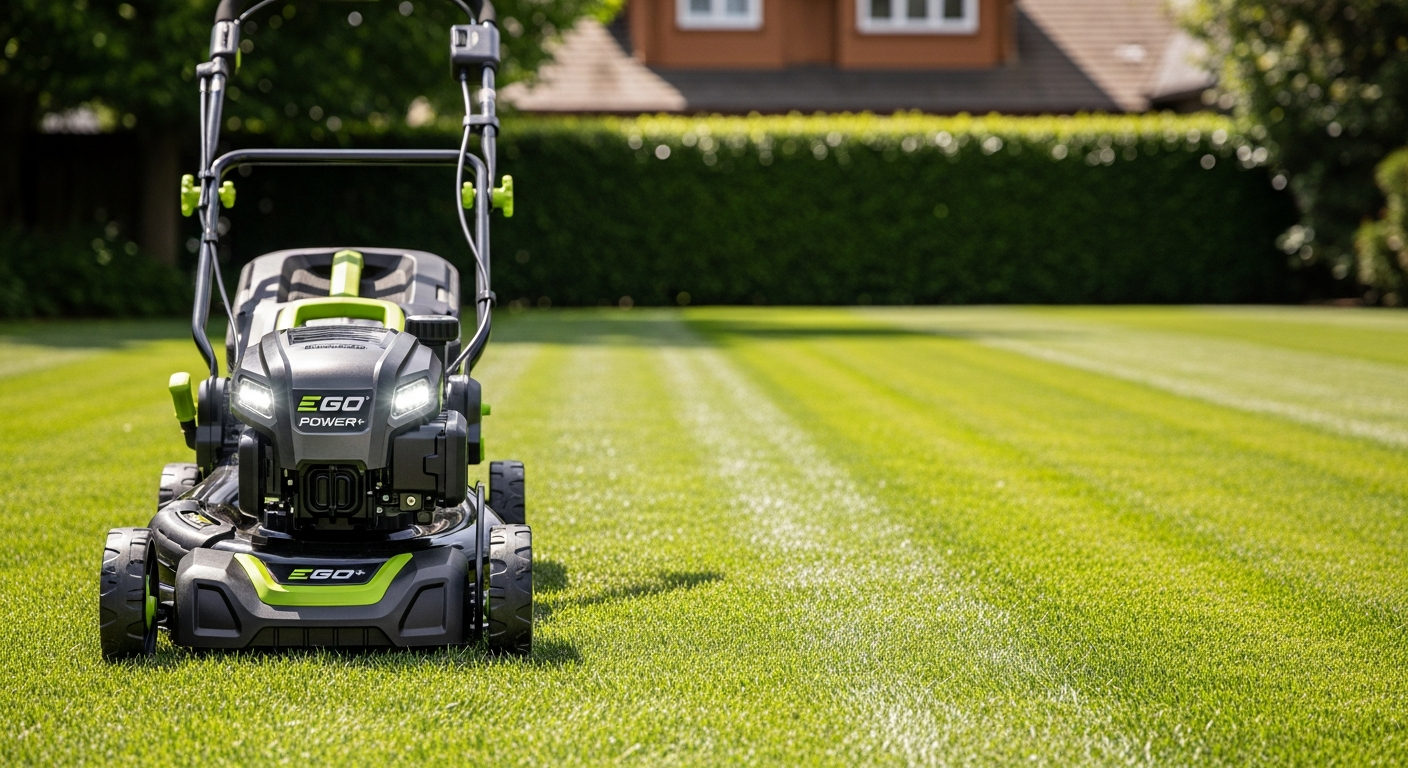
Gas-powered mowers have dominated driveways for decades—but here's what's changing: battery-powered alternatives are now delivering the same cutting power without the noise, fumes, or weekend maintenance headaches. The outdoor power equipment industry has shifted dramatically, and the EGO Power+ 21-inch Select Cut Self-Propelled Mower represents exactly why homeowners are making the switch in record numbers.
EGO consistently ranks as the #1 brand in battery-operated outdoor equipment, and this particular mower has become their flagship lawn care solution. The Select Cut multi-blade system, Touch Drive self-propulsion, and 56V ARC Lithium battery technology work together to create something genuinely different—a mower that doesn't ask you to compromise on performance while going green. Whether you're managing a quarter-acre suburban lot or tackling thicker grass patches, this machine delivers results that rival traditional gas models.
Throughout this guide, you'll find a comprehensive breakdown of the standout features that make this mower worth the investment, real-world performance expectations, and whether the price tag aligns with the value. You'll also learn how this mower compares to gas alternatives, what the battery ecosystem offers, and the practical considerations that matter before you buy.
The Select Cut Multi-Blade System Explained: Customizing Your Cut Strategy
Three cutting modes in one mower: Bagging for pristine lawns, mulching for nutrient cycling, and side-discharge for speed
The Select Cut system represents a fundamental shift in mowing flexibility. Rather than being locked into a single cutting method, this mower adapts to your lawn's needs. Bagging creates that manicured appearance perfect for curb appeal, with the grass clippings collected in a dedicated bin. Mulching returns nutrients directly to your soil, reducing fertilizer requirements and promoting healthier turf growth. Side-discharge offers maximum speed for larger areas, ejecting clippings to the side and keeping momentum throughout your mowing session.
Adaptive blade technology: How the multi-blade design adjusts to different grass types and lawn conditions
The multi-blade configuration works intelligently across varying grass densities and types. Thicker, more aggressive growth responds well to the system's ability to handle dense cutting loads without bogging down. Delicate or thin grass receives gentler treatment, preventing scalping while maintaining a clean cut. This adaptability means fewer passes over problem areas and more consistent results across your entire lawn.
Quick-change mechanism: Single-point adjustment lever for height modifications without tools
Gone are the days of struggling with individual adjustment points on each wheel. The single-point adjustment lever handles all four corners simultaneously, changing cutting height in seconds. This means experimenting with different heights throughout the season—higher cuts for summer heat stress, lower cuts for spring cleanup—requires zero tools and minimal effort.
Deck size options: 21-inch and 22-inch cutting widths and what they mean for lawn coverage
The 21-inch and 22-inch cutting decks represent different sweet spots. The 21-inch option offers superior maneuverability around obstacles and through tight spaces while still covering reasonable ground. The 22-inch variant increases per-pass width, reducing total mowing time for larger properties. Your property size and obstacle density should guide this decision.
Material composition: Understanding the plastic deck components and durability expectations
The deck uses composite materials rather than traditional stamped steel. This approach delivers weight savings that make the mower more portable, reduces rust concerns, and simplifies maintenance. Some users perceive plastic components as less premium than traditional construction, but these materials prove durable under typical residential use. Expect consistent performance for multiple seasons with proper care.
Grass discharge efficiency: Comparing bagging capacity, mulch consistency, and side-discharge throw distance
Each discharge method performs distinctly. The bagging system holds substantial grass volume before requiring emptying. Mulch output produces finely processed clippings that break down quickly. Side-discharge achieves impressive throw distance, directing clippings well away from your mowing path. Your chosen method depends on whether you prioritize aesthetic appearance, soil health, or pure efficiency.
Touch Drive Self-Propulsion: The Technology That Changes How You Mow
Variable speed control: Adjustable propulsion from crawling pace to full-speed traversal
Touch Drive eliminates the complexity of traditional gear systems. Speed adjustment happens intuitively, starting from a slow crawl for detail work around garden beds and accelerating to faster speeds for open sections. This variable approach reduces fatigue by matching propulsion to terrain and working conditions rather than forcing constant manual pushing.
Intuitive operation: How the technology works without complex gear systems
Rather than mechanical gears requiring conscious shifting, Touch Drive uses electronic throttle management. Your hand position on the handle determines speed instantly, creating a natural relationship between your input and the mower's response. First-time users typically master this within a single mowing session.
Obstacle navigation: Maneuverability around trees, garden beds, and hardscape features
The ability to slow to a crawl dramatically improves precision work. Trees, flower beds, and landscape features that typically require multiple passes or manual maneuvering become straightforward. The self-propulsion burden shifts entirely to the mower, letting you focus on steering and cutting quality rather than physical exertion.
Speed adjustment on-the-go: Real-world usability and learning curve considerations
Some users report that fine-tuning speed while actively mowing requires practice. The sensitivity of the touch control can feel imprecise until you develop the feel for incremental hand position changes. Most homeowners develop proficiency quickly, but those transitioning from traditional gas mowers might need a few sessions to feel completely comfortable with the adjustment sensitivity.
Terrain adaptation: Performance on slopes, uneven ground, and different grass densities
Touch Drive adapts responsively to changing conditions. Ascending slopes automatically slow the propulsion to maintain control, while descending triggers natural deceleration. Dense grass patches receive reduced speed, preventing bogging, while thin sections allow faster traverse. This dynamic adjustment happens automatically based on load sensing.
Comparison to traditional self-propulsion: Why Touch Drive represents a generational shift in ease of use
Traditional self-propulsion systems offer fixed speeds tied to specific gears. Touch Drive's variable approach eliminates forced pacing decisions. You're no longer choosing between too-slow or too-fast movement; instead, you dial in exactly the speed your current lawn section demands. This represents a meaningful improvement in user experience, particularly for extended mowing sessions.
56V ARC Lithium Battery Technology: Understanding Runtime and Reliability
Battery specifications: 6.0Ah, 7.5Ah, and 10.0Ah configurations and what they deliver
The 6.0Ah batteries provide solid baseline performance for typical residential properties. The 7.5Ah step-up increases runtime meaningfully without significant size increases. The 10.0Ah configuration delivers extended performance, enabling single-charge mowing of larger properties without mid-session battery swaps. Your property size determines which configuration provides optimal value.
Runtime expectations: 60-75 minute performance windows under typical residential use
A 7.5Ah battery typically delivers around 60 minutes of runtime under normal conditions, while the 10.0Ah configuration approaches 75 minutes. These numbers reflect real-world residential mowing on established lawns. Denser grass, thicker overgrowth, or faster mowing speeds will reduce runtime, while lighter cutting conditions might extend it. For most suburban quarter-acre properties, runtime proves sufficient for complete mowing without battery swaps.
Thermal management: How intelligent power management prevents overheating and extends battery lifespan
EGO's ARC Lithium technology incorporates sophisticated thermal management that monitors battery temperature continuously. When conditions approach dangerous levels, the system automatically reduces power output to cool the battery, then restores full power once safe temperatures return. This intelligent approach prevents the damage that occurs when lithium batteries overheat, extending overall lifespan by years.
Battery compatibility: Universal integration across the entire EGO 56V tool ecosystem
Any EGO 56V battery fits any EGO 56V tool. This universal architecture means a single battery investment works across string trimmers, leaf blowers, pressure washers, chainsaws, and countless other devices. You're not locked into this mower alone; you're buying entry into an expanding ecosystem.
Charging infrastructure: Time requirements, charger options, and multi-battery workflows
Standard chargers typically restore a 6.0Ah battery to full capacity in roughly 60 minutes. Rapid chargers accelerate this to approximately 30 minutes for smaller batteries. Most EGO mower packages include two batteries—one charging while you mow with the other—enabling continuous work without downtime. Professional-grade chargers can condition multiple batteries simultaneously, valuable for homeowners managing extended projects.
Battery degradation: Long-term performance and replacement costs
Lithium batteries naturally lose capacity over time. EGO's ARC technology slows this degradation significantly compared to older battery chemistries. After three to five years of regular use, you might notice a 10-15% runtime reduction. Replacement batteries represent a meaningful investment—typically $150-$300 depending on capacity—but they're significantly more affordable than complete mower replacement.
Cost-per-use analysis: Total ownership expenses compared to gas mower fuel and maintenance
Calculate your actual operating costs: A typical residential lot requires roughly 40-50 mowing sessions annually. At $0.10-0.15 per charge in electricity costs, annual charging expenses total $4-$8. Compare this to gas mowers requiring $20-40 in fuel per season, plus regular oil changes ($40-60 annually), spark plug replacements, seasonal maintenance, and occasional repairs. The battery-powered system substantially reduces annual operating expenses while eliminating weekend maintenance obligations.
LED Headlights and Convenience Features: Mowing Beyond Standard Hours
Bright LED illumination: Visibility for early morning and evening mowing sessions
Integrated LED headlights transform your mowing window. Early morning sessions before work become feasible, as do evening cuts after sunset. The illumination provides sufficient visibility for safe, precise mowing without waiting for full daylight. This scheduling flexibility proves invaluable during peak growing seasons when grass grows faster than typical weekend mowing frequencies.
Practical applications: Why scheduling flexibility matters for busy homeowners
Summer schedules often leave weekend mornings for other activities. Morning or evening mowing in 30 minutes becomes realistic with cordless operation and adequate lighting. For homeowners juggling work, family, and seasonal yard demands, this flexibility meaningfully reduces the perceived burden of lawn maintenance.
Oversized control knobs: Ergonomic design and accessibility for different hand sizes
Large, prominently positioned knobs serve users across different hand sizes and ages. Arthritic hands or those wearing work gloves find operation straightforward. The oversized design eliminates fiddling with tiny controls, making adjustments intuitive even while actively mowing.
Push-button operation: Simplified starting compared to pull-cord gas engines
No pull cords means no wrestling with resistance, no repeated jerking motions, and no frustration when engines won't start. A single button press initiates operation. For older homeowners or those with physical limitations, this represents a significant quality-of-life improvement.
Vertical storage capability: Space-saving design for compact garages and sheds
The mower stands upright against a wall, occupying roughly one-third the floor space of traditional horizontal storage. For homeowners managing small garages or shared storage areas, this vertical positioning proves invaluable. Winter storage becomes feasible in tight quarters that couldn't accommodate conventional mowers.
Weight distribution: Maneuverability and physical demands during extended mowing sessions
The self-propelled system carries most of the pushing burden, but lightweight materials mean the total package remains manageable. Multi-hour mowing sessions feel less physically taxing than pushing traditional mowers. Weight distribution centers the heaviest components low and centered, improving stability on slopes and uneven ground.
Noise levels: Decibel comparison to gas models and neighborhood-friendly operation
Gas mowers typically generate 85-95 decibels—roughly the volume of heavy traffic or a chainsaw. The EGO operates at approximately 65-75 decibels, comparable to normal conversation or a vacuum cleaner. This dramatic reduction means early morning or evening mowing without disturbing sleeping neighbors or invoking community noise ordinances.
Performance Comparison: Battery-Powered vs. Gas-Powered Mowers
Cutting power equivalency: How 56V performance matches traditional gas engine output
Modern battery technology delivers force equivalent to mid-range gas engines without the weight penalty. The EGO's cutting performance rivals gas models in the $600-900 range. You're receiving similar blade speed, torque delivery, and cutting consistency—the fundamental difference is power source, not capability.
Maintenance requirements: Oil changes, spark plugs, and seasonal prep eliminated
Gas mowers require consistent maintenance: seasonal oil changes, spark plug replacements every couple years, fuel stabilizer during storage, and seasonal tune-ups. The EGO requires none of this. Battery maintenance amounts to occasional terminal cleaning and proper winter storage—roughly two hours annually versus eight to ten hours for gas equipment.
Fuel costs: Long-term expense comparison between battery charging and gasoline
Residential mowing costs roughly $4-8 annually in electricity. Gasoline expenses typically run $20-40 per season, with additional costs for oil and maintenance supplies. Over a five-year ownership period, fuel and maintenance expense differences exceed $200 in the battery-powered mower's favor.
Environmental impact: Emissions reduction and eco-friendly operation
Gas mowers produce hydrocarbon emissions, nitrogen oxides, and carbon monoxide. A single gas mower operating for one hour generates emissions equivalent to driving a modern car approximately 100 miles. The EGO produces zero direct emissions, contributing meaningfully to improved air quality, particularly in residential neighborhoods where multiple gas-powered tools operate simultaneously.
Noise pollution: Decibel levels and early-morning mowing feasibility
The 20-30 decibel reduction fundamentally changes when you can operate. Early morning mowing becomes realistic without neighborhood complaints. Evening sessions after work flow naturally into yard schedules rather than requiring specific weekend windows.
Cold-weather performance: Battery efficiency in cooler temperatures
Lithium batteries lose capacity in extreme cold, typically delivering 20-30% reduced runtime in freezing conditions. However, most residential mowing occurs during warmer months when temperatures prove optimal. Spring and fall sessions operate near full capacity, with winter mowing generally unnecessary in most climates.
Learning curve: Transition considerations for gas mower users
Switching from gas involves minimal learning. The button start eliminates pull-cord familiarity requirements. Touch Drive feels intuitive immediately. Most users master all features within a single mowing session, with proficiency building over subsequent uses. The adjustment represents a positive experience for most transitioning homeowners.
Pricing Strategy and Value Proposition for 2026
Base model configurations: Standard package with dual 6.0Ah batteries around $779-$879
The standard package includes the mower, two 6.0Ah batteries, and a dual-port charger. This configuration typically prices between $779-$879 depending on current promotions and retailer pricing. You receive everything needed for immediate operation without additional purchases.
Battery bundle options: Different Ah ratings and multi-battery packages
Retailers offer configurations with 7.5Ah or 10.0Ah batteries, increasing the package price to $899-$1,099. These options suit homeowners with larger properties or preferences for extended runtime without mid-session charging. Some packages include four batteries with dual chargers, optimizing multi-tool ecosystems.
Initial investment vs. lifetime savings: ROI calculation including fuel, maintenance, and repairs
Comparing a $800 EGO purchase to a $500 gas mower reveals a $300 premium. However, across a typical 8-10 year lifespan, the battery-powered system saves approximately $400-500 in fuel and maintenance costs. The initial premium essentially vanishes within the first five years, with years 6-10 generating pure savings. Additionally, reduced maintenance time has value—eight to ten hours annually translates to meaningful quality-of-life improvements.
Financing and warranty coverage: Extended protection plans and manufacturer guarantees
Most retailers offer financing options spreading payments across 12-24 months with zero interest, making the investment more palatable. EGO typically provides a 5-year consumer warranty covering manufacturer defects. Extended warranty plans are available, typically costing $100-150 for additional years of coverage beyond the standard warranty period.
Seasonal promotions: Timing strategies for optimal purchase windows
Spring promotions (March-April) frequently offer price reductions as retailers build inventory ahead of peak mowing season. Early fall (August-September) sometimes features discounts as retailers clear stock before winter. End-of-year clearance events occasionally offer deeper discounts, though selection becomes limited. Patient shoppers can typically find 10-15% savings by timing purchases strategically.
Resale value: Battery-powered mower market trends and equipment longevity
Battery-powered equipment now dominates the residential market, creating strong secondary market demand. Used EGO mowers typically retain 60-70% of original value after three years, compared to 40-50% for gas equipment. Strong brand reputation and ecosystem loyalty support healthy resale markets.
Hidden costs: Replacement parts, battery upgrades, and accessory expenses
Battery replacement represents the primary future expense, typically $150-300 per battery after 3-5 years. Replacement blades cost $30-50. Wear items like grass bags might require replacement ($40-60). Additional batteries for ecosystem expansion run $100-200 each. These costs remain substantially lower than equivalent gas mower expenses.
Real-World Limitations: What the Specs Don't Tell You
Size and maneuverability: Challenges in tight spaces and narrow gate access
The 21-inch deck width creates challenges in certain scenarios. Gate openings narrower than 22 inches require tilting or removing the mower. Extremely tight garden spaces demand careful maneuvering that some users find frustrating. Properties with numerous obstacles may benefit from the traditional push-mower simplicity for perimeter details.
Deck width trade-offs: Balancing cutting efficiency with storage constraints
The 21-inch width completes typical residential mowing in 45-60 minutes for quarter-acre properties—reasonable but not instantaneous. Larger properties require proportionally extended session times. The storage advantage of compact deck dimensions comes with slightly longer operating sessions compared to larger commercial equipment.
Speed adjustment sensitivity: Fine-tuning propulsion on varied terrain
The Touch Drive control's responsiveness can feel overly sensitive initially. Incremental hand movements produce noticeable speed changes that require practice to master. Most users adapt within 2-3 sessions, but initial sessions might feel less smooth than anticipated.
Plastic component durability: Long-term wear patterns and impact resistance
The composite deck demonstrates durability under residential use but lacks the perceived ruggedness of steel construction. Extended use shows surface scratching and minor cosmetic wear. Functional durability remains strong, but the appearance deteriorates faster than traditional decks. This represents an aesthetic rather than functional concern.
Battery dependency: Planning around charge cycles for larger properties
Properties exceeding one-half acre might require dual batteries or strategic mowing to complete full coverage on single charges. The battery-dependent nature demands planning absent with gas mower unlimited fuel capacity. Homeowners with multi-acre properties should verify runtime adequacy before purchasing.
Thick grass challenges: Performance expectations on overgrown or neglected lawns
Exceptionally dense or overgrown grass might cause the system to slow or require multiple passes. The mower performs excellently on well-maintained turf but struggles less gracefully with severely neglected areas. Initial thick cutting jobs might require slower propulsion speeds and multiple passes.
Wet grass operation: Moisture handling and clumping concerns
Wet grass creates more mulch clumping than dry conditions, potentially clogging the discharge chute. The self-propulsion sometimes loses traction on wet, slippery grass. Most experts recommend mowing when grass moisture is moderate—dry enough to prevent clumping but established beyond morning dew.
Who Should Buy This Mower (And Who Might Want Alternatives)
Ideal user profile: Suburban homeowners with quarter to half-acre properties
The sweet spot comprises homeowners with 10,000-20,000 square foot properties—typical suburban lots. Properties in this range benefit from the mower's capabilities without battery limitations becoming problematic. Suburban neighborhoods with noise restrictions also align perfectly with this equipment's quiet operation.
Noise-sensitive neighborhoods: Early morning and evening mowing without guilt
Residential areas with noise ordinances, close neighbors, or community deed restrictions benefit substantially from cordless operation. The ability to mow at 7 a.m. Saturday without invoking complaints represents genuine lifestyle improvement for these communities.
Eco-conscious buyers: Zero-emission operation and reduced carbon footprint
Homeowners prioritizing environmental responsibility appreciate the zero-emission operation and reduced noise pollution. Families with young children or those concerned about air quality find particular value in eliminating hydrocarbon emissions from their property.
Low-maintenance seekers: Elimination of seasonal engine prep and fuel storage
Busy professionals and homeowners who dread seasonal maintenance find genuine relief with cordless equipment. No oil changes, no spark plugs, no fuel stabilizer—just straightforward button operation and battery charging. This simplicity appeals to those valuing convenience and time efficiency.
Multi-tool ecosystem users: Leveraging existing EGO battery compatibility
Homeowners already invested in EGO tools receive maximum value from this mower. Shared batteries eliminate the need for additional battery purchases, and the mower complements existing string trimmers, leaf blowers, and other equipment. Ecosystem compatibility represents genuine financial advantage.
Tight storage situations: Vertical storage for apartment dwellers and small yards
Vertical mounting solves storage challenges for homeowners with limited garage space. Apartment dwellers and those with compact properties benefit substantially from the mower's space-efficient design compared to conventional equipment requiring horizontal floor space.
When to consider alternatives: Large acreage, commercial use, or extreme terrain demands
Properties exceeding one acre benefit from larger cutting decks, extended battery capacity, or gas-powered alternatives. Commercial or semi-professional use demands equipment rated for heavy continuous operation. Extremely steep slopes or rugged terrain might require alternatives engineered for such conditions. If your property or use case falls outside these parameters, the EGO remains excellent; these scenarios simply benefit from purpose-built alternatives.
Battery Ecosystem Advantage: The Hidden Value Proposition
Cross-compatibility: 56V batteries work across 100+ EGO tools and equipment
The transformative advantage extends beyond this single mower. Any EGO 56V battery operates with string trimmers, leaf blowers, chainsaws, pressure washers, hedge trimmers, cultivators, and numerous other devices. This ecosystem compatibility means intelligent investment—you're building capability across an entire yard care platform rather than purchasing an isolated tool.
Expandable power system: Building a complete yard care arsenal with shared power source
Initial mower investment positions you for future tool additions. The same batteries powering your mower simultaneously power new equipment. Expanding your tool collection doesn't require duplicate battery purchases—the ecosystem scales economically as your needs grow.
Ecosystem growth: How investing in one battery platform pays dividends over time
As you acquire additional EGO tools, the per-battery cost of ownership decreases. Early mower investment seems premium until you add a second device, third device, and beyond. Within 3-4 tools, battery costs amortize across multiple applications, delivering exceptional value per tool.
Tool variety: From string trimmers to leaf blowers, pressure washers to chainsaws
The 56V platform covers residential yard care comprehensively. You're not limited to lawn mowing—the ecosystem includes virtually everything a typical homeowner needs for complete property maintenance. This breadth eliminates the typical multi-brand fragmentation most homeowners experience.
Family of products: Strategic advantage of standardized battery architecture
EGO's commitment to 56V as the platform standard means consistent compatibility across their product line. Unlike companies offering multiple platforms, EGO simplifies decision-making. Any tool they produce uses your existing batteries.
Future-proofing: EGO's commitment to 56V platform expansion
EGO continues expanding the 56V lineup, introducing new applications annually. Your battery investment remains relevant as the company releases new equipment. This long-term commitment provides confidence in platform longevity—your batteries will operate new EGO tools released years after purchase.
Switching costs: Minimal additional investment for homeowners already in the ecosystem
Homeowners already owning EGO batteries face essentially zero switching cost to add this mower. Conversely, homeowners without EGO equipment should factor the battery and charger costs as ecosystem entry investment rather than isolated mower expense. Amortized across future tool purchases, this entry cost disappears rapidly.
Setup, Maintenance, and Long-Term Care Essentials
Initial assembly requirements: What comes pre-assembled and what needs attention
The mower arrives substantially assembled—deck, handle, and frame are integrated. You'll need to attach the handle assembly to the deck and install the batteries. A screwdriver and minimal effort suffice—expect 10-15 minutes total assembly time. The straightforward process requires no special tools or expertise.
First-charge protocol: Optimal battery conditioning for maximum lifespan
Charge batteries fully before first use—approximately 60 minutes with standard chargers. While not strictly required, a full initial charge conditions the battery management system. Thereafter, standard charging practices apply—charge when depleted, avoid complete discharges when possible, and store in cool environments during extended idle periods.
Seasonal storage: Winterization and off-season battery management
Store batteries in cool, dry environments during off-season months. Ideal temperatures range from 40-70°F. Avoid extreme heat or cold exposure. Recharge batteries if storing for extended periods—maintaining 50% charge optimizes long-term battery health. Clean the deck thoroughly, removing grass and moisture before storage.
Deck cleaning: Preventing grass buildup and corrosion
Regular cleaning extends deck life substantially. After each mowing session, briefly tip the mower upright and scrape accumulated grass from the cutting deck. Quarterly deep cleaning removes compacted residue. This simple maintenance prevents rust formation and maintains optimal cutting performance.
Blade maintenance: Sharpening schedules and replacement intervals
Sharp blades produce cleaner cuts and reduce motor strain. Inspect blades monthly—dull edges require sharpening or replacement. Professional blade sharpening costs $15-30 versus $30-50 replacement costs. Sharpen blades twice yearly with moderate use, more frequently with heavy use or tough cutting conditions.
Battery care routines: Extending ARC Lithium performance through proper handling
Charge batteries promptly after use while they're still warm—this optimizes charging efficiency. Avoid leaving fully charged batteries sitting for extended periods; discharge partially for storage. Store batteries away from extreme temperatures and moisture. These simple practices extend battery lifespan by years.
Warranty claim process: Documentation and support channels for issues
Maintain purchase documentation and warranty cards. EGO's warranty covers manufacturing defects for five years. Contact EGO customer service with issues—they typically authorize direct replacement or repair without requiring retailer involvement. Keep receipts and documentation demonstrating proper maintenance for warranty claim support.
The Verdict: Is the EGO Power+ 21-Inch Select Cut Self-Propelled Mower Your Next Lawn Care Investment?
Battery-powered lawn care isn't a future trend anymore—it's the present reality, and the EGO Power+ 21-inch Select Cut Self-Propelled Mower proves why homeowners are embracing the shift in record numbers. You're getting gas-equivalent cutting power, quieter operation that won't upset your neighbors at 7 a.m., and freedom from fuel cans and seasonal maintenance that's genuinely liberating once you experience it. The Select Cut multi-blade system gives you genuine flexibility for different lawn conditions, while Touch Drive self-propulsion handles the physical demands of pushing. The 56V ARC Lithium battery ecosystem extends far beyond this single mower—it's an investment in an entire platform of tools that work together seamlessly.
The honest cost-benefit analysis matters. Yes, the initial $779-$879 price point stings compared to entry-level gas models, but factor in zero oil changes, no spark plug replacements, and the convenience of cordless operation, and the value equation shifts dramatically. Your pocketbook benefits over time as maintenance costs vanish.
This mower excels for suburban properties up to roughly half an acre, noise-conscious neighborhoods, and homeowners who value simplicity and environmental responsibility. If you're managing larger acreage or need industrial-grade equipment, alternatives deserve exploration. But for the average homeowner ready to stop wrestling with pull cords and fuel mixing, the EGO Power+ 21-inch Select Cut delivers on its promise: powerful, efficient, quiet lawn care that actually makes yard work less of a chore.
Leave a Reply