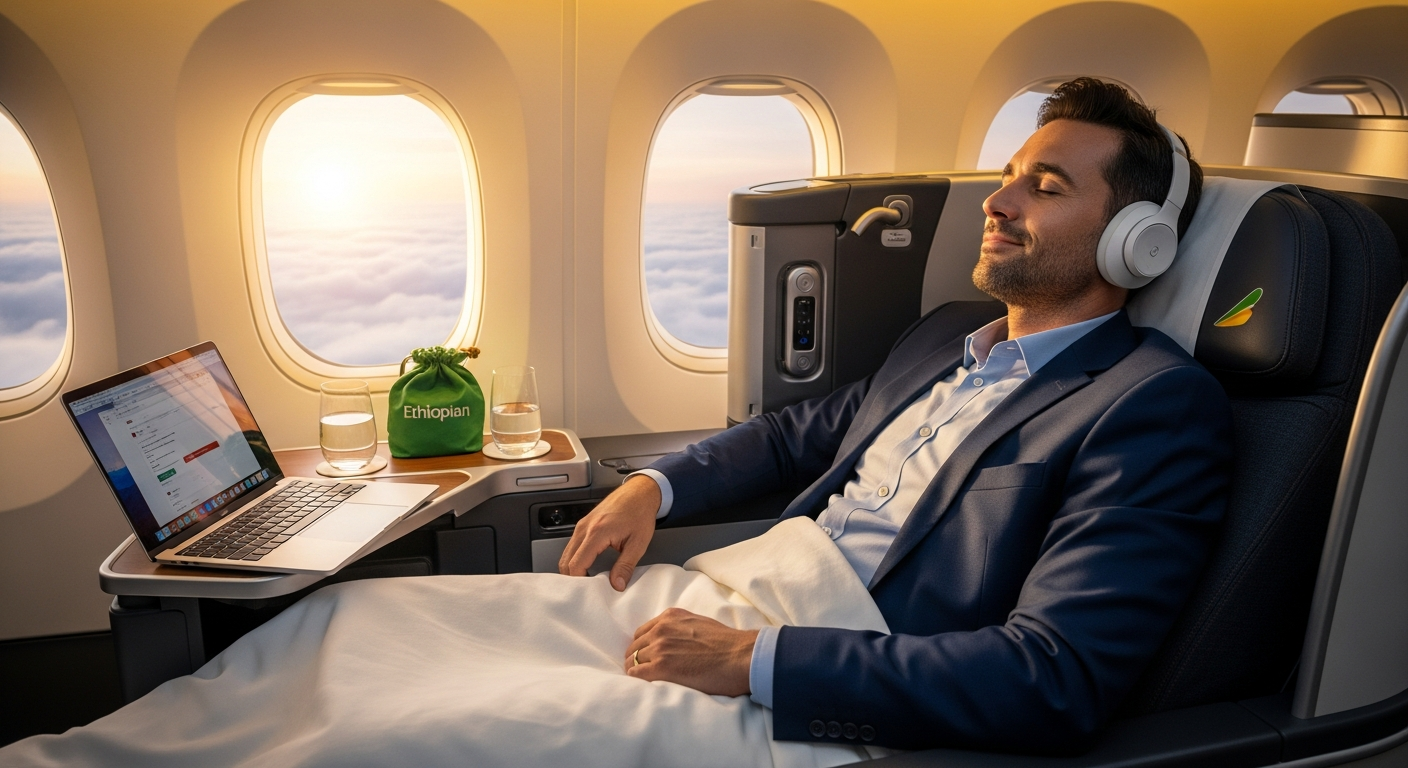
African air travel demands a different kind of premium experience—one that understands regional connectivity as much as it values long-haul comfort. Ethiopian Airlines carries more passengers across Africa than any other carrier, and their Cloud Nine Business Class is where this continental leadership truly manifests. The airline operates a modern fleet connecting over 60 African destinations through the Addis Ababa hub, creating routing possibilities that competitors simply cannot replicate.
For business professionals bouncing between Lagos, Nairobi, Johannesburg, and Addis Ababa, the question isn't whether premium cabin comfort exists—it's whether it justifies the investment on regional flights spanning just four or five hours. Cloud Nine answers that question differently than international carriers focused on transatlantic and transpacific routes. Ethiopian has engineered a product specifically for African connectivity, where lie-flat technology appears on regional flights where legacy carriers still offer angled seats. The modern fleet—primarily Boeing 787 Dreamliners and Airbus A350-900s—brings genuine premium comfort to intra-Africa travel while maintaining competitive standards on intercontinental journeys.
Book your Cloud Nine Business Class experience today and discover African premium travel reimagined. Understanding how Cloud Nine performs across different aircraft types, which regional routes deliver the best value, and whether the Addis Ababa hub advantage genuinely translates to superior travel experience requires looking beyond marketing claims to actual operational reality.
The Aircraft Advantage: Lie-Flat Seats Across Ethiopia's Modern Fleet
Ethiopian Airlines' fleet modernization strategy directly impacts the Cloud Nine experience you'll receive. The airline operates approximately 20 Airbus A350-900s and 29 Boeing 787-8/9 Dreamliners, with an average fleet age of just seven years. This investment in modern aircraft fundamentally changes what's possible in the premium cabin.
Boeing 787 Dreamliner specifications and direct-aisle-access configuration
The 787 Dreamliner features the 1-2-1 direct-aisle-access configuration, meaning every passenger has a direct route to the aisle without climbing over a neighbor. Seats recline to full lie-flat positions, typically measuring 6'7" in length when extended. This configuration provides genuine privacy—a critical factor for business travelers conducting work between flights or needing actual rest on overnight journeys. The 787's larger windows with electronic dimming and lower cabin pressure altitude create a measurably different physiological experience compared to older widebody aircraft.
Airbus A350-900 features and cabin environment
The A350-900 hosts 30 Cloud Nine seats in a 2-2-2 layout, with each seat typically 22 inches wide. While this configuration doesn't provide direct-aisle access for all passengers (those in middle pairs must climb over a seatmate), the A350 compensates through superior cabin environment engineering. The aircraft maintains cabin altitude equivalent to 6,000 feet rather than the standard 8,000 feet on older widebodies, while humidity levels stay between 40-60% rather than the typical 10-20% on conventional aircraft. For longer intercontinental flights, these environmental benefits accumulate into genuinely noticeable comfort advantages—passengers report less fatigue, reduced jet lag symptoms, and better skin hydration.
Boeing 777-200 configurations and privacy trade-offs
Older 777-200s operating some regional and intercontinental routes feature either 2-2-2 or 2-3-2 business class configurations. While these seats still recline to lie-flat positions, the 2-3-2 layout means middle seat passengers lack direct aisle access, creating a genuine privacy compromise. Aircraft age averaging seven years means some 777-200s date back 10-15 years, operating cabin pressure and humidity systems of that vintage. For short regional flights, this matters less; for overnight intercontinental flights, the experience diverges significantly from 787 and A350 standards.
Fleet modernization impact on long-haul comfort
Ethiopian's strategic fleet investment means lie-flat business class appears on regional African routes where competitors still operate narrowbody aircraft or older widebodies with premium economy-style seating. Booking Cloud Nine on a 787 or A350 genuinely delivers cabin altitude and humidity benefits that measurably improve comfort on 7+ hour flights—environmental factors you don't consciously notice until you experience them, then wonder how you ever tolerated conventional aircraft pressurization.
Regional Routes vs. Intercontinental: Where Cloud Nine Delivers Real Value
The true value of Cloud Nine depends entirely on which routes you're actually flying. The product performs differently across African regional routes, medium-haul intra-Africa flights, and intercontinental journeys.
Short-haul African routes: Value assessment
On 2-4 hour regional flights between African cities, the lie-flat seat becomes almost academic—you're boarding at 7:30 AM and landing at 11:00 AM, or departing at 5:00 PM and arriving at 8:00 PM. The seat's ability to recline fully matters far less than it does on 12+ hour intercontinental flights. Where Cloud Nine justifies its premium on these routes is service consistency and network advantage. Ethiopian's crew training emphasizes attentive service without intrusion—they recognize that African business travelers often use these flights for work rather than sleep. The cabin service includes proper business-class meals rather than simplified regional fare, and the beverage service maintains premium standards.
The real value on short-haul routes centers on the Addis Ababa hub advantage. If you're connecting from Nairobi to Lagos with an Addis Ababa stop, Cloud Nine passengers access the Cloud Nine Lounge during layovers, shower facilities allow you to freshen up between legs, and the lounge's traditional Ethiopian coffee ceremony provides a genuine cultural touchpoint rather than generic airport lounge experience.
Medium-haul intra-Africa flights: Optimal use case
Medium-haul African flights spanning 4-7 hours represent the sweet spot for Cloud Nine value. These flights are long enough that lie-flat seating genuinely improves rest quality and productivity, yet they're regional enough that you're experiencing authentic African business travel rather than intercontinental tourism. Flying Cloud Nine from Addis Ababa to Johannesburg (5.5 hours), or from Lagos to Cairo (4.5 hours), genuinely delivers lie-flat comfort where competitor products on the same routes offer angle-flat or premium economy seating. You're getting legitimate business-class sleep on a mid-range regional flight—a value proposition that doesn't exist on the same routes with other African carriers.
Intercontinental routes: Competitive positioning
On routes to Europe, Asia, and the Middle East, Cloud Nine competes directly with Emirates, Qatar, Etihad, KLM, Lufthansa, and other global carriers. On these 9-15 hour flights, Cloud Nine's 1-2-1 direct-aisle-access configuration (on 787s) genuinely rivals competitors, while the A350-900 with superior cabin environment holds competitive ground against direct rivals. However, the pricing asks you to evaluate whether you're paying premium prices for African hub advantage and authentic service or premium prices for the ultra-luxury amenities that global carriers layer into their premium cabins. Ethiopian doesn't compete on caviar service or premium wine collections—it competes on genuine comfort, honest service, and African connectivity.
Addis Ababa hub advantage: Connecting flight strategy
The Addis Ababa advantage shifts the calculation on multi-leg journeys. If you're traveling from New York to Nairobi with a connection through Addis Ababa, booking Cloud Nine through Ethiopian means continuous premium service and lounge access during the connection. Booking with a global carrier and connecting to Ethiopian economy means losing premium status between legs. For executives and frequent business travelers building African itineraries, the ability to maintain premium service and lounge access across the entire journey—even when individual flight segments are short—creates genuine value beyond the seat itself.
The Addis Ababa Cloud Nine Lounge Experience
The Cloud Nine Lounge represents the operational reality of Ethiopian Airlines' premium philosophy—it's authentic rather than ostentatious, focused on genuine rest and cultural experience rather than luxury theater.
Lounge location, access, and facilities
The lounge operates at Bole International Airport in Addis Ababa, accessible to all Cloud Nine business-class passengers and eligible Star Alliance members. Operating hours align with Ethiopian's flight schedule, with extended access for international arrivals and departures. Unlike airport lounges that feel like corporate meeting spaces, this lounge integrates Ethiopian design elements and cultural touches. Shower facilities exist for passengers with longer layovers, and rest area seating provides genuine recline capability—not the token nap pods that some airport lounges offer.
Buffet offerings and culinary traditions
The lounge buffet features both traditional Ethiopian cuisine and international offerings. Injera (Ethiopian flatbread) appears alongside pastries and breakfast items, with Ethiopian coffee and tea available throughout operating hours. Rather than treating Ethiopian food as exotic accompaniment to Western standards, the lounge presents it as primary offering—you're eating what Ethiopians eat, not what airlines assume Western travelers want. Lunch and dinner service includes traditional Ethiopian dishes prepared with authentic techniques, alongside international alternatives. This approach reflects Ethiopian Airlines' service philosophy: cultural authenticity as premium feature rather than token multiculturalism.
Traditional Ethiopian coffee ceremony
The lounge hosts traditional Ethiopian coffee ceremonies during peak hours—a 20-30 minute cultural experience where green coffee beans are roasted, ground, and brewed in front of guests, then served in small cups accompanied by popcorn and frankincense. For business travelers used to generic airport lounge coffee service, the ceremony creates a distinctive experience that becomes a talking point beyond the flight itself. It's the kind of detail that separates authentic premium service from corporate template lounges.
Rest area conditions during peak hours
The lounge can become crowded during peak African business travel hours—particularly early mornings when connections to European destinations depart, or mid-afternoon when regional African flights concentrate. During busy periods, finding quiet seating or shower facilities might require timing strategy rather than immediate availability. Planning lounge time around off-peak hours (late evening, early morning before 6:00 AM) guarantees better rest area conditions and shorter shower queues.
Dining and Hospitality: Authentic Service Meets African Heritage
Ethiopian Airlines' cabin service philosophy distinguishes Cloud Nine from competitors that treat business-class dining as elaborate theater.
Ethiopian cuisine integration on premium menus
Cloud Nine menus regularly feature Ethiopian dishes prepared with authentic techniques and ingredients—not Westernized adaptations designed for international palates. Doro Wot (chicken stew with Ethiopian spices), Misir Wot (red lentil stew), Shiro (chickpea flour-based stew), and Tibs (sautéed meat and vegetables) appear alongside international options like pasta, grilled fish, and beef selections. The culinary approach treats Ethiopian food as premium offering rather than regional curiosity, recognizing that many passengers traveling through the Addis Ababa hub are Ethiopian, East African, or already familiar with the cuisine.
International dining options and meal service
Breakfast service includes fresh pastries, cereals, and hot options prepared to order. Main meal service on longer flights offers multiple protein choices typically including beef, chicken, fish, and vegetarian options. Unlike some airlines that treat business-class meals as pre-assembled components, Ethiopian's service emphasizes fresh preparation—eggs are cooked to order at breakfast, proteins are cooked fresh for lunch and dinner service rather than pre-plated and reheated. This operational approach creates noticeably superior food quality compared to competitors operating pre-plated systems.
Meal service timing and quality variation
On short regional flights (2-4 hours), meal service simplifies to lighter offerings—typically a snack rather than a full meal. On medium-haul flights (4-7 hours), you receive a full meal service with starter, main course, and dessert. On intercontinental flights, multiple meal services occur across the flight's duration. Quality remains generally consistent, though some routes and time-of-day services operate differently from others. Evening flights tend to receive more elaborate meal preparation than early morning flights, and weekend services sometimes operate with reduced catering options compared to weekday operations.
Cabin crew training and service authenticity
Ethiopian Airlines emphasizes cabin crew training that prioritizes genuine hospitality over corporate script-reading. The crew philosophy reflects Ethiopian cultural values of warmth and attentiveness without intrusion—staff engage with passengers as individuals rather than executing scripted service protocols. This manifests as crew members remembering passenger preferences across multiple flights, offering assistance before being asked, and adjusting service timing to passenger needs rather than rigid airline procedures. For business travelers, this translates to crew who recognize that you might want to work rather than sleep, who don't interrupt you every 20 minutes with beverage service, and who understand that premium service means respecting passenger preferences rather than imposing airline standards.
What Cloud Nine Gets Right (And Why Business Travelers Choose It)
Cloud Nine succeeds where it matters most for its core market: African business connectivity with genuinely competitive premium seating.
Lie-flat seats without ultra-premium pricing
On modern aircraft, Cloud Nine delivers full lie-flat seating at price points substantially lower than Emirates, Qatar, or Singapore Airlines' business-class fares on comparable routes. A one-way ticket from Addis Ababa to London in Cloud Nine typically costs $3,000-$5,000 depending on season and advance booking, whereas equivalent competitors charge $4,500-$6,500 for comparable routing. You're getting the seat functionality—complete lie-flat recline—at premium pricing that doesn't approach ultra-premium territory. For business travelers on corporate expense accounts with flexible budgets, Cloud Nine delivers genuine value.
Direct-aisle access on 1-2-1 configured aircraft
On Boeing 787s with 1-2-1 configuration, every passenger accesses the aisle without climbing over a seatmate. This becomes functionally significant on overnight flights—you can use the lavatory, walk the cabin, or adjust your seat position without negotiating with a neighbor. Middle-seat passengers on 2-2-2 A350s or older 777s lose this advantage, but still access lie-flat comfort. For frequent business travelers, the 1-2-1 configuration represents the optimal business-class design—comfort plus autonomy.
Unmatched African connectivity through Addis Ababa hub
Ethiopian Airlines operates to 60+ African destinations through the Addis Ababa hub, with no other African airline approaching this breadth of continental coverage. This creates routing possibilities that competitors cannot match. If you need to reach multiple African cities in a single journey, Ethiopian's hub advantage means you're accessing premium service across legs where competitors' routing would require economy segments or connections with other carriers. The continental network advantage compounds on multi-city African business trips.
Authentic service reflecting Ethiopian hospitality culture
The cabin service philosophy emphasizes genuine hospitality rather than corporate procedure—crew members engage as individuals rather than executing scripted protocols. This distinction becomes noticeable across multiple flights. Ethiopian's cabin crew undergoes training emphasizing cultural warmth and genuine attentiveness without the sterility that characterizes some global carriers' service training. For business travelers conducting high-stakes African business, this authentic service creates a distinctive experience that builds loyalty across multiple journeys.
Where Cloud Nine Falls Short: Realistic Limitations and Inconsistencies
Despite its strengths, Cloud Nine operates within real operational constraints that occasionally compromise the premium experience.
Premium experience variability on older aircraft
Not all Cloud Nine operations deploy modern aircraft with advanced cabin environment benefits. Older Boeing 777-200s with 10-15 year age still operate some routes, particularly on regional African flights where newer aircraft economics don't align with route distance and frequency. These aircraft feature older cabin pressure systems and lack the humidity control that makes A350s distinctly comfortable. A passenger booking Cloud Nine from Addis Ababa to Lusaka might reasonably expect 787 or A350 service based on product name, yet actually receive older 777-200 service with lower environmental quality. Ethiopian doesn't always guarantee aircraft type on booking, creating expectation mismatches.
Privacy concerns on 2-2-2 configured aircraft
The A350's 2-2-2 layout means center-seat passengers must negotiate past middle-seat neighbors to access the aisle. While this remains standard across much of the global business class industry, competitors' 1-2-1 configurations on competing aircraft (Emirates' 777, Qatar's 787 and 777) provide clear privacy advantages. For solo business travelers prioritizing autonomy, the A350's 2-2-2 configuration becomes a notable limitation—you're paying premium prices for lie-flat comfort that doesn't include direct aisle access.
Meal service delays and food quality fluctuations
On some routes and flight times, meal service operates with noticeable delays, particularly on early morning departures where catering might still be loading as passengers board. Food quality remains generally strong, but sometimes varies based on aircraft catering location and time of day. Weekend flights occasionally feature reduced meal options compared to weekday service. While not catastrophic issues, these inconsistencies occasionally undermine the premium positioning—a passenger expecting premium service experiences service that feels more like premium economy on suboptimal operations.
Crowded lounge conditions during peak hours
The Addis Ababa Cloud Nine Lounge operates at capacity during morning hours when multiple European-bound flights prepare to depart and African regional flights concentrate arrivals and connections. During peak times (6:00 AM – 8:00 AM, 2:00 PM – 4:00 PM), finding quiet seating becomes challenging, shower facilities develop queues, and the buffet service depletes items between restock cycles. The lounge experience genuinely delivers during off-peak hours, but represents crowded airport lounge reality during peak times.
Maximizing Your Cloud Nine Experience: Practical Strategies
Experienced Cloud Nine passengers employ specific booking and flight-planning strategies to consistently access the product's premium positioning.
Route selection: Identifying flights with full premium experience
Cloud Nine performs optimally on medium-haul intra-Africa flights (4-7 hours) where lie-flat seating genuinely enables rest, and on longer intercontinental routes where cabin environment benefits accumulate significantly. Short regional hops (2-4 hours) deliver lounge access and service quality but don't meaningfully utilize the lie-flat seat. Research specific routes before booking—Addis Ababa to Johannesburg, Addis Ababa to Nairobi, and Addis Ababa to Lagos represent routes where Cloud Nine consistently delivers full premium experience. Intercontinental routes to London, Paris, Brussels, Bangkok, and Singapore similarly deliver complete premium positioning.
Aircraft research before booking: Confirming 787 or A350 assignment
Before purchasing Cloud Nine tickets, contact Ethiopian Airlines directly or review booking confirmations specifically for aircraft type. Booking Cloud Nine on a 787 or A350 provides cabin altitude, humidity, and configuration benefits that older 777s don't offer. Some booking systems display aircraft type before purchase; Ethiopian's reservation team will confirm aircraft assignment if asked directly. If you're prioritizing 1-2-1 direct-aisle access, specifically request 787 routes. If cabin environment benefits matter most, confirm A350 service. This small research step prevents discovering suboptimal aircraft after purchase.
Lounge timing strategies
Schedule Addis Ababa layovers to include lounge access during off-peak hours—early morning before 6:00 AM or late evening after 8:00 PM. If your connection lands at 7:00 AM and departs at 10:00 AM, expect crowded lounge conditions. If you can arrange connections landing at 8:00 PM with an 11:00 AM departure, you access genuine lounge quiet time and shower availability without waiting. For business travelers with flexible scheduling, timing lounge visits around airline operations creates noticeable experience improvements.
Upgrade bid strategy for regional versus intercontinental flights
Ethiopian's upgrade bid system allows economy passengers to bid for Cloud Nine availability. On short regional African flights, upgrade bids succeed with moderate offers ($300-$600) because premium demand remains lower than intercontinental routes. On intercontinental flights to Europe or Asia, upgrade bids require substantially higher offers ($1,200-$2,000+) where premium demand consistently exceeds availability. If you're flexible on long-haul flights, booking premium economy or economy with upgrade bid flexibility sometimes produces $1,000+ savings compared to premium booking when bids succeed at lower thresholds.
How Cloud Nine Compares to African and Global Competitors
Cloud Nine's competitive positioning differs across African competitors and global carriers.
Versus South African Airways business class
South African Airways' business class features competitive lie-flat seating on newer aircraft, but operates far fewer African destinations than Ethiopian (roughly 20-25 African cities versus Ethiopian's 60+). SAA's Johannesburg hub provides strong coverage of southern African routes, but Ethiopian's Addis Ababa hub creates superior connectivity for East African business travel. On South Africa-centric routing, SAA delivers comparable premium quality; for broader African connectivity, Ethiopian's network advantage dominates.
Versus Kenya Airways premium cabin
Kenya Airways' premium cabin operates on narrowbody aircraft for most African routes (Bombardier Q400, Boeing 737, Airbus A320) with lie-flat seating only appearing on a limited international widebody fleet. Cloud Nine's advantage lies in consistency—lie-flat seating appears across both regional and intercontinental Ethiopian routes, whereas Kenya Airways' premium cabin experience varies dramatically by aircraft type. For Nairobi-based connectivity, Kenya Airways offers competitive service; for reaching multiple African cities with consistent premium seating, Ethiopian's fleet uniformity provides superior experience.
Versus Middle Eastern carriers on Africa-Asia routes
Emirates, Qatar, and Etihad offer premium business-class products superior to Cloud Nine in amenities, luxury positioning, and cabin environment technology. However, their Africa-Asia routing typically flows through Middle Eastern hubs rather than African hubs. Cloud Nine's advantage centers on African hub connectivity—if you're traveling from Lagos to Bangkok, Ethiopian's routing through the Addis Ababa hub (with African lounge experience and network advantage) provides different value than Gulf carriers' Middle Eastern hub routing. Cost positioning similarly favors Ethiopian by $1,000-$2,000 on equivalent Africa-Asia routes.
Versus European legacy carriers on Africa-Europe flights
Lufthansa, KLM, Air France, and British Airways offer premium business products with higher luxury positioning and premium amenities compared to Cloud Nine. However, they charge corresponding premium pricing—typically $5,500-$7,500 one-way on Africa-Europe routes versus Ethiopian's $3,500-$5,000 positioning. Cloud Nine's competitive advantage centers on African hub service, authentic hospitality, and value positioning rather than ultra-premium amenity competition. For business travelers prioritizing comfortable lie-flat seating and African service authenticity over luxury theater, Cloud Nine represents superior value.
The African Business Traveler's Perspective: Who Should Book Cloud Nine
Cloud Nine appeals to specific traveler profiles where its strengths create genuine competitive advantage.
Executive and C-suite travelers with frequent African business
C-suite executives conducting regular African business require consistent premium service across multiple legs, lounge access through Addis Ababa connections, and network connectivity that competitors don't provide. Ethiopian's service authenticity, African hub advantage, and lie-flat comfort across both regional and intercontinental flights align with executive travel requirements. For executives traveling Africa quarterly or more frequently, Cloud Nine's value proposition justifies premium pricing.
Consultants and professionals requiring rest between cities
Management consultants, legal professionals, and engineers traveling between African project sites regularly fly 4-6 hour segments where genuine lie-flat sleep improves productivity. Cloud Nine's lie-flat seating on these specific routes directly enables working productivity across consecutive travel days. The lounge facilities at Addis Ababa provide rest and shower options between tight flight connections. For professionals with intensive African travel schedules, Cloud Nine addresses genuine operational needs.
Leisure travelers seeking premium comfort on African regional routes
Travelers planning multi-city African journeys (visiting East Africa and southern Africa, for example) benefit from Ethiopian's continental network and Cloud Nine's premium consistency across regional routes. Rather than mixing economy segments with premium segments across different carriers, Cloud Nine provides uniform premium experience across the entire journey. For leisure travelers with realistic budgets seeking genuine comfort rather than ultra-luxury, Cloud Nine delivers value across entire African itineraries.
Expats and diaspora travelers prioritizing cultural connection
Ethiopian diaspora members, African professionals working internationally, and expats returning to African bases often prioritize carriers that reflect cultural authenticity alongside premium service. Cloud Nine's cabin service philosophy, Ethiopian cuisine integration, and Addis Ababa hub cultural experience appeal directly to travelers valuing authentic connection alongside comfort. The lounge coffee ceremony, authentic service, and Ethiopian crew representation create distinctive experience compared to global carriers' generic premium positioning.
The Verdict: Strategic Value for African Connectivity
Cloud Nine Business Class succeeds not as a universal premium product competing head-to-head with global carriers' ultra-luxury offerings, but as strategically engineered solution for African-centered business travel. The lie-flat seats on modern 787 and A350 aircraft deliver genuine comfort where competitors offer angled seating on identical regional routes. The Addis Ababa hub creates routing advantages and lounge access that competitors cannot replicate—multi-city African itineraries become genuinely premium experiences rather than patchwork combinations of premium and economy segments.
The service philosophy reflects authentic Ethiopian hospitality rather than corporate template service. Crew members engage as individuals, menus integrate Ethiopian culinary heritage, and lounge experience centers on genuine cultural connection. These distinctions matter most to business professionals traveling Africa repeatedly—the product improves with familiarity as service staff recognize regular passengers and consistently deliver individual attention.
For intercontinental travelers, Cloud Nine holds competitive ground against global carriers by pricing lie-flat comfort at premium rather than ultra-premium levels. The cabin environment benefits on A350s deliver measurable comfort advantages on 10+ hour flights. You're not receiving caviar service or premium wine collections that competitors offer, but you're also not paying corresponding ultra-premium pricing for those amenities.
The real win lies in how Ethiopian Airlines has engineered a product serving its core market brilliantly while remaining competitive on longer routes—that's strategic positioning done correctly. If African business connectivity drives your travel patterns, Cloud Nine justifies its pricing through network advantage, service authenticity, and consistent lie-flat comfort. If intercontinental flights dominate your travel, Cloud Nine competes effectively on value and comfort rather than ultra-luxury positioning.
Leave a Reply