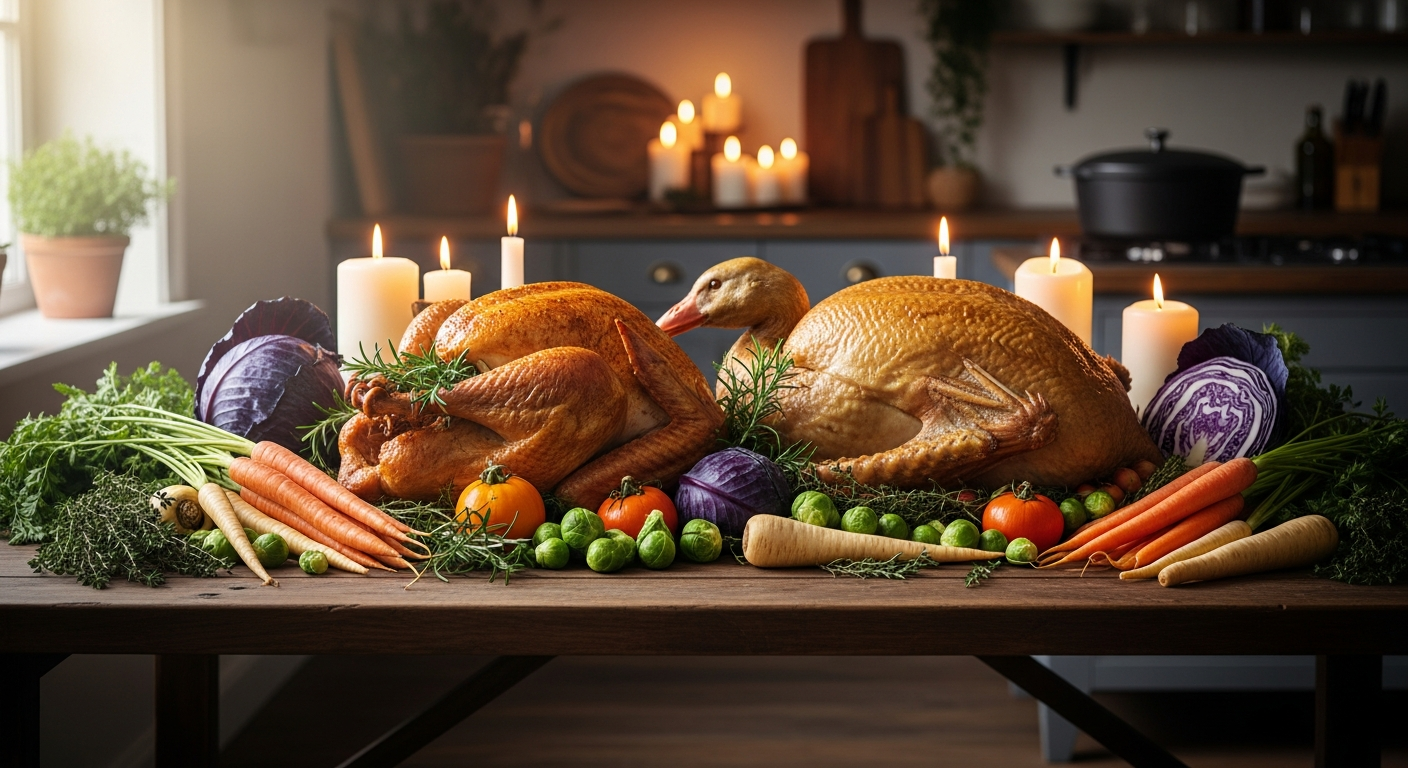
Over 10 million turkeys grace British Christmas tables annually—yet fewer than 5% come from truly ethical, free-range sources. The disconnect between tradition and sustainability has never been starker. Farmfetch has positioned itself at the forefront of this movement, offering organic free-range Christmas turkey and goose that marry exceptional flavor with genuine animal welfare commitments.
These aren't mass-produced birds destined for supermarket shelves. They're raised across British farms where space to roam, wholesome diets, and ethical treatment form the foundation of their production. The difference becomes apparent the moment you begin planning your festive menu—you're choosing between convenience and conscience, between industrial efficiency and genuine care.
Discover Farmfetch's premium organic free-range Christmas turkey and goose selection today.
Throughout this guide, you'll navigate the distinct characteristics that separate turkeys from geese, work through the white versus bronze turkey decision, and develop practical sizing strategies for your gathering. You'll understand why pre-ordering matters, what makes organic free-range truly different, and how to select the perfect bird for your 2026 Christmas feast.
Organic Free-Range vs. Conventional Poultry: Understanding the Real Difference
How free-range farming practices directly impact meat quality, tenderness, and flavor profile
Free-range birds develop superior meat quality through natural movement and muscle development. When poultry has genuine space to roam—not merely token outdoor access, but genuine foraging space—the muscle fibers develop differently than their confined counterparts. This muscular development translates directly to improved texture and firmer meat that holds moisture better during cooking. The flavor becomes noticeably richer, with a complexity that intensifies as you progress from white meat to dark meat.
The nutritional advantages of organically-fed birds (omega-3 content, vitamin density)
Organic feed sourcing creates measurable nutritional differences. Birds fed wholesome, grain-based organic diets accumulate higher levels of omega-3 fatty acids compared to those on conventional feeds. This nutritional profile extends beyond mere numbers—it affects how the meat tastes and how your body processes it. Vitamin density increases across the board, with particularly notable improvements in B vitamins and fat-soluble vitamins.
Why animal welfare standards translate to superior taste and texture
Stress directly impacts meat quality at the biochemical level. Birds raised in low-stress environments with ample space, natural light, and movement freedom produce meat with lower cortisol-influenced compounds. The result is meat that tastes cleaner, sweeter, and more tender. This isn't sentiment—it's measurable, repeatable biochemistry.
The environmental footprint: carbon impact of ethical farming versus industrial production
Industrial poultry operations concentrate birds in spaces that demand intensive feed transportation, climate control, and waste management infrastructure. Farmfetch's distributed British farm model reduces transportation miles, leverages natural seasonal cycles, and distributes environmental impact across multiple smaller operations rather than centralizing it. The carbon footprint per bird decreases substantially through this localized approach.
Certification standards that verify genuine organic and free-range claims
"Organic" and "free-range" labels vary wildly in meaning. Genuine certifications demand verified space-per-bird ratios, documented feed sourcing, and independent auditing. Farmfetch maintains transparency through third-party certifications that verify claims rather than rely on marketing language alone.
How Farmfetch's British farming model ensures traceability and transparency
Farmfetch partners with named British farms where birds are traceable from birth through delivery. You can identify the specific farm that raised your bird, understand their practices, and verify their standards. This transparency eliminates the anonymity that conceals industrial farming practices.
Price justification: what you're actually paying for in premium poultry
Premium pricing reflects genuine costs: higher-standard feed, more space per bird, labor-intensive care protocols, smaller batch sizes that prevent economies of scale, and certification maintenance. You're paying for superior taste, ethical practices, and genuine animal welfare—not for marketing language.
Turkey Varieties Explained: White vs. Bronze Heritage Birds
Traditional white turkeys: mild flavor profile, tender meat, visual presentation advantages
White turkeys deliver subtlety. Their mild flavor profile makes them adaptable to virtually any seasoning approach or accompanying sauce. The meat maintains tenderness throughout cooking, responding well to a wider range of temperature management approaches. Visually, white turkeys present the classic Christmas aesthetic—the golden-brown skin and pale meat align with traditional expectations. Many families choose white turkeys specifically because their neutral flavor doesn't compete with carefully crafted sauces, stuffings, and sides.
American bronze turkeys: richer, more robust taste, firmer texture, heritage breed characteristics
Bronze turkeys, descended from American heritage lines, offer noticeably richer flavor. The meat develops more depth, with darker meat particularly pronounced in character. The texture remains firmer, requiring slightly more precise cooking to avoid drying but rewarding careful preparation with superior taste intensity. Heritage breed birds carry historical significance—these varieties nearly disappeared during the industrial farming boom and represent a deliberate choice to preserve traditional poultry genetics.
Meat-to-bone ratio differences between varieties
White turkeys typically offer slightly higher meat-to-bone ratios, making them efficient for serving larger groups with minimal waste. Bronze turkeys carry proportionally more bone, which creates superior broth and stock potential. This distinction matters for your specific menu planning and leftover strategy.
Cooking time variations and temperature management by type
White turkeys generally cook slightly faster due to leaner composition. Bronze turkeys, with their richer fat content, benefit from longer, slightly lower-temperature roasting that allows fat rendering without exterior drying. Time variations of 15-20 minutes per pound can occur between varieties, necessitating careful thermometer monitoring rather than time-based calculations.
Flavor pairing recommendations: which turkey complements your menu better
White turkey pairs elegantly with classical British accompaniments: traditional sage stuffing, light herb gravies, and subtle vegetable sides. Bronze turkey commands bolder companions—robust herb blends, fruit-forward sauces, and richly spiced preparations that don't overpower the meat's natural intensity.
Size availability across both varieties
Farmfetch offers both white and bronze turkeys across a comprehensive size range, from intimate 10-pound birds suitable for smaller households through 22-pound birds for substantial celebrations. This variety availability ensures you can match heritage preference with practical serving needs.
Heritage breed significance and why bronze turkeys appeal to traditionalists
Bronze turkeys represent conscious choice—a decision to support breed preservation and reject industrial standardization. For many families, selecting bronze turkeys carries cultural weight beyond mere taste preference. It becomes a statement about valuing tradition, supporting sustainable agriculture, and participating in food heritage preservation.
The Case for Native Geese: When Tradition Calls for Gamey Depth
Full, gamey flavor profile: what to expect versus turkey
Geese deliver flavor intensity that turkeys simply cannot match. The meat develops rich, distinctly gamey characteristics that reflect the bird's more active lifestyle and natural diet. This isn't subtle—it's pronounced, traditional, and unmistakably different from poultry alternatives. Those accustomed to mild turkey flavors should approach geese with realistic expectations about flavor boldness.
Rich, succulent meat characteristics and cooking properties
Goose meat carries substantially higher natural fat content than turkey, resulting in meat that remains remarkably moist and succulent throughout cooking. The fat renders during roasting, creating self-basting properties that minimize drying risk. The darker meat develops almost burgundy coloring and offers textural complexity that deepens the eating experience.
Portion sizing: geese versus turkeys for similar guest counts
Geese contain proportionally more bone and slightly less meat per pound compared to turkeys. Calculate approximately 1.5 pounds per person for geese versus 1.25 pounds for turkeys. A 12-pound goose comfortably serves 8 people, while a similar-weight turkey serves 10.
Heritage appeal: native geese breeds and their historical significance
Native British geese breeds carry centuries of agricultural tradition. Unlike turkeys, which arrived from the Americas, geese represent truly indigenous poultry heritage. Selecting native geese reconnects your Christmas table with deep historical roots and supports preservation of breeds that nearly vanished during industrialization.
Flavor intensity: pairing geese with sauces, gravies, and seasonal accompaniments
Goose's assertive flavor demands equally assertive accompaniments. Orange sauces, apple gravies, and robust herb preparations complement rather than compete with the meat. Root vegetables, particularly parsnips and beetroot, balance goose's richness. Spiced beverages and full-bodied wines pair more naturally with goose than the lighter options suited to turkey.
Cooking techniques specific to goose preparation
Goose requires different roasting strategies than turkey. The substantial fat layer benefits from initial pricking to allow fat drainage, preventing soggy skin. Slower roasting at lower temperatures optimizes fat rendering without exterior burning. Many traditionalists roast goose on a bed of root vegetables that absorb rendered fat, creating flavorful side dishes.
Guest preferences: identifying your audience for goose-centric menus
Goose works best for smaller, more adventurous gatherings where guests appreciate traditional, full-flavored poultry. Larger celebrations mixing adventurous eaters with those preferring familiar flavors might benefit from turkey's broader appeal. Consider your guest list's willingness to embrace traditional, gamey flavors before committing to goose.
Sizing Your Bird: From Intimate Dinners to Grand Celebrations
Guest count calculations: poultry weight per person guidelines
Standard calculations suggest 1.25 pounds per person for turkey and 1.5 pounds per person for goose. These guidelines account for bone weight and reasonable leftover portions. For gatherings where appetites run particularly hearty or where minimal leftovers suit your preferences, increase calculations to 1.5 pounds per turkey or 1.75 per goose.
Size range availability from Farmfetch for different gathering scales
Farmfetch maintains selection breadth ensuring every gathering scale finds appropriate options. Small households discover birds under 12 pounds; mid-sized families locate 14-18 pound options; substantial celebrations access 20-pound-plus specimens. This range flexibility eliminates the common problem of purchasing oversized birds for modest gatherings or undersized birds for large ones.
Cooking time adjustments based on bird weight and type
Cooking time calculations must account for both weight and variety. General guidance suggests 12-15 minutes per pound for white turkey, 13-15 minutes for bronze turkey, and 15-20 minutes for goose, all at 325°F. However, thermometer accuracy matters far more than time calculations—internal temperature targets of 165°F for poultry ensure food safety and optimal doneness regardless of calculated times.
Freezer space requirements and storage planning
A 16-pound turkey requires approximately 1.5 cubic feet of freezer space. Larger birds demand proportional space. Measure your freezer before ordering; undersized freezer space creates genuine December stress. Pre-ordering enables you to secure birds with advance knowledge of your storage capacity.
Thawing timelines: why advance planning matters for larger birds
Thawing timelines cannot be rushed. Guidelines suggest approximately 24 hours thawing for every four pounds of bird. A 16-pound turkey requires four days of refrigerator thawing. Larger birds demand up to a week of planning. Cold-water thawing accelerates the process—30 minutes per pound—but demands attention and water changes. Advance ordering enables proper planning of these essential timelines.
Carving considerations: manageable sizes for different skill levels
Novice carvers benefit from smaller birds where carving mistakes remain less consequential. A 12-pound turkey presents far fewer challenges than a 22-pound specimen. Experienced carvers and those comfortable with occasional imperfection can manage larger birds. Match bird size to carving confidence.
Leftover potential: which sizes maximize post-Christmas meal opportunities
Larger birds create substantial leftover potential—turkey sandwiches, soups, stocks, and reimagined dishes filling days beyond Christmas. Smaller birds minimize leftovers, suiting those with limited refrigeration space or reduced interest in extended turkey-focused meals. Consider your post-Christmas appetite before sizing.
Reserve your perfectly-sized organic free-range bird from Farmfetch's complete selection now.
The Pre-Ordering Advantage: Planning Your Festive Centerpiece
Why pre-ordering eliminates December stress and ensures availability
Pre-ordering transforms Christmas poultry from a December scramble into a planned, assured element of your celebration. Rather than hoping your preferred variety and size remain available during the December shopping frenzy, pre-ordering guarantees your selection. The psychological benefit alone—knowing your centerpiece bird is secured months in advance—reduces holiday stress substantially.
Farmfetch's booking timeline and reservation windows
Farmfetch opens pre-ordering windows well in advance of the festive season, typically accepting orders through early December. Early ordering—autumn through November—ensures maximum variety selection and sometimes preferential pricing. December ordering remains possible but risks size or variety depletion as peak season demand intensifies.
Securing your preferred variety before peak season depletion
Popular varieties, particularly heritage bronze turkeys and native geese, deplete quickly during December. Pre-ordering guarantees your preferred bird type rather than accepting whatever remains during last-minute purchasing windows. This certainty transforms menu planning from speculative to definitive.
Customization options available through advance ordering
Pre-ordering enables special requests—particular size specifications, feed clarifications, or preparation preferences—that merit direct communication with farms. These conversations happen naturally through pre-order processes but become rushed or impossible during peak season.
Delivery scheduling flexibility for optimal freshness
Pre-ordering permits delivery timing that ensures optimal freshness. Rather than purchasing days in advance and managing extended refrigeration, you can arrange delivery dates aligned with your specific Christmas plans. Fresh birds arriving 2-3 days before your celebration maintain superior quality compared to those purchased weeks earlier.
Communication channels for special requests or dietary considerations
Direct ordering relationships enable specific requests—birds for particular dietary needs, preparation specifications, or family traditions—that transcend standard offerings. These conversations happen naturally within pre-ordering processes.
Early-bird advantages: discounts or premium selection benefits
Early pre-ordering often provides pricing advantages or premium selection access. Some farms offer modest discounts to those booking well in advance, rewarding planning with tangible savings. Early orders also receive first selection of premium specimens.
Ethical Sourcing and Sustainability: Dining with Conscience
British farm standards and animal welfare certifications
Farmfetch partners with British farms meeting rigorous welfare standards. These aren't self-determined guidelines but independently verified certifications confirming space-per-bird ratios, movement freedom, and natural behavioral allowance. Verifiable standards replace marketing language with measurable reality.
Space-to-bird ratios and movement freedom standards
Ethical free-range farming demands specific space allocations—typically 4-5 square meters of outdoor space per bird, significantly beyond conventional farming's density standards. These spacious conditions enable natural behaviors: foraging, dust bathing, and unrestricted movement. Birds raised with this freedom develop superior meat quality alongside genuine welfare improvements.
Feed sourcing: organic grain quality and nutritional protocols
Organic feed sourcing eliminates pesticide residues, GMO ingredients, and synthetic supplements present in conventional poultry feed. Farmfetch partners verify feed sourcing, ensuring birds consume wholesome grain-based diets reflecting organic farming standards. This feed quality directly influences meat nutritional density and flavor characteristics.
Environmental stewardship practices on Farmfetch partner farms
Partner farms implement rotational grazing, soil conservation, and natural water management practices. These approaches build soil health, minimize chemical runoff, and maintain biodiversity—environmental benefits extending beyond the immediate poultry operation. Supporting these farms means supporting broader agricultural sustainability.
Seasonal farming cycles and natural breeding practices
Ethical poultry farming aligns with natural seasonal cycles rather than forcing year-round production through artificial manipulation. Birds breed seasonally, chicks hatch naturally, and production reflects biological rhythms. This seasonality means Christmas poultry truly is a seasonal product—available specifically during appropriate periods rather than year-round through industrial preservation techniques.
Carbon footprint reduction through local sourcing
Farmfetch's British farm model eliminates international transportation, reducing carbon miles substantially. Local sourcing also means reduced packaging, minimal cold-chain requirements, and distributed environmental impact across multiple smaller farms rather than centralized megafacilities. The cumulative carbon reduction becomes meaningful when aggregated across consumer choices.
Supporting British agriculture and rural communities
Purchasing from Farmfetch directly supports British farm families and rural economies. Money flows to agricultural communities, supporting sustainable farm viability against industrial consolidation pressures. Ethical poultry purchasing becomes participatory agriculture support, strengthening rural food systems.
Preparation and Cooking: From Bird to Centerpiece
Thawing protocols: timeline and temperature management
Refrigerator thawing proceeds at approximately 24 hours per four pounds. A 16-pound turkey requires four days of thawing in 35-40°F conditions. Cold-water thawing accelerates the timeline to approximately 30 minutes per pound, requiring water changes every 30 minutes. Never thaw at room temperature, which creates bacterial contamination risks. Plan thawing dates backward from your cooking schedule with precision.
Seasoning strategies for white versus bronze turkeys
White turkey's subtle flavor accommodates delicate herb blends and sophisticated seasoning approaches. Light herb butters, gentle spice rubs, and refined flavor combinations complement without overwhelming. Bronze turkey's robust character welcomes bold seasonings—sage, thyme, rosemary in confident quantities, plus warming spices like cinnamon or nutmeg that enhance rather than compete with inherent meat flavor.
Goose-specific cooking techniques and temperature targets
Goose roasting differs fundamentally from turkey approach. Initial scoring of the skin enables fat drainage, preventing greasiness. Lower roasting temperatures (300-325°F) and extended cooking times (15-20 minutes per pound) allow controlled fat rendering and even cooking. The target internal temperature remains 165°F, but goose's fat content creates more forgiving cooking windows than lean turkey.
Resting periods: why timing impacts carving and presentation
Resting periods—typically 20-30 minutes post-roasting—allow meat fibers to relax and reabsorb internal moisture. Birds carved immediately after roasting lose interior juices; properly rested birds carve cleanly with superior moisture retention. This seemingly minor detail produces measurable texture improvements.
Stuffing considerations and cavity preparation
Internal stuffing must reach 165°F temperature, often extending cooking times beyond estimates based on bird weight alone. Loose stuffing (prepared separately) cooks more reliably and safely than cavity stuffing. If cavity stuffing is desired, pack loosely, monitor temperature carefully, and recognize that cooking times will exceed unstuffed calculations by 15-30 minutes depending on stuffing volume.
Basting routines and moisture retention methods
Modern cooking science questions whether basting improves results—the oven door openings for basting often cool the oven more than basting benefits the bird. Tent the bird loosely with foil to prevent exterior drying while maintaining even cooking. Remove foil during the final 30 minutes to enable browning.
Roasting pan selection and oven space planning
Choose roasting pans that provide 2-3 inches of space around the bird, enabling air circulation. Shallow pans cook birds faster; deeper pans create steam environments slowing browning. Measure your oven dimensions before ordering birds; a 22-pound turkey requires substantially more space than typical ovens accommodate. Plan backup oven arrangements for larger birds if kitchen space proves limiting.
Flavor Profiles and Menu Pairing: Creating Harmony on Your Table
White turkey's subtle flavor: complementary sauce and side dish pairings
White turkey's delicate profile pairs beautifully with traditional British accompaniments: sage and onion stuffing, light herb gravies, and refined vegetable preparations. Cranberry sauce, with its bright acidity, balances richness without competing with meat subtlety. Root vegetables—parsnips, carrots, and swede—echo turkey's gentle flavor without overwhelming it. Wine pairings should emphasize elegance: crisp Champagne, refined Chablis, or delicate Pinot Noir.
Bronze turkey's robust taste: bold flavor companions and seasoning approaches
Bronze turkey's character welcomes assertive accompaniments. Rosemary and thyme in confident quantities, bold herb stuffings featuring sage and celery, and richer gravies enhanced with red wine or cream complement rather than overpower. Game-bird preparations—fruit sauces with fig or blackberry, warming spices like cinnamon and clove—align naturally with heritage breed character. Full-bodied reds or aged Burgundy pair magnificently.
Goose's gamey depth: traditional and contemporary accompaniment ideas
Goose traditionally pairs with apple sauce, orange sauce, or cherry preparations that cut richness with acidity and sweetness. Contemporary approaches add ginger, star anise, and warming spices reflecting goose's intensity. Root vegetables—particularly beetroot, parsnips, and turnips—absorb rendered fat beautifully. Red wine sauces, mushroom preparations, and legume-based side dishes ground goose's strong flavor effectively.
Wine pairing recommendations by poultry type
White turkey suits lighter wines emphasizing refreshment over weight—Chablis, Sauvignon Blanc, lighter Pinots. Bronze turkey welcomes full-bodied options—aged Burgundy, quality Bordeaux, or fine Pinot Noir reflecting meat's richness. Goose demands wines matching intensity—substantial reds, vintage ports, or complex Rhone blends providing palate support.
Gravy and sauce creation that enhances rather than masks quality meat
Premium birds deserve sauces that enhance rather than disguise. Pan gravies utilizing roasting drippings, enriched with stock and subtle herbs, complement meat quality. Avoid overly sweet or heavily spiced sauces drowning delicate white turkey flavors. Bronze turkey and goose support bolder preparations where fruit, wine, and rich seasonings shine alongside meat.
Vegetable side dishes that balance rich poultry flavors
Root vegetable preparation—roasted parsnips, glazed carrots, sautéed swede—provides textural and flavor balance. Green vegetables offer palate cleansing brightness: braised greens, buttered green beans, or creamed spinach provide vegetative contrast. Lighter preparations prevent overwhelming guests with excessive richness when substantial poultry already dominates plates.
Stuffing and bread sauce traditions across poultry varieties
Traditional sage stuffing complements all poultry varieties. Bread sauce—cream-enriched, studded with breadcrumbs and subtle seasoning—provides textural contrast and palate cleansing properties. For bronze turkey and goose, consider enriched preparations incorporating mushrooms, dried fruit, or assertive herbs. Contemporary variations might incorporate chestnut, wild rice, or vegetable-forward components expanding traditional foundations.
Storage, Handling, and Food Safety Essentials
Proper freezer storage: duration and temperature maintenance
Frozen poultry maintains quality for 6-12 months at 0°F or below. Original packaging protects adequately; rewrapping isn't necessary unless original packaging is damaged. Maintain consistent freezer temperatures through proper sealing and minimal door-opening. Fluctuating temperatures degrade quality faster than consistent cold.
Thawing safely: refrigerator versus cold water methods
Refrigerator thawing at 35-40°F prevents bacterial growth while permitting complete thawing. Cold-water thawing—submerging sealed birds in water changed every 30 minutes—accelerates thawing while maintaining safety. Never thaw at room temperature; bacteria multiply aggressively in warm conditions. Once thawed, refrigerated poultry must cook within 1-2 days.
Cross-contamination prevention during preparation
Designate separate cutting boards, utensils, and preparation surfaces for raw poultry. Avoid transferring raw poultry juices to vegetables or other foods through shared tools. Clean all surfaces, utensils, and hands thoroughly after raw poultry contact using hot soapy water. This simple discipline prevents foodborne illness effectively.
Cooking temperatures that ensure food safety without drying meat
Internal temperature of 165°F—measured in the thickest thigh portion without touching bone—ensures food safety while preserving moisture. Cooking to higher temperatures dries meat unnecessarily; cooking below this threshold creates pathogen risks. Use reliable meat thermometers and verify temperature in multiple locations for large birds.
Handling raw poultry: hygiene protocols and kitchen practices
Keep raw poultry separate throughout preparation. Use dedicated utensils, wash hands immediately after handling, and avoid touching face or other foods after raw poultry contact. Clean preparation surfaces thoroughly; bacteria persistence on inadequately cleaned surfaces creates contamination risks.
Leftover storage and shelf-life guidelines
Refrigerated leftovers remain safe for 3-4 days when properly stored. Remove meat from bones, store in airtight containers, and refrigerate within two hours of cooking completion. Freezing extends storage to 2-3 months. Soups and stocks prepared from carcasses maintain quality for 3-4 months frozen or 2-3 days refrigerated.
Reheating strategies that preserve moisture and flavor
Reheating leftovers above 165°F kills any potential pathogens. Low-temperature reheating (300°F) prevents drying; covering with foil during reheating traps moisture. Soups and sauces based on leftover poultry warm gently on stovetops, avoiding microwave radiation that can dry meat. Consider using leftovers in cold salads, sandwiches, or fresh preparations preserving inherent moisture.
Making Your Decision: Which Bird Suits Your 2026 Christmas?
Assessment questions: gathering size, flavor preferences, tradition level
Honestly evaluate your celebration scale. Small gatherings under eight people suit 10-14 pound birds; larger groups benefit from 16-20 pound specimens. Consider whether your guest list appreciates adventurous flavors (goose) or prefers familiar territory (white turkey). Assess tradition value—does your family's Christmas demand specific poultry heritage, or does experimentation appeal?
Budget considerations within premium poultry market
Premium organic free-range birds cost more than conventional alternatives—typically 30-50% premium pricing. This reflects superior quality and ethical practices. Determine your budget ceiling and recognize that premium pricing corresponds to genuine value: superior taste, ethical sourcing, and nutritional density justifying the investment.
Dietary preferences and allergies across your guest list
Confirm no poultry allergies exist within your gathering. Identify guests with particular dietary preferences—some guests might avoid certain meat types or prefer lighter proteins. Ensure your chosen bird accommodates these preferences without sacrificing centerpiece prominence.
Cooking experience and confidence levels
Novice cooks benefit from white turkeys' forgiving nature; experienced cooks might embrace bronze turkey or goose complexity. Evaluate your comfort with temperature monitoring, timing management, and troubleshooting unexpected cooking scenarios. Oversizing challenges proportionally to reduced cooking experience.
Kitchen equipment and oven capacity realities
Measure your oven dimensions honestly. Can your oven accommodate a 20-pound turkey while simultaneously roasting vegetables? Does your refrigerator provide adequate thawing space for larger birds? These practical constraints determine realistic bird sizes. Oversized birds won't fit available kitchen infrastructure.
Time availability for preparation and cooking
Large birds demand extended cooking—a 20-pound turkey requires 4-5 hours roasting plus resting time. Smaller birds reduce time commitment. Assess your actual time availability and choose bird sizes aligning with realistic preparation windows.
Leftover preferences and post-Christmas meal planning
Consider whether your family enjoys extended turkey-focused weeks or prefers moving on quickly to varied menus. Larger birds create substantial leftovers; smaller birds minimize post-Christmas turkey saturation. Align bird size with your family's leftover preferences.
Your 2026 Festive Table Awaits: Selecting Premium Poultry with Purpose
Choosing between organic free-range Christmas turkey and goose represents far more than selecting dinner—it's a statement about your values, your commitment to quality, and your respect for the animals that grace your table. Farmfetch's offerings deliver on every front: exceptional flavor that elevates your entire celebration, ethical sourcing that aligns with conscious consumption, and the convenience of pre-ordering that transforms December stress into genuine anticipation.
Whether you gravitate toward the mild elegance of a white turkey, the robust character of a bronze heritage bird, or the traditional gamey depth of native goose, the right choice hinges on understanding your guests, your kitchen capacity, and your flavor preferences. The investment in premium, ethically-raised poultry pays dividends the moment you carve into succulent meat that tastes noticeably superior to conventional alternatives.
Your guests will taste the difference. Your conscience will feel lighter knowing these birds were raised with genuine care across British farms. The preparation becomes less about managing a challenging centerpiece and more about celebrating a thoughtfully sourced, supremely flavorful foundation for your festive gathering.
Leave a Reply