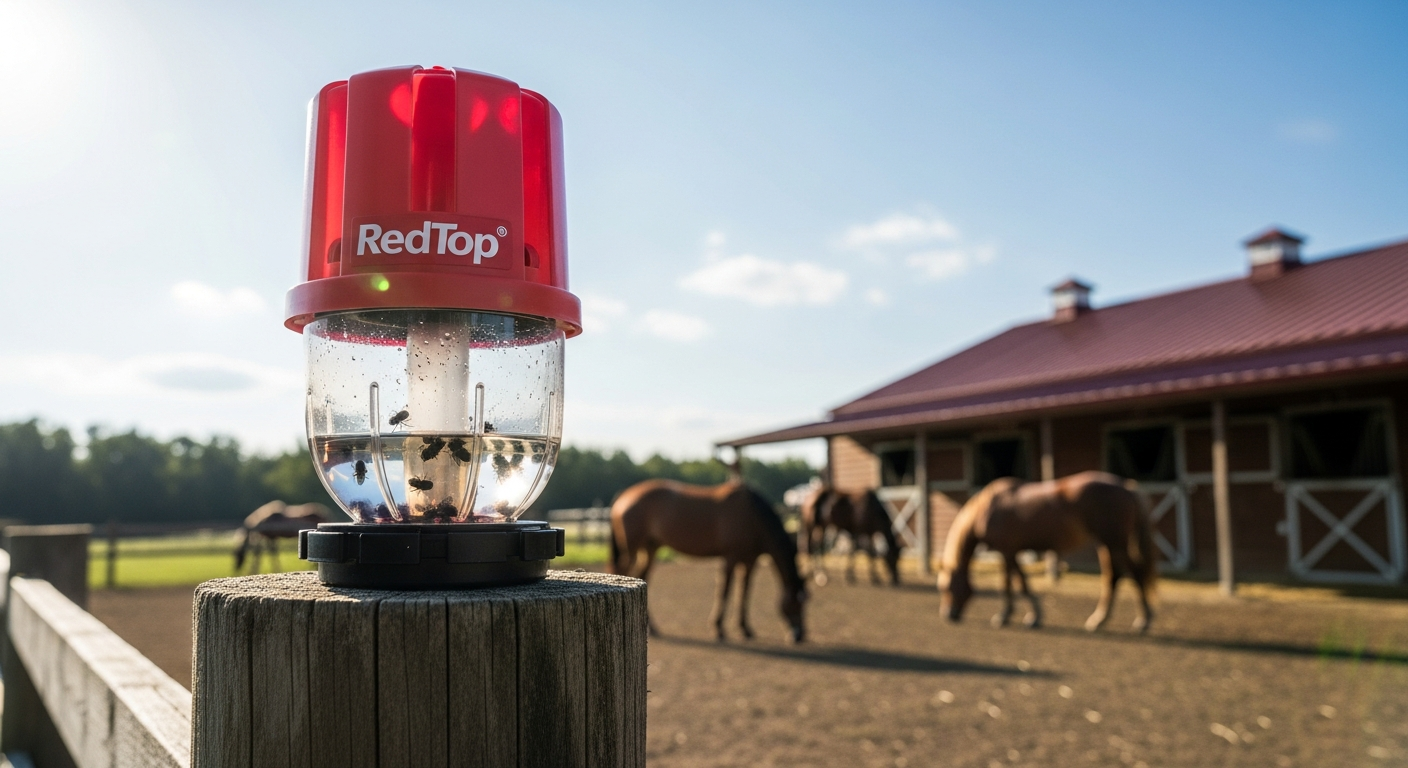
Flies buzzing around your livestock aren't just a minor inconvenience—they're costing you real money. Lost productivity from stressed animals, reduced feed intake, weight loss, and disease transmission add up to thousands of dollars annually on farms and stables worldwide. What if you could eliminate this problem without chemicals, electricity, or complicated equipment?
Since 1981, the Redtop brand has been solving this exact challenge for agricultural operations across 27 countries. The company recognized that farms needed a solution working with nature rather than against it, and engineered the Redtop Outdoor Non-Toxic Fly Trap to disrupt fly breeding patterns at the source using environmentally safe protein lures. This approach has earned its position as the go-to choice for agricultural pest management globally.
Agricultural fly infestations demand a dedicated control strategy that addresses the root problem: exponential population growth. The Redtop trap specifically handles farm and stable operations by targeting female flies, disrupting reproductive cycles, and preventing future generations. This guide examines how the trap's capacity and durability perform under heavy-use conditions, explores the long-term cost advantages for large-scale operations, and reveals the strategic placement tactics that maximize effectiveness in agricultural settings.
Discover how Redtop transforms farm fly control today.
Why Agricultural Operations Need a Dedicated Fly Control Strategy
Heavy fly populations in farm and stable environments create compounding problems that extend beyond simple annoyance. Animal stress directly translates to reduced milk production in dairy operations, slower weight gain in cattle and sheep, and diminished performance in horses. Meanwhile, flies serve as vectors for diseases including mastitis, pinkeye, and various pathogens that spread rapidly through confined animal populations.
Chemical pesticides present a fundamentally flawed long-term strategy. Fly populations develop resistance over successive generations, forcing farmers to rotate products constantly and increase application frequency. This escalating chemical burden contaminates pastures, affects water supplies, and creates health concerns for livestock and farm workers alike. The resistance problem compounds annually, making chemical solutions progressively more expensive and less effective.
Non-toxic solutions like Redtop offer a different approach entirely. Instead of fighting biology with chemicals, the trap works by interrupting the reproductive cycle at its source—specifically targeting female flies that would otherwise spawn thousands of offspring. This creates cumulative population reduction across successive generations without environmental contamination or livestock health risks. For organic and sustainable farming operations facing stricter regulatory requirements, chemical-free pest management has shifted from optional to mandatory.
How the Redtop Trap Outperforms Traditional Farm Fly Control Methods
The capacity advantage stands out immediately. A single trap catches up to 20,000 flies, dramatically reducing the number of units needed across large properties. Where farmers might previously deploy dozens of smaller traps or rely on daily pesticide applications, Redtop traps consolidate the workload into manageable numbers.
Breeding cycle interruption creates the compounding benefit over time. By targeting female flies specifically, the trap prevents entire generations from developing. Over a 12-week operational period, this approach achieves cumulative population reduction far beyond what the trap catches directly. The female flies that would produce thousands of offspring never reproduce, naturally suppressing future populations.
The operational design eliminates infrastructure requirements that plague traditional systems. No electricity means remote pastures and outdoor enclosures function perfectly without power infrastructure. No maintenance means the trap operates passively once activated, reducing labor costs associated with daily pesticide application or equipment upkeep.
Resistance-proof mechanics provide permanent protection against one of chemical solutions' greatest weaknesses. Flies cannot develop immunity to physical trapping—the mechanism works identically in year one and year ten. This contrasts sharply with chemical pesticides where resistance builds predictably over time, rendering products ineffective until rotation to alternative chemicals.
The design protects beneficial insects crucial to farm operations. Bees and other pollinators that drive crop production are specifically not attracted to Redtop's lure, preserving the ecosystem services farms depend on. This makes the trap compatible with integrated pest management approaches that minimize environmental disruption.
Extended operational windows reduce service frequency. A single activation lasts up to 12 weeks under normal conditions, meaning farmers can plan trap servicing around their seasonal schedule rather than responding to constant pest pressure. Even under severe infestation conditions where traps fill in three days, the replacement model remains straightforward compared to daily pesticide application protocols.
Start your farm's fly control transformation with Redtop.
Sizing and Placement Strategies for Farm-Scale Operations
Strategic distance placement creates an interception zone that protects livestock while concentrating fly capture. Position traps approximately 15 meters away from animal housing to intercept flies before they reach barns or pasture areas. This distance allows the lure to work effectively while keeping any odor from the trap away from living spaces.
UV and warmth activation determines lure effectiveness. Hang traps in sunny, warm locations where UV light triggers the protein lure's attraction mechanism. Shaded or cool positions significantly reduce trap performance, making placement as important as trap selection itself. South-facing locations and well-exposed pasture areas provide optimal conditions.
Multi-trap deployment serves larger operations effectively. Rather than relying on single traps to protect vast areas, distributed placement across different pasture zones and barn sections creates overlapping coverage. A 50-acre property might deploy traps in the main barn area, secondary shelters, pasture water points, and loafing zones to intercept flies across the entire operation.
Capacity planning for heavy infestations demands backup units and clear replacement schedules. During peak season or severe infestation conditions, traps can reach 20,000-fly capacity in as little as three days. Farms should calculate expected fill rates based on their specific fly population and maintain replacement inventory to prevent service gaps when traps reach capacity.
Seasonal adjustment recognizes that fly pressure varies throughout the year. Peak season (typically summer months) demands increased trap density and more frequent monitoring compared to spring and fall transition periods. Forward planning allows farmers to stage trap deployment as temperatures rise, rather than scrambling during crisis-level infestations.
Elevation and positioning relative to animal movement patterns affects interception rates. Traps hung at heights where flies naturally congregate and positioned where air currents carry lure scent toward problem areas outperform randomly placed units. Observation of fly behavior during placement adjustments improves performance significantly over time.
Cost-Benefit Analysis for Bulk Farm Operations
Single-unit pricing starts at £14.99 per trap, creating an accessible entry point for farms testing the system. Individual units cost little enough that experimentation with placement strategies and trap density requires minimal investment commitment.
Bulk purchasing power transforms economics at scale. A 100-trap order reduces per-unit cost to £11.99, representing a 20% reduction compared to single-unit pricing. Farms deploying dozens of traps achieve meaningful savings while ensuring adequate inventory for peak season.
Reusable trap options with refill cartridges lower ongoing replacement costs compared to disposable models. After the initial trap investment, farmers purchase only the bait refills rather than replacing entire units. For large-scale operations, this structural advantage compounds significantly across seasons and years.
Labor cost reduction eliminates the daily requirements of pesticide application. Traditional chemical programs demand regular scheduling, equipment maintenance, safety protocols, and application labor. Passive trap operation removes these recurring tasks entirely, freeing farm staff for productive work.
Productivity gains deliver measurable returns that exceed trap costs. Reduced fly stress on livestock translates to quantifiable improvements in milk yield (reduced mastitis and stress hormones), weight gain (higher feed intake without fly distraction), and breeding success (flies impact fertility and pregnancy rates). A dairy operation reducing fly stress by 50% through trap deployment typically sees milk production increases exceeding the trap investment within weeks.
Preventive cost advantage protects against infestation escalation requiring emergency interventions. Early-season trap deployment prevents fly populations from reaching crisis levels that would demand intensive pesticide applications or veterinary interventions. The cost of prevention is always lower than treating established infestations.
Real-World Performance in Livestock and Equestrian Environments
Stable fly control addresses one of equestrian operations' most persistent problems. Stable flies bite horses, causing visible distress that reduces feed intake and performance. The Redtop trap's female-targeting approach interrupts breeding cycles before populations spiral to unmanageable levels, maintaining horse comfort and athletic potential throughout the season.
Horse fly reduction targets larger, more aggressive fly species that cause significant distress. These powerful biters create panic in horses, disrupt grazing patterns, and cause secondary health issues from stress and wound infection. Trap deployment in pastures and around facilities provides direct relief observable within days of activation.
Dairy farm applications benefit substantially from fly pressure reduction. High-producing dairy cattle under fly stress experience reduced milk yields, higher somatic cell counts indicating mastitis risk, and behavioral changes reflecting anxiety. Operations deploying Redtop traps typically report production improvements within 2-3 weeks as fly stress decreases.
Poultry and small livestock see equally impressive results. Chicken operations struggle with fly populations in litter and manure areas, while sheep farms face challenges from blow flies and other species. The single-trap solution works across diverse farm animal populations without species-specific adjustments, making it valuable for operations managing multiple animal types.
Multi-species effectiveness means farmers can use identical traps and strategies regardless of whether they raise cattle, horses, poultry, sheep, or combinations thereof. One trap design addresses all fly species common in agricultural settings, simplifying inventory and strategy development.
Documented results since 1981 provide 45 years of field data from 27 countries across diverse climate zones. This extensive real-world performance record demonstrates consistency that laboratory studies alone cannot establish. Farmers implementing Redtop benefit from proven effectiveness rather than experimental solutions.
Building a Sustainable Fly Control Legacy
The Redtop Outdoor Non-Toxic Fly Trap represents far more than a pest control product—it's a fundamental shift in how agricultural operations approach fly management. Four decades of proven performance across 27 countries demonstrate conclusively that you don't need chemicals, electricity, or complicated systems to achieve superior results.
For farm and stable owners, the combination proves compelling: exceptional capacity catches thousands of flies per trap, breeding-cycle disruption prevents future generations, and proven cost-effectiveness delivers returns that justify the modest investment. The scalability works perfectly whether you're deploying five traps on a small operation or 500 across a large commercial farm. Bulk pricing and reusable options adapt to your needs without compromising performance.
The investment pays dividends through multiple channels simultaneously. Reduced animal stress translates directly to improved productivity metrics—higher milk yields, better weight gain, enhanced breeding success. Your operation runs more smoothly without daily pesticide application requirements. Your environmental footprint shrinks as chemical runoff and livestock chemical exposure disappear. Chemical-free pest management provides the peace of mind that comes from knowing your animals and land remain uncontaminated by toxins.
That's the integration that earned Redtop its reputation across four decades of agricultural use. Livestock benefits from fewer flies. Operations run more efficiently. Environmental responsibility becomes operational reality rather than aspirational goal.
Begin your sustainable fly control legacy with Redtop today.
Leave a Reply