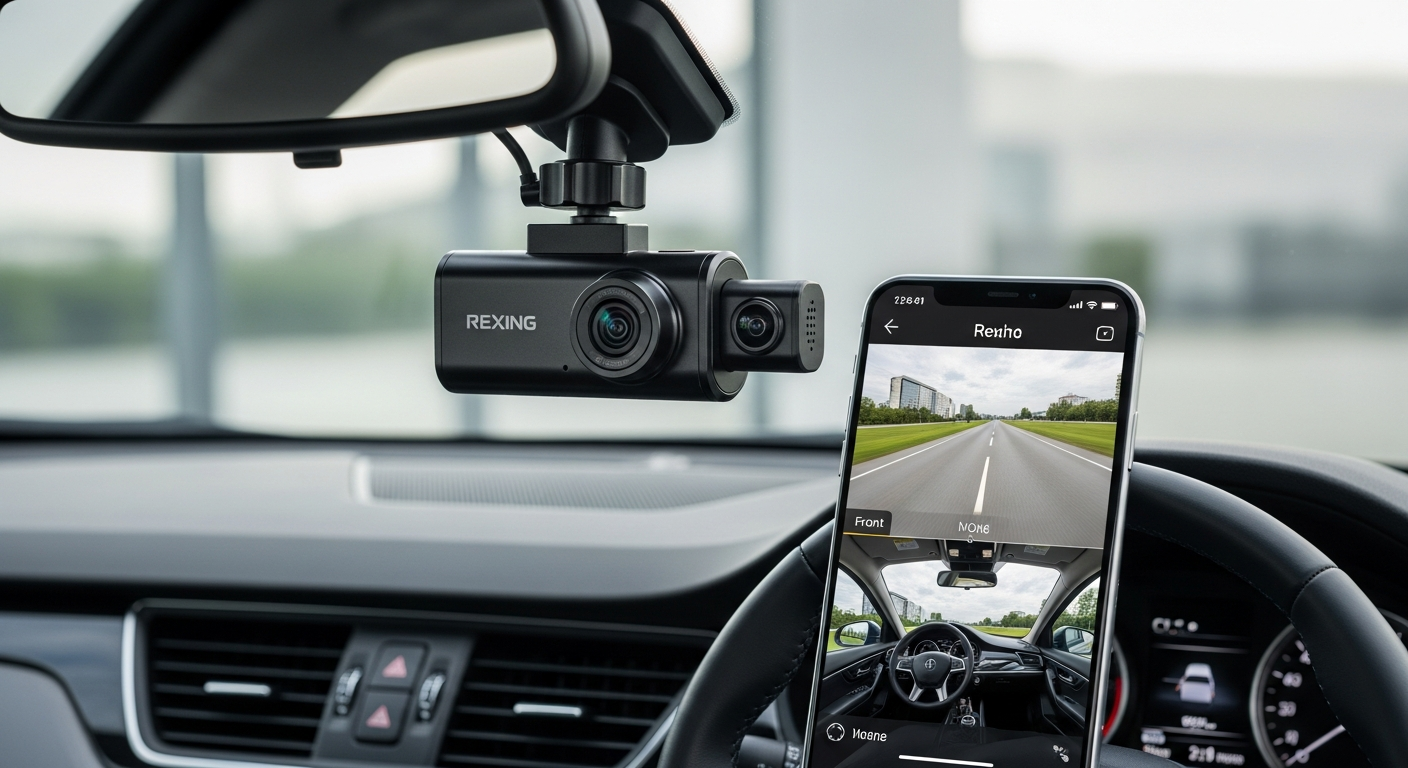
Over 60% of drivers never report accidents because they lack video evidence—yet most dash cam shoppers still hesitate to invest in dual-channel systems. The reality cuts deeper than indecision: a front-only camera leaves your vehicle's rear completely vulnerable to hit-and-runs, parking lot incidents, and insurance disputes you can't defend. That rear blind spot isn't just an inconvenience—it's a financial liability waiting to happen.
The Rexing V1P Pro Dual has earned its reputation as one of the most accessible dual-camera solutions on the market, priced around $199.99. Rexing Inc. built this system specifically for drivers who want professional coverage without the professional price tag, combining 1080p front and rear recording, integrated GPS tracking, and Wi-Fi connectivity in a single package. This bridges the gap between budget dash cams and premium systems that cost three times as much.
I've analyzed the V1P Pro Dual's real-world performance, scrutinized its supercapacitor technology, and examined what owners actually say about its strengths and limitations. You'll learn exactly what this dual-camera system excels at, where it falls short, and whether it's the right choice for your vehicle. By the end, you'll have the clarity needed to make a confident purchasing decision.
Dual-Camera Architecture: Coverage That Matters
Front Camera Specifications and Performance
The front unit delivers 1080p resolution at 30 frames per second with a 170-degree ultra-wide field of view. This expansive lens captures not just what's directly ahead, but vehicle positions at extreme angles—crucial for reconstructing multi-vehicle incidents. During daylight hours, users consistently report crisp, usable video that stands up to insurance company scrutiny.
Rear Camera Capabilities and Real-World Expectations
The rear camera mirrors the front's specifications: 1080p, 30fps, 170-degree lens. However, user feedback reveals a notable gap between specs and actual nighttime performance. The rear unit struggles in low-light conditions, producing grainy footage that, while technically 1080p, lacks the clarity of the front camera. This limitation matters most for drivers navigating poorly lit parking areas or highways without street lighting.
Simultaneous Recording and Liability Protection
Both cameras record simultaneously, eliminating the synchronization delays found in some competitor systems. This means when a side-impact occurs, you're capturing what the front camera sees while the rear camera documents the traffic behind you. For liability disputes, this simultaneous dual perspective becomes invaluable—insurance adjusters can triangulate fault using both angles.
Blind Spot Elimination and Accident Reconstruction
The 170-degree field of view on both cameras dramatically reduces blind spots. Traditional single-camera systems leave everything behind your vehicle invisible. The V1P Pro Dual transforms your vehicle's rear into a documented space, capturing hit-and-run perpetrators, lane-change conflicts, and parking lot damage incidents that would otherwise be your word against theirs.
Dual-Channel Coverage Versus Single-Camera Alternatives
Single-camera dash cams cost $50-100 less but sacrifice rear visibility entirely. Mid-range dual systems cost $300-400. The V1P Pro Dual's $199.99 price point delivers dual coverage that competing single-camera systems simply can't match, making this the logic choice for drivers serious about comprehensive protection.
Real-World Scenarios Where Rear Footage Proves Invaluable
Imagine a delivery driver rear-ended in traffic or a rideshare driver subject to a passenger's claim of reckless driving. The rear camera captures the tailgating vehicle or confirms the driver's safe operation. Parking lot scenarios are equally compelling—damage to your rear bumper documented by the rear camera becomes irrefutable evidence your insurance company accepts without hesitation.
GPS Integration and Location Tracking Features
Built-in GPS Logger Functionality
The integrated GPS logger records latitude, longitude, altitude, and timestamp data directly into your video files. This isn't optional post-processing or cloud-dependent tracking—the GPS data embeds within the video itself, creating a unified evidence package. When an accident occurs, your footage arrives with its own geographic coordinates.
How GPS Data Appears on Video Footage
The V1P Pro Dual displays time, date, location, and speed as an overlay on your recordings. Insurance adjusters see your exact position when the incident occurred, your vehicle's speed, and the precise timestamp. This metadata transforms casual dash cam footage into professional-grade accident documentation.
Time, Date, and Speed Information Recording
Speed data proves critical in fault determination. If you're hit by another vehicle, the GPS overlay shows your speed at impact—defending you against false claims of excessive velocity. The timestamp eliminates any ambiguity about when the incident occurred, which matters for traffic pattern analysis and corroborating witness statements.
Legal Admissibility of GPS-Tagged Footage
Law enforcement and insurance companies treat GPS-embedded footage as more credible than untagged video. The data's difficulty to fabricate makes it courtroom-viable evidence. Several users report insurance companies accepting V1P Pro Dual footage without requiring additional verification, a significant advantage over competitor systems lacking GPS integration.
Geolocation Benefits for Fleet and Personal Vehicle Tracking
Fleet managers monitoring multiple vehicles gain automatic location documentation for every incident. Personal vehicle owners benefit from the same capability—your vehicle's exact location during an accident is logged permanently, helpful for accident reconstruction specialists and insurance investigation teams.
GPS Accuracy Limitations in Urban Environments
Urban canyons with tall buildings cause GPS signal degradation. Tunnels eliminate GPS entirely. The V1P Pro Dual's GPS performs reliably on open roads and highways where you need it most, though downtown driving in dense metropolitan areas may show location variance of 10-50 feet depending on signal strength.
Supercapacitor Technology vs. Traditional Batteries
What Supercapacitors Are and How They Differ
Supercapacitors store electrical energy electrostatically rather than chemically like lithium-ion batteries. Unlike batteries that slowly degrade through charge cycles, supercapacitors maintain consistent performance over years of use. The V1P Pro Dual uses supercapacitor technology instead of the traditional batteries found in many competitor systems.
Temperature Resistance Advantages
Lithium-ion batteries suffer dramatically in extreme heat. Temperatures above 130°F cause rapid degradation and potential failure. Supercapacitors maintain reliability from -4°F to 158°F. For vehicles parked in Arizona summers or frozen northern winters, this temperature resilience becomes a genuine operational advantage—your dash cam won't fail when you need it most.
Reliability in Extreme Climate Operation
A vehicle parked in 140°F summer heat with a battery-powered dash cam faces serious reliability risks. The V1P Pro Dual's supercapacitor shrugs off these conditions. Winter drivers benefit equally—supercapacitors don't suffer from cold-induced capacity loss that affects battery-based systems.
Longevity and Degradation Patterns
Supercapacitors degrade far more slowly than lithium-ion batteries over time. A battery-based dash cam might show 50% capacity loss after three years. A supercapacitor system maintains 90%+ performance over the same period. This longevity translates to lower total cost of ownership and consistent recording reliability year after year.
Why Supercapacitors Matter for Sun-Baked Vehicles
Vehicles left in direct sunlight all day accumulate interior temperatures that destroy battery-based dash cams. Commercial delivery vehicles, rideshare cars, and contractors' trucks face constant heat exposure. The supercapacitor ensures your dash cam continues functioning reliably regardless of how hot your interior gets.
Cost-Benefit Analysis of Premium Power Technology
Supercapacitor dash cams typically cost $30-50 more than battery equivalents. The V1P Pro Dual's $199.99 price includes this premium technology without premium pricing. Over a five-year ownership period, the extended lifespan and avoided replacement costs make supercapacitors the more economical choice despite higher initial pricing.
Video Quality Assessment: Daytime, Nighttime, and Edge Cases
Front Camera Video Clarity in Daylight
During daylight driving, the front camera produces sharp, detailed footage that captures license plates from reasonable distances and clearly documents roadway conditions. Users consistently praise daytime performance as equal to dash cams costing twice as much. License plate identification—critical for insurance claims—remains reliable in good lighting.
Night Vision Performance and WDR Technology
The Wide Dynamic Range (WDR) technology adjusts exposure across the frame to handle mixed lighting conditions. The front camera performs adequately in nighttime scenarios, though without the specialized night vision hardware found in premium systems. Low-light performance is usable rather than exceptional—streetlit highways show good clarity, but completely dark rural roads produce grainier footage.
Rear Camera Video Quality Concerns
This is where the V1P Pro Dual shows its weakest link. The rear camera's nighttime video quality noticeably lags behind the front unit. License plate identification becomes difficult in darkness, and overall clarity diminishes significantly. Users frequently describe rear night video as resembling lower resolution despite official 1080p specifications. For nighttime rear coverage, this system accepts a real limitation.
Wide Dynamic Range Explained and Practical Impact
WDR analyzes brightness levels across your frame and adjusts exposure to prevent overblown highlights and crushed shadows. When you're driving toward a bright sun with dark buildings flanking your vehicle, WDR prevents the buildings from turning completely black. Practical impact: better detail preservation in contrasting light conditions, though still not matching the capabilities of higher-end systems.
Frame Rate Stability and Footage Smoothness
The consistent 30fps frame rate across both cameras produces smooth video without jerkiness or stuttering. Motion blur during lane changes and turns remains minimal. Users report reliable frame rate maintenance even during heavy traffic or rapid maneuvers, indicating solid hardware stability.
User Reports on License Plate Identification
Daytime front camera footage reliably captures license plates from 20-30 feet away. This distance proves sufficient for most accident scenarios. Rear camera plate identification depends heavily on lighting—excellent in daylight, questionable after dark. Insurance adjusters have successfully identified vehicles using V1P Pro Dual front footage in numerous reported cases.
Wi-Fi Connectivity and Mobile App Experience
Wireless Transfer Capabilities
The V1P Pro Dual's integrated Wi-Fi allows your smartphone to connect directly to the dash cam, viewing and downloading recordings wirelessly. No cable required, no computer necessary. Video files transfer to your phone for immediate insurance company submission or personal archival.
How the Mobile App Functions
The iOS and Android companion app displays a live preview of both cameras and provides playback of recorded footage. Users can save specific clips to their phone's local storage, manually create backups, and manage recordings. The interface handles basic functions reliably, though some users report occasional connection hiccups.
User Feedback on App Reliability and Interface
Opinions divide notably on app quality. Some users find it intuitive and dependable, while others describe it as underwhelming or frustrating to navigate. Connection drops occasionally require dashboard-mounted unit resets. The app works for essential functions but lacks the polish of premium competitors' offerings.
Alternative File Transfer Methods
Users frustrated with the app frequently resort to manual SD card extraction and computer-based file management. Removing the memory card and uploading footage via USB proves reliable, though less convenient than wireless transfer. This workaround eliminates app dependency for critical footage backup.
Remote Access Features and Cloud Integration
The V1P Pro Dual lacks cloud storage integration. Footage remains on your local SD card until manually transferred via app or card removal. This approach prioritizes privacy over convenience—your recordings never upload to external servers, eliminating cloud subscription requirements and data privacy concerns.
Common App Frustrations and Experienced User Workarounds
Frequent complaints center on occasional Wi-Fi connection delays, app crashes on older devices, and sluggish menu navigation. Experienced users recommend keeping firmware updated, clearing app cache regularly, and avoiding simultaneous playback of both camera feeds on older smartphones. These workarounds mitigate most issues.
Installation, Setup, and Hardware Integration
Mounting Considerations for Front Camera
The front unit mounts on your windshield using an adhesive pad and ball-joint bracket. Placement matters—center positioning near the rearview mirror balances visibility and discreteness, though some drivers prefer higher positioning for better forward road documentation. The mounting system feels sturdy once properly adhered.
Rear Camera Installation Requirements
The rear camera connects via a thin cable threaded through your vehicle's headliner and door jambs to the front unit. Installation typically requires 30-60 minutes of careful routing through existing wire channels. Most vehicles accommodate the cable without modifications, though some SUVs and trucks require creative routing through weatherstripping.
Power Supply Options
The V1P Pro Dual ships with a 12V cigarette lighter power adapter. Many users upgrade to hardwired installation using a fuse-tap connection to eliminate the obvious cable running down from the windshield to the dashboard. Hardwiring provides cleaner aesthetics and eliminates accidental unplugging.
Parking Monitor Feature Setup
Parking mode requires a separately purchased smart hardwire kit ($30-40), which connects to your vehicle's battery and enables dash cam recording even when the engine is off. This feature provides overnight surveillance for parked vehicles, though it adds complexity and cost beyond the base system.
Ease of Initial Configuration
The on-device 2.4-inch LCD screen guides basic setup: time/date, GPS initialization, Wi-Fi network connection, and recording preferences. Menu navigation is straightforward, taking most users 10-15 minutes to configure their preferred settings. GPS typically locks within 2-3 minutes of engine startup.
Professional Installation Recommendations
For users uncomfortable with rear camera cable routing, professional installation averages $100-150 at electronics retailers or automotive shops. This cost remains reasonable compared to potential installation damage. DIY installation succeeds for mechanically inclined users, though professional installation guarantees proper wire routing and secure connections.
Storage, Loop Recording, and Accident Detection
Micro SD Card Compatibility
The V1P Pro Dual accepts Micro SD cards up to 256GB (not included). Rexing recommends Class 10 or U3 rated cards for reliable continuous recording. Popular choices include SanDisk, Samsung, and Kingston brands. A 64GB card provides roughly 8-10 hours of continuous dual-channel recording.
Loop Recording Functionality
Loop recording automatically overwrites oldest files when your SD card reaches capacity. This eliminates manual file management—the dash cam continuously records, deleting the oldest footage to make room for new recordings. For users who prefer not to manually backup footage, loop recording provides hassle-free continuous operation.
G-Sensor Accident Detection
The integrated G-sensor detects sudden deceleration or impact. Upon accident detection, the current video file locks, preventing loop recording from overwriting that footage. This automatic protection ensures your accident video survives indefinitely, even if continuous recording would normally delete it days later.
How Locked Files Prevent Overwriting
When the G-sensor triggers, the current video segment receives a lock flag preventing loop recording deletion. Multiple sequential segments can lock simultaneously if the G-sensor remains activated during multi-vehicle collisions. Manually locked files via the on-device menu also receive permanent protection from overwriting.
Storage Capacity Calculations
A 64GB card stores approximately 70 hours of dual 1080p recording at 30fps. For daily drivers, one 64GB card covers 2-3 weeks of continuous recording before requiring backup or replacement. A 128GB card extends this to 5-6 weeks, while a 256GB card provides nearly three months of continuous coverage.
Memory Card Recommendations and Compatibility
High-endurance SD cards designed for dash cams outperform standard cards. Brands like Samsung Pro Endurance and SanDisk High Endurance handle continuous write operations better than consumer-grade cards. Avoid generic no-name cards—reliability matters when your accident footage depends on SD card integrity.
Pricing, Value Proposition, and Market Positioning
Price Point Relative to Feature Set
At $199.99, the V1P Pro Dual delivers dual-channel 1080p recording, GPS integration, Wi-Fi connectivity, and supercapacitor technology—features that would cost $350-500 in premium systems. This aggressive pricing reflects Rexing's strategy: maximize market penetration through value rather than premium positioning.
Cost Comparison with Competing Systems
Single-camera systems range from $80-200. Entry-level dual systems start around $250-300. Premium dual-camera rigs exceed $500. The V1P Pro Dual captures dual coverage at near-budget pricing, occupying an unusual market sweet spot that few competitors match.
Value Assessment for Budget-Conscious Buyers
If you're deciding between a $120 single-camera setup and the V1P Pro Dual, the additional $80 investment buys comprehensive rear coverage and GPS tracking—transformations that multiply your protection. The value ratio heavily favors the dual system despite higher absolute cost.
What's Included in the Box
The V1P Pro Dual ships with both cameras, mounting hardware, a 12V power adapter, USB cable, and documentation. Notably absent: a Micro SD card. Most buyers budget $20-40 for a quality 64GB card, adding real cost to the system.
Long-Term Cost of Ownership
Beyond the initial $199.99, factor SD card replacement ($25-50 every 2-3 years), potential professional installation ($100-150 if needed), and optional hardwire kits ($40-50 for parking mode). Five-year total cost averages $300-400 including all typical upgrades—roughly $5-7 monthly for comprehensive dual-camera protection.
Return on Investment Through Insurance Benefits
A single accident claim with clear footage often saves thousands in liability costs or premium increases. Insurance companies frequently offer modest discounts ($50-100 annually) for documented dash cam installation. Over five years, these discounts recoup your entire system investment while protecting against catastrophic claim costs.
Real User Feedback: Strengths That Stand Out
Customer Praise for Overall Value
Users consistently highlight the impressive feature-to-price ratio. Comments frequently appear comparing the V1P Pro Dual to systems costing significantly more, with users concluding they made a smart financial choice. This value perception builds strong customer loyalty and repeat purchases.
Positive Experiences with Front Camera Performance
Daytime front camera footage receives almost universal praise. Users describe crystal-clear video suitable for insurance documentation, reliable license plate capture, and detailed roadway documentation. Multiple users report successfully using V1P Pro Dual footage in insurance claims with minimal dispute.
Straightforward Installation Experiences
Front unit mounting proves quick and reliable for most users. While rear camera installation challenges some drivers, installation difficulty rarely exceeds moderate difficulty. Users frequently report 45-90 minute total installation times, with many completed in under an hour.
Reliability in Capturing Accident Evidence
Users who've experienced accidents praise the V1P Pro Dual for its dependable documentation. Reports describe clear proof of fault, liability determination aided by dual angles, and insurance adjusters' acceptance of footage without extensive verification. This real-world reliability exceeds many newer competitor products.
Satisfaction with Dual-Channel Coverage
Drivers appreciate rear camera peace of mind, even acknowledging that rear video quality doesn't match the front. The psychological security of documented rear coverage—the knowledge that hit-and-runs and parking lot incidents are recorded—justifies the system's existence independent of rear video quality.
Long-Term Durability Reports
Multi-year owner reports indicate sustained reliable operation. Units with 2-3+ years of ownership continue functioning without meaningful degradation. This durability suggests the V1P Pro Dual's supercapacitor approach delivers genuine longevity advantages over battery-based competitors.
Honest Limitations: Where the V1P Pro Dual Falls Short
Rear Camera Night Vision Quality Concerns
The rear camera's nighttime performance is undeniably the system's Achilles heel. Grainy, lower-contrast footage limits nighttime rear protection despite theoretical 1080p specifications. Users requiring premium night vision should consider more expensive alternatives like Blackvue or Viofo systems.
Bulkier Front Unit Design
The front camera unit is noticeably larger than some competitors' sleeker alternatives. Drivers preferring ultra-discreet dash cams—nearly invisible to vehicle interiors—find the V1P Pro Dual's more prominent mounting less appealing. This bulkiness doesn't affect functionality but impacts aesthetic preferences.
Mobile App Refinement Issues
The companion app's inconsistent reliability frustrates users expecting smartphone integration. Connection delays, occasional crashes, and unintuitive navigation menus lead some users to abandon wireless transfer entirely, reverting to manual SD card management. The app functions adequately but falls short of premium expectations.
Perceived Rear Camera Quality Discrepancy
The rear camera theoretically matches the front unit's 1080p specifications. Practically, nighttime rear video quality appears substantially lower. This specification-to-reality gap confuses some buyers who expect matching camera performance. Transparency about rear camera limitations would reduce these disappointments.
Limited Parking Mode Functionality Without Additional Hardware
Parking mode requires purchasing a separate smart hardwire kit, adding $40-50 to total system cost. Users discovering this requirement after purchase feel blindsided. Competitors often include hardwire kits or build parking mode into base hardware, making the V1P Pro Dual feel incompletely equipped.
Screen Size Limitations for On-Device Review
The 2.4-inch LCD screen adequately handles menu navigation and settings adjustment but feels cramped for detailed video review. Users preferring on-device footage verification find the small screen inconvenient, necessitating phone or computer-based playback for critical inspection.
Who Should Buy the Rexing V1P Pro Dual?
Ideal Buyers: Budget-Conscious Dual Coverage Prioritizers
Drivers who recognize dual-channel recording as essential but refuse premium pricing are the V1P Pro Dual's core audience. You understand that comprehensive protection doesn't require luxury features—you want practical coverage at practical prices.
Best Use Cases
Rideshare drivers operating daily with passenger interaction find rear camera documentation invaluable for liability protection. Delivery professionals navigating high-traffic urban environments benefit from GPS-embedded incident proof. Daily commuters on congested highways who prioritize dual perspective and accident documentation find ideal alignment with this system's strengths.
Audience Segments
Insurance-conscious vehicle owners understand that dash cams reduce claim disputes and premium increases. Fleet operators managing multiple vehicles benefit from GPS-tracked incidents and standardized documentation. Drivers upgrading from single-camera systems gain comprehensive coverage without premium investment.
Geographic Considerations
Drivers in temperature-extreme climates—Arizona, Florida, Alaska, Minnesota—benefit most from supercapacitor reliability. The V1P Pro Dual's thermal tolerance makes it logical for vehicles experiencing genuine seasonal extremes that stress traditional battery systems.
Unsuitable For
Premium night vision requirement drivers should consider higher-end alternatives like Viofo or Blackvue systems. Aesthetics-first buyers preferring ultra-discreet mounting should evaluate sleeker competitors. Users demanding flawless mobile app integration may prefer systems with more refined software.
Upgrade Candidates
Single-camera dash cam owners ready to eliminate rear blind spots are natural upgrade candidates. Users frustrated with battery-based systems' thermal sensitivity benefit from supercapacitor switching. Drivers experiencing feature inadequacy from budget systems gain substantial capability uplift with the V1P Pro Dual.
Setup Recommendations and Optimization Tips
Optimal Camera Placement for Maximum Coverage
Position the front camera centered just above or below the rearview mirror, high enough to capture road signage and lane markers clearly. This placement balances coverage with discreteness. Avoid extreme angles that capture excessive sky or hood, wasting resolution on non-critical areas.
SD Card Selection Guidelines
Prioritize Class 10, U3-rated Micro SD cards from established manufacturers. SanDisk High Endurance, Samsung Pro Endurance, and Kingston Canvas Focus perform reliably in continuous recording. Avoid generic budget cards—reliability matters more than minimal cost savings. A 64GB minimum provides practical storage capacity.
GPS Initialization and Calibration
Allow your V1P Pro Dual three minutes after startup for GPS signal acquisition. The unit displays GPS lock confirmation on-screen. For optimal accuracy, operate the vehicle in open areas during first-time GPS initialization. Urban canyon environments may require initial open-road driving for proper satellite positioning.
Wi-Fi Pairing Troubleshooting
Ensure your phone's Bluetooth is disabled during Wi-Fi app connection—conflicting wireless protocols cause connection failures. Reset the dash cam's Wi-Fi by restarting the unit. Clear your phone's app cache if connection drops repeatedly. Modern phones connecting reliably far outnumber those experiencing persistent issues.
Firmware Updates and Feature Enhancements
Periodically check Rexing's website for firmware updates. New versions occasionally improve video processing, stability, or feature functionality. Firmware updates transfer via SD card and Micro USB connection—straightforward process requiring 10-15 minutes.
Maintenance Routines
Clean camera lenses monthly with microfiber cloths to remove dust and moisture film affecting clarity. Inspect mounting adhesive annually, reseating if necessary. Check SD card health annually by testing random footage playback. These simple routines maximize system longevity and video quality.
The Bottom Line: Making Your Decision
Investing in the Rexing V1P Pro Dual fundamentally shifts your position from vulnerable to protected. You're getting a legitimate dual-camera system with GPS tracking and Wi-Fi connectivity at a price point that doesn't demand financial sacrifice. Yes, the rear camera struggles in darkness, and the app could use refinement—but these tradeoffs pale against the core benefit: comprehensive evidence capture from both directions.
The supercapacitor technology means you're not gambling on battery reliability in extreme temperatures. The 170-degree field of view on both cameras eliminates those blind spots that haunt single-camera owners. The integrated GPS transforms your footage into legally credible documentation that insurance companies and law enforcement take seriously.
This system excels for drivers who understand that dual-channel recording is non-negotiable, but premium features are optional. It's the practical choice for rideshare drivers, delivery professionals, and anyone whose vehicle represents their livelihood. If you're torn between a budget single-camera setup and a $500+ premium system, the V1P Pro Dual occupies that intelligent middle ground where smart investments live.
Your next accident—whether you're at fault or not—could cost thousands in liability, medical bills, or insurance premiums. For $199.99, this dash cam becomes your financial protection and your insurance company's best friend. The question isn't whether you can afford it. It's whether you can afford not to have it.
Protect yourself with the Rexing V1P Pro Dual Dash Cam today.
Leave a Reply