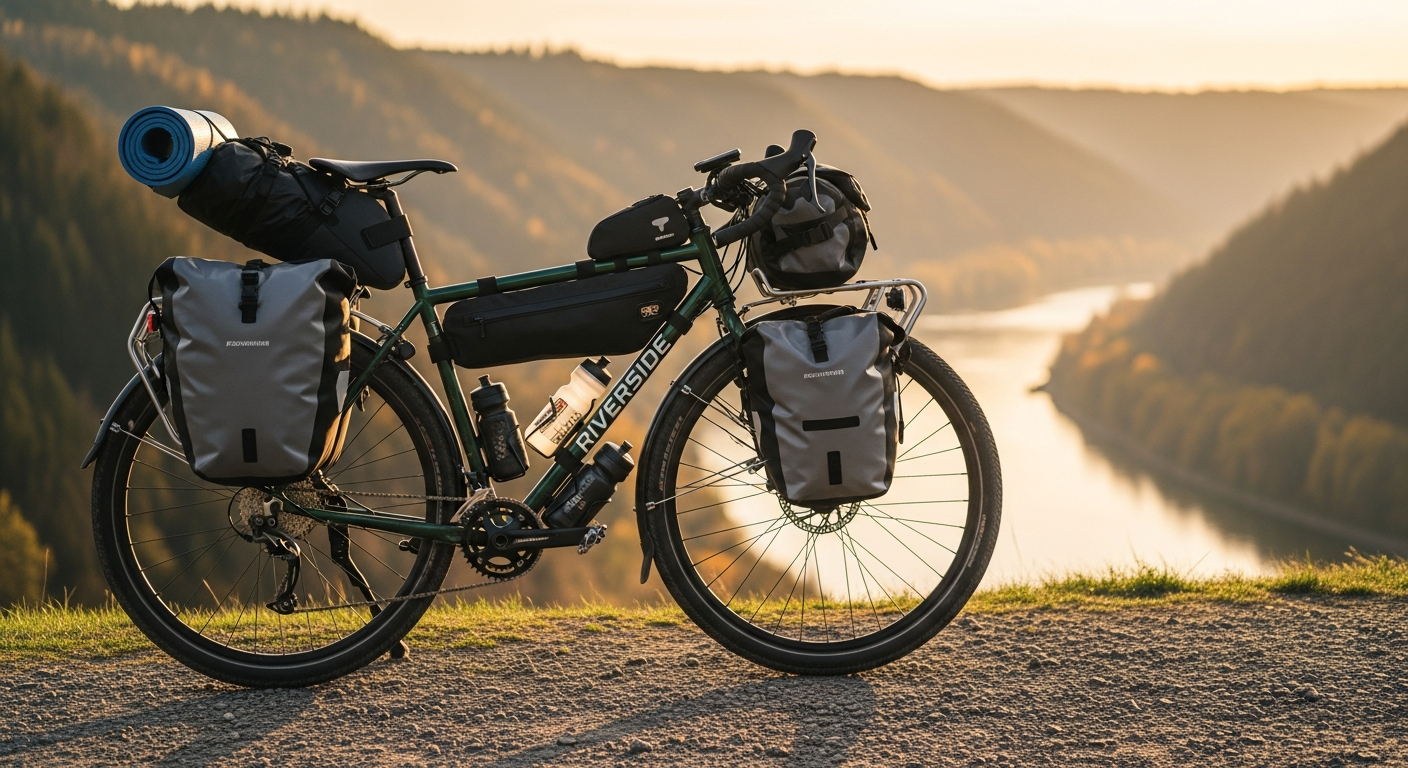
Over 500,000 kilometers tested across multiple continents—that’s the real-world credential behind the Riverside Touring 520. This bike has evolved from a solid performer into something genuinely exceptional for riders planning extended expeditions. The numbers speak volumes: a 170 kg total load capacity, 40 kg rear pannier rack, and a frame designed to handle whatever terrain you throw at it.
When you’re planning a multi-day cycling adventure, your bike becomes more than transportation—it’s your partner, your support system, your lifeline. The Riverside Touring 520 addresses a specific challenge that many expedition cyclists face: balancing carrying capacity with comfort during those long, demanding days on the road. Decathlon engineered this bike specifically for riders who refuse to compromise between durability and the ability to haul necessary gear.
Discover the Riverside Touring 520 and start planning your next adventure today.
Expedition-Grade Load Capacity: What 170 kg Actually Means for Your Adventure
The 170 kg total weight capacity isn’t arbitrary—it represents the result of engineering that understands expedition realities. This figure distributes across three critical elements: the rider (typically 70-90 kg), the bike itself (around 14-16 kg), and the cargo you’re carrying (leaving roughly 70-90 kg for panniers, frame bags, and gear).
Total weight distribution system: How the 170 kg capacity divides between rider, bike, and cargo for optimal balance
Understanding how weight distributes across your expedition setup determines whether your bike handles predictably or becomes sluggish and difficult to control. The Riverside Touring 520’s geometry accounts for loaded conditions specifically. Your center of gravity shifts considerably when carrying 40+ kilograms of gear, and the frame geometry compensates through slightly slacker angles and a longer wheelbase than racing bikes. This design philosophy keeps the bike’s handling characteristics relatively stable whether you’re carrying minimal gear or your complete expedition kit.
Rear pannier rack engineering: 40 kg carrying potential and why this matters for multi-day self-supported tours
The rear pannier rack represents engineering that goes beyond simply bolting metal to your bike. Decathlon designed this system to distribute 40 kg of luggage—or a child seat in alternative configurations—while maintaining weight balance. Panniers positioned low and close to the rear wheel reduce the pendulum effect that would otherwise make your bike feel twitchy and unstable. This matters profoundly during multi-day tours where you’re managing fatigue alongside handling an increasingly loaded bike. The structural reinforcement at the rear dropout and seat stays accommodates the concentrated stress that heavy rear cargo creates.
Frame geometry for heavy loads: Triple-butted aluminum construction and its role in maintaining stability when fully loaded
Triple-butted aluminum represents a material science approach to balancing weight, strength, and durability. The aluminum tubes vary in wall thickness—thicker at stress points like the bottom bracket and head tube, thinner in less-critical areas. This engineering reduces overall bike weight while maintaining the structural rigidity necessary for stable handling under load. When you’re carrying 170 kg total weight and navigating technical trail sections or crossing rough terrain, frame flex becomes more than a comfort issue—it becomes a control issue. The Riverside Touring 520’s frame rigidity ensures that your steering inputs translate predictably to wheel direction, even when fully loaded.
Weight distribution across the bike: Center of gravity management and how it affects handling on extended journeys
Center of gravity management separates expedition bikes from other categories. Loading your panniers strategically—heavier items lower and centered rather than high and spread—transforms handling dramatically. The Riverside Touring 520 accommodates this through its 33 mounting points and rear rack geometry. When properly packed, the bike’s center of gravity drops, improving stability and reducing the energy required to steer. Over a 100-kilometer day in the saddle, this efficiency gain accumulates into meaningful fatigue reduction.
Real-world load testing: Verified performance data from thousands of kilometers across varied terrain and climates
The 500,000+ kilometer testing credential means you’re not relying on theoretical engineering. Decathlon cycled these bikes across African deserts, European mountain ranges, Asian tropical regions, and North American trails—capturing real-world performance data across temperature extremes, humidity levels, and terrain variations that most bikes never encounter. This testing revealed not hypothetical performance but actual behavior under expedition conditions. Riders reported the bike maintaining its handling characteristics, the frame remaining straight, and the components functioning reliably across this immense distance and diverse environmental range.
Comparison to ultralight alternatives: Why load capacity sometimes trumps weight savings for expedition cyclists
Ultralight touring bikes prioritize minimizing everything—frame weight, component weight, gear capacity. This philosophy works for self-supported cyclists traveling light on well-maintained routes with frequent resupply opportunities. However, expedition touring often means carrying 40-50 kilograms of gear across unpaved trails, remote regions, and undefined routes. In these scenarios, the Riverside Touring 520’s additional weight provides durability and carrying capacity that more than offset the performance penalty of the heavier frame. A lighter bike that fails under load becomes a liability rather than an asset.
Child seat compatibility: Additional carrying options beyond traditional panniers for family touring scenarios
The 40 kg rear rack capacity accommodates a child seat alongside a child’s weight, enabling family expedition touring. Parents can confidently load a child plus their gear, transforming the Riverside Touring 520 into a family adventure platform. The structural engineering that supports heavy panniers equally supports the dynamic weight shifts of a moving child, maintaining stability and control throughout loaded family journeys.
Modular Customization System: 33 Mounting Points for Personalized Expedition Setup
Understanding the 33-insert frame design: Strategic placement of attachment points for racks, fenders, and accessories
The 33 mounting points represent a design philosophy that acknowledges expedition diversity. No two expeditions share identical requirements, and this frame accommodates customization from the ground up. Points exist at the head tube for lights, downtube for accessories, seat tube for tools or repair kits, chainstays for mudguards, and dropouts for racks. This abundance of options means your bike adapts to your specific expedition rather than forcing you to adapt to the bike’s design.
Rack configuration options: Front rack, rear rack, and combined setups for different expedition styles
The mounting points enable multiple rack configurations depending on your expedition philosophy. Some cyclists prefer all cargo on the rear (simpler handling, more concentrated weight). Others split weight front and rear (better weight distribution, more complex setup). Still others add a front rack for easily accessible items alongside rear panniers. The Riverside Touring 520 accommodates each approach through its mounting point placement, enabling you to test different configurations and optimize for your personal preferences and specific expedition requirements.
Fender integration: Protecting both bike and rider from mud and water on unpaved trail sections
Expedition routes frequently mean unpaved trails, and unpaved trails mean mud and water spray. The mounting points strategically accommodate full fender coverage, protecting the frame finish, drivetrain, and rider from the corrosive combination of mud and moisture. This protection becomes increasingly valuable during extended tours where component maintenance options are limited.
Lighting system integration: Dynamo hub compatibility and powering essential navigation lights
The Deore XT front dynamo hub integrated into the wheel generates electrical power as you pedal. The mounting points accommodate headlight and taillight attachment, enabling continuous powered lighting throughout your expedition without battery management concerns. This integration proves invaluable during extended remote journeys where resupply options don’t include battery stores.
Accessory ecosystem compatibility: Water bottle cages, tool mounts, repair kit holders, and emergency equipment placement
Beyond major components, the 33 points accommodate smaller accessories that accumulate into functional expedition systems. Tool mounts position repair kits for trailside access. Water bottle cages place hydration conveniently. Frame bags attach to secure valuable items. Each mounting point follows intentional placement logic rather than random attachment holes.
Customization for different terrain types: Adjusting setup for mixed-surface touring versus road-focused expeditions
A bike configured for pavement touring differs substantially from one optimized for technical trail riding. The Riverside Touring 520 enables this flexibility. Pavement-focused expeditions might prioritize aerodynamic efficiency through minimal fenders and streamlined accessory placement. Trail-focused setups add protective fenders and position accessories for technical control. Your single frame accommodates both approaches through strategic mounting point distribution.
Future-proofing your build: How modular design allows you to adapt your bike as your expedition needs evolve
Your first expedition informs your second. What worked perfectly becomes limiting after months on the trail. The modular design enables evolution without replacing the entire bike. Add front racks after discovering rear cargo handling challenges. Upgrade lights after experiencing poor visibility. Each modification adapts your established platform rather than starting over with new equipment.
Weight consideration in accessory selection: Balancing convenience with the cumulative impact of added components
The abundance of mounting points tempts accessory accumulation. However, each addition contributes to cumulative weight. Strategic selection matters—prioritizing functional necessity over convenience. The 170 kg capacity accommodates reasonable accessory loads, but intentional choices ensure you’re carrying genuine necessities rather than speculative equipment that never gets used.
All-Terrain Comfort Architecture: Staying Fresh Across 100+ Kilometer Days
Ergonomic saddle design: Pressure relief and support engineered for extended saddle time
Expedition cycling means spending eight, ten, or twelve hours daily in the saddle across multiple consecutive days. Poor saddle design becomes torture. The Riverside Touring 520 features an ergonomic saddle engineered specifically for touring comfort rather than racing efficiency. Wider padding distributes pressure across a larger surface area, reducing the numbness and discomfort that narrow racing saddles create. The saddle width accommodates the sitting position changes that touring requires—shifting weight constantly as you manage fatigue and adjust to terrain changes.
Upright riding position benefits: Reduced strain on shoulders, neck, and lower back during multi-day expeditions
The upright geometry keeps your torso nearly vertical, distributing your upper body weight across the saddle rather than concentrating it on your hands and forearms. This positioning reduces shoulder strain, eliminates neck tension from head elevation, and prevents the lower back compression that aggressive racing geometries create. During multi-day expeditions, this upright position proves invaluable—your shoulders stay relaxed, your neck remains pain-free, and your lower back doesn’t accumulate the fatigue that forces early-expedition termination.
Grip ergonomics: Hand position variety and fatigue reduction on long-distance riding
The handlebar and grip design accommodates multiple hand positions. Varied hand positioning during long days prevents pressure point buildup and reduces forearm and wrist fatigue. You can shift hand position constantly without specialized drop bars or complex grip configurations, allowing your body to naturally vary contact points and prevent repetitive strain.
Puncture-proof tire technology: B’Twin Trekking 9 Grip Protect+ specifications and flat prevention on remote routes
Puncture-resistant tires represent expedition insurance. The B’Twin Trekking 9 Grip Protect+ incorporates a protective layer below the tread that prevents thorns, glass, and sharp stones from penetrating the tube. On remote expeditions hundreds of kilometers from bike shops, this technology prevents the devastating situation of multiple flats that strand you without repair options. The tires employ proven puncture-resistance technology—not a theoretical promise, but proven performance across thousands of expedition kilometers.
Wide tire profile advantages: 28 x 1.75 (42-622) sizing for improved traction on mixed surfaces and reduced rolling resistance
The 28 x 1.75 (42-622) tire size represents an expedition compromise between traction and rolling efficiency. Wider than typical road tires, they provide substantial grip on unpaved surfaces, mud, and loose terrain. Yet they’re narrower than full mountain bike tires, avoiding the rolling resistance penalty that makes climbing loaded hills exhausting. The wide profile distributes your weight across a larger contact patch, improving traction on technical sections while maintaining reasonable efficiency on pavement and hardpack surfaces.
Suspension characteristics: How rigid frame geometry absorbs trail vibration without sacrificing efficiency
The rigid frame transmits vibration directly to your body—a reality that sounds punishing but actually works advantageously for expedition cycling. Unlike suspension bikes that absorb and release energy inefficiently, the rigid Riverside Touring 520 converts your pedaling power directly to forward motion without energy loss to compression cycles. The wide tires provide suspension-like compliance, cushioning impacts while the frame remains rigid and efficient. This combination delivers unexpected comfort without the weight and complexity of suspension components.
Seat tube angle and reach: Geometry optimized for loaded touring rather than racing or casual riding
The seat tube angle positions your body for pedaling power generation under load. Racing bikes optimize for speed over smooth pavement. The Riverside Touring 520’s geometry instead optimizes for sustainable power delivery while carrying weight across varied terrain. The reach accommodates an upright hand position without requiring extreme bar angles or excessive stem extension. Everything aligns for hours-long steady pedaling rather than sprint efforts or casual cruising.
Handlebar positioning: How steering geometry changes with heavy loads and why the Touring 520 handles this well
Loaded bikes steer differently than unloaded ones. The additional weight affects how quickly the bike responds to steering input and how stable it feels in turns. The Riverside Touring 520’s geometry accounts for this reality through head tube angle and fork offset that maintain predictable handling whether carrying minimal gear or full expedition loads. The steering response remains direct without feeling nervous or twitchy, even when fully laden.
Gearing Strategy for Varied Expedition Terrain: When 11-46 Ratios Work Best
Microshift RD-M665M derailleur specifications: Gear range breakdown and climbing capability analysis
The Microshift RD-M665M derailleur manages an 11-speed cassette with a 11-46 tooth range. This creates gearing from approximately 26 gear inches (the easy low gear) to 105 gear inches (the fast high gear). For loaded touring, the low-end gearing matters most. The 46-tooth cog provides adequate climbing capability when carrying full expedition loads across rolling terrain and modest grades. Professional mountaineers might criticize this for steep Alpine passes, but for mixed-terrain expedition touring along green paths and established bike routes, the gearing provides genuine utility.
Low-end gearing for loaded climbing: Performance on steep grades with full expedition cargo
At 170 kg total weight, the 11-46 gearing enables sustainable climbing at walking speed rather than requiring dismounting and hiking. A fully loaded expedition cyclist can maintain momentum on 8-10 percent grades indefinitely without excessive effort. Steeper grades require accepting slower climbing speeds or brief walking sections, but the gearing enables continuous climbing on typical expedition terrain rather than forcing repeated dismounting.
High-end gearing for efficiency: Maintaining momentum on flat sections and descents with weight onboard
The 11-tooth high gear provides reasonable top-end speed on downhill sections and flat terrain. While not as aggressive as racing bikes, this gearing enables meaningful speed maintenance when conditions permit. During descents with full cargo, the 11-tooth gear provides sufficient mechanical advantage to maintain acceleration without pedaling frantically, offering both control and efficiency.
Cadence management on extended tours: Finding sustainable pedaling rhythms for all-day riding
The 11-46 cassette enables maintaining comfortable cadence across varied terrain and loads. Rather than forced cadence changes that cause muscle fatigue, the gearing accommodates your natural rhythm. Finding your personal sustainable cadence—typically 70-90 RPM for expedition cyclists—and maintaining this across terrain variations through gear selection prevents the fatigue that comes from constantly fighting the drivetrain.
Alpine climbing limitations: Understanding where the gearing falls short and alternative solutions
The honest assessment: this gearing doesn’t excel on sustained steep climbing like Alpine mountain passes. Routes with extended sections above 10 percent gradient require accepting slow climbing speeds or hiking portions. For expeditions specifically planned around high mountain passes, you might consider gearing modifications. However, for typical mixed-terrain expeditions following established routes with reasonable grades, the gearing performs admirably.
Gear ratios for different expedition types: Adjusting expectations based on terrain profile
Coastal expeditions with minimal elevation change enable using higher gears continuously for steady speed. Mountain expeditions demand constant use of lower gears for sustainable climbing. The Riverside Touring 520’s gearing works optimally for mixed-terrain expeditions balancing road sections, rolling terrain, and modest climbing—the typical expedition profile. Specialized terrain types might require gearing modifications, but diverse expeditions fit this gearing perfectly.
Shifting reliability under load: How Microshift performs when fully loaded versus unloaded conditions
The Microshift derailleur maintains consistent shifting performance whether your bike carries minimal gear or full expedition load. Unlike derailleurs that struggle with heavy chains or cable stretch, the Microshift handles loaded conditions reliably. Users report consistent shifting throughout expeditions, maintaining this reliability across varying weather conditions and extended use periods.
Upgrade pathways: Options for modifying gearing if your expedition routes demand steeper climbing
Should you discover through experience that steeper climbing demands exceed your current gearing, upgrade pathways exist. Installing a larger cassette (up to 11-50 teeth with some derailleurs) provides additional low-end climbing capability. Alternatively, smaller chainrings up front offer gearing reduction. The Riverside Touring 520’s frame and drivetrain accommodate these modifications, enabling gear optimization after you understand your personal expedition requirements.
Braking Power and Control When Fully Loaded: Safety on Long Descents
B’Twin by Tektro T275 hydraulic disc brake specifications: Stopping power and modulation characteristics
Hydraulic disc brakes provide superior stopping power and modulation compared to mechanical alternatives. The T275 model delivers strong braking force while enabling precise modulation—progressive brake lever pressure creates proportional braking force rather than binary on-off engagement. This precision becomes critical during long expedition descents where you’re managing speed continuously rather than simply stopping.
Load-dependent braking performance: How braking changes with 170 kg total weight versus empty bike
Heavier bikes require greater braking force to achieve the same deceleration as lighter bikes. The hydraulic disc system accommodates this reality through its superior power multiplication. An unloaded bike stopping in 15 meters requires 170 kg of bike and rider stopping in roughly 30 meters when fully loaded with expedition cargo. The T275 brakes generate sufficient force to manage this loaded stopping distance consistently, providing confidence whether lightly loaded or fully laden.
Descent control on extended tours: Preventing brake fade during long, sustained downhill sections
Extended descents—particularly with full expedition loads—generate tremendous heat in brake systems. Mechanical disc brakes struggle during sustained braking, experiencing fade as friction materials degrade under heat. Hydraulic systems manage heat more effectively through better cooling characteristics and more consistent friction material performance. During the long Alpine descents or sustained hill descents typical of expedition touring, the hydraulic system maintains consistent braking power rather than progressively weakening.
Wet weather reliability: Hydraulic disc advantages on rain-soaked expedition routes
Expedition routes cross diverse climates and weather conditions. Hydraulic discs perform reliably in rain, mud, and wet conditions where mechanical brakes struggle to maintain consistent braking force. The sealed hydraulic system prevents water contamination of the braking surfaces or friction materials, ensuring reliable stopping power throughout wet expedition sections.
Maintenance requirements: Brake servicing intervals for extended touring use
Expedition use creates more brake maintenance demands than casual riding. Extended descents increase pad wear, and extensive use creates more opportunities for contamination. The Riverside Touring 520’s hydraulic disc brakes require periodic pad inspection and replacement—typically every 2,000-3,000 kilometers of expedition use. Brake fluid bleeding intervals extend longer, typically annually for touring use. Understanding this maintenance schedule and planning servicing between expedition segments ensures reliable braking throughout your touring career.
Modulation and control: Fine-tuning stopping power for technical terrain while carrying cargo
The progressive power delivery of hydraulic systems enables precise speed control on technical terrain. Whether navigating rocky descents, managing loose surfaces, or pacing yourself on steep grades, the brakes respond proportionally to lever pressure. This precision dramatically reduces the risk of skidding or losing control—critical safety factors when fully loaded on challenging terrain.
Comparison to mechanical alternatives: Why hydraulic discs matter for expedition cyclists
Mechanical disc brakes weigh less and cost less initially, offering certain advantages for minimalist touring. However, hydraulic systems provide superior reliability and performance under extended use, particularly with heavy loads. The performance advantage justifies the minimal weight penalty for expedition cyclists prioritizing safety and control over absolute weight minimization.
Emergency stopping capability: Confidence-building performance when unexpected obstacles appear
Unexpected situations—animals crossing the trail, debris blocking your path, other cyclists appearing suddenly—demand immediate stopping. The Riverside Touring 520’s hydraulic disc brakes provide the stopping power and modulation to handle emergency situations decisively. You can brake hard without skidding, achieving quick stops without losing control. This capability builds confidence throughout extended expeditions.
Frame Durability and Warranty Protection: Your Investment Security
Lifetime warranty coverage: What’s included for frame and fork across years and continents
Decathlon backs the Riverside Touring 520’s frame and fork with a lifetime warranty—covering defects in materials and construction for the life of the original owner. This coverage extends regardless of miles accumulated or years passed. Should your frame or fork fail due to manufacturing defect, Decathlon replaces it at no cost. This warranty transforms a £799 purchase into a durable asset rather than consumable equipment with predetermined obsolescence.
Triple-butted aluminum engineering: Material science behind durability without excessive weight
Triple-butted construction varies aluminum tube wall thickness based on stress distribution. Stress points—the bottom bracket area where pedaling forces concentrate, the head tube where steering forces load the frame—receive thicker walls. Lower-stress areas feature thinner walls, reducing weight without compromising strength. This engineering approach delivers the durability necessary for 500,000+ kilometers of expedition use while maintaining reasonable bike weight.
500,000+ kilometer real-world testing: Verified performance across diverse climates and conditions
The 500,000+ kilometer credential represents actual expedition performance testing—not laboratory simulation. Decathlon sent these bikes across continents and through diverse environments: tropical heat and humidity, arctic cold, monsoon rains, desert dust, and everything in between. The bikes returned not with theoretical predictions but with proven performance across this immense real-world testing. Users know they’re riding on verified engineering rather than marketing claims.
Fatigue resistance: How the frame handles repeated stress cycles over extended touring seasons
Cycling creates cyclic stress—repeated loading and unloading of the frame structure. Over thousands of kilometers, these stress cycles accumulate. The triple-butted aluminum and the design geometry distribute these stresses to avoid stress concentration points where cracks might initiate. The engineering anticipates that your frame might accumulate 50,000 kilometers over five years of expedition touring, and ensures the structure withstands these cumulative stresses without fatigue failure.
Repair and replacement options: Warranty claim process and parts availability through Decathlon
Should warranty coverage apply, Decathlon’s global store network handles claims efficiently. You can initiate claims at any Decathlon location, which then coordinates with central repair facilities. Replacement frames ship relatively quickly, minimizing expedition interruption. The widespread Decathlon presence ensures you can access warranty service even while traveling far from your home location.
Long-term value proposition: Cost-per-kilometer economics over a multi-year touring career
At £799 with a lifetime frame warranty, the Riverside Touring 520 delivers exceptional long-term value. If your bike accumulates 50,000 kilometers over a five-year expedition career, your cost-per-kilometer drops to approximately 1.6 pence per kilometer. Add maintenance costs (perhaps £500-700 over five years) and the total cost per kilometer remains impressively low compared to other expedition platforms.
Frame size availability: Four-size range (S, M, L, XL) for riders 1.55 m to 2.01 m tall
The four-size range accommodates most adult riders. Decathlon engineered each size proportionally rather than simply scaling the design, ensuring that smaller riders don’t feel cramped and larger riders don’t feel stretched. This size availability means finding your proper fit rather than compromising with an ill-fitting frame.
Resale value: Market demand for used Riverside Touring 520 bikes and their expedition heritage
The Riverside Touring 520’s reputation creates strong resale value. Used examples maintain surprising value due to the brand recognition, proven durability, and lifetime warranty transferability. Should you eventually outgrow expedition touring or want to upgrade, selling your used Riverside Touring 520 recovers a substantial portion of your initial investment.
Weight Considerations and Trade-offs: When Carrying Capacity Outweighs Lightness
Actual bike weight specifications: Understanding the baseline before adding expedition gear
The Riverside Touring 520 weighs approximately 14-16 kilograms depending on size and exact specification. For comparison, racing bikes weigh 6-8 kilograms and casual city bikes weigh 13-15 kilograms. The touring bike lands between categories—heavier than racing bikes but comparable to casual bikes. Understanding this baseline weight helps contextualize the actual performance implications.
Cumulative weight impact: How bike weight affects performance when combined with 40+ kg cargo loads
A 2-kilogram bike weight difference matters negligibly when you’re carrying 50+ kilograms of cargo. Your total weight increases from perhaps 120 kilograms to 170 kilograms—the bike’s weight becomes less than 10 percent of the total system. In this context, sacrificing bike durability to save weight makes minimal sense. The additional durability that accepts 170 kilograms of load matters infinitely more than saving 1-2 kilograms of bike weight.
Acceleration and climbing penalties: Real-world performance differences on steep sections
On short climbs, weight matters. The heavier Riverside Touring 520 requires more effort to accelerate than lighter racing bikes. However, on expedition climbs measured in kilometers rather than meters, the difference becomes imperceptible. You’re climbing at sustainable speeds for extended periods—the bike’s weight influences this minimally compared to your personal fitness, gearing selection, and pacing discipline.
Rolling resistance characteristics: How weight distribution affects efficiency on flat terrain
Rolling resistance increases with weight—heavier bikes roll slightly harder than lighter ones. However, the wide puncture-proof tires contribute more rolling resistance than the additional frame weight. The combined system (heavier frame plus puncture-proof tires) creates modest rolling resistance increases compared to lightweight racing setups, but this becomes acceptable given the durability and flat prevention benefits.
Durability versus lightness trade-off: Why touring bikes intentionally weigh more than racing bikes
Every touring bike design decision reflects a conscious choice: durability over minimalism. The triple-butted aluminum weighs more than single-butted alternatives but handles repeated stress better. The wide tires weigh more than road tires but resist punctures. The hydraulic disc brakes weigh more than rim brakes but deliver superior control. These intentional design choices acknowledge that expedition reliability matters more than ultra-lightweight performance.
Rider fitness adaptation: Training considerations for expedition cyclists transitioning to loaded touring
Cyclists transitioning from road cycling to loaded touring benefit from gradual weight adaptation. Starting with a lightly loaded bike and progressively increasing cargo weight allows your fitness to adapt. After several weeks of gradual loading, what initially felt heavy becomes normal. Your legs, core, and cardiovascular system adapt to the additional demands, and the weight becomes less psychologically daunting.
Comparison to ultralight touring alternatives: When weight savings matter and when they don’t
Ultralight touring bikes weigh 10-12 kilograms, substantially less than the Riverside Touring 520. This weight advantage matters significantly on steep sustained climbing and when you’re self-supported across mountainous terrain. However, ultralight bikes sacrifice durability and carrying capacity—tradeoffs that matter less for expedition cyclists carrying 40+ kilograms of gear and planning multi-week journeys. For most expedition profiles, the Riverside Touring 520’s weight represents an acceptable compromise.
Long-distance fatigue factors: How bike weight influences overall expedition endurance
Fatigue over extended expedition days results from cumulative stress—pedaling muscles tiring, climbing efforts draining energy reserves, hours-long saddle pressure accumulating. Bike weight contributes to this cumulative stress but represents one factor among many. Proper pacing, adequate nutrition, sleep quality, and saddle comfort likely influence fatigue more substantially than the 2-4 kilogram difference between the Riverside Touring 520 and ultralight alternatives. Focusing on these factors often matters more than obsessing over bike weight.
Sizing and Fit for Expedition Comfort: Finding Your Perfect Match
Four-size range overview: S, M, L, XL specifications and height recommendations (1.55 m to 2.01 m)
The Riverside Touring 520 comes in four sizes: S (for riders 1.55-1.70 m), M (1.65-1.80 m), L (1.75-1.90 m), and XL (1.85-2.01 m). These ranges overlap intentionally—your exact fit depends not just on height but also on arm length, leg proportions, and personal preference regarding reach and stack height.
Reach and stack measurements: How geometry changes across sizes for different body proportions
Reach describes the horizontal distance from the bottom bracket to the top of the head tube—how far forward you stretch to the handlebars. Stack describes the vertical distance—how high you reach. Larger sizes increase both reach and stack proportionally. This means tall riders aren’t simply getting a larger version of a small-sized frame; the geometry proportionally expands to suit larger bodies.
Inseam calculation: Proper seat height adjustment for loaded touring comfort
Proper seat height ensures your knee reaches approximately 25-30 degrees of bend at the bottom of the pedal stroke. Too high and you’ll rock on the saddle; too low and you’ll experience knee pain. Measure your inseam (from your crotch to the floor while standing barefoot) and multiply by 0.885 to approximate proper seat height. This calculation provides your starting point, adjustable through small increments once you’re riding.
Handlebar reach optimization: Achieving ergonomic hand positioning for multi-day riding
Handlebar reach should position your hands where you can reach them comfortably while maintaining proper posture. In the upright touring position, your arms should maintain roughly a 10-15 degree bend when hands are on the bars. Too stretched and your shoulders fatigue; too close and your wrists experience pressure. The frame’s reach and stem length work together to achieve this positioning—understanding both ensures optimal hand position.
Frame clearance for fenders and accessories: Ensuring modular components fit your chosen size
The 33 mounting points accommodate various accessories, but each size must provide adequate clearance for fenders and racks without interference. Smaller frame sizes might experience tire-to-fender rubbing with certain accessory configurations while larger sizes provide more clearance. Confirming that your chosen size accommodates your intended accessory configuration prevents purchasing accessories that don’t fit.
Standover height considerations: Dismounting ease when fully loaded with expedition gear
Standover height—the distance from the ground to the top tube when straddling the frame—determines how easily you can dismount, particularly when wearing expedition gear or bulky clothing. Proper standover height provides 5-7 centimeters of clearance between your body and the frame. This becomes crucial during loaded expeditions where dismounting ease matters more than during casual riding.
Test ride importance: Why trying before purchasing matters for expedition-specific use
Expedition bikes demand extensive time investment—weeks or months riding loaded. Purchasing without a test ride risks discovering fit issues after you’ve committed to a bike. If possible, rent a Riverside Touring 520 from a Decathlon location and take it on a fully loaded day ride. This experience reveals whether the fit works for your body proportions and expedition riding style before committing to ownership.
Adjustment range: Seat post and stem compatibility for fine-tuning fit after purchase
After purchasing, seat post and stem adjustments fine-tune your fit. The seat post allows vertical adjustment, and modern seat posts accommodate 50+ millimeters of height variation. Stems vary in length and rise, providing horizontal and vertical reach adjustment. These components enable personalizing your fit within a size range, accommodating different body proportions and preferences.
Dynamo Hub Integration: Self-Powered Lighting for Remote Expeditions
Deore XT front dynamo hub specifications: Power generation capacity and efficiency
The Deore XT front dynamo hub generates electrical power as you pedal—typically producing 3 watts continuously at normal pedaling speeds. This power drives lights bright enough for navigation while riding, eliminating battery management concerns during extended remote journeys. The dynamo converts rotational energy into electrical current, powering lights continuously as long as you’re pedaling.
Lighting system compatibility: Compatible headlights and taillights for expedition use
The dynamo hub powers compatible headlights and taillights engineered for dynamo operation. These lights typically produce 20-80 lumens depending on quality and design—bright enough for trail navigation at night or low-light conditions. Compatible taillights ensure following traffic visibility, improving safety during expedition sections crossing populated areas.
Continuous power availability: Eliminating battery concerns on extended remote journeys
Battery-powered lights require carrying spares and managing battery life across expedition weeks. The dynamo eliminates this concern entirely. As long as you’re riding, you’re generating light power. Camping or stopped periods don’t deplete your lighting—you generate fresh power as soon as you start pedaling again.
Efficiency at various speeds: How power generation changes with pedaling cadence
Power generation scales with pedaling speed—faster pedaling generates more power. This creates an interesting dynamic: at slow speeds or climbing, light output decreases when you’re most likely navigating challenging terrain. At high speeds on descents, light output increases when you need less light. This relationship typically works acceptably for expedition use, though very slow climbing in darkness might require supplementary lighting.
Weather performance: Reliability in rain, mud, and challenging expedition conditions
The dynamo hub withstands extended exposure to mud, rain, and challenging expedition conditions. The sealed bearing design prevents water from entering the electrical generation chamber. Dynamo hubs function reliably throughout wet seasons and rain-soaked expedition sections, maintaining lighting output without weather-related failures.
Leave a Reply