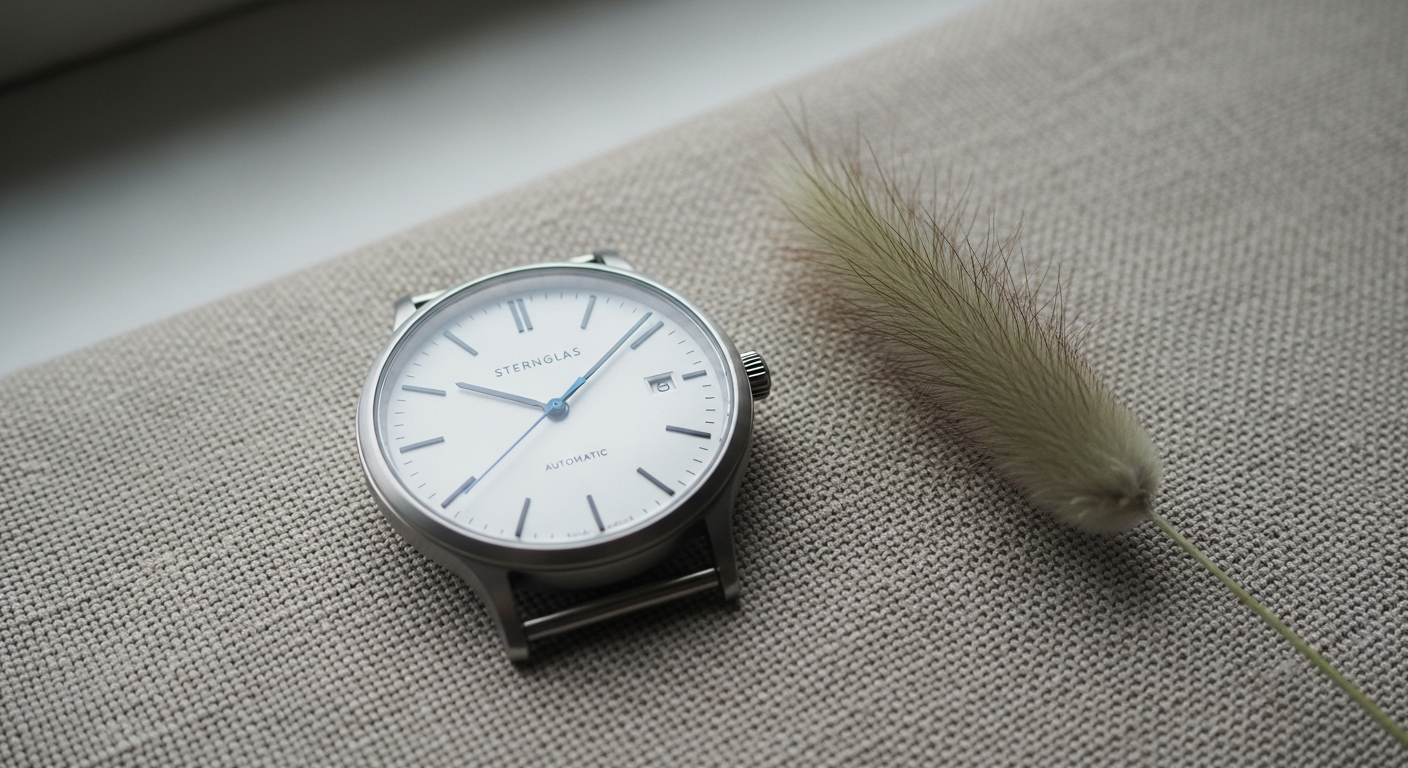
The minimalist design movement has exploded in recent years—and the watch industry is no exception. Collectors are ditching cluttered dials and unnecessary complications in favor of clean, purposeful timepieces that whisper rather than shout. The Sternglas Naos Bauhaus automatic watch represents exactly what this shift looks like: a watch that proves you don’t need Swiss prestige or luxury pricing to own a genuinely exceptional mechanical timepiece.
Sternglas built its reputation by staying true to Bauhaus principles—functionality, clean lines, and understated elegance. The Naos is their flagship achievement in this philosophy. It’s earned bestseller status because it delivers on every front: solid engineering, genuine craftsmanship, and a price point that doesn’t require taking out a second mortgage.
Discover the Sternglas Naos collection and experience Bauhaus design firsthand.
The Bauhaus Philosophy Behind the Sternglas Naos Automatic
Historical context of the Bauhaus movement and its core design principles
The Bauhaus movement emerged in 1919 Germany as a radical rethinking of how design could serve everyday life. Rather than ornamentation for its own sake, Bauhaus designers embraced the principle that form must follow function. Every element existed for a reason. Every detail had purpose. This philosophy spread across architecture, graphic design, furniture, and eventually, watchmaking—though it took decades for the watch industry to fully absorb the lesson.
How Sternglas interprets form follows function in modern watchmaking
Sternglas doesn’t treat Bauhaus as a aesthetic box to check. The brand genuinely interprets “form follows function” through its design decisions. The Naos features a 38mm case because that size balances readability with wearability across different wrist sizes. The dial contains only essential information: hour markers, minute track, hands, and a date window. Typography is deliberate—sans-serif fonts that echo the Bauhaus design language without screaming for attention.
The connection between Bauhaus minimalism and contemporary design trends
Contemporary design culture has rediscovered what Bauhaus understood a century ago: clutter exhausts us. In a world of notification overload and digital complexity, mechanical watches with clean, purposeful dials offer genuine respite. The Naos taps into this hunger for authenticity and simplicity. Its popularity reflects a broader cultural shift away from maximalism toward intentional design that respects the user’s attention and space.
Why minimalist watches are experiencing a resurgence in popularity
Younger watch enthusiasts particularly gravitate toward minimalist designs because these watches don’t demand constant validation or explanation. A minimalist watch simply works—it tells time, it looks refined, and it doesn’t need a backstory. This stands in sharp contrast to sports watches bristling with bezels and subdials, or dress watches that feel precious and untouchable. The Naos appeals to people who want ownership without performance anxiety.
The difference between Bauhaus design and oversimplified watch design
Not every watch with a plain dial qualifies as Bauhaus design. Genuine Bauhaus watches demonstrate intentionality in proportions, material choices, and hierarchy of information. The Naos proves this distinction through its domed sapphire crystal (which provides both aesthetic depth and functional protection), its carefully balanced case-to-lug ratio, and its typography that feels integral rather than incidental. Many competitors strip away details without understanding what those details served.
How the Naos reflects authentic Bauhaus values versus aesthetic mimicry
The Naos isn’t playing at minimalism—it’s implementing it. Sapphire crystal costs more than plexiglass but serves the double function of scratch resistance and classic visual presentation. The 38mm size wasn’t chosen because it’s fashionable; it was chosen because it works. The stainless steel case finishes cleanly without requiring polishing rituals that would undermine daily wearability. This represents genuine philosophy applied, not Bauhaus aesthetics grafted onto a fundamentally different design approach.
Mechanical Heart: Understanding the Miyota Automatic Movement
What makes an automatic movement superior to quartz for watch enthusiasts
Automatic movements transform timekeeping from a consumable function into an experience. A quartz watch delivers accuracy with battery-powered convenience. An automatic watch delivers that same accuracy while requiring you to wind it—either through daily wear or manual winding—and creates a tactile connection to mechanical engineering. Watch enthusiasts prize this connection. There’s genuine pleasure in feeling the rotor wind as you move your wrist, knowing that mechanical energy is being stored and released in precisely measured increments.
Overview of the Miyota movement: reliability, accuracy, and heritage
Miyota movements deserve their reputation. Manufactured by the Japanese company Citizen, Miyota calibers power millions of watches across price points and brands. They’re engineered for reliability rather than prestige—which paradoxically makes them more dependable than many celebrated Swiss movements. Accuracy typically runs within -20 to +40 seconds per month, competitive with movements costing significantly more. Miyota doesn’t pursue the minimalist aesthetic through sloppy manufacturing; it achieves that aesthetic through disciplined engineering.
The smooth sweep second hand and what it reveals about movement quality
The second hand on the Naos doesn’t tick. It sweeps—a continuous, smooth motion powered by the balance wheel oscillating at around 8 beats per second. This sweep reveals mechanical sophistication. Budget quartz watches produce a jerky tick-tick-tick motion. Quality automatic movements, including Miyota calibers, produce this characteristic smooth sweep. For enthusiasts, watching that second hand move is partially about timekeeping accuracy and partially about experiencing mechanical poetry.
Power reserve specifications and what they mean for daily wear
The Naos automatic typically offers between 40-50 hours of power reserve, depending on the specific caliber. This means the watch can function for roughly two days without movement before the mainspring fully unwinds. For daily wear patterns, this creates practical flexibility—miss a day of wearing the watch, and you won’t need to reset it. Power reserve matters less for collectors who rotate multiple watches and more for people seeking a single everyday companion that won’t require constant adjustment.
Comparison between automatic and quartz versions of the Naos
Sternglas offers the Naos in multiple configurations. Quartz versions deliver 2-3 year battery life, superior accuracy, and lower maintenance for around €199. Automatic versions command premium pricing but deliver the mechanical movement experience and indefinite operational lifespan. The choice fundamentally reflects whether you value watchmaking philosophy (automatic) or pure practicality (quartz). Both represent legitimate decisions; the difference is intentional rather than quality-driven.
Why mechanical movements appeal to collectors despite modern quartz efficiency
Quartz movements are objectively superior for pure timekeeping. They’re more accurate, require minimal maintenance, and cost less. Yet collectors gravitate toward mechanical movements because they represent human engineering elevated to an art form. A mechanical watch demands respect—you must remember to wear it, you might occasionally regulate it, and you accept that it will vary slightly from atomic time. This engagement creates meaning that pure precision can’t generate.
Maintenance requirements and longevity of the Miyota automatic
The Naos automatic requires servicing approximately every 5-10 years, depending on wear conditions and water exposure. Service involves disassembly, cleaning, lubrication, and reassembly—skilled work that costs substantially more than replacing a battery. However, a properly serviced Miyota movement can function reliably for decades. The upfront cost consideration is this: you’re buying a watch that requires periodic professional attention versus one that simply needs battery replacement. Most owners consider this acceptable given the mechanical experience gained.
Design Elements That Define the Naos Aesthetic
The 38mm case diameter: why this size works across different wrist types
Case diameter matters profoundly for wearability across different wrist sizes. The Naos 38mm diameter occupies the Goldilocks zone—substantial enough to command presence on larger wrists without overwhelming smaller frames. This size emerged from Bauhaus principles of universal design: creating objects that function well for the broadest possible audience. A 42mm watch can look absurd on a smaller wrist. A 34mm watch can look modest on a larger wrist. The 38mm Naos navigates these constraints with historical precedent; watches from the 1930s-1950s—the era when Bauhaus philosophy influenced watchmaking—typically ranged between 36-40mm.
Sapphire crystal technology and scratch resistance advantages
Sapphire crystal represents the practical edge of materials engineering. Unlike acrylic or mineral crystal, sapphire resists scratching through sheer hardness—it’s second only to diamond on the Mohs scale. This matters for minimalist watches specifically: on a clean, unadorned dial, any scratch becomes immediately visible. The Naos sapphire crystal preserves that clean aesthetic across years of daily wear. You can set this watch down on a desk, place it against a zipper, or brush it against your wrist without creating micro-scratches that accumulate into haziness.
Domed crystal design: visual impact and protective benefits
The Naos features a domed (rather than flat) sapphire crystal—a characteristic both aesthetic and functional. Visually, the dome creates depth perception, making the dial appear to float slightly. Functionally, the dome provides superior water resistance by creating a more robust seal at the case edge. The dome also offers modest protective advantages; a flat crystal struck at a high angle might suffer edge damage, while a domed crystal distributes impact more evenly. This design choice exemplifies how Bauhaus philosophy works: form (visual elegance) and function (protection) reinforce each other rather than competing.
Dial layout: minimalist indices versus Arabic numerals
The Naos typically features thin baton indices at the cardinal points (12, 3, 6, 9) with a minimal minute track forming the dial’s perimeter. Some variations incorporate Arabic numerals for enhanced legibility, particularly in the Naos Solar or Quartz versions. This hierarchy of information reflects Bauhaus thinking: essential information (hour positions) receives emphasis, while secondary information (minutes) receives subtle presence. The absence of running seconds markers (a feature on many dress watches) further reduces visual noise, allowing the smooth-sweeping second hand to shine as the movement’s crowning detail.
The date window placement and functional design considerations
The date window sits at 6 o’clock, a position that doesn’t disrupt the dial’s vertical symmetry while remaining immediately accessible to the eye. This placement represents a Bauhaus compromise: include functional information (the date) without sacrificing design unity. The window frame typically matches the case finishing, creating visual integration rather than a patch applied to the dial. This attention to detail distinguishes thoughtful design from thoughtlessness.
Typography choices and their role in Bauhaus authenticity
The Naos employs sans-serif typography—typically clean, geometric letterforms that echo the Bauhaus design language. Serif fonts (with decorative flourishes on letterforms) would contradict the minimalist philosophy. Sans-serif fonts feel modern and utilitarian, qualities that Bauhaus designers championed. Sternglas applies this principle consistently across the dial, case marking, and printed materials, creating a cohesive visual identity that reinforces the design philosophy.
Stainless steel case finishing and durability for everyday wear
Stainless steel provides the material foundation for the Naos. The case typically features a polished center (the visible lugs) with brushed finishing on the top surface of the case—a pattern that balances visual interest with practical durability. Polished surfaces show fingerprints and scratches more readily than brushed surfaces, yet they catch light in ways that enhance presence. The Naos pattern creates a two-tone visual effect while the brushed surface on top conceals daily wear patterns. This represents another Bauhaus principle: materials should express their true nature and durability characteristics.
Explore the full Sternglas Naos range and find your perfect Bauhaus timepiece.
Building Your Perfect Naos: Strap Options and Customization
Premium calf leather strap quality and break-in experience
The Naos typically ships with a high-quality calf leather strap—supple enough to feel refined but durable enough to withstand daily wear. Leather straps require a break-in period. New leather feels slightly stiff; over two to four weeks, it molds to your wrist, becoming progressively more comfortable. This break-in period represents a form of ownership engagement. Rather than buying a finished product, you’re participating in the watch’s evolution. The leather develops patina—subtle color shifts and wear patterns—that become personalized markers of your ownership.
Interchangeable strap ecosystem and aftermarket options
The Naos typically uses standard lug widths (commonly 20mm), making it compatible with thousands of aftermarket straps. This opens genuine customization possibilities. You might wear fabric straps in summer, leather in autumn, and potentially a metal bracelet in winter. Each strap transforms the watch’s character—a fabric NATO strap creates a sporty aesthetic, a suede strap introduces texture, a metal bracelet shifts toward formal territory. This versatility makes the Naos genuinely adaptable across life contexts.
Pairing the Naos with fabric, rubber, or metal bracelets
Fabric straps (particularly NATO-style designs) introduce utility and color variation while maintaining the minimalist aesthetic. Rubber straps offer water resistance advantages if swimming or water sports matter to you, though they introduce sporty visual character that slightly contradicts the Naos’s refined nature. Metal bracelets—stainless steel or occasionally other materials—create a formal, dressy presentation. The Naos performs acceptably with all three categories, though leather remains the most authentic to the Bauhaus philosophy of material honesty.
Leather care tips for maximizing strap longevity
Leather requires modest maintenance. Occasional conditioning with leather cream preserves suppleness and prevents cracking. Avoiding prolonged water exposure prevents color fading and structural damage. Allowing the strap to dry completely if it contacts moisture prevents mold growth. These maintenance rituals aren’t burdensome—a few minutes annually—and create a relationship with your watch that battery-powered alternatives never achieve. Many owners appreciate this engagement rather than resenting it.
How strap selection transforms the watch’s versatility
The Naos with its original leather strap reads as refined, slightly formal, genuinely versatile. Swap that strap for a worn-in canvas NATO, and it becomes a creative professional’s weekend companion. Switch to a metal bracelet, and it elevates toward business formal. This transformation capacity means a single watch can genuinely serve multiple lifestyle contexts rather than requiring multiple watches. From a purely economical perspective, this versatility justifies the Naos’s position in the market.
Seasonal strap switching and personal styling strategies
Many watch enthusiasts rotate straps seasonally—leather in cooler months when water exposure decreases, fabric or rubber in summer. Beyond practical considerations, this rotation maintains engagement with the watch. You’re actively choosing how the watch presents itself rather than passively accepting a fixed configuration. This agency creates ownership satisfaction that purchasing preset watches rarely delivers.
Cost-effectiveness of customization versus buying multiple watches
A quality strap costs €30-100. A second quality watch costs €400+. Even purchasing three different straps for seasonal or contextual variation costs less than acquiring a second watch while delivering greater versatility from a single timepiece. This economic calculus appeals particularly to minimalist philosophy adherents who value quality depth over quantity breadth.
Real-World Performance: Water Resistance and Daily Durability
5 ATM water resistance: what activities it supports and limits
The Naos’s 5 ATM water resistance rating translates to protection against accidental splash and brief water immersion, approximately up to 50 meters. This covers daily scenarios: hand-washing, rain, accidentally dropping the watch in a sink or toilet. It does not cover swimming, snorkeling, or any prolonged water contact. A 10 ATM watch (suitable for swimming) or 20 ATM watch (suitable for diving) represents a different category of product. The Naos explicitly positions itself as an urban, everyday watch rather than a sports or marine tool.
Splash and rain protection for urban environments
For the primary use case—urban professional navigating daily weather—5 ATM provides genuine security. Rain won’t compromise the watch. A splash of water won’t damage it. You don’t require anxiety about accidental water contact. This practical assurance allows the Naos to genuinely function as an everyday watch without constant worry about environmental hazards.
Why water resistance matters differently for minimalist watches
Water resistance matters more for minimalist watches than for sports watches because minimalist watches prioritize daily wearability without sports-specific justification. A sports watch’s 10+ ATM rating makes sense given its intended use category. A minimalist everyday watch needs only enough water resistance to accommodate realistic daily scenarios—which is exactly what 5 ATM provides.
Sapphire crystal durability against scratches and impacts
Sapphire crystal protection extends beyond pure water considerations. The hardness that prevents scratching also contributes to impact resistance. While no crystal is unbreakable, sapphire’s durability means the Naos can genuinely withstand daily contact—resting on desks, brushing against clothing, minor impacts—without cosmetic damage accumulating. This robustness aligns with Bauhaus minimalism’s emphasis on durability and honest material expression.
Case material resilience under everyday conditions
Stainless steel case material withstands daily environmental exposure effectively. Unlike softer metals that develop dents from minor contact, stainless steel brushed finishing actually benefits from light surface contact—tiny abrasions blend into the existing brushed texture rather than creating visible blemishes. This resilience allows the Naos to age gracefully while maintaining refined appearance.
Long-term durability expectations for the Naos automatic
Properly maintained, the Naos automatic should function reliably for decades. The stainless steel case won’t corrode. The sapphire crystal won’t degrade. The Miyota movement, serviced every 5-10 years, will continue operating accurately. Leather straps will eventually require replacement, but that represents modest cost. The Naos represents a genuine multi-decade investment rather than a disposable consumer good.
Comparing the Naos to sports watches and dress watches in its price range
In the €300-600 price bracket, sports watches typically feature stronger water resistance (10+ ATM), plastic crystals, and robust cases oriented toward athletic use. Dress watches typically feature delicate proportions, limited water resistance, and refined materials that demand careful handling. The Naos occupies middle territory: refined enough for professional contexts, robust enough for daily wear, with water resistance adequate for realistic scenarios. This balanced approach appeals to people seeking a genuine daily companion rather than a context-specific tool or occasion piece.
The Affordability Advantage: Value Proposition in the Bauhaus Market
Price comparison between Sternglas Naos and luxury Bauhaus alternatives
Luxury brands have recognized Bauhaus market demand. German manufacturers like Nomos and Junghans produce exceptional Bauhaus watches. Their prices reflect Swiss craftsmanship, in-house movements, and brand heritage—typically €1,500-3,000 for automatic versions. The Naos delivers comparable design philosophy at roughly one-third the cost. This price differential doesn’t reflect inferior quality; it reflects Sternglas’s position as an independent manufacturer without luxury brand overhead or in-house movement manufacturing.
What you’re actually paying for: engineering, materials, and design
The Naos price covers genuine engineering investment (designing a watch that works across diverse wrist sizes and contexts), quality material selection (sapphire crystal, stainless steel, premium leather), and thoughtful design execution. You’re not paying for a storied watchmaking heritage or a marketing department that sizes its budget to match the luxury market. This price transparency represents honest commerce—the product’s actual value rather than perceived prestige.
Entry-level automatic watch pricing across the market
Automatic watches at €300-500 exist across multiple brands. Seiko produces exceptional automatics in this range. Invicta offers affordable automatics with questionable design philosophy. The Naos distinguishes itself by combining accessible pricing with refined design approach and quality material selection. You’re not buying the cheapest automatic available; you’re buying an accessible automatic with Bauhaus principles integrated throughout.
Quartz versions starting at €199 versus automatic investment
The quartz Naos (€199) serves a different market—people attracted to Bauhaus design but indifferent to mechanical movement philosophy. The automatic version (€300-500+, depending on specific model) justifies its premium through movement sophistication, power reserve, and the inherent durability of mechanical systems that don’t depend on battery chemistry. For people considering their first automatic watch, this price point provides genuine accessibility without sacrificing quality.
Resale value and collector interest in Sternglas timepieces
Sternglas watches maintain solid secondary market value, particularly the Naos given its bestseller status. You won’t recover 100% of purchase price, but you’ll recover substantially more than typical fashion watches. Some Sternglas models appreciate over time as the brand gains recognition. This consideration matters for people approaching watches as modest investments rather than pure consumption.
Cost-per-wear analysis for a minimalist daily wearer
If you wear the Naos daily for five years (1,825 days), a €400 investment produces a cost-per-wear of approximately €0.22. This calculation improves dramatically for watches worn longer or more frequently. Even factoring in eventual strap replacement and maintenance service, the cost-per-wear remains minimal compared to other lifestyle goods. This economic reality makes the Naos genuinely inexpensive when analyzed across its operational lifespan.
Where the Naos sits in the affordable luxury watch spectrum
“Affordable luxury” typically denotes €300-1,000 products positioned above mass-market goods but below luxury brand pricing. The Naos comfortably inhabits this territory. It’s expensive enough to indicate quality and care in its production. It’s affordable enough that ownership doesn’t require financial sacrifice. This positioning appeals precisely to people who value design philosophy and craftsmanship over brand prestige.
Styling the Sternglas Naos: From Boardroom to Weekend
Pairing a minimalist automatic watch with business casual wardrobes
The Naos excels at business casual contexts. Against navy trousers and a button-down shirt, the refined dial and leather strap communicate professionalism without formality. The 38mm case size strikes the right visual balance—substantial without aggressive presence. The minimalist aesthetic complements clean, functional clothing that shares its design philosophy. You won’t encounter any visual discord between a Bauhaus watch and modernist business attire.
How the 38mm case transitions between formal and business contexts
The 38mm diameter occupies professional territory without formal pretension. Against a tuxedo, it reads appropriately. Against business casual, it reads refined. Against weekend denim, it reads sophisticated without overdressing. This versatility stems from the size’s near-universal acceptability across decades of design precedent. The watch neither disappears nor dominates—it presents itself as a functional tool that happens to be aesthetically accomplished.
Wrist presence and visual balance with different outfit types
Wrist presence describes how prominently a watch visually registers when viewed in normal conversation distance. The Naos achieves subtle wrist presence: visible enough that the watch appears intentional rather than accidental, reserved enough that it doesn’t demand attention. This balance suits minimalist aesthetic philosophy—the watch should enhance your presentation without becoming the presentation’s focal point.
The Naos as a watch that doesn’t require outfit coordination
Some watches demand outfit coordination—a sports watch feels incongruous with formal wear, a dress watch feels overwrought with casual clothing. The Naos genuinely works across contexts. This represents a profound advantage for people seeking a single reliable daily companion. You dress according to context or preference, and the Naos adapts rather than constraining your choices.
Versatility advantages of Bauhaus design philosophy
Bauhaus philosophy explicitly prioritized universal design—objects that functioned well across different contexts and user types. The Naos inherits this legacy. The minimalist dial doesn’t read as exclusively formal or casual. The leather strap doesn’t feel overdressed or underdressed. The case proportions work across different body types and style preferences. This universality represents a genuine design achievement rather than an accident.
Minimalist watches and their appeal across age demographics
Minimalist watches appeal across age demographics with unusual consistency. Younger professionals appreciate the lack of flashiness and the design sophistication. Established professionals appreciate the refined aesthetic and the reliability. Older generations often appreciate the connection to historical Bauhaus design. This broad appeal reflects genuine design quality rather than fashion positioning that will expire in a season or two.
Building a capsule watch collection around the Naos as an anchor piece
Minimalist designers often build “capsule wardrobes”—limited clothing pieces that mix across many combinations. The Naos functions as a capsule watch collection anchor. Its refined aesthetic and material honesty complement virtually any watch partner you might eventually acquire. A sports watch, a dress watch, or a vintage piece will all coexist comfortably in a collection that includes the Naos. This compatibility reflects design philosophy alignment rather than forced aesthetic compromise.
Potential Limitations Worth Considering
Water resistance constraints for swimmers and water sports enthusiasts
If you regularly swim, snorkel, or engage in water sports, the Naos’s 5 ATM rating creates a genuine limitation. Water resistance scales directly with submersion and pressure; 5 ATM suits splash and brief immersion, but not sustained water exposure or depth. Someone committing to a watch for water sports should recognize this limitation and either accept it or choose a sports-oriented alternative. Pretending the Naos suits purposes for which it wasn’t engineered creates unnecessary risk.
When the Naos automatic falls short versus specialized watch categories
The Naos explicitly targets everyday urban wear. It intentionally de-prioritizes features that specialized watches emphasize. Compared to a dive watch, it offers inferior water resistance. Compared to a chronograph, it lacks timing complications. Compared to a pilot’s watch, it lacks aviation-specific functionality. This isn’t a shortcoming; it’s a philosophical choice. The Naos succeeds precisely because it refuses to include unnecessary complications that would undermine its minimalist aesthetic.
Movement preferences: Miyota reliability versus Swiss-made prestige
Some collectors specifically prioritize Swiss-made movements for historical or prestige reasons. Miyota movements are manufactured in Japan—which actually reflects exceptional engineering but doesn’t carry the historical cachet associated with Swiss watchmaking. This represents a legitimate preference difference rather than an objective quality hierarchy. Someone prioritizing Swiss provenance above all other considerations shouldn’t commit to the Naos expecting satisfaction.
Case size considerations for larger or smaller wrists
The 38mm case diameter works across a broad spectrum of wrist sizes. However, someone with an extremely large wrist (over 8 inches circumference) might find 38mm slightly modest. Someone with a very small wrist (under 6.5 inches) might find the lug-to-lug distance slightly long, creating overhang past the wrist’s edge. These represent edge cases rather than typical limitations, but they merit acknowledgment. Trying on the watch before committing eliminates this concern entirely.
Dial legibility in low-light conditions
The minimalist Naos dial prioritizes aesthetic refinement over maximum legibility in all conditions. Thin indices and minimal luminous markers mean that reading time in dim light requires closer inspection compared to watches with bold lume plots or larger numerals. This represents a genuine tradeoff. If you frequently require rapid time-reading in darkness (emergency medicine professionals, night security personnel), the Naos’s aesthetic refinement conflicts with practical requirements.
Service and repair accessibility for automatic movements
Unlike quartz watches requiring only battery replacement, automatic watches require professional service. You must locate a qualified watchmaker and budget €150-300 for a complete overhaul every 5-10 years. This creates both convenience friction and recurring cost. Urban residents typically access watchmakers easily; rural residents might face traveling considerable distances. This represents a meaningful long-term consideration when committing to automatic watch ownership.
Honest assessment of who shouldn’t buy the Naos
The Naos doesn’t suit someone prioritizing maximum water resistance without compromise. It doesn’t suit someone requiring constant low-light legibility. It doesn’t suit someone demanding Swiss-made provenance above aesthetic considerations. It doesn’t suit someone unwilling to service mechanical movements periodically. It doesn’t suit someone seeking a sports-specific tool watch. Honest self-assessment about whether you belong to any of these categories prevents acquisition regret.
The Collector’s Perspective: Why the Naos Earned Bestseller Status
Community reviews and owner testimonials across watch forums
Watch enthusiast communities—Hodinkee, r/Watches, dedicated forums—consistently highlight the Naos with genuine enthusiasm. Owners appreciate the design authenticity, the reliable movement performance, and the value proposition that doesn’t require rationalizing. Unlike purchases that demand defensive justification, Naos owners articulate straightforward satisfaction. This community recognition reflects genuine product quality rather than marketing success.
Sternglas’s reputation within the independent watchmaking space
Sternglas has built credibility by consistently delivering on design promises. The brand doesn’t overhype; it executes. Collectors recognize Sternglas as genuinely committed to Bauhaus philosophy rather than opportunistically exploiting minimalist trends. This reputation matters profoundly in watch communities where authenticity evaluation occurs through collective scrutiny. A brand pursuing profit through design compromise would face swift, withering community response.
The Naos as a gateway watch for mechanical movement enthusiasts
Many Naos owners describe it as their entry to automatic watch appreciation. The reliable Miyota movement delivers the mechanical experience without Swiss premium pricing. The clean dial allows focus on movement appreciation rather than competing visual elements. The affordable price point removes financial barriers to experimentation. For people curious about mechanical watches but uncertain whether they’ll appreciate the increased maintenance burden, the Naos provides ideal introduction.
Recognition as a bestseller: what the data actually shows
Sternglas designation of the Naos as a “bestseller” reflects genuine sales volume rather than arbitrary marketing classification. The product consistently appears among highest-selling models across watch retailers. This sales performance against competitors across various price points indicates that the market has collectively validated the value proposition. Popularity doesn’t guarantee quality, but sustained popularity across discerning audiences suggests legitimate merit.
Longevity and timelessness of the design versus trend-driven watches
The Naos’s design roots in 1920s-1930s Bauhaus philosophy mean the watch will never feel dated in the way that contemporary trend-driven designs inevitably will. Fashion watches from 2015 often appear almost quaintly period-specific just ten years later. Bauhaus design principles possess timeless quality because they transcend specific cultural moments. This longevity means the Naos purchased today will feel equally refined twenty years forward.
Investment in a watch that won’t feel dated in five years
Watch purchases represent meaningful financial commitments for most people. The Naos’s investment value extends beyond potential resale value to personal satisfaction longevity. You won’t purchase a Naos, wear it for five years, and suddenly feel its design has aged poorly. Bauhaus philosophy creates enduring design that matures rather than deteriorates aesthetically.
The psychology of owning a minimalist mechanical timepiece
Owning the Naos carries subtle psychological dimensions. The minimalist aesthetic rewards close observation—the domed crystal, the dial proportions, the case finishing—rather than immediate obvious features. This invites ownership engagement where you notice details with repeated interactions. The mechanical movement creates awareness of temporal passage through wind-up rituals and maintenance schedules rather than invisible battery functionality. These psychological dimensions create satisfaction that extends beyond objective watch utility.
Making Your Decision: Is the Sternglas Naos Right for You?
Identifying whether you value aesthetics or functionality more
Self-assessment begins with honest evaluation of your priorities. Do you gravitate toward watches primarily because they tell time accurately and reliably? The Naos satisfies this requirement, but so do countless cheaper quartz alternatives. Do you gravitate toward watches because of design sophistication and ownership engagement? The Naos excels here. Neither priority is superior; they’re simply different. Your answer clarifies whether the Naos represents an inspired match or a misaligned choice.
Assessing your daily lifestyle and watch wear patterns
Consider your typical daily environment. Does your work environment accommodate leather straps and 5 ATM water resistance? Would you wear the watch during activities where higher water resistance would provide genuine security? Do you appreciate mechanical watch maintenance rituals, or does battery-free operation appeal primarily through eliminating hassle? These lifestyle factors directly influence whether the Naos will integrate smoothly or feel perpetually compromised.
Comparing the Naos to competitor models in the same price bracket
The €300-500 automatic watch market includes competitors. Seiko automatics deliver mechanical experience at lower price points but with different aesthetic. Citizen offers affordable automatics with Japanese engineering heritage. Timex produces minimalist watches with different movement technology. Thorough comparison shopping ensures you’re choosing the Naos for authentic preference rather than default selection.
Questions to ask yourself before committing to an automatic watch
Before purchasing any automatic watch, establish clarity: Are you genuinely interested in mechanical watch appreciation, or attracted primarily to aesthetic? Can you commit to periodic professional service without feeling burdened? Does your daily lifestyle accommodate the Naos’s water resistance limitations? Can you accept that mechanical watches vary slightly from perfect timekeeping? Affirmative responses across these questions suggest automatic watch ownership will provide satisfaction.
Understanding the difference between want and need in watch collecting
Watches represent luxury goods—objects you want rather than need. Embracing this distinction prevents justification gymnastics where you convince yourself that a watch’s features address needs it doesn’t actually serve. The Naos is exceptionally attractive. Its value proposition is genuinely compelling. If you want it, that provides sufficient justification without requiring elaborate rationalization about water resistance limitations or mechanical necessity.
Trial period considerations and return policies
Before committing to permanent ownership, investigate whether retailers offer trial periods or acceptance-free return windows. Wearing the Naos for 14-30 days provides genuine insight into whether the aesthetic experiences translate to daily satisfaction. Return policies provide insurance against discovering post-purchase that the watch doesn’t integrate into your actual lifestyle despite theoretical appeal.
Long-term satisfaction factors for minimalist watch ownership
Long-term satisfaction with minimalist purchases stems from authentic preference alignment rather than aspirational identity construction. If you genuinely appreciate clean design and purposeful objects, the Naos will continue satisfying decades forward. If you purchased it because minimalism currently feels fashionable or because you aspire to a minimalist identity that doesn’t match your actual preferences, satisfaction will inevitably deteriorate. Honesty about your authentic values creates better purchasing decisions than pretending
Leave a Reply