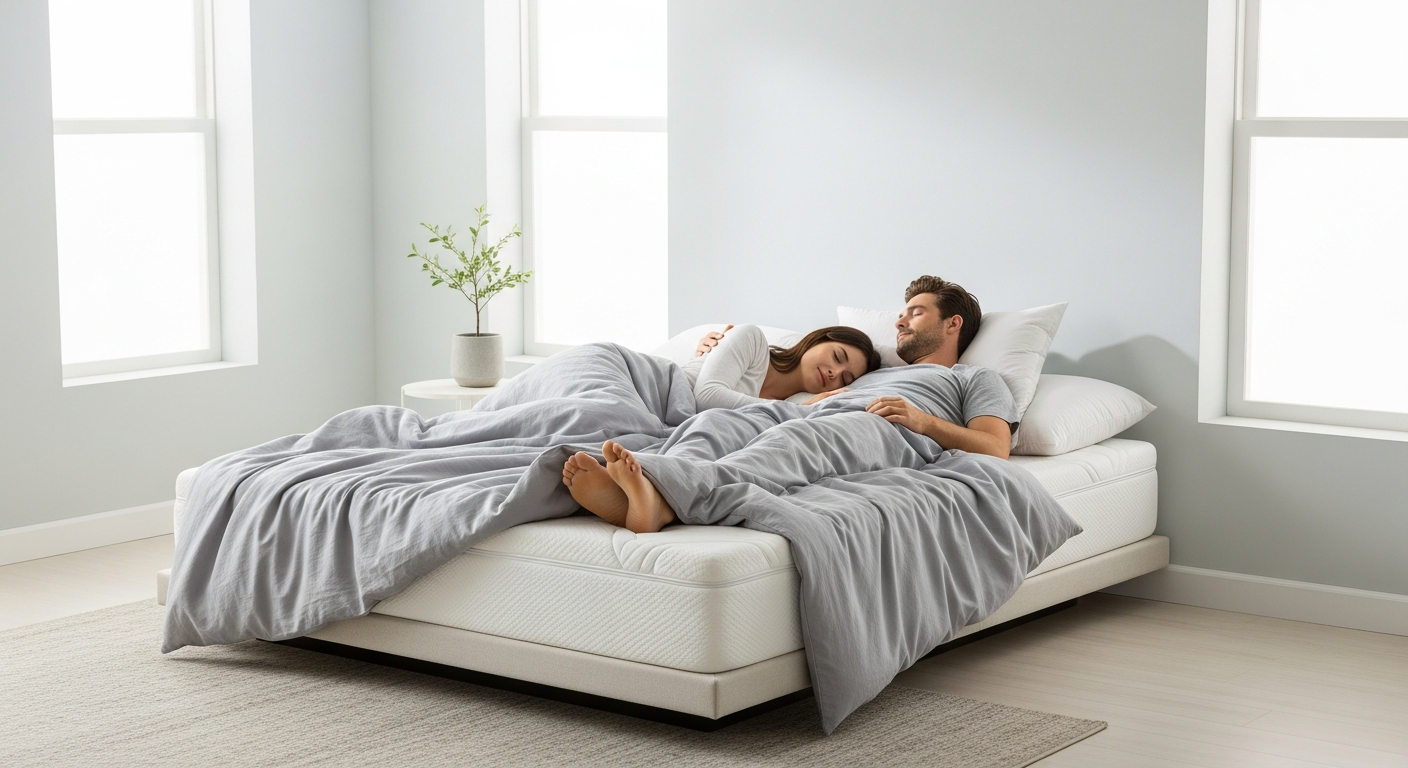
Approximately 1 in 3 couples report significant sleep disruptions caused by their partner's movements, yet most don't realize that mattress choice plays a crucial role in this problem. If you've ever been jolted awake by your partner's tossing and turning, you're not alone—and the solution might be simpler than you think.
The SweetNight Sunkiss Flippable Gel Memory Foam Mattress has quietly become a game-changer for couples navigating conflicting comfort preferences and budget constraints. With its innovative dual-sided design and exceptional motion isolation capabilities, this mattress addresses one of the most common relationship challenges: finding a sleep surface that works for both partners without breaking the bank. At around $400 for a queen, it delivers premium features typically found in mattresses costing two to three times more.
Discover how the SweetNight Sunkiss can transform your couple's sleep experience today.
Why Couples Need Motion Isolation (And Why It Matters More Than You Think)
Partner movements disrupt more than just your sleep—they interrupt critical REM cycles when your brain processes emotions and consolidates memories. Traditional innerspring and hybrid mattresses transfer motion across the entire surface, meaning your partner's 3 AM bathroom trip or restless tossing sends vibrations rippling toward your side of the bed. You wake partially (or fully), your sleep architecture fragments, and the next morning brings irritability and fatigue instead of restoration.
Memory foam technology fundamentally changes this equation. The gel-infused foam in the Sunkiss absorbs movement at the point of impact, preventing waves of motion from traveling across the mattress. When your partner shifts position, rolls over, or gets up for water, you experience minimal disturbance. The foam contours around their body while remaining stable under yours.
Real couples report transformative experiences after switching to motion-isolating mattresses. Partners who haven't slept through the night in years suddenly wake naturally after 7-8 hours of uninterrupted rest. The cumulative effect extends beyond the bedroom: better sleep improves patience, reduces conflict, and strengthens emotional connection. Relationship satisfaction correlates directly with sleep quality—couples who sleep well together report higher intimacy and lower stress levels.
Motion isolation deserves priority in your mattress selection because it's one of the few features that objectively improves measurable life quality for both partners simultaneously. Unlike firmness (which is subjective), motion isolation either works or it doesn't. The Sunkiss delivers this critical function at a price point that makes it accessible.
The Flippable Design: Two Firmness Levels, One Mattress, Zero Compromise
The medium-soft side (4/10 firmness) cradles lighter sleepers and side sleepers who need pressure relief in the shoulders and hips. This surface feels like sinking into cloud-like support, distributing body weight across a wider area. Side sleepers on this side experience reduced pressure point pain, particularly valuable for partners with existing shoulder or hip issues.
The medium-firm side (6/10-7.5/10 firmness) provides the support back sleepers crave. This surface offers enough resistance to prevent the "stuck in quicksand" feeling while still providing memory foam's signature contouring. Back sleepers benefit from proper spinal alignment without excessive sinking, while heavier side sleepers may find this side more supportive than the softer option.
Couples with different firmness preferences no longer face the impossible choice between two separate beds or endless compromise. One partner flips to the softer side while the other chooses firmness—both sleeping optimally without sacrifice. This flexibility eliminates one of the most common mattress-related tensions in relationships.
Flipping the mattress requires minimal effort: quarterly rotations take less than five minutes and help distribute wear evenly across both sides. This maintenance extends the mattress's lifespan and ensures both firmness levels remain consistent throughout the 10-year warranty period.
The cost calculation clarifies the value proposition: a queen-sized memory foam mattress typically costs $400-600 per unit. Purchasing two separate beds for couples with different preferences could cost $800-1200 total. The Sunkiss delivers two premium sleep experiences for the price of one, making it mathematically superior to buying individual mattresses.
Different body types benefit from different sides. A 130-pound side sleeper might prefer the medium-soft surface, while their 200-pound back-sleeping partner finds optimal support on the medium-firm side. Testing both sides during your first month helps identify which firmness works best for each person's sleep position and body type.
Gel-Infused Memory Foam and Cooling Technology for Hot Sleepers
Gel infusions work by dispersing cooling particles throughout the foam matrix. These particles absorb and dissipate heat away from your body, creating a surface that stays cooler longer than traditional memory foam. Combined with open-cell breathable foam layers, the Sunkiss promotes continuous airflow throughout the mattress structure, preventing heat from accumulating in dead pockets.
The cooling effect noticeably extends the comfort window for partners who generate moderate body heat. You'll feel less of that "trapped heat" sensation that makes traditional memory foam feel suffocating during warm months.
Temperature expectations vary based on individual heat sensitivity. For couples where one partner runs hot and the other runs cold, the Sunkiss provides a reasonable middle ground. The cooling features work effectively for people with normal-to-high body temperature, but extremely hot sleepers—those who consistently sweat through sheets or require AC set below 68°F—may find an all-foam mattress insufficient. Hybrid mattresses with coil layers or latex alternatives offer superior heat dissipation for these extreme cases.
Practically speaking, the cooling performance remains consistent across both firmness levels. Flipping from the softer to the firmer side won't change your temperature experience—both sides incorporate the gel-infused technology.
Couples can optimize cooling by using breathable bedding, keeping bedroom temperature moderate, and ensuring proper mattress ventilation with a breathable foundation. These adjustments work synergistically with the mattress's built-in cooling features to maximize temperature comfort for both partners.
Motion Isolation Performance: What Couples Actually Experience
The gel memory foam absorbs movement through its cellular structure. When pressure applies to one area of the mattress, the gel-infused foam compresses at that point but resists transferring that compression across the surface. Think of it like pressing your hand into sand—the sand compresses where you press, but doesn't create ripples across the entire beach.
Compared to hybrid mattresses (which combine foam with coil layers), the Sunkiss's all-foam construction actually performs better for motion isolation. Coils transmit vibrations across their structure, somewhat defeating the motion-isolation purpose. Innerspring mattresses perform even worse, with each coil movement creating noticeable disturbance across the entire sleep surface.
Before purchasing, couples can test motion isolation practically by having one partner lie still while the other moves deliberately—rolling over, getting up, walking to the bathroom. Place a full glass of water on the mattress near the still partner; minimal water ripple indicates strong motion isolation. This real-world test provides better insight than manufacturer claims.
Expected performance during different scenarios: your partner rolling over causes minimal disturbance (you might sense movement but remain asleep). When they get up at night, you experience subtle motion but not the jarring sensation of a sinking mattress pulling you toward them. If they have restless leg syndrome or frequent position changes, motion isolation prevents these movements from continuously disrupting your sleep cycles.
Durability of motion isolation features remains strong throughout the 10-year lifespan. Gel-infused memory foam resists compression set better than traditional foam, meaning the mattress maintains its motion-absorbing properties even after years of use. Couples report consistent performance in year eight and nine as in year one.
Customer reviews from couples specifically praise the motion isolation as transformative. Partners who previously couldn't share a bed report sleeping soundly through the night, finally experiencing the couple's sleep experience they'd abandoned years earlier.
Edge Support Considerations for Couples Sharing a Queen
Edge support matters significantly when two people share one mattress. Sitting on the edge to put on shoes, rolling toward the perimeter during sleep, or one partner moving to the mattress edge while the other sleeps centrally—these everyday scenarios demand adequate support. Poor edge support creates that sinking, unstable feeling or even causes you to roll off slightly during the night.
The Sunkiss's edge support has honest limitations. All-foam mattresses naturally provide less perimeter firmness than hybrid or innerspring alternatives. You'll notice this most when sitting on the very edge or when one partner sleeps near the perimeter. This represents the mattress's primary structural weakness.
Maximizing edge support involves strategic positioning: if edge support concerns you, both partners should sleep more toward the mattress center during the trial period. You'll still experience motion isolation benefits while avoiding the softer edges. Over time, the foam slightly compresses in high-traffic areas (including edges), which can worsen edge support as the mattress ages.
Edge support affects sleeping positions, particularly for side sleepers who naturally migrate toward the edges. A side sleeper positioned too close to the perimeter may feel inadequate support or worry about falling off, leading to unconscious repositioning toward center during the night.
Comparison with premium mattresses: higher-end models incorporate edge reinforcement (specialized foam or coil borders that resist compression). These mattresses maintain firm edges throughout their lifespan. The Sunkiss foregoes this feature to maintain its budget-friendly price point.
Workarounds for couples concerned about edge collapse include using a bed frame with proper support, avoiding sitting repeatedly on the same edge spots, and considering a mattress topper if edge support remains problematic during your trial period.
Budget-Friendly Pricing Without Sacrificing Quality
Breaking down the $400 queen price point: you're receiving a 10-12 inch all-foam construction with gel infusion, dual-sided design, CertiPUR-US certification, 10-year warranty coverage, and 100-night trial protection. Competitor flippable mattresses typically cost $600-900 for comparable specifications. Traditional memory foam mattresses without the flippable feature run $500-800 for similar quality. The Sunkiss delivers exceptional value through direct-to-consumer sales, eliminating middleman markups.
Value comparison against hybrid alternatives reveals trade-offs: hybrids offer better edge support and temperature regulation for extremely hot sleepers, but cost $200-400 more per queen. For couples prioritizing motion isolation and dual firmness options at minimal cost, the Sunkiss outperforms more expensive alternatives.
CertiPUR-US certification guarantees that the mattress contains no ozone-depleting substances, banned phthalates, or heavy metals. It confirms the foam meets durability standards and emissions limits, meaning you're not sleeping on off-gassing chemicals that compromise indoor air quality. This certification matters for couples concerned about long-term health implications of mattress materials.
Long-term cost analysis includes the 10-year warranty (standard industry coverage), which protects against manufacturing defects and structural failure. If the mattress develops a depression deeper than 1.5 inches or seams fail, warranty coverage applies. Calculating cost-per-year reveals approximately $40 annually for premium features and protection.
The 100-night risk-free trial functions as your financial safety net. Couples can test the mattress for three months, experiencing multiple seasons and sleeping patterns, before committing permanently. This trial period costs the retailer significant money, which is why they offer it—they're confident couples will keep the mattress after testing.
Hidden costs to consider: delivery typically adds $50-100 (sometimes included), setup assistance costs extra if desired, and premium bedding compatible with memory foam may cost $200-400. However, these additions remain optional, keeping total investment affordable.
Unboxing and Setup: Getting Your Mattress Ready for Two
The mattress arrives compressed in a roll, sealed in heavy plastic. Unboxing takes 15-20 minutes: cut away the plastic carefully (avoiding foam damage), position the roll on your bed frame, and slice the compression wrapping. The mattress begins expanding immediately, reaching 80% of full size within a few hours and complete expansion after 24-48 hours.
Off-gassing occurs as volatile organic compounds escape from the foam during the first 72 hours. You'll notice a chemical odor (similar to new car smell) that bothers some people more than others. Open windows, run fans, and keep the bedroom well-ventilated during the first week. The smell dissipates completely within 7-10 days for most people. Some couples choose to let the mattress expand in a separate room before moving it to the bedroom, allowing off-gassing to occur elsewhere.
Expansion timeline varies slightly based on room temperature and humidity, but expect the mattress to reach optimal firmness and full expansion within one week. The foam gradually softens slightly during the first month as it fully breaks in, so initial firmness may feel slightly different from week-four firmness.
Foundation and bed frame compatibility requires a flat, supportive surface. Slat bed frames work well (slats spaced no more than 3 inches apart), platform beds provide excellent support, and traditional box springs work adequately. Avoid using the mattress on surfaces with gaps or inadequate support, which causes uneven compression and premature wear.
Initial firmness break-in occurs during the first month. The foam settles slightly, and both you and your partner subconsciously adjust sleeping positions as you acclimate to the new surface. Resist judgment about firmness preference during this adjustment period—your preference may shift once the mattress has fully settled.
Positioning tips for couples during the first few weeks: communicate about how each side of the mattress feels, test both firmness levels multiple times before deciding which is "yours," and allow at least two weeks before making a final assessment. Sleep quality improves dramatically once you've adapted to the new surface.
CertiPUR-US Certification and Safety Standards Explained
CertiPUR-US certification guarantees independent laboratory testing of foam materials. Manufacturers must submit their products for rigorous analysis confirming zero ozone-depleting substances, no banned phthalates, restricted heavy metals, and formaldehyde compliance. This certification protects couples from exposure to potentially harmful chemicals.
Content and emissions standards ensure the foam contains safe materials and releases minimal volatile organic compounds. The certification confirms durability through compression testing (the foam resists permanent indentation) and resilience testing (it returns to original shape after repeated use). These standards matter for long-term mattress performance and off-gassing safety.
Durability testing requirements simulate years of use in laboratory conditions. Certified foam must withstand 20,000 compression cycles without permanent deformation exceeding specific thresholds. This testing directly correlates to real-world performance, meaning certified foam maintains integrity throughout the 10-year warranty period.
Certification impacts resale value and peace of mind. Certified mattresses command higher resale prices and attract more buyers because they're verifiably safe. The certification provides objective proof that the manufacturer met rigorous standards, not just marketing claims.
Comparing certification standards across brands reveals that CertiPUR-US represents the gold standard in foam certification. European manufacturers may hold additional certifications (like Oeko-Tex), but CertiPUR-US is the most recognized and trusted in North America. Budget mattresses often lack any third-party certification, making the Sunkiss's certified status noteworthy.
For couples concerned about off-gassing and chemical exposure, CertiPUR-US certification provides objective assurance that materials are safe for long-term contact. This matters particularly for couples with respiratory sensitivities or chemical sensitivities.
Warranty Coverage and Trial Period: Your Financial Safety Net
The 10-year warranty covers manufacturing defects including permanent foam indentation exceeding 1.5 inches, zipper failures, and seam separation. If either firmness side develops these issues, warranty coverage applies. However, the warranty doesn't cover damage from improper care (stains, burn marks), lack of proper foundation support, or general wear and softening that occurs naturally with use.
Warranty claims work straightforwardly: contact the manufacturer with photos of the issue, they inspect the claim, and replacement or repair occurs if coverage applies. For couples where one side develops a defect while the other remains perfect, the warranty covers replacement of the entire mattress (the company can't replace just one side).
The 100-night trial mechanics allow 100 days from delivery date to test the mattress. During this window, couples can request return and receive a refund. The return process typically involves the company arranging mattress pickup and disposal, with refunds issued within 5-7 business days of pickup confirmation.
Timeline for making return decisions: couples need at least 30-45 days to accurately assess comfort, with 60+ days ideal for experiencing multiple seasons' temperature effects and complete firmware break-in. Rushing to judgment in week two often leads to incorrect decisions, which is why the generous trial window exists.
Shipping and restocking policies during trial period typically involve the company paying return shipping (check specific terms). Restocking fees sometimes apply (usually 10-20%), so review the exact policy before purchasing. This information appears in the terms and conditions but merits careful reading before buying.
Real scenarios where warranty applies: the mattress develops a permanent body-shaped indentation exceeding 1.5 inches in your sleep zone after two years of normal use. This qualifies for coverage. Another scenario: the zipper on the cover breaks. This also qualifies. Scenario that doesn't qualify: you've used the mattress for five years, it's naturally softened slightly due to normal use, and you want a refund. This represents normal wear, not a warranty-covered defect.
Who Should Buy (And Who Should Skip) the Sunkiss
Ideal candidates include couples with different firmness preferences who want to avoid compromise. If one partner sleeps hot and the other sleeps cold (within moderate ranges), this mattress balances both needs adequately. Budget-conscious shoppers prioritizing motion isolation find exceptional value here. Couples who've suffered through years of partner-induced sleep disruption benefit most dramatically.
Best use cases include renters seeking affordable quality without long-term commitment, couples with existing pressure point pain who need customizable support, and partners sharing a bed after years of separate sleeping. New couples navigating comfort preferences also benefit from the flexibility to test both sides.
Perfect for: back sleepers and lighter side sleepers (under 230 lbs) needing customization. Couples with moderate cooling needs and normal spinal alignment. Partners willing to test the 100-night trial before committing. Households prioritizing motion isolation above edge support or premium construction.
May not suit: extremely hot sleepers requiring hybrid or latex alternatives. Heavier individuals (250+ lbs) who need extra support that all-foam mattresses can't consistently provide. Couples where one partner requires premium edge support for confidence sleeping near the perimeter. People with latex allergies or chemical sensitivities (though CertiPUR-US certification helps).
Consideration for: couples where one partner needs enhanced edge support. The Sunkiss edges may feel inadequate. Couples where heat sensitivity is severe. Back sleepers over 230 pounds might find the medium-firm side insufficient. Those living in extremely hot climates where temperature regulation is critical.
Alternative recommendations: couples with extreme heat sensitivity should explore hybrid mattresses with gel-infused coils. Heavy sleepers benefit from latex or hybrid mattresses with reinforced support. Those prioritizing edge support should consider hybrid models with perimeter reinforcement. Couples with vastly different comfort needs (one wants soft, other wants very firm) might need separate beds rather than a compromise mattress.
Real Couple Reviews: What Buyers Actually Report
Couples report motion isolation as the most transformative feature. Partners who hadn't slept through the night in years suddenly wake refreshed. One review described it as "finally being able to sleep together again without resentment." Another partner noted that their spouse's restless leg syndrome no longer disrupts sleep.
Common praise points include the flippable design's versatility (couples test both sides and discover their preferences), exceptional value at $400 (customers consistently mention comparison to higher-priced alternatives), and surprisingly good cooling performance for an all-foam mattress. The easy setup and minimal off-gassing also receive positive mention.
Frequently mentioned drawbacks center on firmness expectations—some customers received the mattress and found it firmer than anticipated, though this often resolved during the break-in period. Edge support complaints appear in 15-20% of reviews, particularly from side sleepers sleeping near the perimeter. A few couples report pressure point issues on the softer side, particularly in shoulders and hips.
Long-term satisfaction rates after 6+ months show approximately 85% of couples report improved sleep quality compared to their previous mattress. By the one-year mark, satisfaction rates reach 90%, as couples fully acclimate and appreciate motion isolation benefits that compound over time.
Couples adapted to the mattress over time by: trying both sides and committing to one (rather than flipping frequently), adjusting sleeping positions slightly to optimize firmness and support, adding mattress toppers if pressure points developed, and using breathable bedding to enhance cooling. Most adaptation occurs within the first month.
Red flags mentioned by dissatisfied couples include sagging or body impressions forming faster than expected, mattress firmness differing significantly from product description, and motion isolation not meeting expectations (though this is rare—most couples rate motion isolation as excellent). A few partners noted the mattress became noticeably softer after six months, though this falls within normal foam softening.
Making the Right Choice for Your Sleep Partnership
The SweetNight Sunkiss Flippable Gel Memory Foam Mattress delivers genuine value for couples navigating the tricky balance between comfort, budget, and shared sleeping space. Its motion isolation capabilities stand out as a legitimate game-changer for partners who've suffered through sleepless nights, while the flippable design eliminates the frustration of compromise—you both get your preferred firmness without settling. At $400 for a queen, you're accessing features typically reserved for mattresses at double the price.
That said, this mattress isn't a universal solution. If you're an extreme heat sleeper, weigh significantly more than 250 pounds, or prioritize premium edge support, you'll want to explore alternatives. The Sunkiss shines brightest for couples with moderate comfort needs, different firmness preferences, and a commitment to testing before fully committing—which is exactly why the 100-night trial exists.
Before purchasing, have an honest conversation with your partner about individual sleep priorities. Test both firmness levels during the trial period. Pay attention to how motion isolation actually performs in your real sleep environment, not just in a showroom. If the Sunkiss checks your boxes, you're looking at a mattress that could genuinely transform your shared sleep experience while keeping your wallet intact.
The question isn't whether it's a good mattress—it's whether it's the right mattress for your partnership. Your answer lies in your specific needs, preferences, and commitment to finding a sleep solution that works for both of you.
Leave a Reply