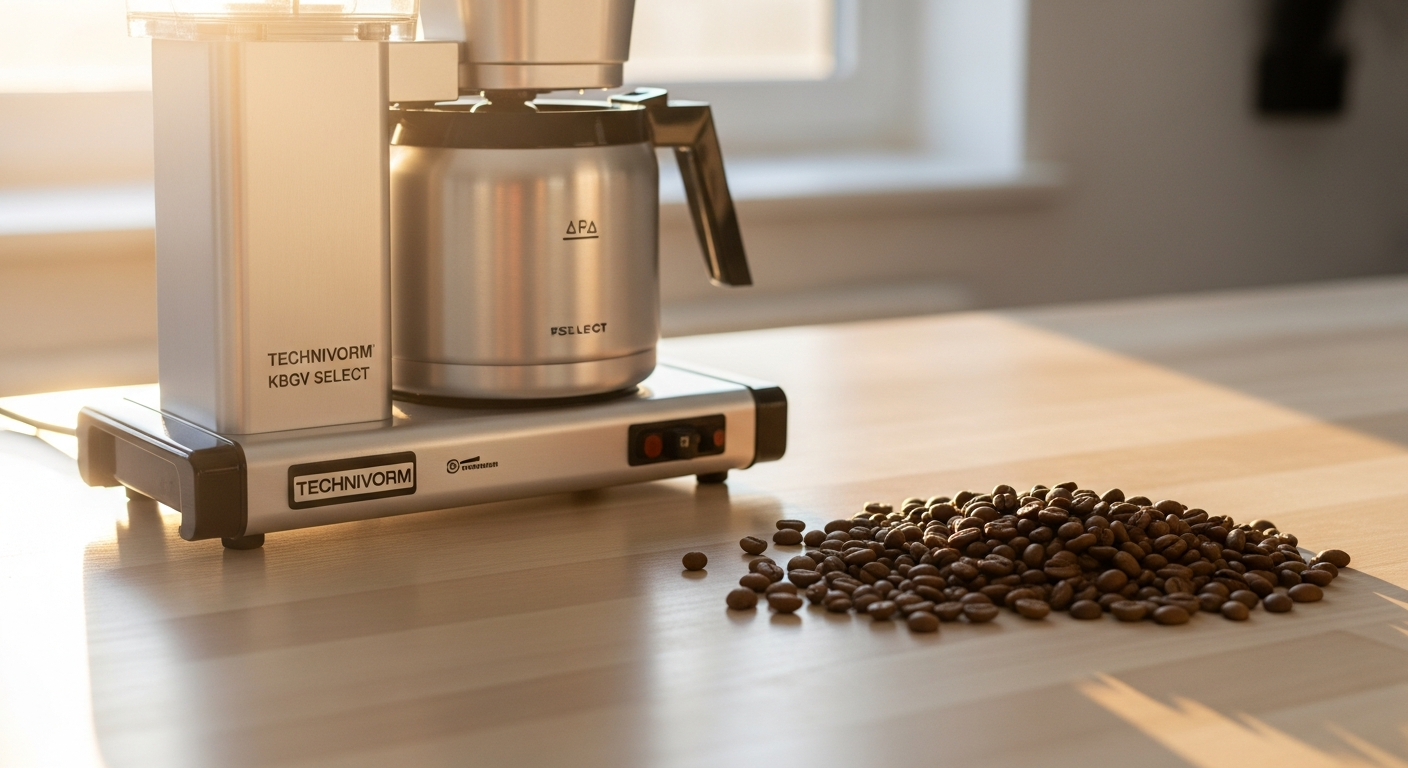
The Specialty Coffee Maker That Sets Professional Standards
The specialty coffee industry has exploded over the past decade, yet 73% of coffee shops still struggle to maintain consistent cup quality across their morning rush. That's a massive problem when your reputation depends on every single pour. The Technivorm Moccamaster KBGV Select stands apart because it's engineered specifically for professionals who refuse to compromise on extraction.
Handcrafted in the Netherlands and certified by the Specialty Coffee Association, this machine meets rigorous brewing standards that most competitors simply don't pursue. It's not just a coffee maker; it's a precision instrument that translates quality beans into exceptional cups, day after day.
This guide breaks down exactly why specialty coffee operations choose the Moccamaster, from its SCA certification and temperature precision to its practical advantages for high-volume brewing. You'll also understand the trade-offs and whether this premium investment aligns with your operation's goals.
Explore the Moccamaster KBGV Select on Coffeemakers.de today.
SCA Certification and What It Means for Your Coffee Program
What the SCA certification actually verifies and why it matters for specialty coffee operations
The Specialty Coffee Association certification isn't a marketing badge—it's a rigorous validation of brewing science. The SCA establishes specific standards for water temperature, contact time, turbulence, and saturation that separate precision brewing equipment from ordinary drip machines. When a machine earns SCA certification, it has been independently tested and proven to extract coffee within parameters that optimize flavor while minimizing defects.
How the Moccamaster's copper heating element meets SCA temperature requirements
The Moccamaster's copper heating element maintains water temperature between 196°-205°F (91°-96°C) throughout the entire brew cycle. This narrow range is critical because temperatures below 195°F produce under-extracted coffee with sour notes, while temperatures above 205°F cause over-extraction and bitter flavors. Copper conducts heat efficiently and recovers temperature quickly when cooler water passes through, ensuring stability that aluminum alternatives struggle to achieve.
Comparison of SCA-certified machines versus uncertified alternatives in the premium market
Most drip coffee makers operate without SCA testing or validation. They may produce acceptable coffee, but they operate without documented evidence that their brewing parameters meet extraction standards. SCA-certified machines like the Moccamaster undergo third-party testing that verifies their performance metrics. This distinction matters significantly in professional environments where consistency is non-negotiable.
How certification impacts customer perception and willingness to pay for specialty coffee
Customers who understand specialty coffee recognize SCA certification as a mark of quality commitment. When they see this certification displayed prominently, they understand that the café invested in equipment specifically designed to honor their beans. This perception supports premium pricing and customer loyalty. People pay more for products they trust.
The role of third-party validation in building trust with discerning coffee drinkers
Third-party certification removes guesswork from equipment selection. Rather than relying on manufacturer claims or marketing hype, café owners and roasters can point to independent testing standards. This transparency builds credibility with customers who've experienced poor coffee and recognize when equipment genuinely makes a difference.
Why roasters use SCA certification as a selling point when recommending equipment to cafés
Coffee roasters who work with specialty cafés often recommend SCA-certified brewing equipment because it gives their beans the best chance to express intended flavors. A roaster's reputation depends on the final cup quality, which means they have a vested interest in equipment that performs reliably. When roasters recommend the Moccamaster, they're essentially endorsing it as equipment worthy of their product.
Precision Brewing Technology That Transforms Bean Quality into Cup Quality
The 9-hole spray arm design and how it ensures even ground saturation for balanced extraction
The Moccamaster features a unique 9-hole spray arm that distributes water evenly across the coffee bed. This design prevents channeling—a common problem where water finds paths of least resistance and flows through some grounds while bypassing others. When water distribution is uneven, some grounds extract fully while others extract too little, creating an unbalanced flavor profile. The spray arm's geometry ensures that every coffee particle receives consistent water contact.
How consistent temperature maintenance throughout the brew cycle prevents under- or over-extraction
As water passes through coffee grounds, it cools slightly. Most machines allow this temperature drop to continue unchecked, resulting in inconsistent extraction across the brewing window. The Moccamaster's copper heating element continuously monitors and adjusts water temperature, maintaining the optimal range throughout the 4-6 minute cycle. This consistency prevents the sour notes of under-extraction and the bitterness of over-extraction.
The copper heating element's role in rapid heat-up and stability compared to aluminum alternatives
Copper's superior thermal conductivity means the Moccamaster reaches optimal brewing temperature faster than machines using aluminum heating elements. Additionally, copper's heat capacity allows it to recover temperature more quickly when cooler water flows through, maintaining stability that aluminum simply cannot match. This technical advantage directly impacts the final cup quality.
Extraction science: why precision matters more than speed in specialty coffee brewing
Specialty coffee extraction is about time, temperature, and turbulence working in harmony. A machine that brews quickly but inconsistently produces worse coffee than one that brews slowly and precisely. The Moccamaster's approach prioritizes extraction science over speed benchmarks. Its 4-6 minute brew cycle allows full flavor extraction without rushing the process.
Real-world impact on flavor profile: what roasters notice when switching to precision brewing
Roasters accustomed to working with precise brewing equipment report that switching to the Moccamaster reveals subtle flavor notes that standard drip machines mask. Single-origin coffees show clearer geographic character. Seasonal offerings display intended complexity. The machine doesn't add flavor—it removes the barriers preventing flavor from reaching the cup.
How the brew-pause function enables quality control checks mid-cycle
The brew-pause function allows baristas to pour a cup mid-brew without disrupting the brewing process. This capability serves multiple purposes: it enables quality checks that catch brewing problems early, it builds engagement when customers observe the brewing process, and it accommodates customers who want coffee immediately while preserving the remainder of the batch's brewing time.
Find the Moccamaster KBGV Select at competitive prices on Coffeemakers.de.
Operational Flexibility for Specialty Coffee Shops and Roasteries
The selector switch for full or half carafe brewing and its advantage for specialty operations
The selector switch allows operators to choose between brewing a full 10-cup carafe or a half carafe of 5 cups. This flexibility directly addresses waste reduction in specialty operations. During slow periods, brewing a half carafe ensures coffee stays fresher longer. For roasteries running tasting sessions, half-batch brewing accommodates smaller groups without forcing larger volumes. For single-origin rotations, operators can brew smaller quantities as they transition between coffees.
How smaller batch options reduce waste during slow periods or custom order fulfillment
Specialty coffee operations often prioritize freshness over volume. A busy café might brew a full carafe every 20 minutes during peak hours, but operating the same schedule during slow periods creates waste. The half-carafe option allows operators to match brewing volume to actual demand, reducing the number of cups dumped at the end of the shift.
The 1.25-liter capacity and 4-6 minute brew time in context of café workflow demands
The 1.25-liter (40-ounce) capacity produces 10 cups in approximately 4-6 minutes. For specialty cafés where most customers order single cups, this timing fits naturally into the café's workflow rhythm. A barista can complete a pour-over or espresso drink while the Moccamaster finishes its cycle, with freshly brewed coffee ready just as the previous batch approaches its consumption window.
Integration with specialty brewing protocols: single-origin rotations, seasonal offerings
Many specialty cafés rotate single-origin coffees or feature seasonal offerings, sometimes changing what's available weekly or even daily. The Moccamaster's straightforward operation—no programmable memory or complex settings to reprogram—makes these transitions simple. A barista can switch from a Ethiopian natural to a Colombian washed process without adjusting equipment settings. The machine's precision ensures each coffee expresses as intended.
The brew-pause function for quality checks and customer engagement during brewing
The brew-pause function serves operational purposes beyond convenience. A barista can check that grounds are saturating properly, observe color development, and ensure the spray arm is functioning correctly. This hands-on involvement creates opportunities for customer engagement—baristas can explain the brewing process and invite customers to observe quality being built into their cup.
Why operational simplicity matters when training baristas on equipment
Equipment complexity creates training overhead and increases the likelihood of operator error. The Moccamaster's straightforward operation—fill the reservoir, insert filter, select carafe size, press start—means new baristas can learn the equipment quickly and operate it reliably. This simplicity reduces mistakes and ensures consistency across different team members.
Durability and Long-Term Cost Analysis for Professional Environments
Metal housing construction and BPA-free materials designed for daily professional use
The Moccamaster's metal housing withstands the demands of professional environments better than plastic-heavy alternatives. Daily use, transport to different locations, and the cumulative wear of intense use cycles all take tolls on equipment. Metal construction provides structural integrity that plastic housings cannot match. The use of BPA-free materials ensures the machine meets modern standards for food contact safety and durability.
Expected lifespan and maintenance requirements compared to consumer-grade machines
The Moccamaster is designed for a 10+ year lifespan in professional use environments. This longevity dramatically impacts total cost of ownership. A consumer-grade machine purchased for $100 might last 2-3 years before requiring replacement. The Moccamaster costs more upfront but operates reliably for far longer, spreading its investment across many more cups of coffee.
How the robust build justifies the $300-$370 price point through reduced replacement cycles
The premium price reflects engineering quality and durability. A café that replaces cheaper machines every 2-3 years accumulates equipment costs that rival or exceed the single Moccamaster investment. When viewed across a 10-year timeline, the Moccamaster's higher initial cost becomes economical compared to the cumulative expense of replacing inferior equipment multiple times.
Warranty considerations and parts availability for specialty coffee operations
The Moccamaster includes manufacturer warranties that cover defects in materials and workmanship. More importantly, replacement parts are readily available from specialty coffee equipment suppliers. The heating element, spray arm, glass carafe, and other components can be purchased and installed if needed. This parts availability ensures the machine remains serviceable rather than disposable.
Heat plate auto-shutoff after 90-100 minutes and its role in energy efficiency and safety
The automatic shutoff after 90-100 minutes serves multiple purposes. It prevents coffee from being overheated or left warming indefinitely, which would degrade flavor in remaining coffee and waste energy. From a safety perspective, an unattended heating plate poses fire risk, and automatic shutoff mitigates this concern. Energy efficiency also reduces operational costs across the machine's lifespan.
Repair costs and ease of servicing when issues arise
When repairs become necessary, the Moccamaster's straightforward design and available parts make servicing cost-effective. Technicians familiar with specialty coffee equipment can diagnose and repair common issues without extensive troubleshooting. This serviceability contrasts with some automated machines where minor failures require returning the unit for manufacturer service.
When the Moccamaster Fits Your Operation (and When It Doesn't)
Lack of programmable timer features and how this affects pre-opening preparation routines
The Moccamaster requires manual operation—you fill it, set the selector, and press start. It doesn't offer programmable timers that allow automatic brewing at preset times. For café operators hoping to arrive to fresh coffee already brewed, this limitation requires adjustment. Pre-opening routines must include five minutes for manual brewing rather than relying on a timer-activated system.
Proprietary filter requirements and workarounds using standard cone filters
The Moccamaster uses proprietary filter baskets sized to its specific design. However, specialty coffee operators have discovered that standard cone filters can often be adapted. This workaround expands filter options and sourcing flexibility, though the proprietary setup remains slightly limiting compared to machines using universal filter types.
Manual operation and why some operations prefer fully automated systems
Some high-volume operations prefer fully automated brewing systems where equipment manages the entire process from water heating through dispensing. The Moccamaster's manual operation appeals to craft-focused operations but may frustrate those seeking maximum automation. This represents a fundamental philosophical difference in how operators approach coffee preparation.
Ideal scenarios: specialty shops, roasteries, and small-batch coffee programs
The Moccamaster excels in environments where quality and precision take priority over volume and convenience. Specialty coffee shops that source exceptional beans, roasteries that conduct cuppings, and small-batch programs that rotate offerings find the Moccamaster's capabilities perfectly aligned with their priorities. The machine rewards attention and consistency.
Less ideal scenarios: high-volume chains needing pre-programmed brewing or advanced automation
High-volume chains operating multiple locations need equipment that minimizes training variation and operator error through automation. If your operation requires coffee ready at specific times without staff intervention, or if you operate high-volume locations where consistency demands are met through equipment automation rather than operator skill, the Moccamaster's manual operation becomes a liability rather than an asset.
Design aesthetics and how minimalist styling fits or clashes with different café environments
The Moccamaster features minimalist, sleek design available in various colors. This aesthetic suits modern, design-forward café environments and aligns with specialty coffee culture's emphasis on simplicity and craft. However, cafés with different design philosophies—industrial, vintage, heavily automated—might find the Moccamaster's styling less compatible with their brand identity.
The Investment Perspective: Premium Pricing and Return on Quality
Why the $300-$370 price tag positions the Moccamaster as a premium tool, not a commodity
The price range reflects the machine's position at the quality end of the professional coffee equipment spectrum. Unlike commodity drip machines where cheaper competitors barely function differently, the Moccamaster's premium pricing correlates directly with measurable performance advantages: precise temperature control, SCA certification, handcrafted construction, and durability. The cost reflects genuine engineering and quality rather than brand markup.
Cost per cup analysis when accounting for reduced waste and improved extraction efficiency
Consider the cost per cup across the machine's lifespan. A Moccamaster costing $350 that brews 15,000 cups over ten years costs approximately $0.023 per cup in equipment expense. A cheaper $100 machine that lasts two years and brews 6,000 cups costs $0.017 per cup—initially cheaper until you purchase the second unit. Factor in improved extraction efficiency that reduces waste due to inferior brewing, and the Moccamaster's true cost per cup becomes advantageous.
How superior taste consistency drives customer loyalty and repeat purchases
Customers return to cafés where they experience consistently excellent coffee. The Moccamaster's precision ensures that the coffee quality remains predictable across weeks and months. Customers develop confidence that they'll receive the same excellent experience next week as they did today. This consistency builds loyalty that translates to increased repeat purchases and customer lifetime value.
Comparison of total cost of ownership against cheaper alternatives that require frequent replacement
Total cost of ownership accounts for purchase price, maintenance, repairs, and replacement frequency. A café might compare a $350 Moccamaster against a $120 consumer-grade machine. However, if the consumer machine requires replacement every two years, purchasing four units over an eight-year period costs $480 before accounting for downtime from failures and the inconsistency across different units. The Moccamaster's single purchase operating reliably across the same timeline presents dramatically lower total cost.
The psychological value of SCA certification and handcrafted quality in customer communications
When customers understand that equipment is SCA-certified and handcrafted in the Netherlands, they perceive higher value in the coffee they're purchasing. These details support premium pricing strategies. A café can explain to customers why its coffee costs more: not just because of bean quality, but because the equipment respects that quality through precision brewing. This transparency justifies premium pricing.
Real-world examples of how specialty operations recoup their investment through improved margins
Specialty coffee operations that invested in Moccamaster equipment consistently report improved margin profiles. By eliminating waste from poor extraction and customer dissatisfaction with inconsistent coffee, they reduce costs while supporting higher prices through perceived quality. A café might sell 20% more cups at premium pricing after upgrading to the Moccamaster, recouping the equipment investment within the first year of operation.
The Moccamaster as a Competitive Advantage
Choosing the Technivorm Moccamaster KBGV Select isn't just about owning a coffee maker—it's about committing to a standard. For specialty coffee roasters and café operators who've invested in sourcing exceptional beans, the Moccamaster ensures those beans reach the cup exactly as intended. The SCA certification, precision temperature control, and thoughtful design eliminate variables that would otherwise compromise your product.
Yes, the upfront cost stings. Yes, you won't get programmable timers or flashy automation. But every morning when you brew a consistently excellent cup, when customers notice the difference and return for more, when your beans shine through without extraction errors—that's when the investment pays dividends.
The Moccamaster doesn't chase trends or promise shortcuts. It delivers what specialty coffee demands: reliability, precision, and respect for the craft. If your operation prioritizes quality over convenience, if your customers can taste the difference, if consistency matters more than cutting corners—the Moccamaster belongs in your workflow.
Leave a Reply