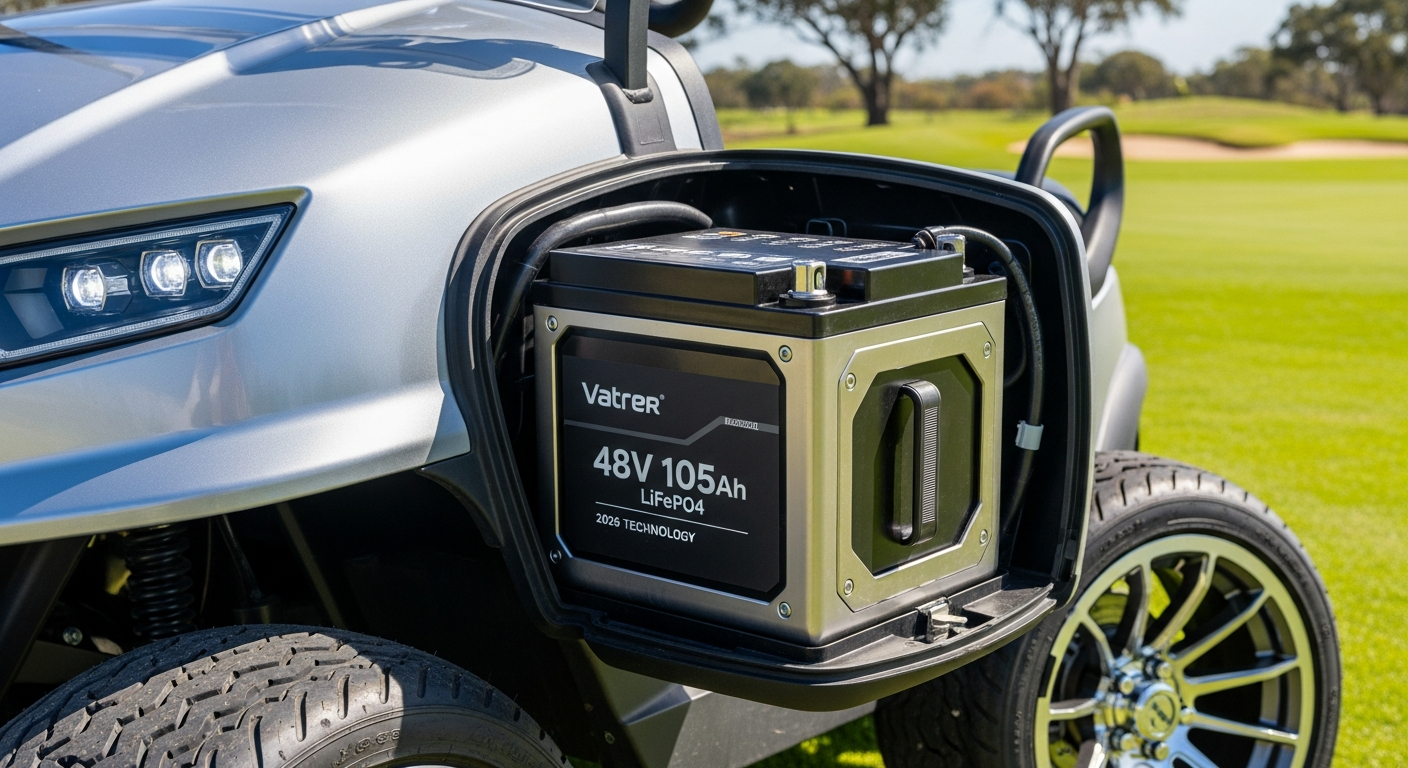
If your golf cart battery dies mid-round, you're left with a dead weight and a long walk back to the clubhouse. The timing is invariably terrible—you're halfway through your best game of the season, or you're hosting clients on what should've been an impressive outing. Traditional lead-acid batteries create this exact scenario because they degrade rapidly, demand constant maintenance, and lose power precisely when you need it most.
The Vatrer 48V 105Ah LiFePO4 battery fundamentally changes this dynamic. Built with military-grade lithium chemistry and refined through hundreds of thousands of real-world installations, this system delivers consistent power for thousands of rounds without the maintenance burden that makes lead-acid batteries such a hassle. The technology has proven itself across golf courses worldwide.
This guide examines the technical specifications that set the Vatrer apart, shows how it performs against conventional batteries, and explains why over 500 verified customers awarded it a 4.86/5 rating. You'll understand the engineering decisions that enable 4,000+ cycles of reliable operation, the practical benefits you'll experience on the course, and whether the investment aligns with your golf cart needs.
Explore the Vatrer 48V 105Ah LiFePO4 battery and upgrade your golf cart's performance today.
Engineering Excellence — What Makes the Vatrer 48V 105Ah Stand Apart
EVE Grade A Prismatic LiFePO4 Cells
The foundation of any lithium battery is its cell quality. Vatrer selected EVE's Grade A Prismatic cells specifically for their consistency and longevity. These aren't commodity-grade components—they're engineered to maintain performance across thousands of charge cycles while resisting the gradual capacity fade that compromises cheaper alternatives. The prismatic form factor offers superior thermal management compared to cylindrical cells, meaning heat dissipates more efficiently during high-demand situations like accelerating uphill or rapid charging.
200A Built-in Battery Management System
A sophisticated BMS protects against the failure modes that destroy batteries. The 200A system monitors voltage, temperature, and current flow in real time, preventing overcharging scenarios that would catastrophically damage lithium cells. It also protects against dangerous over-discharge conditions and temperature fluctuations that occur during cold-weather play or extended summer heat. This isn't a basic protection circuit—it's an intelligent system that actively manages conditions to preserve battery health across its entire lifespan.
5,736Wh Energy with 10,240W Peak Power
The numbers translate directly to on-course capability. 5,736Wh of energy capacity provides sufficient juice for complete 18-hole rounds without the gradual voltage sag you experience with aging lead-acid batteries. The 10,240W peak power output matters when you need immediate response—accelerating from a stop, climbing inclines, or powering multiple accessories simultaneously. This combination ensures your cart doesn't lose pep as the battery discharges.
Rugged SPCC Metal Casing
Golf courses expose batteries to vibrations, temperature swings, and moisture. The SPCC metal casing provides structural rigidity and environmental protection that plastic housings can't match. It withstands the constant bouncing of rough terrain without cracking or warping, and the metal construction dissipates heat more effectively than plastic alternatives, contributing to the overall thermal management strategy.
4,000+ Cycle Lifespan
This specification separates genuine lithium from pretenders. A 4,000-cycle lifespan translates to 8-10 years of reliable service under typical golf cart usage patterns. Compare that to lead-acid batteries, which typically deliver 500-1,000 cycles before capacity degrades to unusable levels (typically 3-5 years in practice). The longer lifespan means fewer replacement cycles, lower long-term costs, and the peace of mind that comes from knowing your battery won't fail during critical moments.
Low-Temperature Cutoff Protection
Cold-weather golf presents challenges for any battery. The built-in low-temperature cutoff prevents charging and discharging operations when ambient temperatures drop below safe thresholds, protecting the cells from damage that occurs when lithium chemistry operates in extreme cold. This means winter play remains reliable without sacrificing accessibility or requiring special procedures.
Performance Metrics That Matter on the Course
Rapid Charging Capability
Lead-acid batteries demand 8-12 hours to charge completely, effectively killing your day if you need a quick top-up between rounds. The Vatrer charges in 2-4 hours, meaning you can play 18 holes, charge during lunch, and complete another full round before sunset. Tournament players gain obvious advantages, but even recreational golfers appreciate never waiting around for adequate charge.
Consistent Voltage Delivery
Lead-acid batteries exhibit voltage sag as they discharge—your cart runs noticeably slower on hole 18 than on hole 1. The Vatrer maintains stable 48V output throughout the discharge cycle, meaning your cart delivers the same acceleration and hill-climbing power regardless of battery state. This consistency eliminates the frustration of diminishing performance mid-round.
Weight Reduction Benefits
Lithium batteries weigh substantially less than equivalent lead-acid systems. This lighter load improves cart acceleration, reduces suspension strain, and can even extend the life of drivetrain components by lowering mechanical stress. You won't notice the weight difference in everyday operation, but you'll feel the improved responsiveness and efficiency.
Range Extension
Full power delivery for complete 18-hole rounds eliminates range anxiety. You won't find yourself moderating speed to stretch battery life or worrying about whether you have enough juice to reach the clubhouse. The Vatrer delivers full-throttle capability from hole 1 through hole 18.
Zero Maintenance Requirements
Lead-acid batteries demand weekly watering, regular terminal cleaning to remove corrosion, and periodic equalization procedures. The Vatrer operates maintenance-free—no watering, no corrosion cleaning, no special procedures. Install it and forget about it. This alone justifies the upgrade for owners tired of battery maintenance routines.
Real-Time Monitoring via Bluetooth App
Smartphone integration lets you track state of charge, temperature, and health diagnostics from your pocket. You can verify the battery is properly charged before leaving the clubhouse, monitor performance during play, and identify potential issues before they become problems. This technological integration appeals to owners who value data-driven optimization.
Head-to-Head Comparison: Lithium vs. Lead-Acid Golf Cart Batteries
The comparison between these technologies reveals why lithium has become the industry standard for serious golf cart owners:
Lifespan advantage — The Vatrer delivers 4,000+ cycles (8-10 years) versus 500-1,000 cycles for lead-acid batteries (3-5 years). Your battery outlasts your willingness to use the current cart.
Maintenance burden — Zero upkeep for LiFePO4 versus the weekly watering, terminal maintenance, and equalization procedures that consume time and frustration. Calculate the hours you'll save over the battery's lifespan.
Power consistency — The Vatrer maintains peak performance throughout discharge while lead-acid batteries experience gradual voltage sag that reduces performance in the second half of play.
Charging speed — Rapid 2-4 hour charging versus 8-12 hours for lead-acid. This eliminates dead time between rounds and enables tournament-style multiple-round play in a single day.
Temperature tolerance — Built-in protection handles cold-weather play that compromises lead-acid performance. Winter golf becomes reliable rather than risky.
Cost per cycle — Despite the higher upfront cost, the lower total cost of ownership favors lithium over the battery's lifespan when you factor in replacement cycles and maintenance costs.
Environmental impact — Lithium chemistry is recyclable and doesn't involve toxic lead or sulfuric acid. You're making an environmentally responsible choice alongside the practical benefits.
Installation and Compatibility Considerations
Drop-in Replacement Capability
The Vatrer fits standard 48V golf cart configurations without major modifications. Your existing mounting system, electrical connections, and charging infrastructure remain compatible. This isn't an exotic component requiring specialized installation—it's engineered to work within your current cart setup.
Mounting Flexibility
Compact dimensions accommodate various battery box configurations, whether you're mounting under the seat, in a rear-mounted enclosure, or in a custom setup. The form factor doesn't dictate location constraints the way some oversized alternatives do.
Wiring Requirements
Standard 48V charging systems and cart controllers recognize the Vatrer's voltage and current output. Your existing charger works without modification, eliminating additional expenses or compatibility surprises.
BMS Integration
The built-in management system communicates with modern golf cart chargers, enabling optimized charging profiles. Older chargers still work, but newer units with BMS-compatible protocols deliver superior charging efficiency.
Professional Installation Option
Vatrer provides comprehensive installation guidance for owners handling setup independently. The process is straightforward for owners with basic electrical familiarity, though professional installation is available if you prefer to avoid DIY procedures.
Warranty Coverage
Comprehensive warranty protection reflects manufacturer confidence in product reliability and provides peace of mind for this significant investment.
Real-World Value: Why 4.86/5 Stars Reflects Genuine Satisfaction
Customer ratings tell the truth when based on verified purchases from actual users. The Vatrer's 4.86/5 rating from over 500 Judge.me reviews represents substantive feedback from golf cart owners who've lived with this battery across multiple seasons.
Performance reliability — Users consistently report full-round power delivery without the mid-game slowdowns that plague aging lead-acid batteries. The battery performs as promised across different usage patterns and environments.
Longevity validation — Owners document multi-year performance that aligns with the 4,000-cycle specification. People who installed these batteries 2-3 years ago confirm they continue operating at peak capacity without degradation.
Ease of installation — Positive feedback centers on straightforward setup and adequate guidance. Most owners complete installation themselves without complications.
Quality construction — Durability praise focuses on the robust metal casing, component integrity, and manufacturing quality that survives years of course conditions.
Minor documentation gaps — Some users note the technical manuals and app tutorials could be more comprehensive. This represents room for improvement rather than a fundamental flaw.
Bluetooth connectivity — Range limitations on certain models are noted, though the operational range proves sufficient for most on-course monitoring scenarios.
The rating reflects a product that delivers on its promises consistently, without the gotchas or reliability issues that plague bargain alternatives.
Pricing Strategy and Investment Return
Current Market Price
The Vatrer carries a current price of $1,684.99 USD, representing a significant discount from the $2,399.99 list price. European pre-order pricing sits at €1,545.20 EUR, reflecting regional market positioning.
Cost-per-Cycle Analysis
The upfront investment is substantially higher than lead-acid alternatives—typically 3-4x the cost. However, the cost per cycle (total cost divided by lifespan) favors lithium significantly. A $200-300 lead-acid battery lasting 500-1,000 cycles costs more per cycle than a $1,685 LiFePO4 battery lasting 4,000+ cycles.
Maintenance Savings
Lead-acid ownership involves recurring costs for distilled water, replacement acid, and periodic complete replacement. These expenses accumulate across the battery's lifespan. The Vatrer's zero-maintenance design eliminates these recurring outlays.
Charging Cost Efficiency
Rapid charging reduces total electricity consumption. Lead-acid batteries lose energy as heat during extended charging periods, while the Vatrer's efficient charging process minimizes losses, resulting in lower electricity costs per charge cycle.
Resale Value
Lithium batteries retain value better than degraded lead-acid alternatives. If you eventually sell or upgrade your cart, the Vatrer contributes more to resale value than a worn-out lead-acid system.
Financing Options
Consider the battery cost as an investment in cart longevity and performance rather than a pure expense. The value delivered across 8-10 years of operation justifies the initial outlay.
Practical Performance Scenarios for Different Golfer Types
Tournament Players
Rapid charging and consistent power delivery ensure peak performance across multiple rounds in a single day. You're never constrained by battery limitations or charging downtime. The reliability translates directly to competitive advantage.
Daily Recreational Golfers
The 4,000-cycle lifespan eliminates the annual battery replacement hassle that plague lead-acid owners. You install the Vatrer and enjoy years of uninterrupted play without thinking about battery degradation.
Resort and Club Operators
Fleet operators benefit substantially from reduced maintenance burden and longer intervals between replacements. This improves fleet economics by reducing downtime and per-cart maintenance costs. A fleet of 20 carts eliminates hundreds of hours of maintenance annually.
Cold-Climate Players
Low-temperature cutoff protection enables reliable winter play without special procedures or reduced performance. You can extend your season into months when lead-acid batteries become unreliable.
High-Mileage Cart Users
Extended range and consistent power handle demanding usage patterns. Commercial or heavily-used private carts benefit from the ability to complete full days without mid-shift charging.
Tech-Savvy Owners
Bluetooth monitoring and diagnostic features appeal to data-driven golfers who want to optimize equipment performance and track battery health metrics over time.
Technical Specifications Deep Dive
Nominal Voltage
The 48V system voltage remains stable across the discharge curve, meaning electrical systems receive consistent voltage regardless of battery state. This consistency prevents the voltage-dependent performance degradation seen in lead-acid systems.
Capacity Rating
105Ah (ampere-hours) provides 5,736Wh total energy storage, representing the amount of electrical energy available for use. This capacity level suits golf carts with moderate to heavy daily use.
Peak Power Output
10,240W instantaneous power handles acceleration spikes and hill-climbing demands without voltage sag or performance limitation. This headroom ensures responsive performance even in demanding situations.
BMS Specifications
The 200A continuous management system includes multi-layer protection protocols that safeguard against electrical faults, thermal runaway, and other failure modes. The system operates continuously, monitoring conditions thousands of times per second.
Cell Chemistry
LiFePO4 (lithium iron phosphate) chemistry was selected for several advantages over other lithium types: superior thermal stability, enhanced safety profile, and exceptional cycle life. This is the chemistry preferred by professionals specifically because of its reliability.
Operating Temperature Range
The battery functions across typical golf course conditions with built-in thermal management. While specific temperature ranges aren't detailed in documentation, the low-temperature cutoff and thermal monitoring protect against extreme weather scenarios.
Charging Voltage Requirements
Standard 48V charger specifications work with the Vatrer. No special charging equipment is required, though newer chargers with BMS-compatible protocols optimize charging efficiency.
Internal Resistance
Minimal voltage drop under load preserves efficiency and ensures consistent power delivery. Lower internal resistance means less energy wasted as heat during discharge cycles.
Addressing Common Concerns and Limitations
Documentation Improvements
Some users note that technical manuals and app tutorials could be more comprehensive. Vatrer continues refining documentation based on user feedback, and this represents a minor limitation rather than a fundamental flaw.
Bluetooth Range Optimization
The Bluetooth connectivity is sufficient for most on-course monitoring, though range limitations exist on certain models. The operational range covers typical golf course layouts without requiring you to be directly next to the cart.
Compatibility Verification
Confirm your specific cart model is compatible before purchase. While the Vatrer fits standard 48V configurations, older or specialty carts may require verification.
Charger Requirements
The battery works with most 48V chargers, though newer models with BMS-compatible protocols optimize charging efficiency. Your existing charger will function, but upgrading enables performance enhancements.
Cold-Weather Performance
Built-in protection activates in freezing conditions, temporarily preventing charging or discharging operations to protect the battery. Performance remains reliable once the battery warms above threshold temperatures.
Warranty Terms
Comprehensive coverage provides peace of mind for this multi-year investment. Review specific warranty terms directly with Vatrer to understand coverage details and claims procedures.
The Bottom Line: Why Your Golf Cart Deserves Better
The Vatrer 48V 105Ah LiFePO4 battery represents a fundamental upgrade rather than an incremental improvement. You gain 4,000+ cycles of dependable performance, complete elimination of maintenance headaches, and the confidence that comes from 4.86/5-star customer validation across over 500 verified owners.
The practical benefits are tangible. Rapid charging means you're never stuck waiting between rounds. Consistent voltage delivery ensures your cart performs identically on hole 18 as it did on hole 1. Zero maintenance frees you from the weekly watering and corrosion cleaning that consume time and frustration with lead-acid systems.
Yes, the upfront investment is steeper than lead-acid alternatives—but the math becomes compelling when you factor in the 8-10 year lifespan, eliminated maintenance costs, and superior performance throughout ownership. You're not just buying a battery; you're purchasing years of reliable, carefree golf cart operation.
Whether you're a tournament competitor demanding absolute reliability, a daily recreational golfer tired of annual battery replacement cycles, or a club operator managing fleet economics, this battery delivers demonstrable value that extends far beyond the initial purchase price. The investment pays dividends through reduced downtime, extended equipment lifespan, and the simple pleasure of never worrying about running out of power mid-round.
Leave a Reply