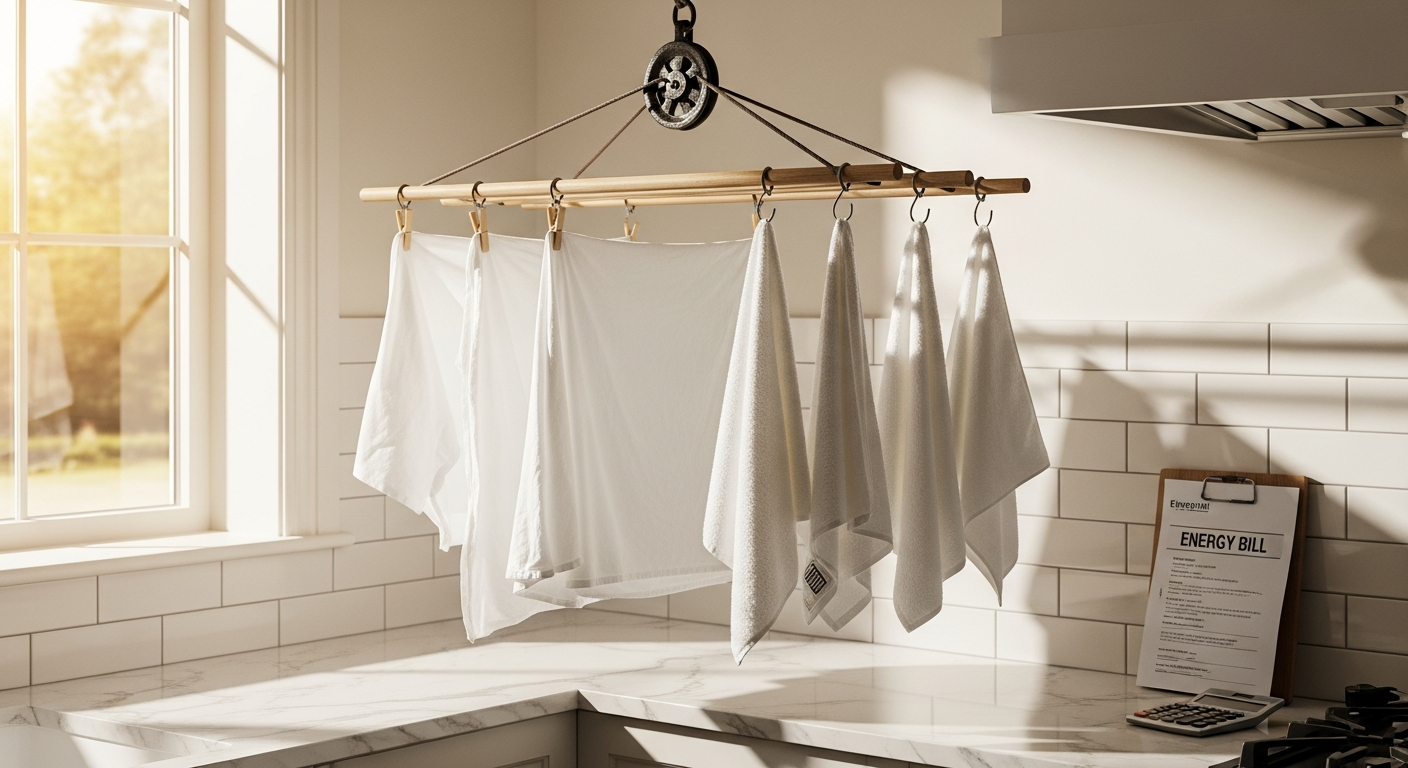
The average household tumble dryer consumes more electricity than nearly any other appliance, often accounting for 3-5% of your entire energy bill. That's thousands of dollars over a decade—money flowing out of your account simply to heat air and tumble wet fabrics. The Victorian Kitchen Maid Pulley Clothes Airer from Cast In Style represents a return to time-tested laundry wisdom, reimagined for modern homes where efficiency matters and space is precious.
This ceiling-mounted airer harnesses rising warm air naturally present in your home to dry clothes efficiently, eliminating the need for electric heat altogether. Rather than fighting against physics with heated drums and exhaust fans, you're working with your home's natural thermal patterns. The result is laundry that dries while you go about your day, without the noise, expense, or environmental guilt that accompanies conventional dryers.
Why Ceiling-Mounted Clothes Airers Outperform Traditional Drying Methods
How rising warm air circulation naturally dries laundry faster than ground-level racks
Warm air rises—it's not a preference, it's physics. When you position a clothes airer near the ceiling of any room, it intercepts naturally rising warm air currents generated by heating systems, kitchens, or simply the ambient warmth of an occupied home. Ground-level racks sit in cooler zones where moisture lingers. A ceiling-mounted airer places wet laundry directly in the path of ascending thermal energy, dramatically accelerating evaporation without requiring any mechanical intervention.
The physics behind passive drying and why ceiling height matters for efficiency
The temperature differential between ceiling-level and floor-level air in most homes ranges from 3-7°C on average. That gap becomes significant when multiplied across hours of drying. Higher ceilings amplify this advantage, creating stronger convection currents. Rooms with 8-foot or higher ceilings see optimal performance because the airer sits far enough above living spaces to capture the warmest air while remaining accessible. Lower ceilings still work effectively, though drying times may extend slightly.
Comparison of drying times between airers, tumble dryers, and wall-mounted alternatives
A tumble dryer handles a full load in 45-60 minutes through active heating—fast, but expensive. Wall-mounted racks perform moderately, typically requiring 12-24 hours depending on humidity and ventilation. A ceiling-mounted pulley airer with proper positioning dries comparable loads in 8-16 hours, depending on ambient temperature and humidity levels. When you factor in the ability to load multiple racks simultaneously and the elimination of energy consumption, the throughput advantage becomes clear.
The environmental impact of eliminating electric dryer usage over a year
A standard tumble dryer generates roughly 2.4 metric tons of carbon dioxide annually for an average household. Over a decade, that's 24 tons—equivalent to driving a car 60,000 miles. Switching to a pulley airer eliminates that output entirely. Even accounting for modest heating system adjustments needed to maintain ambient warmth, households see net carbon reductions exceeding 2 tons annually.
Cast Iron Construction and Long-Term Durability That Justifies the Price
Powder-coated cast iron brackets and their resistance to rust and corrosion
Cast In Style's Victorian Kitchen Maid Airer features brackets finished with industrial-grade powder coating, a process that creates a protective layer far superior to paint or simple finishing. This coating resists moisture, salt air, and temperature fluctuations—the primary enemies of iron. The result is hardware that maintains its appearance and structural integrity through decades of use, even in damp utility rooms or coastal environments.
Why the 5-year rust guarantee reflects Cast In Style's manufacturing confidence
A rust guarantee represents genuine confidence in manufacturing. Cast In Style backs its cast iron components with five years of protection, an assertion that only emerges when a company trusts its material sourcing, casting processes, and finishing standards. This guarantee isn't marketing theater—it's a financial commitment that filters out compromised products before they reach customers.
Comparison of cast iron versus aluminum or plastic pulley systems
Aluminum corrodes through oxidation, requiring regular maintenance and eventual replacement. Plastic wheels degrade under UV exposure and the stress of supporting heavy, wet loads over years. Cast iron, by contrast, strengthens with age as protective patina develops. Steel wheels mounted in cast iron brackets distribute load stress across robust geometry designed over centuries of industrial use. The longevity comparison isn't close—cast iron systems outlast alternatives by factors of 2 to 4.
The longevity advantage: cost-per-use over 10, 15, and 20 years
Initial investment in a quality Victorian Kitchen Maid Airer ranges from $250 to $500 depending on configuration. Spread across a 10-year lifespan, that's $25-50 annually. Most households will realistically use their airer 3-4 times per week, translating to roughly 150-200 uses annually. Over twenty years, cost-per-use drops to $1-3 per session—a fraction of the operational cost of a single dryer run.
The Pulley System Explained—Smooth Operation and Load Capacity
Solid cast iron wheels versus nylon wheels: performance and durability differences
Cast iron wheels handle sustained loads with minimal deformation, maintaining smooth operation even after years of use. Nylon wheels offer lighter operation initially but gradually compress under load, eventually creating friction and resistance. For airers that you'll raise and lower 3-4 times weekly, cast iron wheels prove the better long-term investment, though nylon options work adequately in less-demanding applications.
Learn more about the Victorian Kitchen Maid Pulley Clothes Airer's engineering and specifications.
How the pulley mechanism reduces effort when raising and lowering the airer
A properly designed pulley system creates mechanical advantage, typically offering 2:1 or 3:1 ratios depending on configuration. This means lifting a fully loaded airer—potentially holding 15 kg of wet laundry—requires only 5-7.5 kg of actual upward force from the operator. Rope quality matters here; the Victorian Kitchen Maid uses nylon-core cotton rope that resists stretching and fraying, maintaining consistent mechanical efficiency across thousands of cycles.
Load capacity specifications: understanding 15 kg (33 lbs) to 68 lbs ratings
Load capacity reflects the maximum sustainable weight the airer can support without deformation or mechanical failure. A 15 kg rating suits single loads or small families; 68 lbs accommodates large household loads—roughly two-to-three days of laundry for a family of four. Understanding your typical load size prevents overloading and ensures the airer performs optimally across its designed lifespan.
The role of the nylon-core cotton rope in supporting heavy, wet laundry loads
Wet laundry becomes substantially heavier than dry equivalent—cotton sheets can gain 50% additional weight when saturated. The Victorian Kitchen Maid's rope specification of nylon core with organic cotton lining creates a hybrid that resists stretching (nylon's strength) while maintaining grip and reducing rope burn on the pulley wheels (cotton's surface friction). This rope specification reflects boating-grade standards, indicating engineering designed for genuine reliability rather than aesthetic appeal.
Real Energy Savings—The Numbers Behind Switching from Electric Dryers
Annual electricity cost comparison: tumble dryers versus pulley airers
A standard tumble dryer consumes 3-5 kilowatts per hour of operation. Running it three times weekly for 45 minutes each session costs roughly $150-250 annually at typical electricity rates. A pulley airer requires zero electricity. The annual savings represent not just money recovered, but money never spent—a guaranteed return on investment beginning the moment installation completes.
Carbon footprint reduction and environmental impact calculations
Beyond direct electricity savings, eliminating dryer use eliminates associated infrastructure demands. Fewer households operating peak-demand appliances means reduced grid stress, delayed power plant construction, and lower aggregate emissions from electrical generation. One household's switch saves 2.4 metric tons of carbon annually; multiply that across a neighborhood and the systemic benefit becomes substantial.
Hidden costs of dryer maintenance, repairs, and eventual replacement
Dryers require regular lint trap cleaning, occasional vent duct maintenance, and repairs to heating elements and drum seals that average $150-400 per incident. Thermal shutoffs fail. Drum rollers wear. Over a dryer's typical 13-year lifespan, maintenance and eventual replacement approaches $1,500-2,000 when accumulated. A pulley airer requires no maintenance beyond occasional rope inspection and cleating.
Payback period analysis based on typical household laundry loads
For a household operating a dryer three times weekly, the payback period—the point where cumulative electricity savings exceed the airer's purchase price—occurs within 2-3 years for mid-range models ($300-350). Beyond that point, every year of operation compounds savings. Fifteen-year ownership yields $2,000-3,000 in net electricity savings alone, not accounting for avoided maintenance costs.
Installation, Space Requirements, and Practical Considerations
Pre-installation checklist: ceiling strength, joist location, and height assessment
Before purchasing, identify the ceiling location where the airer will mount. Locate joists using a stud finder—mounting brackets must attach directly to structural framing, not drywall alone. Confirm ceiling height; most models perform optimally with 8+ feet clearance, though 7.5-foot ceilings remain functional. Assess moisture levels; utility rooms and laundries are ideal, though kitchens and conservatories work well if ventilation exists.
Step-by-step installation overview and whether DIY is realistic
Installation requires drilling holes into joists, installing lag bolts or through-bolts, and securing mounting brackets. For someone comfortable with basic carpentry and power tools, DIY is realistic—most installations complete in 1-2 hours. Many retailers offer professional installation for $100-200, a worthwhile investment if you're uncertain about your comfort level or joist location assessment. Either approach yields the same result: a safely mounted system ready for decades of use.
Ideal room locations: utility rooms, kitchens, laundries, and conservatories
Utility rooms top the list because they're designed for laundry-related humidity and moisture. Kitchens offer abundant rising warm air and typically feature adequate ceiling height. Dedicated laundry rooms work excellently, particularly if they have exterior ventilation. Conservatories provide warm air and natural light, accelerating drying. Avoid bedrooms, living rooms, and spaces where you might notice moisture accumulation or where the airer's presence feels incongruous.
Minimum ceiling height recommendations for different model sizes
Standard four-lath models perform well with 7.5-foot minimum clearance. Larger five-lath and six-lath models benefit from 8-9 foot ceilings to maximize the thermal advantage. Models designed for taller ceilings can mount lower if necessary, though efficiency diminishes slightly. Account for clearance below the lowest lath when fully lowered—you want at least 6 feet of space to comfortably load and unload laundry without ducking or reaching uncomfortably.
The Long-Game Investment in Laundry Efficiency and Home Value
The Victorian Kitchen Maid Pulley Clothes Airer represents far more than a drying rack—it's a deliberate choice to reduce household operating costs, shrink your environmental footprint, and invest in a product built to outlast trends. The cast iron construction means you're acquiring something that could realistically serve your family for decades. The energy savings compound year after year, transforming what feels like a premium upfront purchase into genuine financial wisdom.
Beyond quantifiable returns, owning a Victorian Kitchen Maid Airer connects you to a lineage of practical household engineering. You're using the same principle that has dried laundry for centuries, simply refined with modern materials and reliability guarantees. Every load you dry without electricity represents a small defiance of consumption culture—a choice for durability over convenience, wisdom over convenience.
If you're ready to reclaim floor space, lower your electricity consumption, and embrace a more intentional approach to household management, the Victorian Kitchen Maid Airer deserves serious consideration.
Invest in the Victorian Kitchen Maid Pulley Clothes Airer and start saving energy today.
Leave a Reply