Your 50cc scooter or motorcycle has just hit a critical milestone—the cylinder's shot, compression's dropped, and you're staring down a hefty repair bill from your local mechanic. But here's the thing: thousands of riders tackle this challenge themselves every year, and they're discovering that a quality cylinder kit doesn't just restore their machine—it transforms it. The difference between a quick fix and a genuine upgrade often comes down to one decision: choosing the right cylinder kit.
For decades, 50cc two-wheelers have remained the backbone of accessible motorcycling and urban commuting. Whether you're piloting a Beta RR 50 through mountain trails, cruising on a Yamaha Aerox, or keeping an MBK Nitro street-ready, your engine's cylinder is the heart of everything. When wear sets in, you face a choice—replace it with OEM specs or seize the opportunity to unlock genuine performance gains.
Discover the perfect cylinder kit for your 50cc machine at La Bécanerie today.
Throughout this guide, you'll walk through the anatomy of 50cc cylinder kits, break down the material science behind cast iron versus aluminum options, and understand how to navigate the minefield of performance upgrades without compromising reliability. You'll discover exactly what separates a €100 replacement from a €300 precision-engineered build—and most importantly, which path your specific machine demands.
Understanding 50cc Cylinder Kit Components: What's Actually Inside Your Box
The cylinder barrel itself
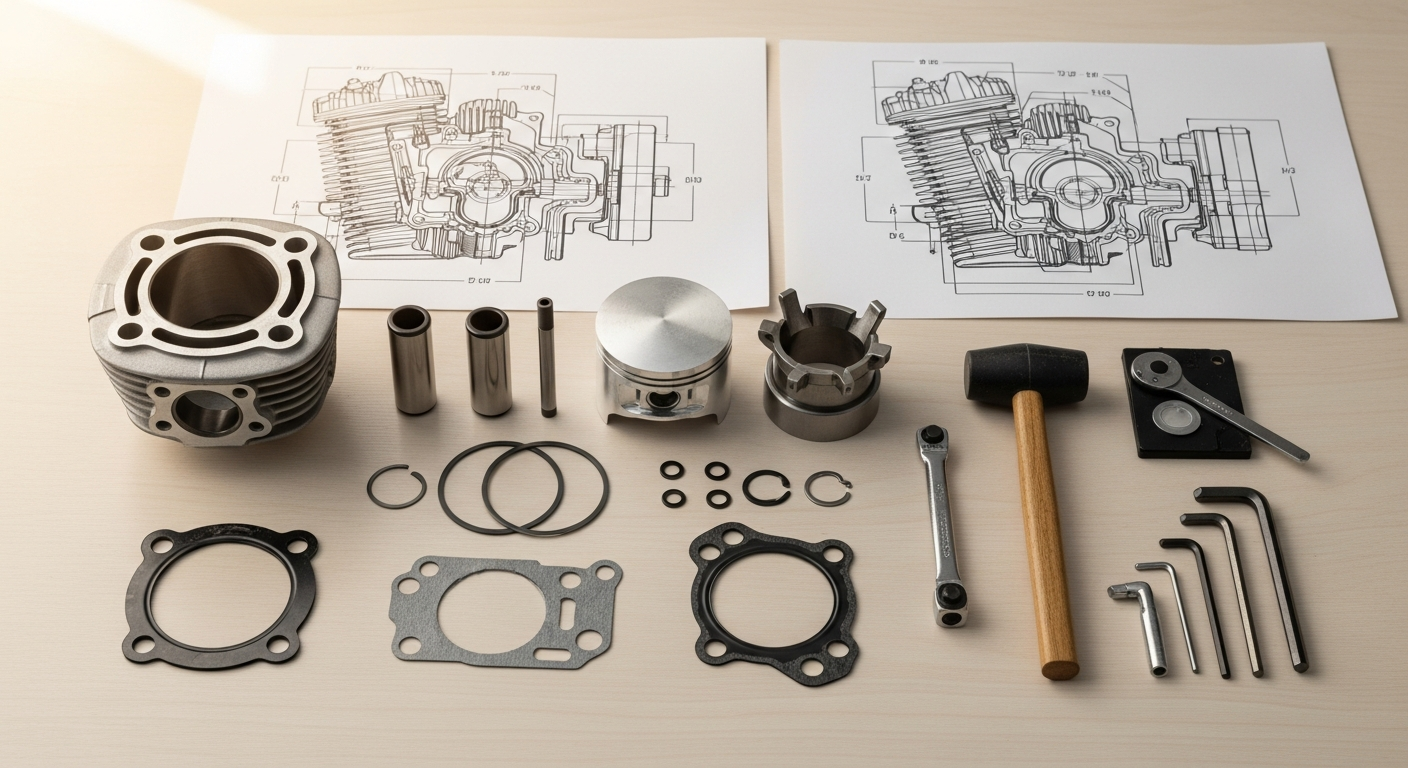
The cylinder barrel forms the core component that houses your piston and determines displacement. This single piece dictates how much air and fuel your engine can compress during each stroke, fundamentally affecting power output and torque characteristics. Whether you're running a stock 50cc barrel or upgrading to a 70cc+ big bore version, this component sets your engine's performance ceiling.
Complete piston assembly breakdown
A quality piston assembly works as an integrated system, not separate parts. You're getting the piston itself, piston rings that maintain compression and control oil, the piston pin connecting it to the connecting rod, and circlips holding everything together. These components must function as one—a mismatch between piston and rings guarantees compression loss and premature failure.
Gasket and seal sets
These components are critical for preventing compression loss and oil leakage post-installation. Many riders make the mistake of reusing old gaskets, which inevitably fails. A complete gasket set ensures proper sealing between the cylinder, crankcase, and head—areas where compression can silently escape without replacement seals.
Material composition options
Cast iron cylinders have been industry standard for reliability and thermal properties. Aluminum options offer lighter weight and superior heat dissipation, which matters during sustained high-RPM riding. Your choice between these materials affects not just performance, but maintenance requirements and long-term durability.
Displacement variations
Stock 50cc replacements maintain your original power delivery and fuel consumption. Big bore kits push displacement to 70cc, 80cc, and beyond—offering dramatic performance gains but requiring supporting modifications to carburetor, ignition, and exhaust systems.
Engine platform compatibility
Minarelli horizontal engines power countless scooters and lightweight bikes. Piaggio platforms dominate European maxi-scooters. Each architecture demands specific cylinder compatibility. Choosing the wrong kit means you've got an expensive paperweight, not an upgrade.
What's included versus what you'll source separately
Complete kits include the cylinder, piston assembly, and gasket set—everything theoretically needed for installation. Partial assemblies require you to source additional components separately. Understanding these distinctions prevents costly surprises during the rebuild process.
Stock Replacements vs. Performance Upgrades — Which Cylinder Kit Fits Your Riding Style
OEM-spec cylinder kits
Maintaining original power delivery and fuel consumption means your engine performs exactly as the manufacturer intended. Your insurance remains valid, your bike stays street-legal everywhere, and reliability isn't a question mark. You're buying predictability.
Why riders choose faithful stock replacements
Reliability, insurance compliance, and predictability drive this choice. Your machine returns to original specifications—no surprises, no legal complications, no wondering if your engine will survive aggressive riding. This path suits commuters and casual riders prioritizing dependability over thrills.
Performance-oriented big bore kits
Realistic power gains range from 15% to 40% depending on displacement increase. A 70cc conversion typically adds noticeable torque without compromising reliability. Moving to 80cc+ introduces trade-offs—more power, but higher temperatures, faster wear, and mechanical stress.
The 70cc sweet spot
This displacement offers genuine power multiplication while maintaining engine longevity. Many riders report 15-20% power gains with minimal additional stress on internal components. It's the upgrade that balances ambition with practicality.
80cc+ extreme upgrades
Expect dramatic power increases—sometimes 40% or more above stock. The trade-off? Reduced engine lifespan, higher operating temperatures, increased fuel consumption, and potential reliability issues. Your cooling system, bearings, and crankshaft face genuine stress at these displacement levels.
Tuning compatibility
Your carburetor must adjust for the cylinder change. Jetting that worked perfectly at 50cc starves a 70cc engine for fuel. Ignition timing may need advancing. Exhaust systems designed for stock displacement can't properly scavenge big bore gases. Each upgrade demands supporting modifications.
Real-world power figures
Stock 50cc machines deliver around 5-6 horsepower. A 70cc conversion typically reaches 7-8 horsepower. Big bore 80cc builds can approach 10-12 horsepower. These aren't massive gains, but they transform throttle response and acceleration noticeably.
Fuel consumption and running costs
This hidden expense deserves serious consideration. A stock 50cc sips fuel, delivering 60+ kilometers per liter. A 70cc conversion might drop to 50 km/L. Aggressive 80cc+ builds can dip below 40 km/L. That increased consumption compounds quickly across a riding season.
Material Science Matters — Cast Iron vs. Aluminum Cylinder Kits Explained
Cast iron cylinders
Traditional cast iron remains the industry standard for reason—it handles thermal cycling beautifully, resists wear over thousands of miles, and maintains dimensional stability as your engine ages. Your ring sealing stays tight longer, and compression loss occurs gradually rather than catastrophically.
Heat dissipation differences
Aluminum cylinders shed heat faster than cast iron, keeping combustion chamber temperatures lower during sustained riding. This matters most during aggressive acceleration or long climbs where your stock cooling system struggles. Aluminum's superior thermal properties can extend engine life under stressed conditions.
Weight reduction benefits
Aluminum cylinders weigh significantly less than cast iron equivalents. For a 50cc machine where every kilogram affects acceleration and handling, this reduction translates to noticeable improvements. Your overall machine becomes quicker and more responsive.
Durability and wear characteristics
Cast iron bores maintain their shape longer. Aluminum can distort at extreme temperatures and develops scoring if piston clearance tightens even slightly. Aggressive riders pushing displacement limits should seriously consider cast iron's durability advantage.
Cost implications
Premium aluminum kits command 30-50% price premiums over cast iron equivalents. Budget cylinders rarely come in aluminum—cost of material and manufacturing makes this technology exclusive to performance-oriented products.
Maintenance requirements
Cast iron cylinders tolerate variable oil quality and extended service intervals better. Aluminum demands consistent maintenance, proper coolant quality if you're using watercooled designs, and closer attention to operating temperatures. They reward diligent care and punish neglect.
Temperature management
Two-stroke engines run hot—combustion temperatures can exceed 2,500 degrees Celsius. Aluminum's superior heat dissipation becomes genuinely valuable in machines experiencing sustained high RPMs. Cast iron gets the job done but runs hotter.
Corrosion resistance
Cast iron rusts without proper maintenance and coating. Aluminum resists corrosion naturally, though salt exposure and contaminated coolant can create problems. For riders in coastal areas or harsh climates, aluminum offers genuine advantages beyond performance.
The Complete 50cc Cylinder Kit Pricing Breakdown — What You're Actually Paying For
Budget-friendly options
Cast iron replacements ranging from €90–€120 exist in the market. These kits deliver functional replacements with minimal margin above raw material cost. You're not getting precision engineering, exotic coatings, or performance optimization—just basic displacement restoration.
Mid-range quality kits
Offerings in the €150–€200 range represent the sweet spot for most riders. These products come from established manufacturers with proven reliability records. Your kit includes proper heat treatment, tighter manufacturing tolerances, and gasket quality that won't leak after 500 kilometers.
Premium performance cylinders
Precision-engineered big bore assemblies ranging €250–€350+ represent engineering excellence. These products incorporate optimized combustion chamber designs, premium aluminum materials, careful balancing, and superior gasket compounds. You're paying for measurable performance gains and proven longevity.
Brand reputation impact
La Bécanerie's curated selection commands trust because the retailer vets suppliers rigorously. Their reputation depends on quality—they won't stock garbage components that damage their community standing. This curation justifies slightly premium pricing versus unknown retailers.
Hidden costs beyond the kit
Your cylinder kit is just the beginning. Gasket sets cost €15–€30. Proper installation demands torque wrenches (€30–€80 if you don't own one), potentially honing services (€40–€80), and specialized tools for piston removal. Professional installation can run €150–€300 depending on complexity.
Warranty and return policies
Quality retailers offer 30-day return policies and manufacturer warranties covering defects. Budget components often arrive with no recourse—if something's wrong, you're stuck. Warranty protection justifies paying slightly more for peace of mind.
Bulk purchasing savings
Buying multiple kits occasionally unlocks minor discounts—10-15% reductions for three or more units. For shops or serious enthusiasts maintaining fleets, bulk purchasing makes financial sense. Casual riders see minimal savings.
Seasonal pricing fluctuations
Spring brings peak demand as riders prepare machines for warm months. Winter often sees promotions and inventory clearance. Timing your purchase for off-season availability can yield 10-20% savings versus spring rush pricing.
Installation Reality Check — Mechanical Skill Requirements and Common Pitfalls
Tools you'll absolutely need
Cylinder removal demands proper pullers—improvised methods strip threads or damage castings. Torque wrenches prevent over-tightening cylinder fasteners. A honing tool refreshes the bore for new piston rings, though some riders skip this and accept slightly loose ring fit. Gasket scrapers prevent damage during old component removal.
Workshop space requirements
Garage installations differ fundamentally from professional shops. You need a sturdy workbench, good lighting focused on the work area, and adequate space to lay out components organized by reassembly order. Attempting this in poor conditions leads to lost fasteners, cross-threaded studs, and installation disasters.
Step-by-step installation sequence
Removing the old cylinder requires careful crankcase inspection—any scoring means professional honing becomes mandatory. Cleaning the mating surface meticulously prevents gasket failure. Positioning the new cylinder straight before tightening prevents binding and misalignment. Ring installation follows strict sequences—compression rings go lower on the piston, oil control rings higher. Overlooking this detail guarantees rapid wear.
Torque specifications and fastener tightness
Over-tightening cylinder fasteners strips threads or cracks aluminum castings. Under-tightening allows compression loss and oil leakage. Manufacturer specifications exist for reason—follow them exactly. This single step determines whether your rebuild survives 10,000 kilometers or 1,000.
Ring gap and piston clearance
Piston rings must have proper gap—typically 0.15-0.35mm—to allow expansion during operation. Too tight, and the engine seizes. Too loose, and compression bleeds past the rings. Similarly, piston-to-cylinder clearance demands precision. Without proper measurement, you're gambling with engine longevity.
Break-in procedures
Fresh builds need gentle running for 100-200 kilometers. Easy acceleration, moderate RPMs, and gradual throttle application allow the new piston rings to seat properly. Aggressive riding during break-in destroys carefully built engines in minutes.
Common installation errors
Upside-down gaskets destroy sealing instantly. Cross-threaded studs create catastrophic failures. Misaligned cylinders bind during operation and seize engines mid-ride. Forgotten circlips launch pistons inside the cylinder during assembly. These mistakes seem obvious afterward but happen constantly to careless installers.
When to call a professional
Stripped threads, warped crankcase surfaces, or deep bore scoring exceed DIY capability. Specialized machine shop equipment costs thousands—professional honing costs €40–€80. Attempting professional-level repairs with home tools guarantees expensive failures.
Navigating Legal Restrictions and Insurance Implications of Big Bore Kits
Road legality in different regions
EU regulations typically restrict modified scooters to original displacement specifications. France, Germany, and Italy enforce these rules inconsistently—sometimes overlooked, sometimes prosecuted. Research your specific region's enforcement philosophy before committing to big bore upgrades.
Insurance policy complications
Displacement modifications often void coverage unless reported to insurers. Some companies refuse coverage entirely for modified machines. Others charge premium increases of 20-40%. Dishonesty about modifications means denied claims when accidents happen—not worth the risk.
Registration and documentation
Updating vehicle papers after engine modifications requires technical inspections and regulatory paperwork. Some regions accept modifications outright; others refuse entirely. Your bike's registration must match actual specifications or face legal complications.
Track-only versus street-legal builds
Competition environments permit modifications forbidden on public roads. Building a track-focused 80cc machine carries zero legal complications—you're operating within purpose-built racing environments. Street use of the same machine brings legal exposure.
Warranty implications
Manufacturer warranty typically expires entirely after cylinder kit installation. Engine problems become your responsibility, not the manufacturer's. This shifts repair costs to your shoulders if something goes wrong.
Inspection and testing requirements
Modified machines may require emissions and safety compliance verification. These inspections add bureaucratic complexity, cost, and downtime. Some jurisdictions demand annual re-certification for modified engines.
International travel considerations
Crossing borders with modified machines creates complications. Countries enforce different regulations, and documentation proving legal modification in your home region might not satisfy foreign authorities. Plan carefully if international travel is part of your riding vision.
Racing versus recreational use
Competition use carries entirely different legal framework—regulations permit modifications impossible for street riding. Building a race-only machine eliminates legal concerns entirely.
La Bécanerie's Advantage — Why This French Retailer Dominates 50cc Cylinder Kit Selection
Historical specialization in 50cc components
Decades of expertise and community trust distinguish La Bécanerie from general retailers. They've watched the 50cc segment evolve, stocked components before others recognized the market, and built reputation through reliability and expertise.
Unbeatable catalog breadth
Compatibility for Beta RR 50, Sherco, Rieju, Yamaha Aerox, MBK Nitro, and countless other platforms means finding solutions for obscure machines that others dismiss. Their inventory depth reflects genuine commitment to the community, not token product selection.
Quality assurance protocols
Rigorous vetting of suppliers and manufacturers means garbage components never reach your hands. Their reputation depends on your success—they won't stock products that fail prematurely or create installation headaches.
Expert technical support
Personalized guidance for kit selection and installation separates La Bécanerie from online retailers shipping blind. Their specialists understand your specific machine's requirements and can recommend compatible solutions.
Hard-to-find parts inventory
Sourcing obscure cylinders others can't locate demonstrates genuine commitment to breadth. Sometimes your machine uses platform variations that disappeared years ago—La Bécanerie often has solutions others have abandoned.
Fast shipping and logistics
Getting your kit when you need it matters practically. Extended delays mean extended downtime and frustration. La Bécanerie's European positioning enables quick delivery for continental riders.
Community reputation
Trusted by handymen and smart bikers across Europe, La Bécanerie's standing reflects consistent delivery on products and expertise. Riders recommend them to friends because personal experience has validated the partnership.
Balancing budget and premium options
Something exists for every rider's needs and budget. Whether you're hunting €100 replacements or investing in €300 performance kits, La Bécanerie carries alternatives across the spectrum.
Making Your Decision — A Practical Framework for Selecting Your Ideal Cylinder Kit
Assessing your current engine condition
Determine whether repair or upgrade makes sense. Does your current cylinder simply need replacement, or are you seizing an opportunity for genuine improvement? A tired engine that's nearly worn out makes big bore upgrades less appealing than newer machines that could benefit from more dramatic transformation.
Defining your performance goals
Honest conversations about desired power gains matter. Do you want your machine back to original condition, or are you pursuing genuine performance enhancement? Your answer determines whether a €100 stock replacement or a €250 big bore kit makes sense.
Evaluating your mechanical skill level
Realistic self-assessment before committing prevents disasters. Can you change oil and filters confidently? Replacing a cylinder involves greater complexity. Have you performed crankcase work before? Installation difficulty increases significantly for first-timers.
Budget allocation
Total cost of ownership includes installation and break-in, not just the kit price. Factor in tools you might need, professional honing if required, and potentially labor if DIY exceeds your capability. Accurate budgeting prevents mid-project surprises that force compromised decisions.
Researching model-specific recommendations
Learning from other riders' experiences prevents costly mistakes. Your specific machine model has history—dedicated forums contain knowledge about which kits work reliably, which modifications are worthwhile, and which pitfalls to avoid.
Consulting La Bécanerie's experts
Leveraging professional advice for your specific machine accelerates decision-making. They've guided countless riders through identical choices. Their recommendations reflect genuine experience, not sales pressure.
Planning your upgrade timeline
Seasonal considerations matter practically. Spring rebuilds mean enjoying summer performance; winter projects eliminate downtime frustration. Tolerance for extended machine downtime influences when you schedule work.
Building a long-term maintenance plan
Protecting your investment after installation means understanding modified engines require tighter maintenance schedules. Plan oil changes, cooling system checks, and performance monitoring accordingly.
Beyond the Cylinder Kit — Complementary Upgrades That Maximize Your Investment
Carburetor tuning and jetting adjustments
Essential for big bore performance realization, jetting matches fuel delivery to your expanded displacement. Stock jetting leaves big bore engines lean—fast, but prone to seizing if you're careless. Proper jetting unlocks power while maintaining reliability.
Exhaust system optimization
Your stock exhaust was designed for 50cc scavenging characteristics. A 70cc or 80cc cylinder demands different exhaust timing and pipe dimensions. Upgrading the exhaust system unlocks additional power and efficiency gains that jetting alone can't deliver.
Ignition timing and CDI modifications
Advancing spark slightly optimizes combustion timing for your modified displacement. This might mean a new CDI module or adjusting existing systems depending on your engine platform. Timing adjustments compound carburetor improvements.
Intake manifold and reed valve upgrades
Improving charge delivery to the cylinder enhances power throughout the RPM range. Reed valve improvements and optimized intake paths support big bore potential that stock components restrict.
Cooling system enhancements
Modified engines run hotter than originals. Larger radiators, improved fans, or upgraded thermostats prevent temperature-related failures during sustained riding. This becomes increasingly important as displacement increases.
Fuel quality and octane requirements
Higher compression ratios demand higher octane fuels. Your big bore conversion might require 98-octane fuel instead of regular 95-octane. This ongoing cost compounds throughout your ownership—factor it into budget calculations.
Regular maintenance intervals
Modified engines demand shorter schedules. Oil changes every 1,000 kilometers instead of 2,000 keep internal components protected. Air filters need more frequent cleaning. Spark plugs wear faster. These increased intervals add maintenance costs.
Monitoring engine parameters
Temperature, compression, and performance tracking prevent small problems becoming catastrophic failures. Learning your machine's normal operating patterns helps you spot warning signs early.
Real Riders, Real Results — Success Stories and Cautionary Tales from the 50cc Community
Transformation stories
Riders revive aging machines with quality cylinder kits regularly—50cc scooters that seemed ready for scrap return to daily service with reliable big bore conversions. A 2010 Yamaha Aerox that had fallen out of favor becomes practical transport again after a 70cc upgrade and supporting modifications.
Performance benchmarks
Documented power gains from stock to upgraded builds show consistent patterns. A 50cc Minarelli gains 15-20% horsepower with a 70cc conversion. Acceleration improves noticeably; top speed increases gradually. Riders report their machines feeling transformed despite modest absolute power gains.
Reliability lessons learned
Why some big bore conversions fail prematurely reveals patterns. Skipped gasket replacement, improper torque specifications, inadequate break-in procedures, and unsupported jetting create failures. Conversely, methodical builds using quality components run reliably for 10,000+ kilometers.
Budget-conscious builds
Maximizing performance on limited budgets means prioritizing carefully. A €150 quality 70cc kit serves better than a €90 mystery cylinder. Skipping professional honing on a decent crankcase works; risking seized engines to save €50 doesn't.
Competitive racing applications
Cylinder kits enable track success—racers push displacement carefully with quality components and meticulous setup. These builds demonstrate what's possible when performance takes absolute priority over cost and longevity.
Long-term durability data
Machines running strong years after installation share common traits: quality kits, proper installation, appropriate break-in, and consistent maintenance. Riders maintaining modified engines like race machines report genuine longevity.
Mistakes to avoid
Cautionary tales from rushed or poorly planned upgrades accumulate—seized engines from lean jetting, destroyed machines from cross-threaded fasteners, reliability failures from budget components. Common thread: skipped steps and ignored specifications.
Community recommendations
What experienced riders consistently choose reveals reliable patterns. Certain brands appear repeatedly in success stories; others appear only in cautionary tales. Following community consensus prevents expensive learning curves.
Your Path Forward — Taking Action on Your 50cc Engine Rebuild
Choosing a 50cc motorcycle or scooter cylinder kit isn't just about swapping metal—it's about reclaiming your machine's potential and embracing the hands-on culture that defines this community. Whether you're hunting for a faithful OEM replacement to restore your Beta RR 50 to original glory or plotting a big bore transformation that'll turn heads at every stoplight, the right kit exists. The real challenge isn't finding options; it's matching the perfect solution to your specific needs, skill level, and ambitions.
La Bécanerie's unbeatable catalog and expert guidance remove the guesswork from this critical decision. You're not gambling on mystery components or hoping budget kits deliver reliability—you're investing in proven parts backed by decades of community trust. The difference between a €100 replacement and a €300 precision-engineered upgrade becomes crystal clear once you understand what you're actually buying, how installation demands vary, and what complementary upgrades truly matter.
Your next step? Assess your current engine condition, define your performance goals honestly, and reach out to La Bécanerie's specialists. They'll help you navigate material choices, compatibility concerns, and installation realities specific to your machine. Whether you're resurrecting a tired cylinder or unlocking hidden performance, the journey starts with choosing the right kit. Your 50cc machine is ready for its comeback—now it's your turn to make it happen.
Start your 50cc rebuild journey with La Bécanerie's expert selection of cylinder kits.
Leave a Reply