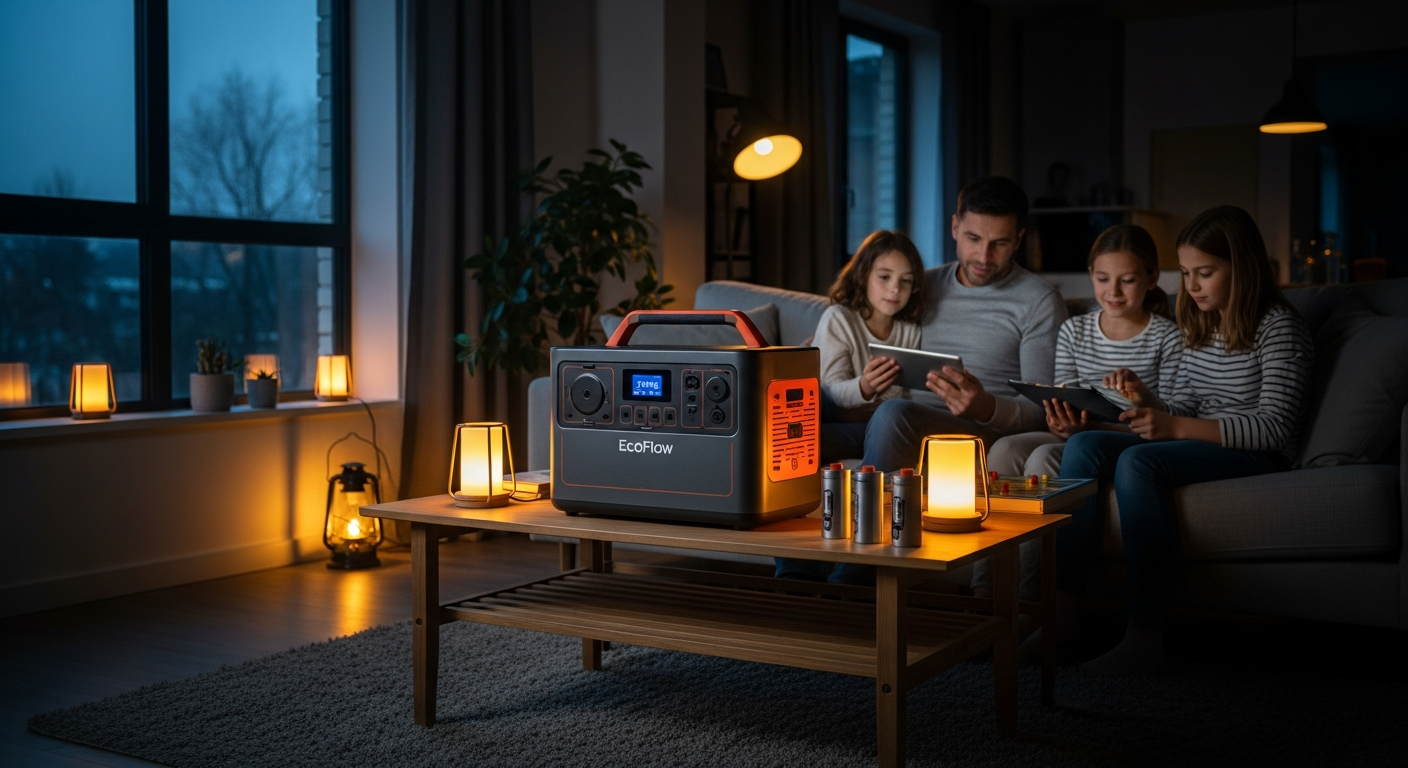
More than 40% of American households lack a reliable backup power solution, leaving them vulnerable during grid outages that can last anywhere from hours to weeks. When the power goes out, families are left scrambling—no refrigeration, no heating, no way to charge critical devices. The stakes are real, and the consequences of being unprepared can be severe.
For decades, backup power meant installing a bulky, noisy generator in your yard. These machines consume fuel, require constant maintenance, and pollute your neighborhood with noise and emissions. The EcoFlow DELTA Pro 3 flips this equation entirely. With a massive 4096Wh capacity that expands to 36kWh or beyond, this portable power station delivers silent, clean energy when you need it most—whether that's during a blackout, off-grid living, or powering your entire RV setup. The LiFePO4 battery technology ensures it'll outlast traditional generators by years.
Explore the EcoFlow DELTA Pro 3 and revolutionize your backup power strategy today.
From Generator Dependence to Silent Power: Why Homeowners Are Switching
Traditional backup generators come with a laundry list of problems that homeowners often overlook until they actually need them. Fuel costs accumulate quickly—especially during extended outages when you're running the generator continuously. Maintenance requirements are relentless: oil changes, air filter replacements, spark plug servicing, and regular tune-ups to ensure the machine starts when you need it. The noise pollution alone makes generators a neighborhood nuisance, often violating local ordinances during peak usage times. Then there's the environmental concern—fossil fuel consumption and carbon emissions from a backup generator don't align with modern sustainability goals.
The shift toward battery-based backup power solutions in residential settings reflects a broader change in how homeowners think about energy security. Modern portable power stations offer reliability without the baggage of traditional generators. They operate silently, require no fuel, demand minimal maintenance, and integrate seamlessly with renewable energy sources like solar panels. This transition isn't just about convenience—it's about rethinking energy independence entirely.
Portable power stations appeal to homeowners seeking reliability without the drawbacks. You get backup power that doesn't disturb neighbors, doesn't require fuel storage, and doesn't demand seasonal maintenance routines. The DELTA Pro 3 specifically addresses the core frustration with smaller portable power stations: insufficient capacity and output for serious household needs.
Real-world scenarios highlight where the DELTA Pro 3 outperforms conventional generators. During a 48-hour outage, you can run your refrigerator, charge laptops and phones, power your home office equipment, and maintain heating or cooling without refueling or changing oil. A traditional generator in the same scenario would consume dozens of gallons of fuel, create constant noise complaints, and require multiple service checks. The DELTA Pro 3 sits quietly in your home or garage, powering what matters without drama.
The long-term cost analysis shows a compelling financial picture. Generator ownership involves fuel costs (often $1–$3 per hour of operation), annual maintenance ($200–$500), eventual engine replacement or major repairs, and replacement parts that add up quickly. The DELTA Pro 3 requires no fuel, no oil changes, and no seasonal maintenance. Over a 10-year period, the total cost of ownership heavily favors the portable power station, especially in areas with frequent outages.
Battery backup aligns perfectly with modern home energy management and sustainability goals. The DELTA Pro 3 pairs naturally with solar panels, allowing you to store renewable energy and reduce grid dependency. This integration supports a broader vision of personal energy independence while eliminating the environmental footprint of fuel-based backup systems.
Capacity That Scales: Understanding the 4096Wh Base and Expandable Architecture
The 4096Wh (4kWh) core capacity is substantial enough to power essential household appliances for a meaningful duration. This base configuration can keep a refrigerator running for approximately 15–20 hours, your internet router and phone charging equipment for 2–3 days, and a laptop computer for 40+ hours of continuous use. For a household facing a typical 8–12 hour outage, the base capacity alone may provide sufficient backup power for critical systems.
Expandability options allow you to scale from 4kWh to 36kWh, 48kWh, or beyond by stacking additional battery modules. This modular design is game-changing because it means you're not forced to overpay for capacity you don't need initially. Start with the base unit and add batteries as your needs evolve, your household grows, or you commit to off-grid living.
The modular approach lets you future-proof your investment strategically. A young family might begin with the 4096Wh configuration for emergency outages, then expand to 16kWh as they add solar panels or consider extended off-grid weekends. An RV enthusiast might eventually reach 24–36kWh for genuine full-time mobile living. Each expansion decision reflects your actual power needs rather than forcing a one-size-fits-all purchase.
Comparing base capacity to expanded setups reveals distinct use cases. The 4096Wh base handles emergency backup for most households. A 16kWh expansion supports 2–3 days of moderate off-grid living. A 36kWh configuration enables week-long off-grid capability or powering multiple buildings simultaneously. Right-sizing your configuration to actual needs prevents overpaying while ensuring adequate capacity for your specific situation.
Real-world runtime examples make capacity tangible. With the 4096Wh base unit, you can run:
- A refrigerator continuously for 15–20 hours
- Your entire home office setup for 2–3 days
- A portable air conditioning unit for 8–10 hours
- Critical medical equipment for extended periods without recharging
These aren't theoretical maximums—they reflect actual user data under normal conditions.
The advantage of scalability extends beyond immediate needs. Technology evolves, household circumstances change, and energy consumption patterns shift. The DELTA Pro 3's expandable architecture means your backup power investment adapts to your future without requiring replacement purchases.
Discover how EcoFlow's scalable battery systems grow with your energy needs.
Power Output That Handles Your Entire Home: 4000W Continuous, 8000W Peak
The 4000W continuous AC output represents the actual sustained power the DELTA Pro 3 can deliver without throttling. This capacity supports practically everything in your home: your refrigerator, microwave, electric heater, air conditioning unit, washing machine, and entertainment systems simultaneously. Unlike smaller portable power stations that max out at 600–1500W, the DELTA Pro 3 operates in genuine household appliance territory.
The 8000W surge capability matters significantly for high-demand devices. Motors and compressors in refrigerators, HVAC systems, and power tools often draw 2–3 times their normal running power during startup. The DELTA Pro 3's surge capacity handles these brief power spikes without shutting down or throttling performance, ensuring your appliances operate normally rather than in a degraded state.
Simultaneous operation scenarios showcase the DELTA Pro 3's real advantage. You can run your refrigerator, microwave, and coffee maker at the same time without any power concerns. A window air conditioning unit and a home office setup draw power concurrently. Multiple phone and laptop chargers operate together. Traditional portable power stations would shut down under these loads; the DELTA Pro 3 handles them without hesitation.
Comparison with smaller portable power stations reveals the gap in capability. A 2000W unit forces priority decisions—refrigerator or microwave, but not both. A 500W solar generator can barely power a laptop while charging phones. The DELTA Pro 3 eliminates these compromises entirely, supporting the full spectrum of household appliances without forced rationing.
Power management features prevent overload and protect your devices through intelligent load balancing and surge protection. The DELTA Pro 3 monitors power distribution continuously and prevents any single connected device from exceeding safe operational parameters. This protection ensures both your appliances and the power station itself remain safe during extended use.
The ability to run power tools, HVAC systems, and major kitchen appliances together defines the DELTA Pro 3's strength. This isn't just backup power for essentials—it's genuine whole-home capability that maintains your normal lifestyle during outages rather than forcing adaptation to minimal power scenarios.
The Battery Technology Advantage: LiFePO4 Longevity and Safety
LiFePO4 (Lithium Iron Phosphate) chemistry represents a generation beyond older lithium-ion technology used in many consumer electronics. Traditional lithium-ion batteries degrade rapidly, suffer thermal instability, and often require replacement after 3–5 years of regular use. LiFePO4 chemistry fundamentally changes this equation through superior thermal stability, slower degradation rates, and inherent safety characteristics that make the battery less prone to catching fire or experiencing catastrophic failures.
The 3000+ cycles to 80% capacity specification translates directly into real-world lifespan. If you discharge the DELTA Pro 3 fully once daily (which exceeds most actual usage patterns), you're looking at over 8 years of continuous use before the battery degrades to 80% of original capacity. Most households cycle their backup power station far less frequently, pushing the realistic lifespan closer to 10–15 years of reliable performance.
The 10+ year durability with daily use represents a fundamental investment advantage. A traditional generator typically lasts 5–7 years before significant maintenance or replacement becomes necessary. The DELTA Pro 3 operates with minimal degradation across a timespan that outlasts most backup power solutions by years. This longevity transforms the cost-per-year calculation significantly in favor of battery-based systems.
Safety features inherent to LiFePO4 technology and thermal management systems eliminate many generator-related risks. There's no gasoline to spill, no carbon monoxide to ventilate, no fire risk from fuel leaks or engine problems. The DELTA Pro 3 operates safely indoors or in any weather condition without specialized installation requirements. This accessibility makes backup power genuinely practical for most living situations.
Minimal degradation over time distinguishes LiFePO4 systems from traditional backup generators that accumulate wear and decline in performance with age. A generator's power output decreases as components wear; the DELTA Pro 3 maintains consistent performance year after year. This consistency means your backup power reliability actually improves psychologically as years pass and the system proves its durability.
Environmental benefits emerge from advanced battery chemistry and sustainable energy storage. LiFePO4 batteries are recyclable, contain no toxic heavy metals, and avoid the fuel consumption and emissions inherent to generator operation. Choosing battery-based backup power aligns with environmental values while providing genuine energy security.
Charging Flexibility: Four Ways to Recharge Your Power Station
Fast AC charging from standard household outlets provides convenient recharging during normal grid operation. The DELTA Pro 3 accepts standard 120V household current and recharges substantially faster than competing portable power stations. This means you can maintain constant readiness without dedicating specialized electrical infrastructure to backup power preparation.
Solar input capability with up to 2600W support enables rapid solar recharging, transforming the DELTA Pro 3 into a true renewable energy storage system. On a sunny day, connecting 5–6 standard solar panels (around 400W each) recharges the battery completely in roughly 2–3 hours. This integration means you're genuinely independent of grid power if you commit to a small solar array.
EV charging compatibility creates seamless integration with electric vehicles. If your home already has an EV charger, the DELTA Pro 3 can accept power from that infrastructure, providing another convenient recharging option. This integration works both directions—the DELTA Pro 3 can also power your EV charger when the grid is down, adding another layer to your energy independence strategy.
Generator charging for hybrid backup scenarios allows the DELTA Pro 3 to accept power from a traditional generator if you maintain one. This flexibility means you can combine battery and fuel-based backup into a comprehensive energy solution: batteries handle the first hours or days silently, and a generator kicks in only if the outage exceeds your battery capacity. This hybrid approach offers flexibility without committing entirely to either technology.
Charging speed comparisons highlight practical advantages. AC charging reaches 80% capacity in roughly 1.5 hours. Solar charging (with optimal panel configuration) achieves similar timeframes on sunny days. Generator input recharges rapidly in hybrid scenarios. This speed ensures you're never stuck with depleted backup power for extended periods.
Multi-charging flexibility ensures you're never caught without power options. Grid down? Solar charges the battery. Cloudy for days? Switch to generator input. Returning to grid power? AC charging tops everything off. This redundancy in charging methods represents genuine energy security—you're never dependent on a single power source.
Smart Monitoring and AI-Powered Management: Control From Anywhere
App connectivity and Wi-Fi monitoring enable real-time power usage tracking from your smartphone. You can monitor exact wattage consumption, remaining runtime, battery health, and charging progress from anywhere with internet connectivity. This visibility transforms backup power from a "set and forget" device into an actively managed energy resource.
AI-powered battery management optimizes performance and lifespan through intelligent algorithms that adjust charging speeds, distribute loads efficiently, and predict maintenance needs. Rather than relying on basic charge controllers, the DELTA Pro 3's AI system continuously learns your usage patterns and adapts its behavior to maximize battery longevity and operational efficiency.
Remote monitoring capabilities provide genuine peace of mind during outages. You can check your power station status from work, from a relative's house, or from anywhere, confirming that your home's backup power is functioning correctly and adequately supporting critical systems. This visibility eliminates anxiety during extended outages.
Integration with smart home ecosystems and automation possibilities means the DELTA Pro 3 can coordinate with other devices. Automated load shedding can prioritize critical systems during extended outages, smart thermostats can adjust temperature settings based on available power, and lighting systems can adapt consumption based on battery state. These coordinated systems maximize your effective runtime during extended power outages.
Battery health insights and predictive maintenance alerts notify you proactively about any developing issues. Rather than discovering problems during emergencies, the DELTA Pro 3's monitoring system alerts you to maintenance needs before they become critical. This predictive approach ensures your backup power system remains reliable when you actually need it.
The user-friendly interface makes energy management accessible to everyone in your household. You don't need technical expertise to understand your power consumption, monitor charging progress, or manage loads. The app presents information clearly, and the system provides recommendations without requiring constant user attention.
Investment Breakdown: Is the $3,999–$7,999 Price Tag Worth It?
The base unit pricing at approximately $3,999 includes the 4096Wh battery, the power station chassis, all integrated electronics, app connectivity, and warranty coverage. This starting point represents significantly higher capacity than most consumer portable power stations while delivering performance approaching or exceeding traditional generators.
Advanced configurations and bundle options range up to $7,999 with expanded battery capacity, additional solar panels, charging accessories, and extended warranty coverage. These premium packages cater to serious off-grid users or households planning significant solar integration. The flexibility to choose your configuration means you only pay for what you actually need.
Cost-per-watt-hour analysis versus traditional generators and smaller alternatives reveals compelling economics. The DELTA Pro 3 costs approximately $0.97 per watt-hour of capacity. A traditional backup generator delivering equivalent sustained capacity costs roughly $2–$3 per watt-hour when accounting for installation, fuel storage infrastructure, and long-term fuel consumption. Smaller portable power stations range from $1–$2 per watt-hour but lack the sustained output capacity for serious household backup.
Long-term value calculation incorporating lifespan, maintenance costs, and fuel savings strongly favors battery-based systems. A traditional generator might cost $4,000–$8,000 initially, then consumes $500–$1,000 annually in fuel and maintenance over 5–7 years of life. Total cost of ownership approaches $7,500–$15,000. The DELTA Pro 3's $3,999–$7,999 investment requires no fuel, minimal maintenance, and lasts 10+ years. Over a decade, the cost advantage becomes substantial.
Financing options and payment plans make the investment more accessible. Many retailers offer zero-interest financing across 12–24 months, spreading the cost across timeframes that align with household budgets. Breaking a $4,000 investment into $200–$300 monthly payments creates accessibility that upfront lump-sum pricing doesn't.
The ROI timeline for homeowners in areas with frequent outages or unreliable grids is remarkably short. In regions experiencing 3–5 outages annually, the DELTA Pro 3 pays dividends immediately through avoided fuel consumption, no emergency generator rental costs, and eliminated productivity losses from power downtime. For off-grid households or RV owners using it as primary power, ROI essentially begins on the first day of use.
Real-World Applications Beyond Emergency Backup
Off-grid living and sustainable homestead power solutions represent the DELTA Pro 3's ideal use case. With expanded capacity reaching 36–48kWh and solar integration, the system can power an entire household indefinitely without grid connection. This application attracts homeowners seeking genuine energy independence and reduced environmental footprints.
RV and mobile living setups finally achieve genuine whole-vehicle power capability. Rather than running generators for hours or limiting power consumption to essential systems, RV owners can expand their battery capacity to 24–36kWh and power full-featured living while traveling. This transforms nomadic lifestyles from power-rationing experiences into genuinely comfortable journeys.
Construction site and remote work power requirements find practical solutions in the DELTA Pro 3's capacity and output. Contractors can power tools, charging stations, and temporary lighting without fuel-dependent generators. Remote work setups in cabins or agricultural properties gain reliable power independence from the grid.
Event hosting and outdoor entertainment lose their generator noise and exhaust concerns. Outdoor weddings, camping events, and festivals can operate on clean, silent battery power. The DELTA Pro 3 maintains full capability for audio equipment, refrigeration, lighting, and charging stations without the acoustic pollution traditional generators introduce.
Backup power for home offices, medical equipment, and critical systems represents another essential application. As more professionals work remotely, backup power that maintains internet connectivity and computer operation becomes business-critical rather than merely convenient. Medical equipment requiring uninterrupted power gains reliable support through battery backup.
Seasonal use cases and flexibility for different household situations allow adaptation across diverse scenarios. Winter homeowners experiencing increased outage frequency gain backup power specifically when grid reliability typically deteriorates. Summer RV enthusiasts leverage the same system for mobile adventures. The DELTA Pro 3's flexibility accommodates vastly different applications and usage patterns without requiring different equipment.
The Verdict: Why the EcoFlow DELTA Pro 3 Represents the Future of Home Backup Power
The EcoFlow DELTA Pro 3 isn't just another portable power station—it's a fundamental rethinking of how homeowners approach emergency preparedness and energy independence. Its 4096Wh expandable capacity, 4000W continuous output, and advanced LiFePO4 technology create a backup power solution that genuinely rivals traditional generators while eliminating the noise, fuel dependency, and maintenance headaches. The ability to charge via solar, AC, EV, or generator input means you're never locked into a single power source.
Yes, the $3,999–$7,999 investment requires serious consideration, and the 113.5 lb weight won't appeal to everyone seeking portability. But when you factor in the 10+ year lifespan, silent operation, scalability to 36–48kWh, and the peace of mind that comes with AI-powered battery management, the value proposition becomes compelling. For homeowners in outage-prone areas, off-grid enthusiasts, RV owners, and anyone serious about energy independence, this portable power station delivers genuine reliability.
The question isn't whether the DELTA Pro 3 can replace your generator—it already has for thousands of households. The real question is whether backup power reliability matters enough to your family to invest in technology that will serve you for the next decade. If it does, begin by assessing your household's peak power needs, calculating your typical daily consumption, and determining whether the base 4096Wh capacity or expanded configurations align with your situation. Your future self—especially during the next grid outage—will thank you.
Secure your energy independence with the EcoFlow DELTA Pro 3 today.
Leave a Reply