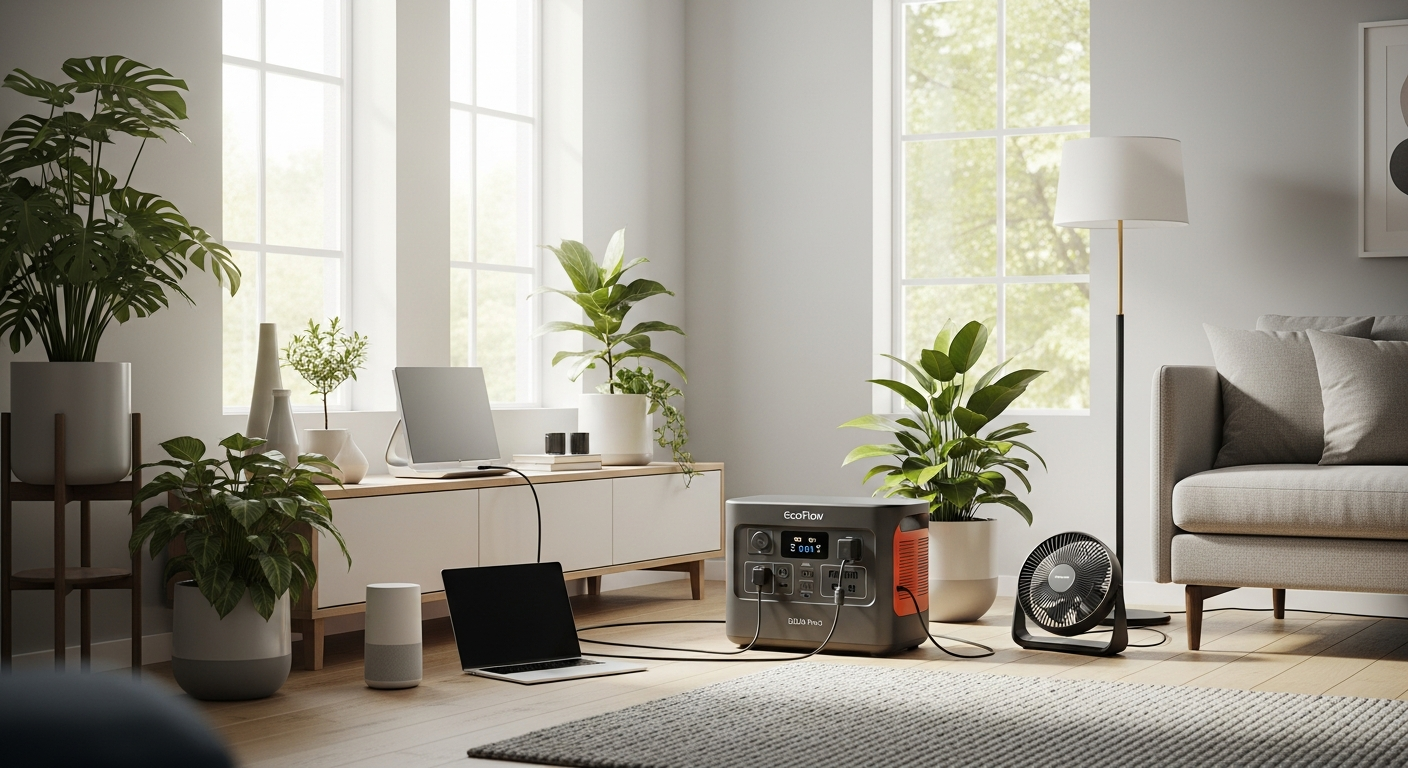
When the power cuts out, most households face a brutal reality: you have roughly four hours before refrigerated food spoils and critical devices drain completely. Over 60% of American households now experience extended power outages, yet the majority remain dangerously unprepared with any backup solution whatsoever. This vulnerability exposes a fundamental gap in how people approach energy security at home.
The EcoFlow DELTA Pro 3 has earned its reputation as one of the most powerful portable power stations available today, specifically engineered for homeowners and off-grid enthusiasts who refuse to compromise when the grid fails. Unlike smaller competitors that struggle with demanding appliances, this system delivers 4000W continuous output with the ability to expand to 36kWh—a capability that fundamentally changes what’s possible with portable backup power.
Explore the EcoFlow DELTA Pro 3 and secure your home’s energy independence today.
This analysis walks through the DELTA Pro 3’s real-world performance for home backup scenarios, breaks down exactly which appliances it can power simultaneously, and shows how its expandability transforms it from emergency solution into a semi-permanent backup system.
Why Home Backup Power Matters More Than Ever in 2026
Grid failures have shifted from occasional inconveniences to predictable seasonal threats. Extreme weather events—hurricanes, ice storms, wildfires—increasingly knock out power for extended periods across entire regions. The infrastructure designed decades ago simply cannot handle modern demand and climate volatility.
The hidden costs of power outages extend far beyond the inconvenience of darkness. A single outage lasting more than four hours spoils thousands of dollars in refrigerated food. Medications requiring cold storage become worthless. Heating and cooling systems fail, turning homes into dangerous temperature zones within hours. Internet routers die, severing remote workers from their income. Data centers go offline. Medical devices that depend on consistent power become liabilities rather than lifelines.
Traditional generators present their own problems. They require fuel storage, generate dangerous carbon monoxide, need regular maintenance, and create noise that antagonizes neighbors. Portable power stations eliminate these friction points entirely. They operate silently, produce zero emissions indoors, require no ongoing fuel supply, and integrate seamlessly into modern home electrical systems. The DELTA Pro 3 specifically bridges the gap between consumer-grade portability and industrial-grade power delivery.
Breaking Down the DELTA Pro 3’s Core Power Specifications
Understanding the DELTA Pro 3 requires clarity on what its numbers actually mean in practice.
4kWh Base Battery Capacity: What This Actually Means for Runtime
A 4kWh battery sounds abstract until you translate it into actual usage time. Four kilowatt-hours means the system can deliver one kilowatt of power for four hours, or four kilowatts for one hour. In household terms, this translates to running a standard refrigerator (150W average) for approximately 26 hours on a single charge, or powering a typical home office setup (laptop, monitor, router) for 10-12 hours continuously.
The practical implication: the base 4kWh capacity handles most home backup scenarios that last under 12 hours. This covers typical outages where power restoration occurs within a day. For longer disruptions, expansion becomes necessary.
4000W Continuous Power Output Versus 8000W Surge Capacity Explained
These two numbers define what the DELTA Pro 3 can actually run. The 4000W continuous rating means the system safely delivers four kilowatts indefinitely without thermal stress. This is what you rely on for steady-state operation of devices like refrigerators, computers, and lighting systems.
The 8000W surge capacity represents the brief spike of power available when devices first start. Electric motors and compressors demand massive current at startup before settling into normal operation. An air conditioning unit might draw 8000W for two seconds during startup, then drop to 3000W for continuous cooling. The DELTA Pro 3’s surge capacity ensures these devices actually start without the system shutting down.
This distinction matters enormously. Many competing systems advertise high surge numbers but mediocre continuous ratings, meaning they start appliances but can’t sustain them. The DELTA Pro 3 does both.
Native 120V/240V Dual-Voltage System and Its Advantage for Home Integration
This feature represents a genuine advantage over competitors. Most portable power stations output only 120V, which limits them to standard wall-outlet devices. The DELTA Pro 3 includes native 240V output, enabling connection to larger appliances like electric water heaters, dryers, and central air conditioning units.
This dual-voltage capability transforms the system from emergency backup to genuine home integration. Rather than running extension cords to a few critical devices, homeowners can configure the DELTA Pro 3 to feed directly into their home’s electrical panel through a transfer switch, enabling whole-home backup power for all connected circuits.
The Expandability Game-Changer: Scaling From 4kWh to 36kWh
The DELTA Pro 3’s true power emerges through expansion. The base unit represents just the beginning.
How Additional Battery Modules Stack and Integrate Seamlessly
The system accepts up to eight additional battery expansion units, each adding 4kWh of capacity. They connect through a simple cable interface without requiring complex rewiring or technical expertise. A user can start with the base 4kWh unit and gradually add expansion batteries as budget allows or needs expand. The system intelligently manages charging and discharging across all connected batteries, ensuring balanced usage and maximum lifespan.
This modularity solves a critical problem: upfront cost. Instead of requiring a $5,000+ investment immediately, users can begin with a $1,999 system and add capacity incrementally.
Cost-Benefit Analysis of Expanding Capacity Versus Buying Multiple Units
The math becomes clear quickly. A single DELTA Pro 3 with eight expansion batteries costs approximately $5,000-$5,500 total. Two separate portable power stations of equivalent capacity would cost $7,000-$8,000 and occupy twice the physical space while providing no integration benefit.
The expansion route offers superior economics and functionality. A fully expanded system operates as a unified platform rather than disconnected devices competing for charging power.
Realistic Scenarios Where 36kWh Capacity Becomes Essential
A 36kWh system can power a typical home’s essential loads for three to four days without any charging input. This covers:
- Complete refrigerator and freezer operation (average 3-4 hours per day compressor runtime)
- 24-hour HVAC operation for heating or cooling critical areas
- Continuous work-from-home setup (computer, monitors, networking equipment)
- Essential lighting throughout the home
- Medical devices or critical equipment
Off-grid cabins and remote properties benefit most dramatically. A fully expanded DELTA Pro 3 paired with a modest solar array becomes a complete energy system, eliminating grid dependence entirely for moderate usage patterns.
Check current pricing and expansion module availability on EcoFlow’s official store.
Real-World Home Backup Scenarios: What Actually Powers
Theory only matters if it translates to practice.
Refrigerator and Freezer Runtime on Single Charge
A standard refrigerator consumes 150-200W during compressor operation, cycling on roughly 8-10 hours per day. On the DELTA Pro 3’s 4kWh base capacity, this translates to approximately 20-26 hours of continuous refrigeration before battery depletion. In real-world conditions with thermal cycling in a typical kitchen environment, expect 18-22 hours of protection per charge.
A freezer operates at similar power consumption but with longer compressor cycles in colder ambient temperatures. The DELTA Pro 3 sustains both appliances simultaneously for roughly 12-15 hours on a single charge, covering most typical outage durations.
HVAC System Compatibility and Power Requirements
Central air conditioning demands significant power. Most modern systems draw 3000-4500W during cooling operation, placing them at or beyond the DELTA Pro 3’s continuous rating when accounting for other household loads.
The reality: running your complete HVAC system on the DELTA Pro 3 isn’t practical for extended periods. However, running zone-based cooling (a single window unit at 1000-1500W) plus essential loads remains entirely feasible. Many users configure the system to power their bedroom cooling at night and critical loads during the day, significantly improving comfort during outages while extending battery life.
Work-from-Home Setup: Laptop, Internet Router, and Monitor Power Duration
This represents the DELTA Pro 3’s sweet spot. A typical work setup consumes 100-200W:
- Laptop: 50-100W
- External monitor: 30-50W
- Router: 10-15W
- Miscellaneous USB devices: 10-20W
On a 4kWh charge, this setup runs for 20-40 hours continuously—more than a full working day and night. Paired with even modest solar charging (200-300W typical residential panels), a work-from-home user could sustain productivity indefinitely during an outage.
The Price-to-Performance Equation: Is $1,999 Worth It?
The sticker shock requires context.
Sticker Price ($1,999) Versus Original MSRP ($3,699) and Discount Reality
The DELTA Pro 3 regularly sells at $1,999, often discounted from its original $3,699 MSRP. This discount reflects market competition and EcoFlow’s aggressive positioning rather than artificial inflation. Even at the full $3,699 price, the system delivers features and capacity that competing products charge $4,500+ to match.
The $1,999 price point represents genuine value. Users obtain industrial-grade battery technology, 4000W continuous output, dual-voltage capability, and a 10+ year projected lifespan for less than many people spend on a used vehicle.
Cost Per Watt-Hour Compared to Competitors and Alternatives
At $1,999 for 4kWh capacity, the DELTA Pro 3 costs approximately $0.50 per watt-hour. Premium competitors charge $0.70-$0.90 per watt-hour for equivalent capacity. Budget alternatives offering $0.30-$0.40 per watt-hour typically sacrifice durability, maximum output power, or expandability.
This cost structure reflects the reality that cheap batteries fail, underperforming systems frustrate users into abandonment, and lack of expandability forces expensive replacement rather than incremental upgrading.
Total Cost of Ownership Including Expansion Modules
A fully expanded 36kWh DELTA Pro 3 system costs $5,000-$5,500 depending on individual expansion module pricing. This investment provides:
- 10+ year lifespan (3,000+ charge cycles at 80% capacity retention)
- Zero ongoing fuel or maintenance costs
- Expandable capacity matching your evolving needs
- Native 240V home integration capability
- Portability with wheels and telescoping handle despite its 113.5 lbs weight
Spread across a 10-year lifespan, this represents roughly $500 annually for complete energy independence during outages—less than many people spend on car insurance while providing far superior peace of mind.
Powering Your Home Through the DELTA Pro 3
The EcoFlow DELTA Pro 3 isn’t simply another portable power station sitting in the garage for theoretical emergencies. It’s a pragmatic solution for whole-home backup power when properly configured and realistically deployed.
The 4kWh base capacity handles essential loads through typical outages lasting under 12 hours. For longer disruptions or permanent off-grid applications, expandability to 36kWh transforms it into a semi-permanent energy infrastructure that fundamentally changes how you approach power security. The native 240V output, multiple rapid charging methods, and LiFePO4 battery durability create a system that actually improves your quality of life during emergencies rather than merely surviving them.
For homeowners serious about energy independence, the $1,999 entry point represents genuine value when factored against the 10+ year lifespan, comprehensive feature set, and competitive advantages over alternatives. The 5-year manufacturer warranty further confirms EcoFlow’s confidence in their engineering.
Start by assessing your critical loads—what absolutely must remain powered during an outage. Calculate total wattage and daily runtime requirements. If the base 4kWh capacity meets your needs, the DELTA Pro 3 delivers immediate protection. If your situation demands extended runtime or whole-home coverage, the expansion pathway becomes clear. Either way, this system transforms grid dependency from an anxiety point into a manageable variable.
Leave a Reply