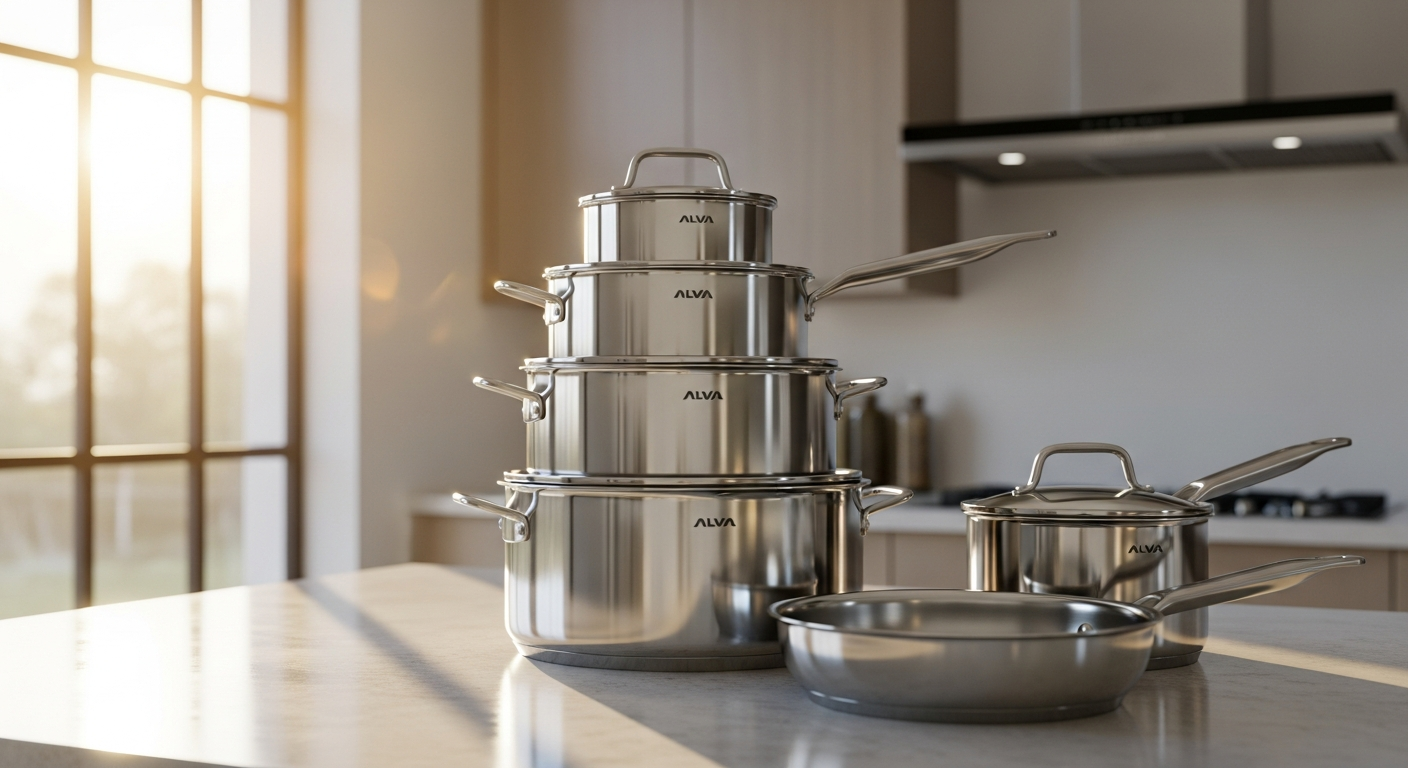
Nearly 60% of home cooks struggle with kitchen storage, and cramped cabinet spaces can turn meal prep into a frustrating treasure hunt. If you've ever had to shuffle pans around just to find the one you need, you understand the real problem: traditional cookware takes up far too much space. The Alva Maestro Ceramic Nonstick Stackable Cookware Set is a game-changing collection designed specifically for kitchens where every inch counts.
This Belgian-engineered 5-piece set combines innovative stacking technology with premium ceramic nonstick surfaces, all while keeping your cooking experience toxin-free. Rather than accepting cluttered cabinets as an inevitable part of cooking, you can choose cookware that actually respects your space constraints. The Maestro Collection has earned its reputation through thoughtful design and genuine performance improvements over standard options.
Why Stackable Cookware Changes Everything for Space-Conscious Kitchens
How traditional cookware storage wastes valuable cabinet real estate
Standard cookware sets sit in your cabinet like puzzle pieces that don't quite fit together. A 10-inch skillet, 8-inch skillet, saucepan, and sauce pot each occupy their own territory. Stack them on top of each other, and you're creating an unstable tower that's prone to toppling. The result: you spread them across multiple shelves, consuming cabinet space that could hold your dinnerware, glassware, or food storage containers. Most home cooks don't realize how much real estate their cookware monopolizes until they face the choice between keeping their pans accessible or actually fitting their dishes into the cabinet.
The ingenious stacking mechanism that makes the Alva Maestro different
The Alva Maestro design doesn't just allow pans to stack—it engineered them to stack intelligently. Each piece sits securely in the next larger piece, creating a compact tower rather than a precarious pile. The ceramic nonstick coating remains protected because the pans nest within each other without direct contact between surfaces. This thoughtful engineering means you're not risking scratches or degradation of the nonstick finish every time you access a single pan. The stacking mechanism feels intentional rather than an afterthought, and that difference shows in how well the set actually functions in real kitchens.
Real-world storage comparisons: standard sets vs. stackable designs
Consider the math: a traditional 5-piece cookware set typically requires vertical space equivalent to 10-12 inches of shelf height when stacked loosely. The Alva Maestro reduces that footprint to roughly 6-7 inches because each piece nests within the previous one. For apartment dwellers or anyone with limited cabinet space, this represents a genuine difference. Some users report reclaiming an entire shelf that previously housed just one cookware set. In smaller kitchens, that recovered space becomes storage for mixing bowls, baking sheets, or the gadgets you actually use regularly.
The Science Behind PFAS-Free Ceramic Nonstick Performance
Understanding harmful chemicals in traditional nonstick cookware
Traditional nonstick coatings rely on synthetic fluoropolymers, most famously PTFE (polytetrafluoroethylene), better known as Teflon. The manufacturing process often involves PFOA (perfluorooctanoic acid), and the cookware may contain PFAS (per- and polyfluoroalkyl substances) that persist in the environment and human tissue for decades. These "forever chemicals" have raised legitimate health concerns among medical professionals and environmental scientists. When traditional nonstick cookware reaches high temperatures or the coating degrades, these substances can leach into food or be released into the air. Even though manufacturers have phased out PFOA in many products, PFAS alternatives remain in widespread use, and their long-term effects are still being studied.
How Alva's ceramic coating eliminates toxic exposure without sacrificing performance
The Alva Maestro uses a ceramic-based nonstick coating derived from inorganic mineral compounds rather than synthetic fluoropolymers. This approach eliminates PFAS, PTFE, PFOA, lead, and cadmium entirely from the cooking surface. The ceramic layer still provides genuine nonstick performance—eggs release cleanly, proteins sear without sticking, and cleanup requires minimal effort. The difference lies in how the coating ages: ceramic coatings degrade without releasing persistent toxins into your environment or bloodstream. This means you can use the cookware at higher temperatures without worrying about chemical off-gassing, and you avoid the guilt of knowing your cookware is contributing to environmental contamination.
The durability factor: does ceramic nonstick last as long as traditional PTFE?
Ceramic nonstick coatings have historically been viewed as less durable than PTFE, but engineering improvements have narrowed that gap considerably. The Alva Maestro's ceramic coating lasts several years of regular home cooking before requiring replacement or showing significant degradation. The 5-year warranty reflects the manufacturer's confidence in the product's lifespan. In practical terms, if you're rotating through multiple pans and not using the same one constantly, the ceramic coating should maintain its performance throughout the warranty period. Users report that proper care—using appropriate utensils, avoiding abrasive scrubbing, and not subjecting the pans to extreme temperature shocks—extends the coating's lifespan considerably.
Forged Aluminum Core: The Engine Behind Even Cooking
How forged aluminum differs from stamped aluminum in cookware construction
The foundation of any quality pan is its core material. Stamped aluminum cookware starts with a flat sheet of aluminum that gets pressed and shaped into a pan. This process is economical but produces uneven material density. Forged aluminum involves heating the metal and hammering it into shape, compressing the material and creating a denser, more uniform structure. The result is superior heat conductivity and better heat retention. Forged construction prevents the warping that often occurs in stamped cookware after repeated heating and cooling cycles. The Alva Maestro uses forged aluminum, meaning your pans maintain their shape and performance characteristics year after year.
Heat conductivity benefits and their impact on cooking consistency
Aluminum conducts heat roughly three times faster than stainless steel, which is why so many professional chefs prefer aluminum-core cookware. The forged aluminum core in the Alva Maestro ensures that heat spreads evenly from the stovetop into the cooking surface. When you turn the burner to medium-high, the heat doesn't concentrate in one spot and fade in another—it distributes uniformly across the entire bottom. This consistency matters when you're searing a steak, simmering a delicate sauce, or cooking multiple items on the same pan. Uneven heating would mean some parts brown while others remain pale, some areas bubble aggressively while others stay calm. Forged aluminum eliminates these variables.
Eliminating hot spots and cold zones across different stovetop types
Different stovetops present different challenges. Gas flames concentrate heat intensely in one area, electric coils have their own heat signature, and induction cooktops require magnetic responsiveness. The forged aluminum core adapts to all three. The dense, uniform material absorbs heat efficiently from any source and distributes it across the cooking surface without creating hot spots or cold zones. Users report that proteins brown evenly on gas stoves, sauces simmer consistently on electric burners, and induction compatibility means the cookware works with modern cooktops. This versatility means you don't have to adjust your cooking technique or accept compromises based on your stovetop type.
Versatility Beyond Stovetop: Oven-Safe Design and Practical Applications
400°F oven-safe rating: what this means for your cooking repertoire
The Alva Maestro is oven-safe up to 400°F, which covers most everyday cooking scenarios. This rating enables techniques that pure stovetop cooking cannot accomplish. You can sear a steak on the burner, then finish it in the oven to your exact preferred doneness. You can start a frittata on the stovetop and complete it in the oven for even cooking throughout. Casseroles, gratins, and baked pasta dishes all become possible. The 400°F limit means you're not attempting high-heat roasting like you might with a traditional stainless steel pan, but for the majority of home cooking applications, this temperature range is more than adequate. Most recipes that call for oven finishing specify temperatures between 350°F and 400°F anyway.
Transitioning from stovetop to oven for one-pan meal solutions
The true value of oven-safe cookware appears when you realize you can build an entire meal in a single pan. Brown ground meat on the stovetop, add vegetables and sauce, then transfer to the oven to finish cooking. The pan that seared your protein becomes your serving vessel. This approach minimizes cleanup and reduces the number of dishes taking up cabinet space. The ceramic nonstick surface means that even foods that traditionally stick—like cheese-topped dishes—release from the pan without damage. When you finish cooking and let the pan cool slightly, cleanup requires minimal scrubbing.
Broiler-safe considerations and limitations
The manufacturer does not recommend using the Alva Maestro under the broiler element, where direct, intense heat can damage the ceramic nonstick coating and handles. The 400°F oven rating should be your upper limit for conventional oven cooking. This limitation is reasonable and reflects the nature of ceramic nonstick coatings, which perform best in more moderate conditions. For most cooking purposes, conventional oven cooking provides all the versatility you need.
Honest User Feedback: Separating Hype from Reality
Analysis of mixed Amazon reviews and what they reveal
The Alva Maestro has generated mixed reviews on Amazon, with a portion of 1-star ratings appearing alongside 5-star praise. Rather than dismissing the negative feedback, examining what users actually complained about provides useful context. Some 1-star reviews cite nonstick degradation after a few months, while others praise the same product for maintaining its surface after a year. This disparity sometimes reflects user expectations versus actual product capabilities, but not always. Some users may have received defective units, others may have used the cookware inappropriately, and some feedback represents genuine product limitations. The variance suggests that while the Maestro performs excellently for many cooks, it doesn't work flawlessly for everyone.
Common praise points from satisfied customers
Users who rate the Maestro highly consistently mention the same strengths: excellent nonstick performance right out of the box, genuinely even heating, and effective space-saving design. People are pleasantly surprised by how well eggs release without sticking, how evenly proteins brown, and how little effort cleanup requires. Customers with small kitchens report that reclaiming cabinet space motivated their purchase, but keeping the cookware came down to performance. The Belgian engineering reputation also attracts quality-conscious cooks who appreciate the thought behind the design. The 5-year warranty gives users confidence that they're making a durable purchase.
Legitimate concerns raised by users and how Alva responds
Some users report that the nonstick surface loses effectiveness after several months of regular use. Others mention that the handles get hot more quickly than expected, requiring oven mitts even at lower temperatures. A few note that food occasionally sticks when cooking at very high temperatures, though this contradicts the claims of others. Alva, as a company, has shown responsiveness to criticism. The brand offers warranty coverage for coating degradation and has been receptive to customer feedback. The fact that the company maintains direct customer communication suggests they take concerns seriously, though individual results may vary. The mixed feedback indicates that while the product performs well for most users, expectations about nonstick durability and performance should remain realistic.
Price-to-Performance Analysis: Is $229 Worth the Investment?
Cost breakdown compared to premium cookware brands
The Alva Maestro typically retails for $199–$229, placing it in the mid-to-premium range of home cookware. A comparable All-Clad stainless steel set costs substantially more. A budget ceramic nonstick set from a mass-market brand might run $50–$80 but will lack the forged aluminum construction and engineering quality. High-end ceramic nonstick sets from specialty brands often exceed $300. The Alva Maestro occupies a sweet spot: premium construction and materials without the luxury brand markup. You're paying for Belgian engineering and ceramic nonstick performance, but not subsidizing a famous name or elaborate marketing campaigns.
Value assessment for different cooking frequencies and skill levels
For someone who cooks daily and treats cookware as an essential tool, the Alva Maestro represents solid value. The forged aluminum core and ceramic nonstick surface deliver performance that matches cookware costing considerably more. Home cooks who appreciate quality and understand the difference between stamped and forged construction will recognize the value. For occasional cooks who use cookware once or twice weekly, the investment is reasonable but perhaps not as critical. The stackable design appeals more to space-conscious users, which could influence the value calculation. If kitchen storage is not a concern, a traditional set might meet your needs at lower cost.
Durability ROI: calculating cost-per-year over the warranty period
The 5-year warranty frames the cost analysis clearly. Dividing $229 by 60 months yields approximately $3.82 per month of guaranteed performance. If the cookware lasts beyond the warranty period, the effective monthly cost drops further. Someone using the pans five times weekly gets substantially more value than someone using them twice monthly. Over five years of regular use, the cost-per-use becomes negligible compared to the convenience and performance advantages. Even if the nonstick coating requires replacement or refinishing after the warranty expires—something some users report—the underlying cookware remains valuable and functional.
Real-World Cooking Scenarios: How the Alva Maestro Performs
Everyday breakfast tasks (eggs, pancakes, bacon)
Breakfast cooking is the ultimate nonstick test. Eggs need to slide around the pan without sticking, pancakes require even browning, and bacon should crisp without burning in spots. The Alva Maestro delivers consistently on all three fronts. Users report that scrambled eggs release effortlessly without requiring butter or oil beyond a light coating. Fried eggs slide cleanly with minimal edge sticking. Pancakes brown evenly without the outer edges burning while the centers remain pale. Bacon crisps uniformly across the pan without some strips burning while others stay limp. These aren't sophisticated techniques, but they reveal whether the cookware actually performs as advertised.
Protein searing and browning capabilities
Serious cooks sear steaks, chicken, and fish to develop flavor through the Maillard reaction—the chemical process that creates that desirable brown crust. The forged aluminum core and even heat distribution of the Alva Maestro enable proper searing. The ceramic nonstick coating doesn't interfere with browning the way some nonstick surfaces do. Proteins develop a nice crust and release cleanly from the pan without sticking or tearing. Users note that while the cookware performs admirably for searing, it doesn't quite match the browning capability of a traditional stainless steel pan used on very high heat. This represents a minor trade-off for nonstick convenience.
Simmering sauces and soups without sticking
Long, slow simmering tests both heat control and nonstick durability. Tomato sauce that simmers for 30 minutes, soup bases reduced slowly, and cream sauces that need gentle heating all reveal whether cookware maintains performance under sustained heat. The Alva Maestro performs well here, with even heat distribution preventing scorching at the bottom. The ceramic nonstick surface doesn't degrade noticeably during moderate-temperature simmering. Users report that acidic sauces don't damage the coating, and stirring simmering foods doesn't cause sticking or coating degradation.
Making the Decision: Is This Stackable Set Right for Your Kitchen?
Assessment questions to determine fit
Before purchasing, consider these questions: Is your cabinet space genuinely limited, or would you simply prefer more room? Do you cook daily, or are you an occasional cook? How important is toxin-free cookware to your household decisions? Do you care about Belgian engineering, or would any functional cookware suffice? Would you actually use the oven-safe feature, or do you stick to stovetop cooking? These answers guide whether the Maestro represents the right choice. If kitchen storage is your primary concern and you cook regularly, the stackable design delivers genuine value. If you have ample cabinet space and rarely cook, a more basic set might serve you better.
Ideal use cases and household types
The Alva Maestro excels in specific situations: apartment dwellers with limited kitchen space, families looking to declutter, health-conscious cooks concerned about nonstick chemicals, and anyone who appreciates thoughtful engineering. Small households benefit from the 5-piece configuration, which provides versatility without excessive cookware accumulation. Multi-generational households with multiple cooks appreciate the quality and durability. Environmental-minded cooks value the PFAS-free ceramic coating. People upgrading from budget cookware will notice the performance difference immediately.
Situations where a different cookware solution might be better
High-volume cooking—meal prep for large families, catering, or restaurant-style cooking—may exceed what a 5-piece set can accomplish. If you regularly cook for 8+ people, you likely need more pans. Very high-heat applications like professional searing or wok cooking might benefit from traditional stainless steel or carbon steel. If oven use is central to your cooking style, stainless steel's higher heat tolerance might be preferable. Cooks with extremely limited budgets might find adequate options at lower price points, though they'll sacrifice construction quality and materials.
Your Path to a More Organized, Healthier Kitchen
The Alva Maestro Ceramic Nonstick Stackable Cookware Set isn't just another kitchen gadget—it's a thoughtful solution for cooks who refuse to compromise. Whether you're maximizing a studio apartment, decluttering a crowded kitchen, or seeking cookware that aligns with your health-conscious values, this 5-piece collection delivers on multiple fronts. The Belgian engineering, PFAS-free ceramic surfaces, and innovative stacking design work together to create something genuinely useful. The forged aluminum core ensures even heating across all stovetop types, the nonstick performance handles everyday cooking tasks beautifully, and the space-saving design actually works in real kitchens.
At the $199–$229 price point, you're investing in chef-quality performance without the premium brand markup. The mixed reviews remind us that no cookware set is perfect for everyone, but the consistent praise for performance, heat distribution, and nonstick capability from satisfied users suggests that most home cooks find genuine value. The 5-year warranty protects your investment and reflects the manufacturer's confidence in durability.
The question isn't whether the Alva Maestro is expensive cookware—it's whether reclaiming cabinet space, cooking with nontoxic materials, and experiencing reliable, even-heating performance matter to your household. If they do, this set warrants serious consideration. Ready to reclaim your kitchen cabinet space while upgrading your cooking experience?
Choose the Alva Maestro Ceramic Nonstick Stackable Cookware Set and start cooking smarter today.
Leave a Reply