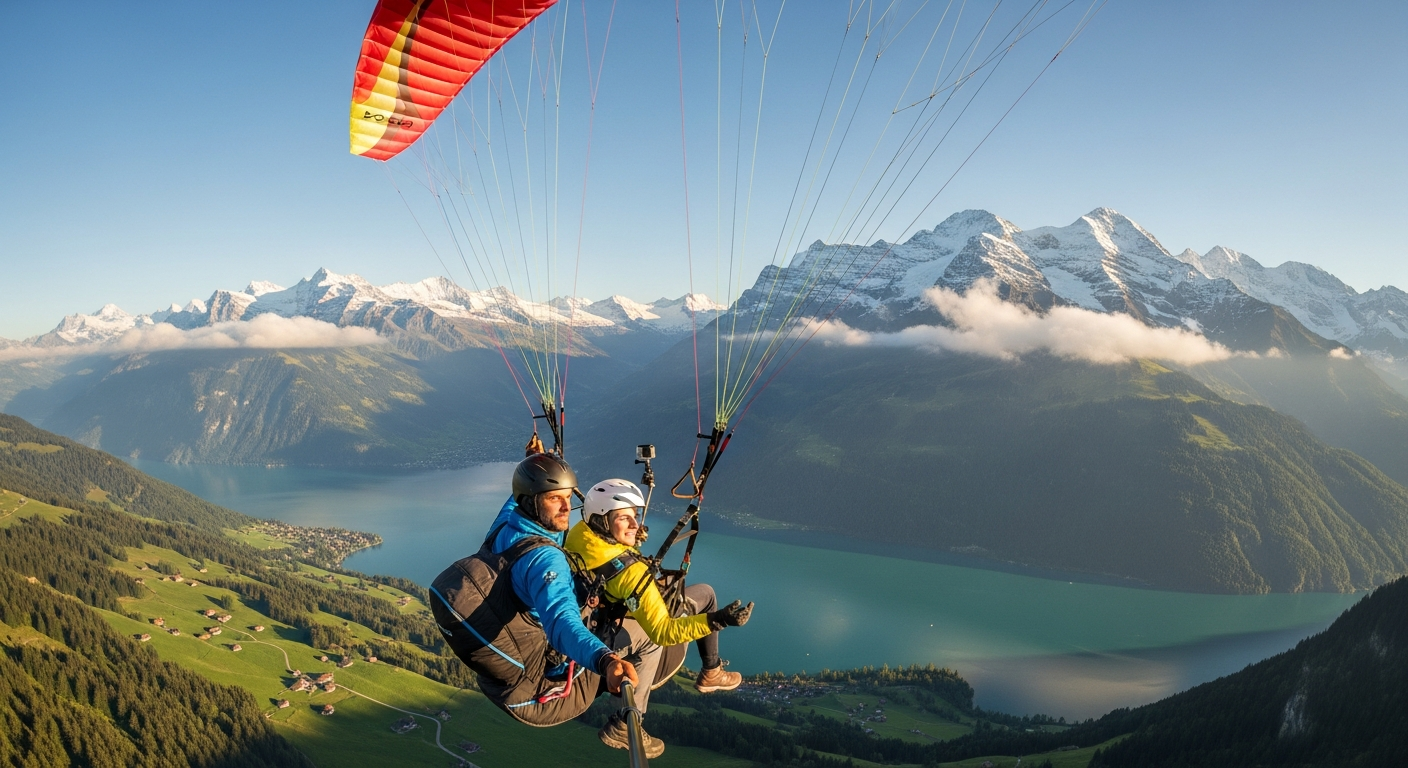
Picture this: you're gliding silently above turquoise lakes, snow-capped peaks stretching endlessly beneath you, and the realization hits that you're experiencing Switzerland from a perspective fewer than 1% of visitors ever will. Tandem paragliding in Interlaken transforms this dream into reality for thousands of adventurers annually. Whether you're a thrill-seeker or simply curious about seeing the world from 3,000 feet up, this activity has become the gold standard for Swiss Alps experiences.
Interlaken has earned its reputation as Europe's adventure capital, and tandem paragliding sits at the crown of its offerings. Unlike activities requiring months of training or elite fitness levels, paragliding welcomes everyone—from 8-year-olds to octogenarians. The experience pairs you with a certified pilot who handles every technical detail while you focus entirely on the magic unfolding around you. With ratings consistently hitting 4.9 stars and pricing starting at CHF 190, it's accessible, thrilling, and genuinely life-changing.
Why Interlaken Became the Paragliding Capital of Switzerland
Unique geographic positioning between two pristine lakes
Interlaken's location between Lake Thun and Lake Brienz creates a natural corridor that funnels air in ideal ways for paragliding. The two massive bodies of water moderate temperatures and generate thermal updrafts that pilots depend on. This geographic fortune isn't accidental—it's what makes the region so sought-after by experienced aviators worldwide.
Proximity to iconic peaks: Eiger, Mönch, and Jungfrau
The three legendary mountains dominate the skyline and create a visual spectacle that justifies the hype. Seeing these peaks from ground level is impressive; witnessing them from 3,000 feet while suspended in silence is transcendent. The amphitheater formed by these mountains naturally funnels wind patterns that favor consistent, reliable flying conditions.
Consistent thermal updrafts and favorable wind patterns for year-round flying
Thermal updrafts—columns of warm, rising air—are paragliding gold. Interlaken's mountain geography generates these naturally throughout much of the year. The valley orientation captures wind patterns that other Swiss locations simply cannot match, making flight schedules more predictable and cancellations less frequent.
What Happens During Your Tandem Paragliding Flight
Pre-flight briefing and safety orientation
Your adventure begins on the ground. A 5-10 minute briefing covers the fundamentals: how the equipment works, what to expect during takeoff and landing, and basic body positioning. The pilot answers every question—nervousness is normal, and professionals expect it. This groundwork transforms anxiety into confidence.
Harness fitting and secure attachment to pilot's equipment
The harness isn't a simple strap. Designed for comfort and security, it distributes weight evenly across your body while keeping you firmly connected to the pilot's parachute system. Once fitted, movement feels natural despite the technical engineering. The attachment points use redundant systems—if one fails, others keep you safe.
Running start down slope and moment of liftoff
The physical act of takeoff is gentler than most expect. You and the pilot run down a short slope together, building momentum. Within 10-20 meters, the wing catches air and suddenly your feet leave the ground. The transition from running to flying happens in seconds, yet it feels like the most natural thing in the world.
Safety Standards and Pilot Certification in Tandem Paragliding
International certification requirements for tandem pilots
Every pilot operating on Swissactivities.ch meets rigorous international standards. Certification requires hundreds of training hours, written exams, and practical demonstrations. These aren't casual weekend flyers—they're professionals who've invested years mastering their craft.
Regular equipment inspection and maintenance protocols
Paraglide equipment undergoes regular inspection cycles. Parachutes are packed by certified technicians. Lines are tested for wear. Harnesses are checked for damage. This preventative maintenance culture means equipment failures are extraordinarily rare events.
Dual-line safety harness systems and redundant attachment points
Modern tandem harnesses use multiple attachment systems. If one line fails, others remain intact. The design redundancy reflects how seriously the industry takes passenger safety. You're not being reckless—you're participating in one of aviation's safest activities.
Decoding the Costs: What's Included and Hidden Expenses
Base flight price: CHF 190 per person
The starting rate of CHF 190 covers the pilot, all safety equipment, and flight time. This isn't a budget option that cuts corners—it represents genuine value for a professional service. The price reflects fair compensation for certified pilots and proper equipment maintenance.
Transportation to launch site
Some packages include transportation from central Interlaken to the launch site; others don't. Clarify this when booking. The distance typically isn't far, but having clear expectations prevents disappointment.
Professional photo package costs and resolution options
Professional photos elevate the experience from memory to keepsake. Packages range from basic digital downloads to high-resolution prints. A photographer accompanying your flight captures moments you'll never replicate—these aren't cheap, but they're worth budgeting for if photography matters to you.
The Weather Factor: When You Can and Cannot Fly
Wind speed thresholds for safe takeoff and landing
Paragliding requires specific wind conditions. Too little wind and the wing won't generate enough lift; too much and landing becomes dangerous. Pilots maintain strict wind-speed thresholds that vary based on conditions and experience level. These limits exist to protect you, not to frustrate bookings.
Temperature inversions that create optimal thermal conditions
Temperature inversions—where cold air sits beneath warm air—create thermal updrafts. These conditions typically form on clear days with strong sun exposure. Early mornings and late afternoons often feature optimal flying windows, which is why many flights are scheduled during these periods.
Cloud ceiling requirements for visibility and safety
Clouds aren't just aesthetic concerns. They affect visibility and can harbor downdrafts that complicate flight. Pilots require minimum cloud ceilings—typically 800-1000 meters—to operate safely. If clouds are too low or storms approach, flights are postponed. This conservatism protects everyone.
Who Should (and Shouldn't) Try Tandem Paragliding
Age requirements and physical fitness expectations
Most operators accept participants from age 8 onwards. No serious physical conditioning is required—the pilot does all the work. You simply need to be able to run a short distance at takeoff and handle basic landing movements.
Fear of heights: why many people find paragliding surprisingly calm
Counter-intuitively, fear of heights often diminishes during paragliding. Being suspended in a harness feels secure. The gentleness of gliding contrasts sharply with the anxiety of looking down from a cliff. Many acrophobes report that tandem paragliding actually helped them process their fear.
Weight restrictions and harness sizing
Weight limits exist primarily for equipment safety, not discrimination. Harnesses come in various sizes and can accommodate different body types. Always disclose your weight accurately during booking—pilots size equipment accordingly to ensure comfort and safety.
Capturing Your Moment: Photography and Video Options
Professional photographer accompanying flight
Some packages include a photographer who flies alongside or behind you. They capture your expression, the landscape, and the raw emotion of the moment—images you couldn't create yourself.
High-resolution image packages and delivery timelines
High-resolution photos arrive within 1-2 weeks of your flight. Pricing varies based on quantity and format. Digital downloads cost less than prints, but prints hang on walls longer than digital files last on drives.
Video recording from pilot's perspective
Video from the pilot's camera provides a different perspective. Watching the full flight from start to landing adds context to still photography. Consider this add-on if you want to share the experience with people who couldn't be there.
Booking Your Flight: Timing, Platforms, and Guarantees
Direct booking through Swissactivities.ch platform
Reserve your flight directly through Swissactivities.ch for secure booking and transparent pricing.
The platform connects you with verified operators, eliminating middleman complications. Ratings and reviews come from genuine participants, providing real insight into operator quality.
Advance booking recommendations
Booking 1-2 weeks ahead ensures availability and allows time for schedule adjustments if weather forces postponement. Popular dates during summer months fill quickly, so advance planning pays dividends.
Same-day availability and walk-up options
While advance booking is smart, same-day flights sometimes open up if conditions are perfect and cancellations occur. Swissactivities.ch displays real-time availability, so checking in the morning of your visit can yield surprising options.
Preparing for Takeoff: What to Wear and Bring
Appropriate clothing layers for altitude temperature drops
Temperature drops roughly 1°C per 100 meters of altitude. At 3,000 feet, expect it to be significantly cooler than ground level. Wear layers you can adjust—a light jacket or fleece makes the difference between discomfort and enjoyment.
Closed-toe hiking boots or sturdy shoes
The running start requires solid footwear. Sandals or flip-flops invite injury. Bring hiking boots or sturdy athletic shoes designed for uneven terrain. Pilots appreciate passengers who arrive properly equipped.
Sunscreen and sunglasses recommendations
Altitude intensifies UV exposure. Apply sunscreen liberally before flight. Sunglasses protect your eyes and reduce glare that can cause headaches during extended observation. Bring a strap to keep glasses secured to your harness.
Beyond the Flight: Combining Paragliding with Other Interlaken Adventures
Proximity to hiking trails and mountain biking routes
Interlaken isn't one-dimensional. After paragliding, hiking trails crisscross the region. Mountain biking routes offer different adrenaline flavors. Multi-sport weekends are standard for serious adventurers.
Combination packages with canyoning or rafting
Some operators offer bundled packages combining paragliding with other water or mountain activities. These all-inclusive experiences let you sample multiple adventures without coordinating logistics separately.
Multi-day adventure itineraries
Plan a multi-day trip and combine paragliding with hiking, mountain biking, rock climbing, or kayaking. Interlaken's infrastructure supports intensive adventure weeks where each day brings a different thrill.
Your Swiss Alps Moment Awaits
Tandem paragliding in Interlaken transcends typical vacation activities—it's a transformative experience that rewires how you see mountains, lakes, and yourself. The combination of safety excellence, world-class scenery, and genuine accessibility makes this adventure worth the investment. Whether you're celebrating a milestone, conquering a fear, or simply chasing an unforgettable memory, those 10-20 minutes suspended above the Swiss Alps will echo through your life for years.
The 4.9-star ratings aren't marketing hype; they're validation from thousands of real people who've stood exactly where you're standing now, nervous and excited. The certified pilots have logged thousands of flights. The equipment meets rigorous international standards. The views are genuinely as spectacular as every photo suggests.
Don't let another season pass wondering what you're missing. Your future self—the one who'll replay this flight in their mind forever—is counting on you.
Visit Swissactivities.ch today, check the weather forecast, and secure your spot in the clouds.
Leave a Reply