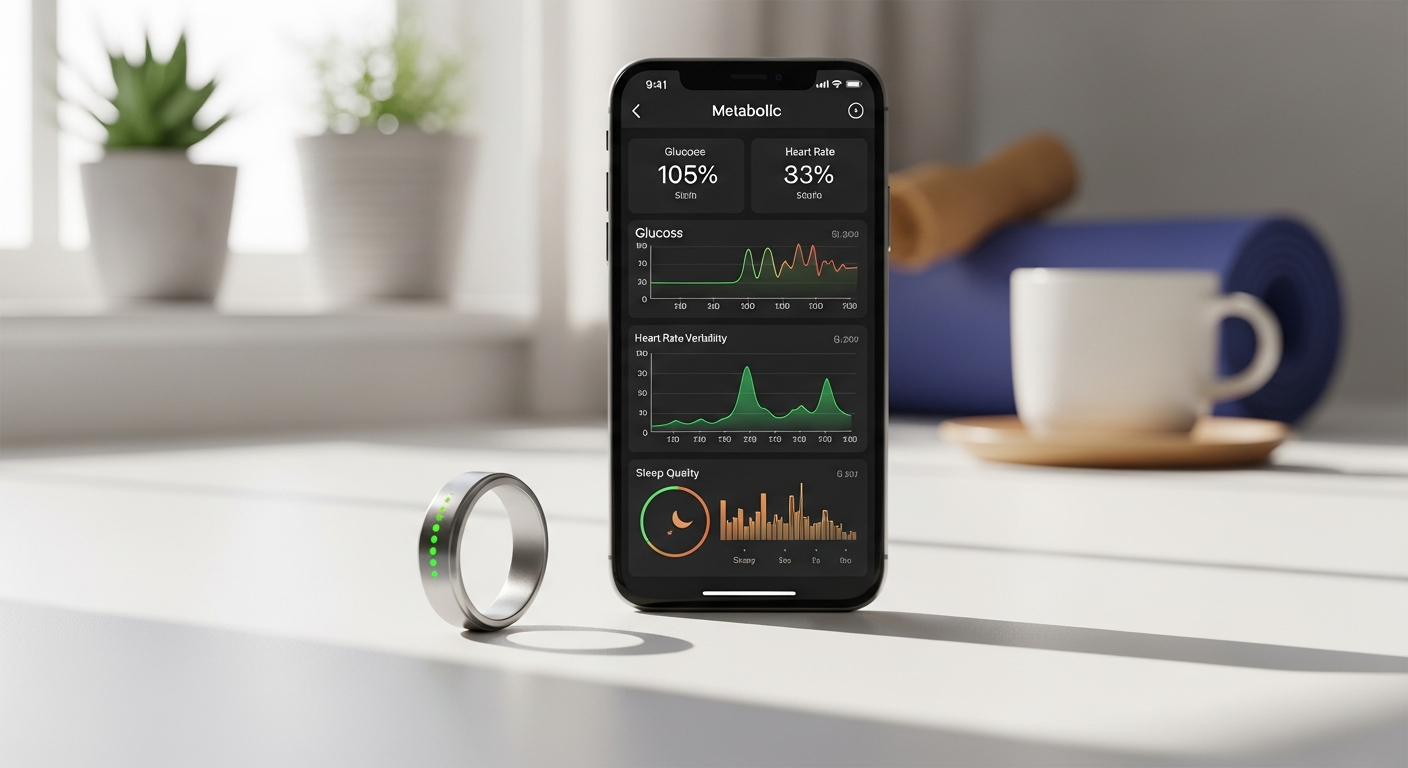
Your health tracker collects thousands of data points, but you still don't know why you crash at 3 PM or why you sleep like a rock one night and toss all night the next. This is the paradox of modern wearables: more data, zero clarity. The Ultrahuman Ring AIR breaks that cycle by doing something radical—it connects your glucose patterns to your sleep, your heart rate variability to your recovery, creating a metabolic intelligence system that actually explains what's happening inside your body.
The fitness tracker industry has a dirty secret. Seventy percent of people who buy these devices abandon them within six months because the metrics feel disconnected from their actual lives. They're drowning in step counts and calorie burns while their real metabolic health remains invisible. The Ring AIR represents a fundamental departure from this approach. Rather than counting activity for activity's sake, Ultrahuman Healthcare built a flagship device that prioritizes metabolic signals—the biological markers that actually determine your energy, sleep quality, and recovery capacity.
This guide examines exactly how the Ring AIR transforms health tracking for serious biohackers, athletes, and metabolic optimizers. You'll understand the specific advantages of CGM integration, discover who genuinely benefits from this ecosystem approach, and identify the real limitations before committing $349 to your wrist. By the end, you'll know precisely whether this device aligns with your health objectives or if a traditional tracker better serves your needs.
Explore the Ultrahuman Ring AIR and start your metabolic optimization journey today.
How CGM Integration Elevates the Ring AIR Beyond Standard Wearables
Glucose-Sleep Connection Reveals Hidden Recovery Patterns
Your glucose stability directly impacts sleep quality, but most wearables never make this connection. The Ring AIR paired with Ultrahuman's M1 or M2 continuous glucose monitors reveals exactly how glucose spikes correlate with sleep disruption. A sudden spike at 7 PM might explain why you're waking at 2 AM. This glucose-sleep relationship transforms generic sleep advice into personalized interventions. Instead of being told "get better sleep," you receive specific recommendations: avoid carbohydrates within three hours of bedtime, time your meals around your personal glucose response, or adjust your workout intensity based on your metabolic state.
Cross-Signal Pattern Recognition Creates Metabolic Stress Intelligence
One glucose reading means nothing. One HRV reading means nothing. But when the Ring AIR combines glucose trends with heart rate variability, skin temperature changes, and activity data, patterns emerge that reveal your true metabolic stress state. The app identifies when you're actually recovered versus when you're operating on fumes despite feeling fine. This cross-signal analysis catches what single-metric trackers miss: the athlete whose HRV looks excellent but whose glucose volatility signals deep metabolic stress, or the person whose sleep appears restful but whose glucose dysregulation is silently accelerating aging.
Seamless Ecosystem Setup with M1 and M2 Compatibility
The Ring AIR doesn't exist in isolation. Integration with Ultrahuman's M1 and M2 CGMs creates a unified data ecosystem. Pairing is straightforward—install the app, authorize the connection, and the system automatically synchronizes glucose data with your ring metrics. No manual logging. No jumping between apps. The ecosystem approach eliminates the fragmentation that plagues most wearable users who cobble together disconnected devices and apps. One unified platform means one source of truth for your metabolic data.
Actionable Metabolic Insights Replace Generic Health Advice
Generic health advice fails because it ignores individual variation. The Ring AIR eliminates guessing by providing specific, personalized recommendations based on your actual glucose response to foods and activity. The app learns your metabolic signature—how your body responds to different macronutrient ratios, meal timing, exercise intensity, and stress levels. Over weeks, you discover that you metabolize carbohydrates differently at breakfast versus dinner, or that your afternoon energy crash correlates with a specific food. This specificity drives behavior change because the insights directly address your unique metabolic needs.
Early Illness Detection Through Glucose Volatility Signals
Before symptoms appear, your body signals distress through metabolic changes. The Ring AIR flags this early warning system by detecting unusual glucose volatility and HRV shifts that often precede infection or illness. Users report receiving alerts about emerging colds or flu days before traditional symptoms manifest, allowing preventive intervention before full-blown illness strikes. This predictive capability transforms the device from a fitness tracker into an early warning system for metabolic disruption.
Personalized Energy Optimization Around Your Metabolic Signature
Energy management is metabolic timing. The Ring AIR provides specific recommendations for meal timing, workout scheduling, and recovery windows based on your individual glucose patterns and circadian biology. Rather than generic "eat before workouts" advice, you receive personalized guidance: workout during your natural energy peak at 10 AM when your glucose handling is optimal, eat your largest meal when your metabolic flexibility peaks, or schedule recovery activities during your natural energy dips. This alignment with your metabolic rhythm multiplies the effectiveness of every decision.
Start optimizing your metabolic timing with the Ultrahuman Ring AIR today.
Design and Durability: Why Comfort Matters for 24/7 Metabolic Tracking
Lightweight Construction Eliminates Wearing Friction
Comfort isn't a luxury when you're tracking 24/7. The Ring AIR's lightweight design means you forget you're wearing it—and that's the point. Traditional smartwatches feel heavy by comparison, creating awareness that interrupts sleep or irritates during extended wear. Lightweight construction directly impacts data quality because a ring you're conscious of wearing often gets removed prematurely, creating tracking gaps. The minimalist design ensures continuous skin contact, which means more accurate temperature monitoring and consistent HRV readings throughout sleep cycles.
Premium Material Options Balance Aesthetics with Durability
The Ring AIR offers titanium for maximum durability and minimal weight, 18K gold for luxury aesthetics, and platinum for those demanding both elegance and longevity. Material choice affects both comfort and psychological ownership. Users report higher adherence when wearing a device they consider visually appealing rather than purely functional. The premium material options eliminate the visual compromise between health tracking and personal style—you're not sacrificing appearance for data collection.
Water Resistance Handles Real-World Environments
Daily life includes showers, swimming pools, rain, and sweat-drenched workouts. The Ring AIR's water resistance handles all of these without hesitation. Unlike some fitness trackers that require removal during aquatic activities, the Ring AIR continues tracking even in the shower, capturing skin temperature and recovery metrics during activities when this data is most valuable. Users report confidence wearing the device in any environment without worrying about water damage.
Sizing Precision Directly Impacts Tracking Accuracy
A ring that's too loose slides around, creating inconsistent skin contact and poor temperature readings. A ring that's too tight restricts circulation. The free sizing kit solves this problem by mailing you a set of sizing rings in all available sizes, allowing you to determine your perfect fit before purchasing. This precision matters because improper sizing degrades the tracking accuracy that justifies the investment. Ultrahuman's attention to sizing detail distinguishes it from competitors who assume one-size-fits-most approaches.
Comfort During Sleep Supports Quality Data Collection
You can't improve sleep tracking by disrupting actual sleep. The Ring AIR's minimal profile means wearing it through entire sleep cycles without triggering the awareness that causes people to remove devices mid-sleep. Uninterrupted 8-hour wearing periods capture complete sleep architecture data—REM, deep sleep, light sleep, and awake periods—that fragmented tracking sessions never achieve. Sleep comfort directly translates to data completeness, which determines the quality of recovery insights.
High-Impact Activity Limitations Require Awareness
Rock climbing and heavy weightlifting create compression forces that the Ring AIR isn't designed to handle. Users attempting deadlifts with maximum grip pressure or rock climbing with intense hand trauma have experienced ring damage. This limitation isn't a defect—it's a design tradeoff. The Ring AIR prioritizes comfort and metabolic tracking precision over extreme durability for impact sports. Powerlifters or climbers need alternative solutions or must remove the ring during these specific activities.
Battery Life and Practical Convenience for Frequent Travelers
Six-Day Battery Performance Handles Real-World Usage
Most smartwatches demand daily charging. The Ring AIR delivers six days on a single charge, a genuine advantage that separates it from traditional wearables. Six-day battery life means business travelers can complete a five-day trip without packing a charger. Weekend warriors can trek into the wilderness without battery anxiety. Real-world usage confirms that six days translates to actual continuous wearing without interruption, capturing the data continuity that makes metabolic tracking meaningful.
Charging Frequency Advantage Over Traditional Smartwatches
Apple Watch requires daily charging. Most fitness trackers demand daily or every-other-day attention. Ring AIR's six-day cycle means charging becomes a weekend ritual rather than daily friction. This practical advantage compounds over time—the saved charging moments accumulate into hours annually, while the reduced charging habit reduces charging-related cable clutter and device dependency anxiety. The longer interval between charges means fewer opportunities for people to abandon the device mid-charge.
Travel Advantages Eliminate Charging Anxiety
International trips across multiple time zones create logistical challenges for daily-charging devices. Ring AIR's six-day capacity eliminates this friction entirely. A two-week vacation requires one charge mid-trip, and the extended battery means that charge can happen on a convenient travel day rather than forcing daily planning around device management. Business professionals report that not carrying a smartwatch charger reduces luggage weight and eliminates one potential failure point during complex travel.
Data Continuity Ensures Uninterrupted Tracking
Interrupted tracking creates gaps in your metabolic baseline. Six-day battery life means continuous data collection across entire weeks without breaks. This continuity reveals patterns that daily-charging devices miss—the multi-day progression of glucose sensitivity, the week-long recovery cycles from intense training, or the gradual metabolic shifts from traveling across time zones. Unbroken data streams create the historical patterns that generate the most actionable insights.
Battery Reliability: Addressing Reported Inconsistencies
Some early users reported inconsistent battery performance, with some units dropping below the advertised six-day capacity. Ultrahuman has addressed these issues through firmware updates and improved manufacturing processes. Current units show consistent performance aligned with marketing claims. Users should understand that battery longevity degrades gradually—the device will still function after two years of use but might drop from six days to five days, which remains competitive with most alternatives.
Charging Method and Dock Design Prioritize Convenience
The proprietary charging dock charges quickly and securely without fragile contacts exposed to damage. The magnetic attachment means no fumbling with plugs or orientation concerns—place the ring on the dock and charging begins automatically. This practical convenience eliminates one of the minor annoyances that drives device abandonment. A charging experience that requires no thought becomes invisible convenience rather than daily friction.
The Ultrahuman App: Transforming Raw Data into Behavioral Change
Dashboard Organization Requires Initial Learning Curve
The Ultrahuman app is information-rich, which creates an initial complexity challenge. New users navigating for the first time encounter multiple sections, numerous metrics, and layered data visualization. This learning curve differs from the intuitive simplicity of basic fitness apps that show only steps and calories. However, the payoff justifies the initial investment. Once you understand the layout, the organization becomes logical and navigable. The app rewards exploration with increasingly specific insights as you spend time understanding the interface.
Sleep Quality Analysis Transcends Duration Metrics
The app tracks REM sleep, deep sleep, light sleep, and sleep transitions, revealing sleep architecture that basic duration metrics never capture. You might sleep seven hours but spend only 45 minutes in deep sleep—the truly restorative stage. The app highlights this distinction, explaining that your sleep problem isn't quantity but quality. It identifies which nights generated genuine recovery and which nights left you depleted despite adequate hours. This granularity changes how you interpret sleep data and drives targeted interventions to improve the most impactful sleep stages.
HRV Trending Reveals Recovery and Stress Patterns
Heart Rate Variability measures the variation between heartbeats—a higher HRV indicates parasympathetic dominance and genuine recovery, while low HRV suggests sympathetic dominance and stress. The app tracks HRV trends across days and weeks, revealing how training intensity, sleep quality, and life stress accumulate. You discover that your HRV drops predictably after high-intensity training, recovers within 24-36 hours, and provides a reliable signal for whether you're ready for another intense session. This insight transforms HRV from an abstract metric into a practical tool for training decisions.
Activity Insights Integrate Movement with Metabolic Recovery
The app doesn't just count steps—it connects your movement to your metabolic recovery state. It identifies when your activity actually generated training stimulus versus when you were moving but not stressed enough to trigger adaptive responses. This distinction matters because high-volume, low-intensity activity can mask metabolic fatigue, while strategic brief high-intensity efforts might be more effective for your current recovery state. The app guides you toward movement that aligns with your metabolic capacity.
Data Visualization Through Charts and Graphs Reveals Personal Patterns
Raw numbers mean nothing. The app visualizes your metrics through intuitive charts that reveal patterns across days and weeks. You see the immediate impact of sleep deprivation on glucose volatility. You watch HRV collapse during high-stress work weeks and recover during vacations. You notice that specific meals consistently trigger glucose spikes while others maintain stability. These visual patterns create the "aha" moments that transform abstract metrics into behavior change. Most importantly, pattern recognition happens faster visually than it ever could with numerical data.
Update Frequency and UI Changes Require Ongoing User Adaptation
The Ultrahuman app updates regularly with feature additions and interface improvements. This continuous development keeps the app current and competitive, but it also means periodic layout changes that require relearning. Some users find this adaptation frustrating, preferring a stable interface they've already mastered. The tradeoff is that stagnant apps eventually feel outdated. Ultrahuman's approach prioritizes long-term evolution over static simplicity.
Integration with Apple Health, Google Fit, and Third-Party Platforms
Data isn't useful if it remains isolated. The app integrates with Apple Health and Google Fit, allowing your Ring AIR metrics to flow into other health applications you use. This ecosystem approach means your glucose, sleep, and HRV data can feed into coaching apps, training platforms, or medical applications without manual export. The integration extends the utility of your data beyond Ultrahuman's ecosystem.
Real-World Performance: Who Benefits Most from This Investment
High-Performance Athletes and Competitive Teams
The Ring AIR has been adopted by elite athletes and high-performance teams seeking competitive advantages in recovery optimization. These users generate the revenue and validation that drives Ultrahuman's success. For this population, the device's glucose-sleep connection and recovery insights justify the $349 investment through improved training decisions. Athletes report that Ring AIR insights prevent overtraining, optimize recovery timing, and identify when they're genuinely ready for peak performance efforts. High-performance investment in marginal gains makes the Ring AIR a practical tool rather than a discretionary purchase.
Metabolic Health Optimizers Tracking Glucose Response
People managing metabolic health—whether pursuing weight loss, optimizing energy, or addressing insulin resistance—find genuine value in glucose tracking paired with sleep and HRV data. The Ring AIR reveals how their specific metabolic type responds to different eating patterns, exercise timing, and stress management. This personalization eliminates frustration from generic diet advice that doesn't match their individual glucose patterns. For metabolic optimizers, the device becomes an educational tool that teaches their body's specific language.
Sleep Quality Seekers Addressing Disruption Issues
Chronic sleep issues—whether insomnia, fragmented sleep, or poor sleep quality—respond particularly well to Ring AIR insights. Users discover that glucose spikes at 9 PM trigger midnight wakefulness, or that evening cortisol dysregulation prevents deep sleep entry. Armed with these specific insights, they implement targeted interventions: glucose stabilization before bed, cortisol-management practices during specific windows, or timing adjustments for evening activities. Sleep improvement from baseline becomes measurable and attributable to specific behavior changes, maintaining motivation for ongoing optimization.
Biohackers and Quantified Self Enthusiasts
The biohacking community values granular data and the ability to test hypotheses about personal biology. The Ring AIR appeals to this population through its comprehensive metrics, ecosystem approach, and detailed app insights. Biohackers report running self-experiments—testing the metabolic impact of different supplements, evaluating how specific exercise protocols affect recovery, or exploring dietary interventions' effects on glucose stability. The device provides the measurement tools that transform self-experimentation from guessing into data-driven biology.
Corporate Wellness Programs Adopting for Team Performance
Forward-thinking companies implement Ring AIR programs for performance-focused initiatives. Employees wearing the device collectively improve recovery quality, reduce stress-induced metabolic dysregulation, and optimize team energy management. The corporate approach delivers benefits beyond individual health—improved team performance, reduced sick days, and measurable productivity improvements. For organizations pursuing wellness beyond step-counting programs, the Ring AIR represents a genuine intervention with measurable outcomes.
Budget Considerations Weigh Price Against Metabolic Advantages
At $349, the Ring AIR sits at the premium end of wearable pricing. This cost isn't trivial for casual fitness enthusiasts who want basic activity tracking. The investment makes sense only when the specific advantages—CGM integration, deep sleep analysis, metabolic insights, and ecosystem benefits—address genuine health priorities. For people primarily interested in step counting and basic activity tracking, traditional fitness trackers at half the price deliver adequate functionality. Budget-conscious consumers must honestly assess whether the device's specific capabilities justify the premium.
Not Ideal for Casual Fitness Trackers, High-Impact Athletes, or Budget-Conscious Buyers
The Ring AIR is overly sophisticated for someone wanting a simple step counter. It's inadequate for rock climbers or weightlifters requiring durability for impact activities. And it's overpriced for budget-conscious buyers prioritizing cost over capability. Understanding who the device isn't designed for prevents mismatches between expectations and reality. A casual runner wanting basic activity metrics will find the Ring AIR unnecessarily complex. A powerlifter will risk damaging the device. A budget shopper will resent the premium pricing. These mismatches explain dissatisfaction better than device defects.
Ecosystem Reliability and Known Limitations
Device Pairing Issues with Multiple Ultrahuman Products
Some users report challenges when pairing the Ring AIR with multiple Ultrahuman devices simultaneously. Bluetooth connection drops, inconsistent data synchronization, and occasional app crashes plague a small percentage of users attempting to connect the ring with a CGM monitor and other Ultrahuman products. These issues appear more common during app updates or when multiple devices attempt data uploads simultaneously. Users operating single-device setups report fewer problems, while users building comprehensive Ultrahuman ecosystems sometimes encounter reliability friction.
App Stability During Updates Sometimes Creates Temporary Bugs
Regular app updates occasionally introduce temporary bugs affecting data display, tracking functionality, or device connectivity. These issues typically resolve within days as Ultrahuman releases patches, but the interim period can frustrate users. The tradeoff between rapid feature development and update stability creates occasional friction. Users should anticipate brief periods of app instability following major updates and exercise patience while issues resolve.
Ring Bloating: A Documented but Rare Swelling Issue
A small percentage of users have reported the ring developing a "bloating" or swelling issue after extended wear, where the ring expands slightly, affecting fit and potentially impairing sleep tracking. This appears to be a rare manufacturing issue affecting specific units rather than a design defect in the entire product line. Ultrahuman addresses this through warranty replacement, but the phenomenon exists and represents a known limitation. Users experiencing this issue receive replacement devices, but the issue creates uncertainty about long-term reliability for a small user population.
Data Accuracy Validation Compares Ring AIR Metrics Against Clinical Standards
Clinical validation studies comparing Ring AIR measurements against gold-standard laboratory equipment show strong correlation for sleep tracking, reasonable accuracy for HRV measurement, and good performance for basic activity counting. The glucose data itself comes from the CGM (Ultrahuman M1 or M2), which is independently validated. The Ring AIR's value lies not in ground-truth measurement—which it doesn't claim—but in consistent baseline tracking that reveals personal patterns. As long as the device measures consistently from day to day, absolute accuracy matters less than relative trending.
Customer Support Responsiveness Determines Experience When Issues Arise
Ultrahuman's customer support quality directly impacts user experience when problems occur. Responses are typically available within 24 hours, with technical troubleshooting provided efficiently. Warranty replacements for defective units process smoothly. However, support responsiveness varies by region, and some users report longer wait times during high-volume periods. The quality of customer experience during problem resolution often determines whether temporary issues become permanent dissatisfaction.
Warranty and Replacement Process Covers Specific Scenarios
The Ring AIR includes a standard manufacturer's warranty covering manufacturing defects and hardware failures. The warranty covers bloating issues, battery failures, and sensor malfunctions. It doesn't cover physical damage from impact activities, intentional misuse, or normal wear. Users should understand warranty scope before purchase and maintain their receipt and proof of purchase for warranty claims.
Comparing Ring AIR to Alternative Smart Health Trackers
Versus Oura Ring Gen 3: Sleep Tracking Depth and Battery Life
The Oura Ring Gen 3 is the Ring AIR's primary competitor, offering similar form factor and comparable battery life (up to six days with Oura). Oura focuses exclusively on sleep tracking and recovery metrics without CGM integration. The comparison reveals distinct philosophies: Oura optimizes the sleep tracking experience to perfection, while Ring AIR adds glucose data and broader metabolic context. For users prioritizing sleep data accuracy above all else, Oura's specialized approach might edge out Ring AIR. For users wanting metabolic integration, Ring AIR wins decisively. Oura costs $299—$50 less than Ring AIR—making it the budget option for ring-based tracking.
Versus Apple Watch Series 9: Ecosystem Integration and Daily Usability
The Apple Watch Series 9 offers vastly broader capability—notifications, payments, fitness apps, health monitoring, and seamless Apple ecosystem integration. However, it requires daily charging, lacks CGM integration, and provides less detailed sleep analysis. For iPhone users deeply embedded in Apple's ecosystem, the Watch's daily utility might justify its drawbacks. For users prioritizing metabolic tracking and extended battery life, the Ring AIR's specialization wins. The Apple Watch is a general-purpose device that does everything adequately; the Ring AIR is a specialized device that does metabolic tracking exceptionally well.
Versus Whoop Band: Recovery Focus and Subscription Model Differences
The Whoop Band focuses on recovery and training readiness through HRV and strain metrics. Unlike Ring AIR, Whoop operates on a subscription model ($30/month), making long-term usage costly. Whoop's recovery insights are excellent, but integration with glucose data—the Ring AIR's unique advantage—is absent. For athletes prioritizing training optimization without glucose tracking, Whoop might suffice. For metabolic optimizers wanting the glucose-recovery connection, Ring AIR's one-time purchase justifies the upfront cost over Whoop's recurring fees.
Versus Fitbit Premium: Activity Tracking and Heart Health Monitoring
Fitbit Premium provides activity tracking, heart health monitoring, and sleep analysis with a $10/month subscription. The Fitbit ecosystem is accessible and beginner-friendly, making it excellent for casual users. However, Fitbit lacks the ring form factor advantage, CGM integration, and deep metabolic insights that define Ring AIR. Fitbit operates at the mass-market end of the spectrum, emphasizing accessibility over sophistication. Ring AIR targets users who value depth and specialization over simplicity and accessibility.
Unique Advantages: What Ring AIR Accomplishes That Competitors Cannot
The Ring AIR's irreplaceable advantage is CGM integration—the glucose-sleep-recovery connection that creates metabolic intelligence. No competitor offers this specific ecosystem. The ring form factor eliminates the visual trade-offs of wrist-worn devices while delivering superior comfort for 24/7 wear. Six-day battery life combined with ring form factor creates a use case—especially for travelers—that traditional smartwatches can't match. The Ultrahuman ecosystem approach, particularly when combined with M1 or M2 CGMs, creates feedback loops about metabolic health that isolated devices never achieve.
Trade-offs to Consider: Where Traditional Smartwatches Might Serve Better
Users wanting daily notifications, payment capability, or general smartwatch features should choose an Apple Watch or similar device rather than Ring AIR. Users prioritizing absolute lowest cost should select Fitbit or basic fitness trackers. Users wanting the most accurate sleep tracking specifically should consider Oura. Users needing durability for high-impact sports should choose alternatives designed for that purpose. The Ring AIR excels in a specific niche—metabolic tracking for committed optimizers—rather than being a universal device.
Maximizing Your Investment: Setup, Optimization, and Best Practices
Initial Setup Process: Sizing Kit, App Installation, and Configuration
Ring setup begins with ordering the free sizing kit, which arrives within five business days. Try on each sizing ring (you'll receive approximately ten sizes) to determine your perfect fit. Order your selected size and material. Upon arrival, install the Ultrahuman app, create an account, and follow the initial configuration wizard. The process takes approximately 15 minutes and is straightforward enough for non-technical users. Take time during setup to explore the app's main sections rather than rushing through basic configuration.
Optimal Placement and Wearing Position Affects Tracking Accuracy
The ring performs best when worn consistently on the same finger throughout each day and night. Most users prefer the ring finger or middle finger for comfort. Thumb wearing sometimes causes sleep disruption due to natural sleep position stress. Index finger wearing creates typing friction for office workers. Consistency matters more than specific finger selection—if you change fingers frequently, the app's personal baseline calibration becomes unreliable. Wear your ring in the same location daily, and let the app build personalized reference metrics around that position.
Integrating with Your CGM: Step-by-Step Pairing with M1 and M2 Monitors
If you're purchasing an Ultrahuman M1 or M2 CGM to create the full ecosystem, pairing is managed through the app. Open your CGM settings within the app, select "Add CGM," authorize the connection, and the data synchronization begins automatically. Subsequent glucose readings automatically populate in your metabolic dashboard, creating the glucose-sleep-HRV connections that define the Ring AIR's unique value. If you're using a third-party CGM, manual export-import functionality allows data integration, though automatic synchronization provides superior user experience.
Establishing Baseline Metrics During the First Week
The app learns your personal metabolic baseline during the first week of wear. Consistency matters—wear the ring continuously, use the app daily to review insights, and avoid major behavioral disruptions during this calibration period. The baseline period establishes your normal HRV range, typical sleep patterns, and baseline glucose sensitivity. Once the baseline establishes, the app's recommendations and alerts become personalized to your specific biology rather than population averages.
Using Insights for Behavior Change: Translating Metrics into Daily Decisions
Data collection means nothing without action. The power of Ring AIR emerges when you use insights to drive specific behavior changes. Notice that glucose spikes at 7 PM? Implement a post-dinner walk to enhance glucose clearance. See HRV collapse after high-intensity training? Schedule recovery activities on those days. Identify that sleep quality drops after evening coffee? Implement a 2 PM caffeine cutoff. Each insight generates a testable hypothesis about your metabolism. Implement one change at a time and monitor the results across 3-7 days before adding additional interventions.
Regular Maintenance: Cleaning, Battery Care, and Longevity Practices
Rinse your Ring AIR under clean water weekly to remove skin oils, sweat residue, and environmental contaminants that degrade sensor accuracy. Use a soft cloth to dry completely. Avoid harsh chemicals or abrasive materials. Charge the device at least twice weekly to maintain battery health—leaving the device completely discharged for extended periods degrades battery capacity. Store the ring in a dry environment away from extreme temperatures. These simple maintenance practices extend device longevity and preserve tracking accuracy.
Troubleshooting Common Issues: Connectivity, Tracking Gaps, and App Problems
If the ring loses Bluetooth connection, restart the app and ensure Bluetooth is enabled on your smartphone. If tracking gaps appear (hours missing from your sleep or activity record), check that the ring was worn continuously and had active Bluetooth connectivity. If the app crashes repeatedly, force close the app completely, clear the app cache, and reopen it. If these steps don't resolve the issue, restart your smartphone entirely. If tracking accuracy seems degraded, verify that you're wearing the ring on the same finger in the same position as your baseline week. Most issues resolve through these standard troubleshooting approaches.
The Metabolic Tracking Revolution Starts Here—But Only If You're Ready
The Ultrahuman Ring AIR represents a genuine breakthrough in personal health monitoring. It transcends the limitations of traditional fitness trackers by building a metabolic intelligence system that connects glucose patterns to sleep quality, recovery capacity, and daily energy. Most wearables collect data; the Ring AIR collects meaning.
Your body contains biological signals that reveal your true metabolic state—glucose stability, heart rate variability, sleep architecture, and recovery capacity. For decades, these signals were invisible unless you spent thousands on clinical testing. The Ring AIR democratizes this intelligence, delivering clinical-grade metabolic insight through a ring you barely notice wearing. The technology works. The ecosystem approach creates insights that isolated devices cannot match. The 4.4-star rating from over 500 Amazon reviews confirms that real users experience real results.
This investment makes sense only if you're genuinely ready to engage with metabolic data and translate insights into behavior change. If you want a simple step counter, save your money—traditional fitness trackers cost less and serve that purpose adequately. But if you're serious about optimizing sleep, improving energy stability, or understanding your metabolic health at a deeper level, the Ring AIR delivers insights that justify the $349 price point.
Start with proper sizing, commit to learning the app's interface during your first week, and prepare to discover patterns about your metabolism you've never noticed. The data you collect today becomes the personalized insights that reshape your health decisions tomorrow. Your future metabolic health depends on understanding your current metabolic patterns.
Take control of your metabolic health with the Ultrahuman Ring AIR today.
Leave a Reply