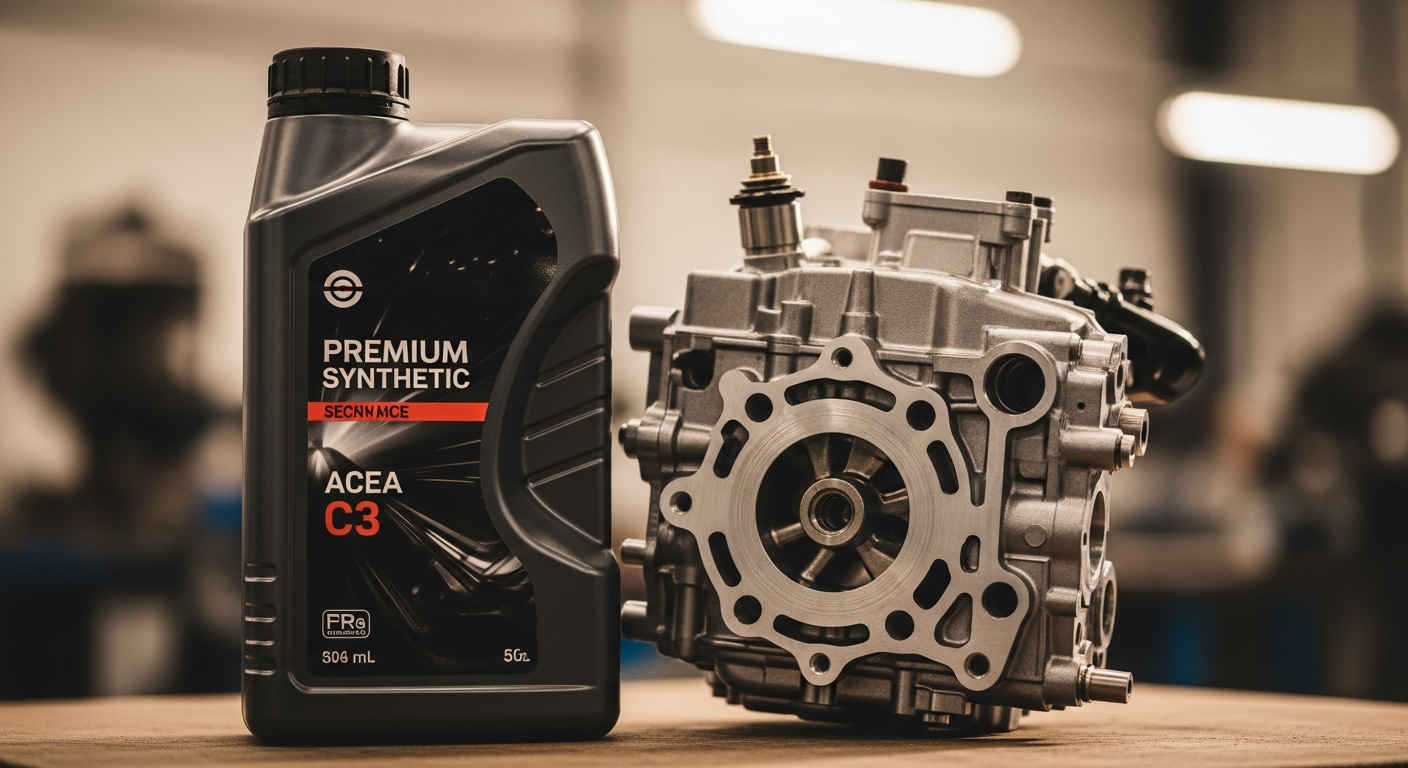
Modern European diesel engine with DPF system and ACEA C3 compliant synthetic oil bottle

Why European Diesel Owners Trust ACEA C3 Compliant Synthetic Engine Oil for Emission System Protection

Modern European diesel engines face a critical challenge: balancing raw power with increasingly strict emissions regulations. Over 60% of new European vehicles now rely on DPF-equipped engines, making the choice of engine oil far more consequential than it was a decade ago. The wrong lubricant can clog your particulate filter, trigger expensive warning lights, and tank your fuel economy—all within months.

That’s where ACEA C3 compliant synthetic engine oil steps in. Developed by the European Automobile Manufacturers’ Association, this specification represents a watershed moment in automotive lubrication. These aren’t generic oils slapped with a fancy label; they’re preciselwy engineered formulations with controlled ash, phosphorus, and sulfur content that work with your emission control systems rather than against them.

Discover ACEA C3 compliant oils that meet European standards

Understanding the ACEA C3 Specification and Mid-SAPS Technology

What the ACEA C3 designation means and who sets these standards

The European Automobile Manufacturers’ Association (ACEA) establishes rigorous performance benchmarks for engine oils sold across Europe. When an oil carries the C3 designation, it signals compliance with specific technical requirements designed for modern engines with advanced emission control systems. This isn’t bureaucratic busywork—it’s the result of decades of engineering refinement and industry collaboration.

The critical difference between mid-SAPS and high-SAPS formulations

SAPS stands for Sulfated Ash, Phosphorus, and Sulfur—components that accumulate in an engine over time. High-SAPS oils (the older standard) contained elevated levels of these substances, which worked fine for engines built decades ago. Mid-SAPS formulations, the hallmark of ACEA C3, restrict these components significantly. This controlled approach prevents ash buildup that would otherwise clog diesel particulate filters and deactivate three-way catalytic converters.

How sulfated ash, phosphorus, and sulfur levels affect DPF longevity

Diesel particulate filters trap soot particles to reduce emissions. Excessive ash from engine oil oxidation accelerates filter saturation, forcing regeneration cycles that stress the engine and consume fuel. Phosphorus, while essential for engine protection, can form glassy deposits on DPF surfaces at high temperatures. Sulfur contributes to corrosive compounds. ACEA C3 oils limit all three: sulfated ash to a maximum of 1%, phosphorus to 0.1%, and sulfur to 0.4%. These tighter tolerances mean your DPF stays cleaner longer.

Why low-ash formulations prevent emission system clogging

The ash that remains after fuel combustion enters the crankcase and mixes with oil. In high-SAPS oils, this accumulation thickens the oil and eventually leaves deposits throughout the system. Low-ash ACEA C3 formulations reduce this problem substantially, allowing emission systems to function at peak efficiency without premature clogging that triggers expensive regeneration cycles or complete filter replacement.

Viscosity grades and stay-in-grade stability under extreme conditions

ACEA C3 oils come in several viscosity grades: 5W-30, 5W-40, 0W-30, and 0W-40. The first number (5W or 0W) indicates cold-start performance; the second number (30 or 40) shows high-temperature viscosity. Stay-in-grade means the oil maintains its protective properties even when engines push toward their thermal limits. Modern turbocharged engines create extreme shear forces that can thin ordinary oils; ACEA C3 formulations resist this degradation.

High Temperature/High Shear (HT/HS) performance metrics and what 3.5 cP means

High Temperature/High Shear viscosity measures how well an oil protects metal surfaces when an engine is running flat out. The ACEA C3 specification requires a minimum HT/HS viscosity of 3.5 centipoise (cP). This number guarantees that even under maximum stress—sustained highway driving, steep climbing, aggressive acceleration—your oil won’t thin beyond safe protective limits. It’s the difference between an engine that survives 200,000 miles and one that seizes prematurely.

Comparison of ACEA C3 against older specifications (ACEA B4, C2)

ACEA B4, the predecessor specification, allowed much higher SAPS levels and worked well for older diesel engines without emission systems. ACEA C2 represents a lighter, lower-viscosity alternative to C3 that some manufacturers specify for fuel economy optimization, but it offers less protection for high-stress applications. C3 strikes the balance: strict enough to protect modern emission systems, robust enough to defend today’s turbocharged engines against wear and sludge accumulation.

Which Vehicles Actually Require ACEA C3 Oils

Modern European diesel engines with DPF systems (Mercedes, BMW, Audi, Volkswagen)

Nearly every diesel vehicle produced by German premium manufacturers in the last decade demands ACEA C3 compliance. Mercedes-Benz, BMW, Audi, and Volkswagen all specify this standard in their owner’s manuals for good reason: their DPF systems were engineered expecting this precise oil formulation. Substituting a lower specification invites filter clogging and potential warranty voidance.

High-performance gasoline engines with direct injection technology

Direct injection gasoline engines operate at higher temperatures and pressures than traditional fuel-injected engines. They’re equally sensitive to oil composition. Many high-performance variants from Porsche, Mercedes-AMG, and turbocharged models across European brands require ACEA C3 specifically to prevent deposit buildup on fuel injectors and intake valves.

Light-duty diesel trucks and commercial vehicles

Small commercial vehicles and light trucks used for trades rely heavily on diesel power across Europe. These vehicles often see heavy loads and frequent stop-start city driving, conditions that accelerate oil degradation. Manufacturers recommend ACEA C3 to ensure oil film strength under load and extended drain intervals that reduce downtime.

Luxury vehicle manufacturers’ strict oil recommendations

Lamborghini, Ferrari, Maserati, and other premium brands often specify ACEA C3 for their advanced engines. These manufacturers won’t compromise on lubrication quality; their engineering teams designed engines around specific oil properties, and deviation risks performance warranties.

How to verify your vehicle’s oil specification in the owner’s manual

Your vehicle’s owner’s manual contains explicit oil recommendations on the inside cover or in the maintenance section. Look for text stating “ACEA C3” or the specific oil grade and approval number. Never assume; different model years or regional variants may have different specifications. European vehicles often include VW 504.00, Mercedes 226.51, or BMW LL-01 codes that directly correspond to ACEA C3 compliance.

Common misconceptions about universal oil compatibility

Many drivers believe “synthetic” automatically means suitable for any modern engine. False. An oil can be 100% synthetic and still not meet ACEA C3 standards. Conversely, some conventional oils technically qualify for C3, though synthetics are far more common in this category. Never rely on a retailer’s assurance; verify the ACEA specification yourself.

Consequences of using incorrect oil grades on warranty coverage

Use non-compliant oil and you’ve handed the manufacturer grounds to deny warranty claims on engine damage. Premium vehicles often decline coverage for premature wear, sludge, or DPF failures if the service records show wrong oil. Even with meticulous maintenance otherwise, one oil choice can cost you tens of thousands in repairs.

Browse ACEA C3 certified options from trusted manufacturers

Real-World Performance Benefits for Diesel and Performance Engines

Enhanced DPF and Three-Way Catalytic Converter (TWC) protection and extended lifespan

Proper ACEA C3 oil keeps your DPF operating efficiently. When ash levels stay controlled, the filter needs fewer regeneration cycles, which extends its service life from 80,000 miles to potentially 150,000 miles or beyond. Three-way catalytic converters benefit similarly; lower phosphorus content prevents surface deposits that reduce catalytic efficiency.

Reduced engine wear and improved internal cleanliness in high-stress conditions

The proprietary detergent and dispersant packages in ACEA C3 oils keep combustion byproducts suspended rather than allowing them to settle as sludge. In turbocharged engines pushing 200+ horsepower from small displacements, this cleanliness translates directly to reduced piston ring wear, cleaner valve stems, and longer engine life.

Fuel economy improvements through low-friction formulation design

Lower viscosity grades (5W-30) reduce internal engine friction compared to heavier 15W-40 oils. This means the engine works less hard to pump oil, returning 2-4% better fuel economy on mixed driving. Over a year, that improvement pays for the oil’s premium price.

Lower emissions output and compliance with Euro 6 standards

A properly lubricated engine burns fuel more completely and produces fewer particulates. ACEA C3 oils actively support this by maintaining engine cleanliness and allowing emission systems to function optimally. Vehicles using correct oil show measurably lower real-world emissions than those running on incompatible lubricants.

Engine temperature stability during sustained highway driving

The stay-in-grade stability of ACEA C3 formulations means engine temperature remains more consistent during long drives. Better temperature stability reduces stress on seals, gaskets, and the block itself, lowering the risk of costly failures during vacation trips or highway commutes.

Protection against sludge buildup in modern turbocharged engines

Turbocharged engines create extreme combustion temperatures that degrade low-quality oils rapidly. ACEA C3’s advanced synthetic base stocks and oxidation inhibitors resist thermal breakdown, preventing varnish and sludge that would otherwise accumulate on turbo components and restrict oil flow.

Long drain interval capability and cost savings over time

Many ACEA C3 formulations support extended 10,000 to 15,000-mile drain intervals. Some premium synthetic variants stretch to 20,000 miles. Fewer oil changes mean fewer service visits, reduced disposal costs, and less environmental impact—savings that offset the higher per-bottle cost over time.

Top ACEA C3 Brands and Viscosity Options Available in 2026

Castrol Edge Professional and mid-range offerings

Castrol Edge Professional stands among the most widely trusted ACEA C3 options in European markets. Their Titanium technology and proprietary additive packages deliver excellent wear protection and emission system compatibility. Castrol also offers more budget-friendly alternatives that still meet C3 specifications, making them accessible across price points.

Valvoline SynPower and European-specific formulations

Valvoline SynPower delivers strong ACEA C3 performance with excellent thermal stability. The brand tailors formulations for regional fuel characteristics, recognizing that diesel quality varies across Europe. Valvoline’s European-specific blends account for these differences, providing optimized protection where you drive.

Mobil 1 ESP and advanced synthetic technology

Mobil 1 ESP represents advanced synthetic engineering with proven performance in high-stress conditions. Their superlative detergency keeps engines exceptionally clean, and the formulation excels in protecting turbocharged engines. Mobil 1 ESP carries recognition from multiple luxury vehicle manufacturers.

Liqui Moly TopTec and German engineering excellence

Liqui Moly’s TopTec line represents German engineering precision, with formulations specifically optimized for BMW, Mercedes, and Volkswagen engines. German drivers often prefer Liqui Moly for its heritage and meticulous attention to OEM specifications. TopTec delivers outstanding protection and excellent availability throughout Europe.

Shell Helix Ultra and premium synthetic blends

Shell Helix Ultra combines premium synthetic base stocks with Shell’s PurePlus technology, delivering strong ACEA C3 performance. Wide availability across service stations and retailers makes Helix Ultra convenient for routine top-ups and changes. Shell’s research into engine deposit prevention makes this a solid choice for long-term reliability.

Viscosity grades: 5W-30, 5W-40, 0W-30, 0W-40 (with 5W-30 dominance)

The 5W-30 grade dominates the current market, favored by manufacturers seeking the balance of cold-start performance and fuel economy. In northern climates, 0W-30 or 0W-40 provides superior low-temperature fluidity. Southern European drivers often prefer 5W-40 for its extra high-temperature protection. Always match your climate zone and manufacturer recommendation rather than assuming one grade suits all regions.

Price comparison: 1-liter bottles ($15-$20) vs. 5-liter containers ($40-$90)

A 1-liter bottle runs roughly $15-$20, suitable for top-ups between services. The 5-liter jug, priced $40-$90 depending on brand prestige and synthetic base quality, offers better per-liter value for complete oil changes. Premium brands like Liqui Moly command the high end; budget alternatives meeting ACEA C3 sit closer to $40-$50 for five liters.

Availability across online retailers and brick-and-mortar shops

ACEA C3 oils are widely available through online retailers like Amazon and specialized auto suppliers, as well as traditional shops, dealerships, and service centers. Availability varies by region; German brands find deeper stock in Germany, while Castrol and Shell maintain broader continental distribution. Always verify the specific ACEA approval before purchasing online.

The Cost-Benefit Analysis: Premium Price vs. Long-Term Savings

Why ACEA C3 oils cost 30-50% more than conventional alternatives

ACEA C3 formulations require synthetic base stocks refined to exacting standards, plus proprietary additive packages developed specifically to protect emission systems. Manufacturers invest in research, testing, and certification to ensure compliance with European specifications. This engineering complexity justifies the 30-50% premium versus conventional mineral oils. You’re paying for precision, not marketing hype.

Advanced synthetic base stock technology and proprietary additive packages

Synthetic base oils are engineered at the molecular level, providing superior oxidation resistance and thermal stability compared to mineral stocks. Proprietary additives—detergents to prevent sludge, dispersants to keep particles suspended, friction modifiers for efficiency—cost significantly more than generic packages but deliver measurable benefits under stress.

DPF replacement costs ($800-$2,000) avoided through proper lubrication

A diesel particulate filter replacement runs $800-$2,000 depending on vehicle and region. Using the wrong oil dramatically shortens DPF life, potentially triggering replacement within 60,000-80,000 miles instead of 120,000-150,000. One DPF failure during your ownership completely erases years of “savings” from cheaper oil.

Extended engine life and reduced major repair bills

Proper lubrication extends engine life by thousands of miles. In high-mileage vehicles, this means the difference between a 200,000-mile engine still running strong versus one facing expensive head gasket work, turbo failure, or complete rebuild. The aggregate protection prevents catastrophic failures that cost $3,000-$8,000 or more.

Fuel economy gains offsetting premium oil prices over 12-24 months

The 2-4% fuel economy improvement from low-friction ACEA C3 oils directly offsets their premium pricing. On average driving (12,000 miles annually), improved efficiency saves 20-40 gallons yearly. At current fuel prices, that’s $60-$150 in annual savings—easily covering the additional oil cost.

Warranty compliance and manufacturer-approved protection

Using ACEA C3 oils preserves your manufacturer warranty coverage. Submitting warranty claims on engines damaged by incorrect oil leaves you exposed to denial. The peace of mind and coverage preservation have real financial value, especially on newer vehicles where warranty periods extend five years or longer.

Calculating total cost of ownership for European vehicles

Over a 10-year ownership span with 120,000 miles, proper ACEA C3 oil might cost $200-$300 more than cheaper alternatives. Against that, factor avoided DPF replacement ($1,500+), extended engine life (additional 30,000-50,000 miles of use), warranty protection, and fuel economy savings ($500-$1,000 over the period). The true cost of ownership clearly favors correct oil selection.

Budget-friendly alternatives and their hidden risks

Yes, non-ACEA C3 synthetic oils cost less. But using them on a DPF-equipped engine creates a hidden time bomb. The extra $20-$30 saved per oil change disappears the moment your DPF clogs at 70,000 miles. This false economy has stranded countless owners with expensive repairs that proper oil selection would have prevented entirely.

Common Pitfalls and Compatibility Mistakes to Avoid

Assuming all synthetic oils meet ACEA C3 standards (they don’t)

This is the single most dangerous misconception. A synthetic oil can be PAO-based, ester-blended, or Group III and still not qualify for ACEA C3. The specification demands specific ash, phosphorus, and sulfur limits; many excellent synthetic oils exceed these thresholds. Always verify the ACEA approval code, not just the “synthetic” label.

Mixing different ACEA specifications or brands within the same engine

Never combine ACEA C2, C3, and B4 oils in the same engine, even for top-ups. Different additive packages can interact unpredictably, potentially reducing protection or voiding warranties. Similarly, mixing brands from different manufacturers introduces chemistry combinations not tested together. Use the same approved oil for top-ups that you used for the last service.

Ignoring viscosity recommendations for specific climate zones

Using 5W-40 in Scandinavia or 0W-30 in Southern Spain isn’t equivalent. Viscosity grades are selected based on regional fuel characteristics and climate extremes. Cold temperatures thicken heavy oils, risking inadequate circulation; excessive heat thins light oils, compromising protection. Match your climate zone exactly.

Overlooking DPF warning signs that indicate wrong oil usage

Your dashboard displays DPF warnings when ash accumulation reaches critical levels. These warnings signal insufficient protection—time to switch oils immediately. Ignoring them guarantees filter replacement within months. Heeding them suggests oil compatibility problems that proper ACEA C3 oil should resolve within 5,000-10,000 miles.

Relying on generic oil recommendations from non-specialist retailers

Big-box retailers and general mechanics sometimes recommend “good enough” oils rather than manufacturer-specified standards. They mean well, but they lack OEM expertise. Always reference your owner’s manual or call the dealership; their recommendations trump retail staff suggestions.

Overlooking regional fuel quality differences affecting oil performance

Diesel sulfur content, cetane ratings, and biodiesel percentages vary across Europe. Northern European fuel differs from Mediterranean and Eastern European grades. Your ACEA C3 oil is formulated considering these regional variations; this is another reason to avoid “universal” cheap alternatives that might not account for local fuel characteristics.

Neglecting scheduled oil changes despite synthetic durability claims

Modern synthetics last longer than mineral oils—but they don’t last forever. High-mileage intervals (15,000-20,000 miles) are manufacturer recommendations, not guarantees. Severe conditions (short trips, dusty environments, frequent towing) reduce intervals. Skipping changes based on “it’s synthetic, so it’s still good” courts engine damage and warranty denial.

The European Emissions Landscape and Why ACEA C3 Matters More Than Ever

Euro 6 emissions standards and their impact on engine design

Euro 6 regulations, implemented across the EU starting in 2015, slashed allowable nitrogen oxides (NOx) and particulate matter dramatically. Meeting these standards required manufacturers to redesign engines completely, implementing advanced DPF systems, selective catalytic reduction (SCR), and exhaust gas recirculation (EGR). These technologies are extraordinarily sensitive to engine oil composition.

Stricter regulations driving demand for specialized lubricants

As emissions standards tighten globally, engine designs grow more complex and sensitive. This complexity necessitates increasingly specialized lubricants. ACEA C3 oils represent this evolution; future standards will likely demand even stricter specifications. Adopting proper oils today future-proofs your vehicle against compatibility issues.

How DPF technology has evolved since 2015 implementation

Second-generation DPF systems are more efficient and durable than early iterations, but they’re also more sensitive to ash accumulation. Passive regeneration (where soot burns off without active engine intervention) works only on engines running properly lubricated with low-ash oils. Incompatible oils force expensive active regeneration cycles that stress the engine and consume fuel.

ACEA C3 specifications influence automotive lubrication standards worldwide. Japanese manufacturers now reference ACEA C3 for engines sold in Europe; American premium brands do similarly. As emissions regulations converge globally, ACEA specifications influence lubricant development on every continent.

Future emissions regulations and anticipated oil specification changes

Euro 7, expected in the late 2020s, will likely impose even stricter requirements on ash, phosphorus, and sulfur. ACEA may introduce C4 or higher specifications. Using ACEA C3 oils today positions you well for future compliance; selecting cheaper alternatives risks compatibility problems when regulations shift.

Environmental benefits of proper DPF maintenance through correct lubrication

Proper lubrication directly reduces emissions. Clean DPF systems emit less particulate matter; efficient engines burn fuel more completely. The environmental benefit compounds: fewer regeneration cycles, reduced fuel consumption, and extended component life all lower your vehicle’s cumulative emissions footprint.

The role of ACEA C3 compliance in vehicle certification and sales

ACEA C3 compliance is mandatory for certification in European markets. Dealerships cannot sell new vehicles without demonstrating compatibility with approved lubricants. Used vehicle buyers benefit from this standardization; any European vehicle labeled ACEA C3 compatible is guaranteed compatibility with properly specified oils.

The Bottom Line on ACEA C3 Investment

Choosing ACEA C3 compliant synthetic engine oil isn’t about chasing premium branding—it’s about protecting one of your largest investments. I’ve seen too many European diesel owners ignore this specification, only to face DPF failures and four-figure repair bills that could have been prevented with the right lubricant. The reality is straightforward: modern emission systems demand precision engineering, and your oil choice directly influences whether those systems thrive or fail prematurely.

The upfront cost stings, absolutely. A 5-liter bottle runs $40-$90 depending on the brand, which feels steep when conventional oils cost half as much. But here’s what shifts the equation: proper ACEA C3 oil extends your DPF lifespan by years, improves fuel economy by 2-4%, and keeps your engine running cleaner under stress. Over a vehicle’s lifetime, these benefits compound into genuine savings that dwarf the premium you paid at the pump.

If your vehicle’s manual specifies ACEA C3, don’t compromise. Stick with established brands like Castrol, Mobil, Shell, or Liqui Moly, verify the viscosity grade matches your climate zone, and commit to the recommended change intervals. Your engine—and your wallet—will thank you for this single, critically important decision.

Explore ACEA C3 compliant options and protect your engine today


Comments

Leave a Reply

Your email address will not be published. Required fields are marked *