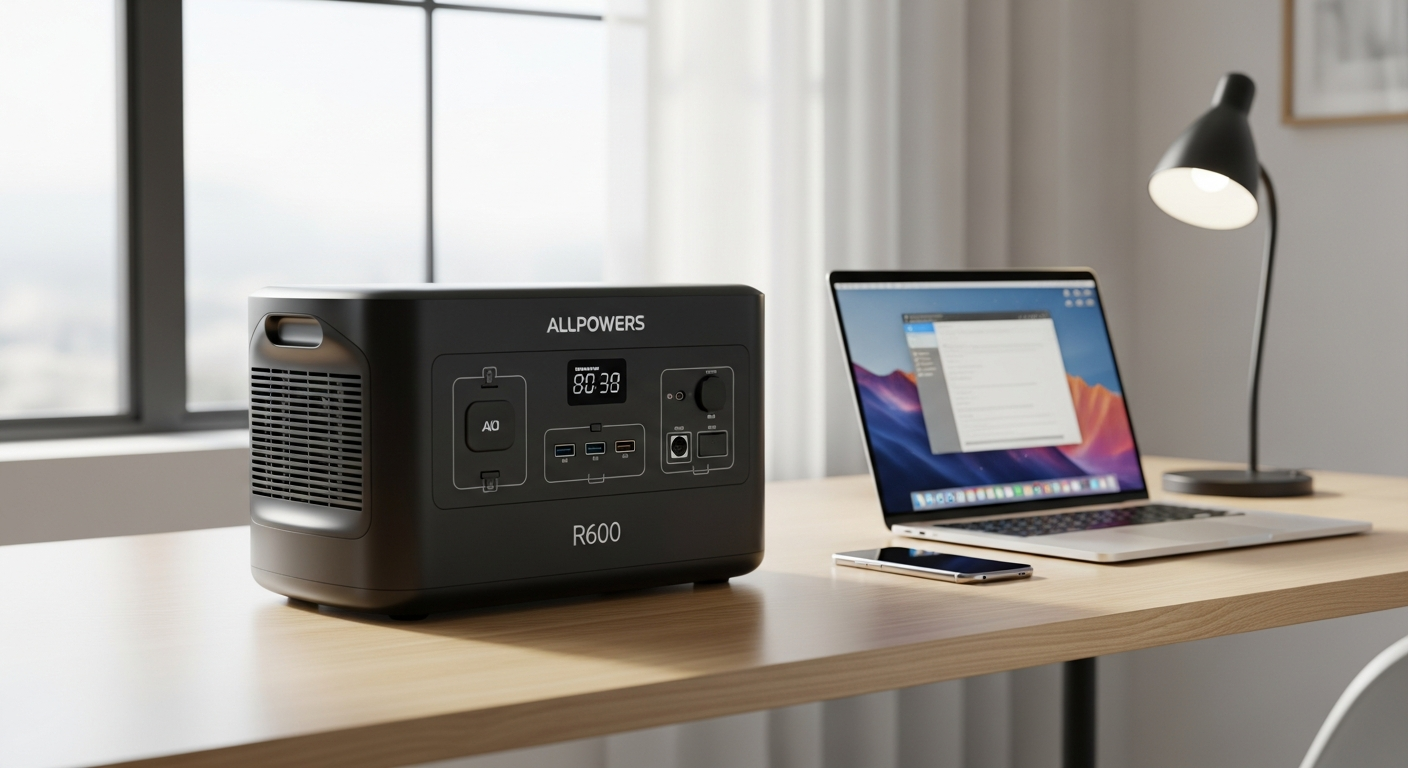
More than 40% of households now report concerns about power grid reliability, yet most people remain unprepared for extended outages. When the lights go out—whether from severe weather, natural disasters, or planned maintenance—having a dependable backup power source becomes the difference between comfort and chaos. Portable power stations have evolved dramatically over the past few years and are no longer bulky, unreliable devices reserved for serious preppers or remote adventurers.
The ALLPOWERS R600 exemplifies this transformation with its LiFePO4 battery chemistry and 600W continuous output, representing a meaningful shift toward accessible, sustainable backup power for everyday people. Its 299Wh capacity paired with pure sine wave protection means you're not just buying a battery box—you're investing in genuine energy security that works with your lifestyle rather than against it.
Explore the ALLPOWERS R600 and take control of your power supply today.
Beyond the Specs: What 600W and 299Wh Actually Mean for You
Understanding portable power requires translating technical specifications into real outcomes. The 600W continuous output and 299Wh capacity interact together to determine what your power station can actually accomplish in practical terms.
How 600W Continuous Output Compares to Household Appliances and Real Devices
A 600W output capacity places the R600 squarely in the practical range for most essential devices. Your smartphone charger typically draws 18-30W. A laptop usually requires 45-90W during active use. These numbers leave substantial headroom. A small portable cooler operates around 40-60W continuously. A ceiling fan pulls roughly 75W. These devices work perfectly with the R600.
However, certain household staples demand more power. A standard microwave needs 1000-1500W. A window air conditioning unit requires 1000-1500W as well. Electric kettles pull 1500-2000W. These appliances exceed the R600's capacity and won't run, period.
Breaking Down 299Wh Capacity Into Practical Runtime Examples
The 299Wh battery functions like a container holding energy. How long it lasts depends on what you're powering.
A smartphone with a 20Wh battery charges roughly 14-15 times before the R600 depletes completely. In real terms, that's about two weeks of daily charging for the average user. A laptop consuming 60W of power runs for approximately 5 hours before the R600 reaches zero. A portable cooler drawing 50W operates for roughly 6 hours. An LED camping light using just 5W could theoretically run for 60 hours.
Why Wattage and Watt-Hours Work Together, Not Separately
Wattage measures power draw at any given moment—the instantaneous demand. Watt-hours measure total energy available. Think of it like a water analogy: wattage is the flow rate coming out of a faucet, while watt-hours represent the total water in your tank.
The R600's 600W capacity means it can supply up to 600 watts continuously without shutting down. The 299Wh means you have roughly 0.3 kilowatt-hours of total energy stored. Dividing total energy by power consumption tells you runtime. A 100W device lasts approximately 3 hours. A 50W device lasts 6 hours.
Common Misconceptions About Portable Power Station Capacity
Many people assume a 600W power station can run any appliance continuously—it cannot. The 600W refers to maximum output, not unlimited power. Once you exceed 600W, the unit simply won't turn on that device.
Another misconception suggests that 299Wh provides full day operation for everything. Reality requires honest assessment of your actual loads. Powering a CPAP machine overnight works fine; running a space heater does not.
Surge Power vs. Continuous Power: What the R600 Can and Cannot Handle
Most electrical devices experience an initial surge when first powered on. A refrigerator compressor might spike to 800W at startup, then settle to 300W running. The R600 handles modest surge requirements, but extreme spikes exceed its capability. Industrial power tools with sudden high-demand phases won't function reliably.
Device Compatibility Guide: What Charges, What Runs, What Struggles
Smartphones and tablets charge effortlessly. Laptops and tablets run without issue. Portable speakers operate continuously. LED lights function indefinitely on the available capacity. Small fans, USB devices, and charging banks work perfectly.
Larger appliances struggle or fail outright. Microwave ovens won't power on. Air conditioning units won't start. Electric kettles won't activate. Power tools operate unpredictably.
The sweet spot includes CPAP machines, oxygen concentrators, small coolers, WiFi routers, LED work lights, and battery charging stations. These represent real-world backup priorities for most households.
LiFePO4 Battery Technology: Why Chemistry Matters More Than You Think
Battery type determines safety, longevity, reliability, and overall cost of ownership. The R600's LiFePO4 chemistry represents a significant advantage over standard lithium-ion alternatives.
The Safety Advantage of Lithium Iron Phosphate Over Standard Lithium-Ion
LiFePO4 chemistry exhibits superior thermal stability compared to conventional lithium-ion batteries. Standard lithium-ion cells can experience thermal runaway—a cascading reaction that produces heat and potentially causes fires. LiFePO4 cells are inherently more resistant to this dangerous condition.
The crystal structure of lithium iron phosphate makes it chemically more stable. This translates to real-world benefits: the R600 operates safer in high-temperature environments, resists damage from overcharging, and maintains integrity if accidentally punctured. You're not just buying a power station; you're buying protection for yourself and your surroundings.
Cycle Life Expectations: How Many Charge Cycles Before Degradation Occurs
LiFePO4 batteries endure 3000-5000 charge cycles before capacity degrades to 80% of original specifications. That's dramatically better than standard lithium-ion cells, which typically manage 500-1000 cycles.
Translating this to real usage: if you fully charge the R600 every single day, the battery remains above 80% capacity for roughly 8-13 years. Most households using it intermittently will see operational lifespan exceed 10-15 years. This longevity justifies the initial investment.
Temperature Resilience and Performance in Extreme Conditions
LiFePO4 cells maintain performance across a broader temperature range than standard lithium-ion. The R600 operates reliably in cold climates where conventional batteries struggle. Winter camping in northern regions presents no problem. High-temperature environments also pose less risk—the chemistry resists degradation in desert heat.
Self-Discharge Rates and Long-Term Storage Reliability
A charged R600 left sitting for weeks loses roughly 2-3% of its charge monthly through self-discharge. This means a fully charged unit retains approximately 97% capacity after a month of storage. In practical terms, your backup power station remains ready when you actually need it, even after weeks of non-use.
Why LiFePO4 Costs More Upfront But Saves Money Over Time
The manufacturing process for LiFePO4 cells costs more than standard lithium-ion production. This explains why the R600 carries a higher price tag than some competitors. However, total cost of ownership favors LiFePO4 decisively.
A standard lithium-ion unit requiring replacement after 3-5 years of regular use becomes expensive. The R600's 10-15 year lifespan means one purchase covers two decades of backup power. You're spending more initially to avoid replacement costs and hassle.
Environmental Impact and Recyclability Compared to Other Battery Types
LiFePO4 cells contain no cobalt, unlike standard lithium-ion batteries. Cobalt mining creates significant environmental damage and raises ethical concerns. LiFePO4 production presents fewer environmental complications.
Additionally, LiFePO4 cells remain recyclable. The materials recover for secondary uses, reducing electronic waste. Standard lithium-ion recycling proves more problematic and energy-intensive.
Protection Mechanisms: How the Advanced Battery Management System Keeps You Safe
The R600 includes an Advanced Battery Management System (BMS) that continuously monitors cell voltage, temperature, and charging rate. If any parameter exceeds safe thresholds, the BMS automatically disconnects the battery, preventing damage or danger.
Overcharging protection prevents the battery from accepting more energy than it safely stores. Over-discharge protection prevents drawing the battery completely empty, which damages lithium cells. Temperature monitoring shuts down operation if the unit gets too hot or cold. Short-circuit protection cuts power instantly if internal faults occur. These layered protections transform the R600 from a risky battery into a genuinely safe power source.
Discover the R600's advanced safety features and reliable LiFePO4 battery technology.
Solar Charging Synergy: Pairing the R600 with Renewable Energy
The R600 becomes genuinely transformative when paired with solar panels. This combination shifts from temporary backup to genuine energy independence.
Why the R600 Becomes a Game-Changer When Combined with Solar Panels
A portable power station without solar capability eventually empties. You must return to grid charging or accept depleted reserves. Solar panels eliminate this dependency entirely. Sunlight becomes your fuel source—free, renewable, and unlimited.
The R600 accepts solar input directly, making it ideal for off-grid scenarios. Combine solar panels with the R600, and you create a closed-loop system requiring no external power source. This represents genuine energy independence.
Compatibility With the ALLPOWERS SP027 100W Solar Panel and Similar Options
The R600 accepts solar input up to a specified amperage, allowing rapid charging from compatible panels. The ALLPOWERS SP027 100W panel pairs perfectly with the R600, featuring integrated kickstands for angle adjustment and a lightweight foldable design.
100W solar panels generate adequate current to charge the R600 meaningfully even in less-than-perfect conditions. Multiple SP027 panels can be connected in parallel for faster charging if budget allows. Other quality 100W+ panels from different manufacturers also work reliably, provided they output the correct voltage and amperage specifications.
Realistic Charging Timelines Under Various Weather and Sunlight Conditions
Under ideal conditions—bright sun, optimal panel angle, no clouds—a 100W solar panel reaches full R600 capacity in approximately 4-5 hours. Real-world conditions rarely match ideal scenarios.
Partially cloudy skies reduce charging to roughly 8-10 hours for full capacity. Heavy overcast conditions extend charging to 12-16 hours or may not fully charge before sunset. Geographic latitude and season significantly impact available sunlight hours.
Morning and evening provide reduced charging rates due to sun angle. Midday charging proves most efficient. Seasonal variations mean summer offers faster charging than winter in most locations. Planning solar charging requires honest assessment of local climate patterns.
Calculating Your Solar Setup Cost and Return on Investment
The ALLPOWERS SP027 100W panel costs roughly $100-150. The R600 ranges from $100-300 depending on sales. A complete solar setup totals approximately $200-450 for one panel and power station.
The ROI calculation depends on avoided grid power costs. If you charge the R600 daily from the grid at typical electricity rates, solar panels pay for themselves through energy savings within 2-4 years. Beyond that, charging becomes essentially free. Over a 10-year ownership period, a solar setup saves hundreds in electricity costs.
Seasonal Performance Variations and Planning Around Daylight Hours
Summer provides abundant sunlight and extended daylight hours. The R600 charges quickly and remains charged longer. Winter presents opposite conditions—shorter days, lower sun angle, reduced charging efficiency.
In extreme northern latitudes, winter solar charging becomes inefficient. Backup grid charging becomes necessary during winter months. Southern locations maintain reasonable solar efficiency year-round. Plan your solar strategy around local seasonal patterns.
Expandability: Adding Multiple Panels for Faster Charging
The R600's solar input accepts multiple panels connected in parallel. Two 100W panels double charging speed compared to a single panel. Three panels triple it. This expandability means you can start with one panel and add more as budget allows.
Parallel connections provide flexibility. If one panel needs maintenance or repair, others continue functioning. The system scales gradually rather than requiring a large upfront investment.
Grid-Tie Considerations for Homeowners Exploring Hybrid Systems
Some homeowners want to integrate portable power stations into larger residential solar systems. A grid-tie solar setup feeds excess power to the utility grid, receiving credit on your bill. The R600 can be charged from home solar systems when designed appropriately.
Consult a solar installer before integrating portable power stations into residential grid-tie systems. Proper installation ensures safety and compliance with local electrical codes. The R600 becomes a valuable battery backup component for homes with solar installations, storing power for nighttime use.
Real-World Applications: Where the R600 Truly Shines
Understanding theoretical specs matters less than knowing whether the R600 solves your actual problems. Real-world scenarios determine true value.
Emergency Backup Power During Grid Outages and Natural Disasters
A grid failure becomes manageable with the R600. Your phone stays charged for communication. Your laptop maintains connectivity if your internet router works. LED lights provide visibility after dark. Medical devices like CPAP machines continue operating overnight.
Natural disasters—hurricanes, earthquakes, severe storms—frequently cause extended outages. The R600 powers essentials until grid restoration. In regions prone to planned maintenance outages, the R600 prevents inconvenience and maintains communication with emergency services.
Off-Grid Camping and Backpacking Trips: Weight, Portability, and Runtime
Weighing roughly 6-8 pounds, the R600 represents a genuinely portable option for backpackers. It's not light—serious ultralight enthusiasts choose smaller capacity units—but it's manageable for multi-day trips.
Charging phones, powering headlamps, running portable speakers, and operating small camping fans all work within R600 parameters. A camping trip lasting 3-5 days sees the R600 handling all personal electronics comfortably. Beyond a week, you'd need solar panels or accept reduced charging frequency.
Van Life and Mobile Living Setups: Powering Essentials on the Road
Digital nomads living in vans benefit tremendously from the R600. Laptop charging, phone power, LED lighting, and fan operation all work reliably. When parked in sunny locations, solar charging becomes available. The R600 serves as an entry-level power system before investing in larger capacities.
Van lifers appreciate portability—the R600 moves from vehicle to campsite easily. It supplements rather than replaces a van's primary power system, providing backup for critical scenarios or extended off-grid periods.
Remote Work Scenarios: Keeping Laptops and Routers Running During Outages
Home office professionals depend on continuous power. The R600 keeps a laptop running for 5+ hours and a WiFi router operating indefinitely during grid failures. This maintains productivity and communication capabilities during outages lasting several hours.
For remote workers in areas with frequent outages, the R600 prevents lost income and missed deadlines. The investment directly pays for itself through maintained work capacity.
Outdoor Events, Tailgating, and Recreational Activities
Music speakers, charging stations, LED lighting, and small coolers all operate from the R600 during outdoor gatherings. A tailgate party becomes more comfortable with powered amenities. Outdoor events gain flexibility through portable power.
The R600's compact size fits easily in vehicles. Its quiet operation allows use without disturbing others, unlike gas generators.
Small Appliance Powering: Coolers, Fans, Charging Stations, and More
Portable coolers operate continuously from the R600. Fans maintain comfortable temperatures during heat waves or in poorly ventilated spaces. USB charging stations power multiple devices simultaneously. These represent practical daily-use scenarios beyond emergency backup.
Medical Device Backup: CPAP Machines, Oxygen Concentrators, and Critical Equipment
For individuals dependent on medical equipment, the R600 provides life-critical backup. A CPAP machine runs all night, every night on the R600's charge. Oxygen concentrators operate for extended periods. Dialysis pump backup power becomes available. For these users, the R600 isn't optional—it's essential.
The Honest Trade-Offs: When the R600 Isn't the Right Choice
The R600 excels in specific scenarios. Recognize situations where it falls short before committing your budget.
Battery Capacity Limitations for Extended Off-Grid Periods
The 299Wh capacity supports roughly one day of typical usage. Extended off-grid periods lasting weeks require either drastically reduced power consumption or solar panels for continuous charging. If your scenario demands multi-week independence, the R600 alone proves inadequate.
High-Power Appliance Restrictions (Air Conditioners, Electric Heaters, Power Tools)
The 600W ceiling eliminates high-power appliances. Space heaters, air conditioners, electric kettles, and power tools simply won't operate. If your backup needs include these devices, the R600 won't solve your problem.
Scenarios Where Upgrading to R4000 or S2000 Pro Makes Financial Sense
For frequent users powering substantial loads, larger capacity units make sense. The ALLPOWERS R4000 provides 4096Wh capacity and 3600W output. The S2000 Pro offers similar capacity with enhanced features. These units cost substantially more but handle scenarios the R600 cannot.
Calculate your actual energy needs honestly. If the R600 repeatedly proves insufficient, a larger unit delivers better long-term value despite higher initial cost.
Solar Panel Costs as a Separate Expense Consideration
Solar panels aren't included with the R600. Adding solar capability requires additional investment. Budget accordingly if solar charging is essential to your plan. The R600 itself is affordable, but a complete solar setup costs considerably more.
Noise Levels During Operation Compared to Gas Generators
The R600 operates nearly silently. This represents an enormous advantage over gas generators, which generate 70-90 decibels of noise. In campgrounds, neighborhoods, and quiet settings, the R600 excels. However, if you anticipate running high-power devices continuously for extended periods, gas generators remain the only practical solution.
Weight and Size Constraints for Specific Use Cases
At 6-8 pounds, the R600 works for most portable scenarios. Ultralight backpacking requires lighter solutions. Large-scale applications need bulkier systems. Assess your portability requirements honestly. The R600 represents ideal middle ground, but extremes demand alternatives.
Charging Time From Standard Wall Outlets vs. Solar Panels
Wall outlet charging takes roughly 8-10 hours for full capacity. Solar charging under good conditions matches this timeline. If you frequently deplete the R600 and need rapid grid recharging, longer charge times create inconvenience. Plan usage patterns accordingly.
Value Proposition: Why Budget-Conscious Buyers Choose the R600
The R600 occupies a unique market position—quality and capability without premium pricing.
Price-to-Performance Ratio Compared to Competing Entry-Level Models
The R600 typically ranges from $100-300 depending on current sales and promotions. Competing units at similar price points often sacrifice LiFePO4 battery chemistry, pure sine wave output, or safety features. The R600 delivers premium features at budget pricing.
Brands charging $500+ for 300Wh capacity provide no meaningful advantage. The R600 proves that quality backup power doesn't require premium pricing.
Frequent Sales and Promotional Pricing Strategies
ALLPOWERS regularly discounts the R600 during sales events. Black Friday, holiday seasons, and seasonal promotions push prices toward the lower end of the range. Patient buyers who monitor pricing secure exceptional value.
Setting up price alerts allows you to catch promotions. Purchasing during sales events reduces your investment by 30-50% compared to full retail pricing.
Long-Term Cost Savings Through Durability and Battery Longevity
The LiFePO4 battery's 10-15 year lifespan prevents premature replacement. Standard lithium-ion units may require replacement within 5 years. Over a decade, the R600 proves far more economical.
Durability extends beyond battery chemistry. Quality construction, reliable components, and professional manufacturing mean fewer failures and warranty claims. You're not replacing the unit repeatedly.
Avoiding the Cheap Power Station Trap: Quality Indicators
Ultra-budget power stations ($30-60) cut corners dangerously. Lower-quality batteries degrade rapidly, safety systems prove inadequate, and failure rates spike. These units save money initially but cost more through replacement and inferior performance.
The R600 represents a genuine sweet spot—quality construction at accessible pricing. You're not paying premium prices for marketing; you're paying for actual durability and capability.
Warranty Coverage and Customer Support Expectations
ALLPOWERS offers reasonable warranty coverage on the R600. Standard manufacturer warranties cover defects and battery failures for 1-3 years depending on product line. Customer support proves responsive when issues occur.
Compare warranty terms across competitors. Longer warranties indicate confidence in product quality. ALLPOWERS' warranty positioning suggests genuine commitment to reliability.
Resale Value and Upgrading Pathways
The R600 holds resale value reasonably well. If you later upgrade to larger capacity, selling your used R600 recovers a meaningful portion of your investment. This creates flexible upgrade pathways.
The R600 functions perfectly as a starter unit within an expanding power system. Begin here, add solar panels next, upgrade to larger capacity later. Each step builds on previous investments.
Total Cost of Ownership Over 5-10 Years
Factor all costs: initial purchase, solar panels (optional), maintenance, and eventual replacement. Over 10 years, the R600 plus solar panels (if desired) costs substantially less than repeated battery replacements with cheaper units or continuous grid power consumption.
Calculate your actual scenario. Compare total spending across options. In most cases, the R600's value proposition becomes obvious.
Pure Sine Wave Output: Protecting Your Expensive Electronics
How electricity flows from a power station matters as much as how much power it provides. Wave shape determines safety for sensitive devices.
What Pure Sine Wave Means and Why It Matters for Sensitive Devices
Household electricity flows in a smooth, continuously varying curve called a sine wave. This natural pattern allows all devices designed for home use to operate safely. Pure sine wave inverters in power stations replicate this pattern exactly.
Sensitive electronics—particularly laptops, audio equipment, medical devices, and smart components—depend on this smooth power flow. Irregular power delivery damages delicate internal circuits.
Difference Between Pure Sine and Modified Sine Wave Power
Modified sine wave output approximates a sine wave using stepped patterns rather than smooth curves. To human perception, devices appear to work normally. Internally, sensitive electronics receive distorted power that gradually damages components.
Budget power stations often use modified sine wave inverters to reduce manufacturing costs. The R600 includes a pure sine wave inverter, eliminating this compromise. Your expensive electronics receive power quality matching household electricity.
Device Safety: Which Electronics Require Pure Sine Wave Protection
Laptops absolutely require pure sine wave protection. Modified sine wave can corrupt data and damage power circuits. Medical devices like CPAP machines and oxygen concentrators need pure sine wave for safe operation. Audio and video equipment produces distortion with modified sine wave. Smart devices with microprocessors depend on clean power.
Basic devices like older LED lights work with any power source. Battery chargers prove more forgiving than others. Most modern electronics demand pure sine wave protection.
Preventing Damage to Laptops, Phones, Medical Equipment, and Smart Devices
Using the R600's pure sine wave output prevents premature failure of expensive devices. Your $1000 laptop remains protected. Irreplaceable medical equipment operates safely. Smart home devices function reliably.
The cost of replacing even one damaged laptop exceeds the entire R600 price. Pure sine wave protection provides insurance against this risk.
Noise and Interference Elimination in Audio and Video Equipment
Modified sine wave power creates audible hum in audio systems. Video equipment displays visible artifacts and distortion. Powered microphones, recording equipment, and professional audio gear suffer noticeably. The R600's pure sine wave eliminates these issues entirely, allowing professional-quality audio and video from backup power.
Content creators, musicians, and audio professionals appreciate the R600's clean power output.
Long-Term Reliability of Powered Devices
Devices powered by pure sine wave electricity last longer than those powered by inferior alternatives. Internal components experience less stress, fewer failures occur, and devices remain operational years longer. The initial investment in quality power protects your total equipment investment.
Testing and Verification Methods for Confirming Pure Sine Wave Output
The R600's specifications confirm pure sine wave output—verify this before purchase. Quality manufacturer descriptions explicitly state pure sine wave capability. Third-party reviews often test and confirm this feature.
For verification, a digital oscilloscope would display the actual power waveform, but such testing proves unnecessary for consumer purchases. Trusting manufacturer specifications and reputable reviews suffices. The R600's specifications confirm pure sine wave delivery.
Your Next Steps Toward Energy Independence
The ALLPOWERS R600 Portable Power Station 600W represents a genuine turning point for anyone serious about energy resilience without breaking the bank. Whether you're preparing for unpredictable outages, planning your first off-grid adventure, or building toward complete energy independence, this unit delivers measurable peace of mind.
The LiFePO4 battery won't let you down, the 600W output handles what matters most, and the solar charging potential opens doors to genuine sustainability. The real question isn't whether you need backup power—it's whether you're ready to stop waiting for the next outage to catch you unprepared.
Start with the R600 as your foundation, add solar panels when your budget allows, and watch your energy independence grow. Your first step is clear.
Get started with the ALLPOWERS R600 and build your energy independence today.
Leave a Reply