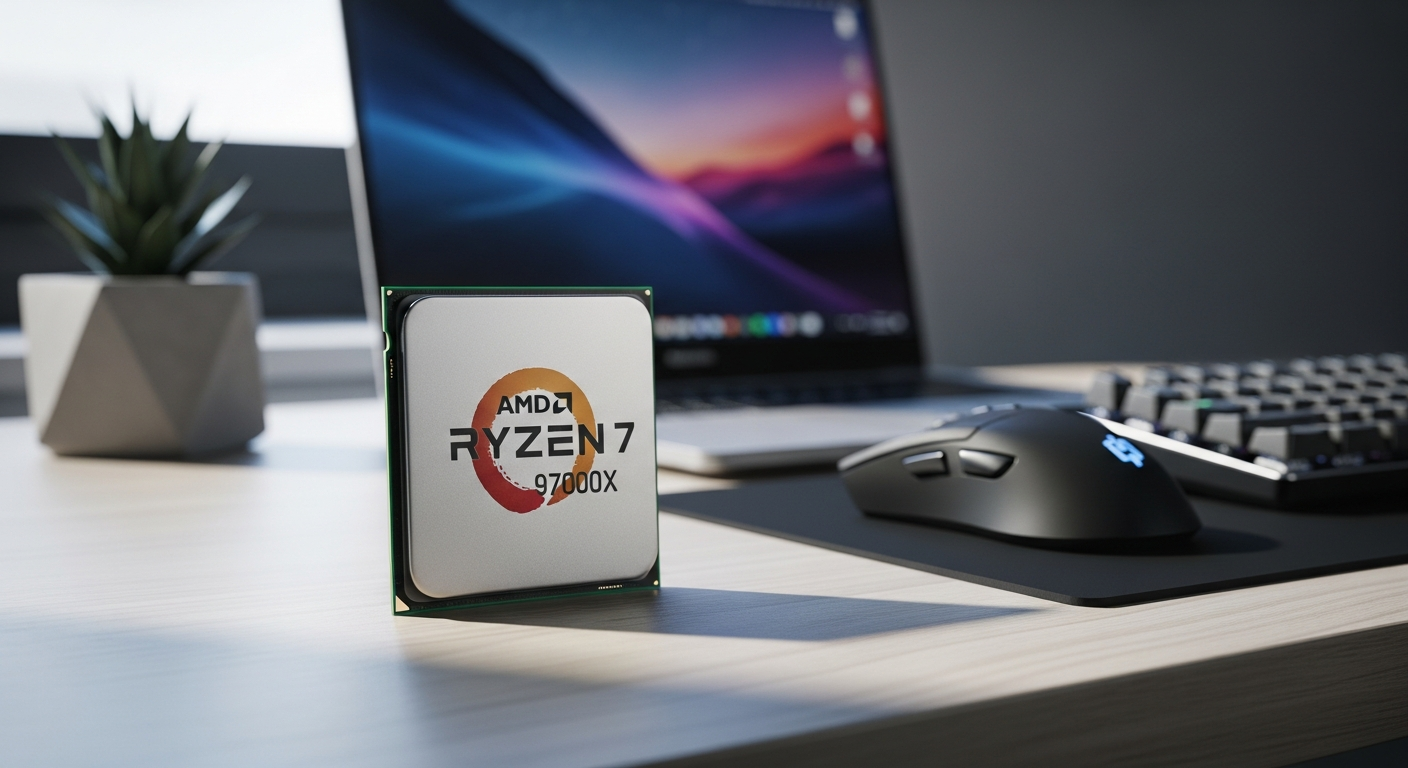
Over 40% of PC builders prioritize energy efficiency and thermal management alongside raw performance—and the AMD Ryzen 7 9700X delivers exactly that combination without breaking the bank. This processor stands as a watershed moment in mainstream computing, where you no longer have to choose between serious horsepower and reasonable power consumption.
Launched in August 2024, the Ryzen 7 9700X represents AMD's commitment to the AM5 platform with its cutting-edge Zen 5 microarchitecture. The processor strikes a rare balance: it packs serious performance credentials while maintaining a remarkably low 65W TDP—a significant leap from previous generations. Whether you're upgrading an existing AM5 system or building from scratch, this CPU offers compelling efficiency gains that directly impact your power bill and cooling requirements.
Discover the AMD Ryzen 7 9700X at competitive pricing today.
Why the 65W TDP Changes Everything for DIY Builders
The dramatic reduction in thermal design power compared to the Ryzen 7 7700X fundamentally reshapes what's possible in mainstream PC building. The previous generation demanded significantly more power, forcing builders to invest in beefier cooling solutions and more robust power supplies. The 9700X eliminates that requirement entirely.
The Power Consumption Reality
Lower TDP translates to reduced electricity consumption over time in tangible, measurable ways. Running a CPU at 65W instead of the 105W demands of the 7700X means your system draws approximately 40W less during full-load scenarios. Across a year of moderate to heavy use, that difference compounds into real savings on your electricity bill—potentially $30-50 annually depending on your local power rates and usage patterns.
Cooling Solution Flexibility
Cooling solution flexibility becomes a genuine advantage with this processor's thermal footprint. Stock coolers and budget aftermarket options now become viable choices rather than bottlenecks. You can confidently pair the 9700X with a modest 65-90W capable cooler, whereas previous-generation chips often required mid-range or higher-end cooling to avoid thermal throttling under sustained loads. This flexibility extends to case selection as well—smaller cases with limited airflow become practical options.
Temperature and Noise Benefits
Impact on system temperatures and ambient noise levels proves particularly valuable for anyone sensitive to acoustic pollution. Lower temperatures mean quieter fan profiles across your entire system. The CPU itself won't push heat into your case as aggressively, allowing case fans to spin slower while maintaining safe operating temperatures. For bedroom builds or living room PCs, this becomes a genuine quality-of-life improvement.
Long-Term Economic and Environmental Impact
Long-term cost savings in power consumption accumulate especially quickly for users running 24/7 systems or heavy-use configurations. Content creators, streamers, and server-room enthusiasts see the most dramatic ROI from the efficiency gains. Environmental benefits and reduced carbon footprint per watt also matter if sustainability factors into your purchasing decisions.
Zen 5 Architecture: What's Actually Different Under the Hood
AMD's Zen 5 microarchitecture brings substantial refinements beyond simply bumping clock speeds. Branch prediction improvements represent one of the most significant upgrades, with better algorithm efficiency that reduces pipeline flushes during conditional jumps. This manifests as tangible performance gains in real-world applications, particularly single-threaded workloads where branch-heavy code dominates.
Floating-Point and IPC Enhancements
Enhanced floating-point capabilities prove crucial for scientific computing and content creation applications. The improvements allow the 9700X to execute floating-point operations with greater throughput and efficiency. Instruction-per-cycle (IPC) gains across the architecture benefit single-threaded applications dramatically. Benchmarks show anywhere from 8-15% IPC improvements over Zen 4, translating to noticeably snappier responsiveness in everyday computing and gaming scenarios.
Manufacturing Process Refinement
Manufacturing process refinement at 4nm TSMC facilities plays a foundational role in efficiency. Moving from 5nm to 4nm allowed AMD's engineers to pack more transistors into the same physical space while actually reducing power requirements—a testament to TSMC's process maturation. This reduction forms the technical backbone supporting the 65W TDP.
Architectural Gains vs. Incremental Updates
Comparison of architectural improvements versus incremental spec bumps reveals that the 9700X represents a genuine generational leap rather than a modest refresh. AMD didn't just overclock the 7700X and call it new. The microarchitectural changes, combined with process improvements, create an entirely different efficiency profile.
Future-Proofing Through AM5 Socket
Future-proofing considerations with AM5 socket compatibility cannot be overstated. This processor sits midway through AMD's AM5 lifecycle, with announced plans for additional processor generations beyond 2025. Your motherboard investment remains relevant for years.
Performance Breakdown: Gaming, Productivity, and Everyday Computing
The 9700X's performance profile tells different stories depending on your workload. Single-core performance metrics and gaming frame rates at 1080p and 1440p consistently exceed the 7700X by 10-15% depending on the specific game and graphics settings. Esports titles targeting 240+ fps see particularly dramatic improvements, where that single-core performance directly translates to higher minimum framerates.
Multi-Core Workload Reality
Multi-core performance in video editing, 3D rendering, and content creation presents a more nuanced picture. While the 9700X maintains 8 cores and 16 threads—identical to the 7700X—the architectural improvements provide marginal gains in heavily threaded workloads. Some benchmarks show performance parity with the previous generation, while others reveal 5-10% improvements. For users exclusively targeting heavily threaded workloads, the gains might not justify an upgrade from existing 7700X systems.
Real-World Application Performance
Real-world application benchmarks across Adobe Suite, Blender, and streaming software demonstrate where the 9700X genuinely excels. Adobe Premiere Pro benefits from the improved single-core performance for timeline responsiveness and effects preview. Blender rendering times remain largely similar to the 7700X due to the identical core count, though the 9700X's efficiency means longer render jobs produce less heat. Streaming software (OBS, Streamlabs) runs noticeably smoother, particularly during scene transitions and filter processing.
Thermal Throttling Under Load
Thermal throttling behavior under sustained workloads remains virtually nonexistent with proper cooling. The 65W TDP means thermal throttling only occurs in severely restricted cooling scenarios—cases that would challenge any mainstream processor. This stability matters for professional users where consistent performance across an 8-hour workday beats occasional performance spikes.
Memory Performance Scaling
Performance scaling with DDR5 memory speeds demonstrates the value of the platform's memory infrastructure. At the official 5600 MT/s specification, the 9700X performs reliably. Overclocking to 6000-6400 MT/s provides 2-4% performance improvements in games and productivity applications, with enthusiasts often achieving these speeds through stable overclocking.
Competitive Positioning
Comparison against Ryzen 7 7700X, Intel Core i7, and other mid-range competitors positions the 9700X as the single-core performance leader among AM5 processors and competitive with Intel's 14th-gen offerings. The gap narrows considerably in multi-threaded work, where Intel's higher core counts provide measurable advantages for specific professional workloads.
DDR5 Memory Integration and Overclocking Potential
Native DDR5 support at 5600 MT/s represents the official specification, providing baseline stability across all certified RAM modules. The dual-channel memory architecture optimization means your motherboard efficiently manages memory bandwidth to both CPU and integrated graphics.
Overclocking Headroom and Stability
Overclocking headroom and stability considerations for enthusiasts remain favorable. The 9700X handles aggressive memory overclocking substantially better than Zen 4 predecessors, with many users achieving 6000+ MT/s without degrading stability. This improved behavior stems from refined memory controller firmware and improved signal integrity at higher frequencies.
Memory Configuration Recommendations
Recommended RAM configurations vary by use case. Gaming builds benefit most from 32GB configurations (two 16GB modules) running at 6000 MT/s with tight timings. Content creation workloads similarly prefer 32GB or more, though the clock speed advantage matters less than total capacity. Office and productivity builds can function adequately with 16GB, though 32GB provides future-proofing.
Platform Compatibility
BIOS update requirements for 600-series chipset compatibility remain straightforward. Most B850, X870, and X870E boards ship with compatible BIOS revisions, but older 600-series boards may require a BIOS flash using a Ryzen 7000 series CPU or the retailer's flash service. Always verify compatibility before purchasing.
The Integrated Radeon Graphics Advantage
The integrated Radeon Graphics based on RDNA 2 architecture serves dual purposes: enabling display output for systems without discrete GPUs and providing light gaming capabilities. For office environments, productivity builds, and systems awaiting GPU availability, integrated graphics eliminate the need to purchase a dedicated graphics card immediately.
Integrated Graphics Capabilities
RDNA 2 iGPU capabilities remain modest by dedicated GPU standards, but adequate for 1080p gaming in lighter titles at 30-60 fps. Esports titles run smoothly at high framerates, while demanding AAA games require settings compromises. The real value emerges in non-gaming scenarios: encoding and decoding acceleration for content creators proves particularly valuable. Video transcoding with hardware acceleration runs 2-3x faster than CPU-only encoding.
GPU Necessity Thresholds
Performance limitations become apparent quickly if your workload includes 1440p or 4K gaming, professional 3D modeling, or cryptocurrency mining. A discrete GPU becomes necessary once these workloads enter your requirements. For general computing, office work, streaming setup, or light gaming, integrated graphics suffice indefinitely.
Cost Deferral Strategy
Cost savings by deferring discrete GPU purchases become significant when you consider that even entry-level modern GPUs cost $150-200. Building with the 9700X and planning a GPU upgrade in 6-12 months lets you spread the total system cost across multiple budget cycles.
Explore the complete specifications and availability of the Ryzen 7 9700X now.
Pricing Strategy: Value Proposition for Different User Segments
The AMD Ryzen 7 9700X launched with an MSRP of $359 USD, representing a $30 reduction from the 7700X's original $389 launch price. This positioning signals AMD's confidence in the generational improvements while maintaining accessibility for budget-conscious builders.
Current Market Pricing
Current market pricing on retailers shows variations by geography. European pricing on platforms like 1fodiscount.com starts at €191.78, representing compelling value when converted to equivalent USD pricing. North American pricing typically hovers near MSRP with periodic sales dipping toward $330-340.
Value Proposition Across User Segments
Price-to-performance ratio versus the Ryzen 7 7700X and Intel alternatives varies dramatically based on your specific workload. For single-threaded performance gaming, the 9700X delivers exceptional value. For pure multi-threaded computing, Intel's higher core-count offerings sometimes edge ahead despite higher prices.
Upgrade Decision Factors
When to upgrade versus when to stick with older processors depends on your current hardware and workload. Ryzen 5000 series users see dramatic improvements justifying the upgrade. Ryzen 7000 series owners should only upgrade if gaming performance gains or efficiency improvements align with immediate needs.
Platform Investment Considerations
Bundle deals and platform costs matter substantially when calculating true upgrade expense. The 9700X alone costs $359, but a complete AM5 build including motherboard ($150-300), RAM ($80-150), and cooler ($30-100) reaches $620-910. Comparing this against existing platform investments reveals whether a fresh build or CPU-only upgrade makes sense financially.
Long-Term Value Perspective
Long-term value considering AM5 platform longevity becomes increasingly apparent. Unlike Intel's shorter platform lifecycles, AM5 provides upgrade paths through at least 2026. Your motherboard investment today remains relevant for multiple processor generations, reducing total cost of ownership compared to platforms with shorter support windows.
AM5 Socket: The Future-Proof Investment Angle
The AM5 socket represents AMD's commitment to platform longevity, currently supporting three processor generations (Ryzen 7000, 8000G, and 9000) with announced support extending beyond 2025. This extended support window fundamentally changes how you evaluate upgrade costs and platform viability.
Current and Announced Processor Compatibility
Current and announced Ryzen 9000 series compatibility ensures your motherboard remains relevant. The 9700X, along with the 9900X and 9950X models, all utilize the same socket. AMD's roadmap expectations for upcoming AM5 processors through 2026+ suggests additional processor launches maintaining socket compatibility.
Motherboard and Chipset Ecosystem
Motherboard investment protection stems from AM5's broad chipset ecosystem. B850, X870, and X870E chipsets provide varying feature sets while maintaining identical socket compatibility. Your decision to invest in a premium X870E motherboard today remains valid three years from now when you upgrade the processor itself.
Backward and Forward Compatibility
Backward and forward compatibility considerations matter substantially. Older 600-series boards support the 9700X through BIOS updates. Newer boards provide enhanced features (PCIe 5.0, improved VRM) but aren't mandatory for the processor to function optimally. This flexibility reduces forced platform upgrades.
Comparison with Intel's Platform Strategy
Comparison with Intel's platform upgrade cycles reveals a stark contrast. Intel traditionally changes sockets every generation, forcing motherboard replacement alongside CPU upgrades. AM5's extended support window saves money across your ownership timeline while reducing electronic waste.
Real-World Use Cases: Who Should Buy the 9700X
The 9700X excels for specific user profiles where its strengths align perfectly with requirements.
Content Creators on Moderate Budgets
Content creators on moderate budgets seeking efficiency find exceptional value here. Video editors, photo processors, and streaming content creators benefit from the strong single-core performance and integrated graphics support. The 65W efficiency means longer work sessions with less heat generation and noise.
Streamers and Multitaskers
Streamers and multitaskers benefiting from the 8-core architecture discover the 9700X handles simultaneous streaming, gaming, and browser operations smoothly. The cores distribute workload effectively across OBS encoding, game rendering, and chat monitoring without bottlenecking.
Esports Gamers Prioritizing High Refresh Rates
Esports gamers prioritizing high refresh rates over ultra settings find the single-core performance gains directly translate to higher minimum framerates in competitive titles. The efficiency also keeps system temperatures low, preventing thermal throttling during extended tournament sessions.
System Builders Targeting Sub-$1000 Gaming Builds
System builders targeting sub-$1000 gaming PC builds appreciate the 9700X's price point and efficiency characteristics. Pairing it with a mid-range GPU and budget motherboard creates capable 1080p gaming systems without excessive cost.
Office and Productivity Users
Office and productivity users needing reliable, cool-running hardware benefit from the quiet operation and thermal management. Professional writers, analysts, and business professionals appreciate systems that remain practically silent during daily work.
Professionals Avoiding Power-Hungry Workstations
Professionals avoiding power-hungry workstation CPUs find the 9700X adequate for light professional workloads while maintaining modest power consumption and heat output. The integrated graphics reduce system complexity for non-GPU-intensive professional applications.
Thermal Management and Cooling Solutions
Thermal management with the 9700X becomes refreshingly straightforward compared to previous-generation processors.
Stock Cooler Adequacy
Stock cooler adequacy represents a legitimate option with the 65W TDP. AMD's bundled cooler handles sustained loads without aggressive fan noise. Gaming sessions and productivity work remain perfectly stable with stock cooling, though enthusiasts often opt for aftermarket solutions for silence and aesthetics.
Aftermarket Cooling Options
Budget aftermarket cooler recommendations span both air and liquid solutions. Air coolers in the $30-60 range (Thermalright Peerless Assassin, Deepcool AK400) provide excellent performance with silent operation. Liquid coolers ($70+) deliver superior cooling for aggressive overclocking, though they represent overkill for stock operation.
Case Airflow Considerations
Case airflow considerations become less critical with the 9700X. Systems with marginal airflow still maintain safe operating temperatures due to the modest heat output. This flexibility opens possibilities for compact, minimalist case designs that would struggle with higher-TDP processors.
Sustained Load Temperature Expectations
Sustained load temperature expectations under various scenarios remain below 70°C with adequate cooling. Gaming workloads typically hold 50-65°C depending on ambient temperature and cooler choice. Professional rendering tasks stay around 60-75°C with proper cooling solutions.
Noise and Acoustic Performance
Noise levels and acoustic performance comparisons reveal that systems using the 9700X operate noticeably quieter than previous-generation builds. The reduced heat output allows case fans and CPU coolers to spin slower while maintaining safe temperatures. Sensitive listeners notice the difference immediately.
Overclocking Thermal Headroom
Overclocking thermal headroom remains generous despite the low base TDP. All-core overclocking to 5.0+ GHz remains achievable with adequate cooling, with thermal margins remaining comfortable even under stress testing. The architecture's efficiency means overclocking doesn't create the thermal challenges seen with previous generations.
Competitive Landscape: How It Stacks Against Rivals
Direct comparison with Intel Core i7-14700K efficiency and performance reveals interesting trade-offs. The Intel processor boasts 20 cores and stronger multi-threaded performance, but consumes substantially more power and generates more heat. For gaming, the 9700X holds a slight single-core advantage despite having half the cores.
AMD's Lower-Cost Alternative
AMD Ryzen 5 9600X positioning as a lower-cost alternative offers 6 cores and 12 threads for approximately $230. The 9600X serves users whose workloads don't require 8 cores, providing cost savings at the expense of core count. Gaming performance remains competitive with the 9700X due to similar clock speeds and architectural improvements.
Intel's Mid-Range Offering
Intel Core i5-14600K positioning and value proposition target the same market segment as the 9700X. The i5 features 10 cores (6 performance + 4 efficiency) and strong gaming performance, though power consumption exceeds the 9700X. The decision between them often hinges on platform costs and existing ecosystem preferences.
Multi-Threaded Workload Performance
Multi-threaded workload performance gaps and trade-offs reveal that Intel's higher core counts provide measurable advantages for heavily threaded applications. Video rendering, scientific computing, and server applications sometimes complete faster on Intel chips. For most consumer workloads, the difference remains negligible.
Gaming Performance Parity
Gaming performance parity across mainstream competitors surprises many builders. The 9700X, 9600X, and Intel i5-14600K deliver nearly identical frame rates in current gaming titles at 1440p and lower settings. The choice between them becomes a platform decision rather than a raw performance question.
Total System Cost Considerations
Total system cost considerations across platforms often tip toward AMD. AM5 motherboards frequently cost less than Intel's 1700 socket equivalents, and the platform's longevity extends the motherboard's usable lifespan. Over a 5-year ownership cycle, AM5 systems often cost less despite similar performance.
Motherboard Compatibility and BIOS Requirements
AM5 socket universal compatibility with 600-series boards provides broad options for platform builders. The 9700X works with B650, B850, X870, and X870E motherboards—a range spanning entry-level to premium categories.
BIOS Update Procedures
BIOS update procedures and compatibility checking deserve attention before purchasing. Verify your motherboard's BIOS version supports Ryzen 9000 series processors. Most 800-series boards ship with compatible BIOS, but older 600-series boards require updates. Many retailers offer free BIOS flash services if you lack a compatible processor for the update.
Chipset Feature Differentiation
Feature set differences across B850, X870, and X870E chipsets matter for feature-focused builders. B850 boards provide solid fundamentals with PCI-E 5.0 GPU support. X870 boards add PCIe 5.0 storage support and improved power delivery. X870E boards represent the premium tier with enhanced overclocking features and additional connectivity options.
Power Delivery Requirements
Power delivery (VRM) requirements for stable operation remain modest with the 9700X's 65W TDP. Even entry-level B850 boards with basic VRM handle stock operation and mild overclocking reliably. Premium VRM becomes relevant primarily for extreme overclocking enthusiasts.
PCIe 5.0 Support
PCIe 5.0 support and future expansion capabilities matter if you anticipate adding high-bandwidth devices within your ownership timeline. Current adoption remains limited, making PCIe 5.0 more of a future-proofing feature than an immediate necessity.
Warranty and Manufacturer Support
Warranty considerations and manufacturer support vary by board manufacturer. AMD guarantees compatibility across all AM5 boards, but individual manufacturers determine warranty terms and post-purchase support availability. Established manufacturers typically offer superior support than budget brands.
The Bottom Line: Is the 9700X Worth Your Money
The answer hinges entirely on your specific requirements and circumstances.
Ideal Upgrade Scenarios
Ideal scenarios where this processor delivers maximum value include: transitioning from older AM4 platforms, building new systems prioritizing efficiency, upgrading from non-AM5 systems, and needing strong single-core performance for gaming without excessive power consumption. Content creators on budgets, streamers, and esports gamers find exceptional value here.
Situations Favoring Alternatives
Situations where alternatives might serve you better include: professional workloads requiring 16+ cores (consider higher-end Ryzen processors), dedicated streaming with heavy encoding demands (Intel i9 variants with more cores), or budget constraints where the Ryzen 5 9600X provides adequate performance at lower cost.
Long-Term Ownership Costs
Long-term ownership costs including electricity and cooling favor the 9700X substantially. Over five years, the efficiency gains compound into $150-250 in electricity savings depending on usage patterns. Reduced cooling requirements mean lower noise and potentially avoiding expensive aftermarket cooler upgrades.
Justifying Upgrades from Previous Generations
Upgrade justification from previous-generation Ryzen chips depends on your processor. Ryzen 5000 users should seriously consider upgrading for the architectural improvements. Ryzen 7000 users should upgrade only if gaming performance gains matter to your immediate needs. The jump remains incremental rather than revolutionary.
Platform Investment Perspective
Platform investment perspective rewards builders who recognize AM5's longevity. Your motherboard purchase remains relevant through multiple processor generations, and the 9700X positions you for future upgrades without forced platform changes.
Making Your CPU Decision Count
The AMD Ryzen 7 9700X processor represents a turning point in how we think about performance-per-watt in the mainstream CPU market. Its 65W efficiency footprint, combined with Zen 5 architectural gains, creates a genuinely compelling option for builders who refuse to compromise between power and practicality. The integrated Radeon graphics, DDR5 support, and AM5 longevity sweeten the deal considerably.
That said, this chip isn't a universal slam dunk. Multi-threaded workload enthusiasts might find Intel's offerings more attractive, and dedicated gamers could benefit from waiting on potential X3D variants. The real magic happens when you align the 9700X with your specific needs: efficiency-conscious builders, budget-friendly streamers, and productivity-focused users will find exceptional value here.
The question isn't whether the 9700X is good—it clearly is. The real question is whether its particular strengths align with your priorities. If you're tired of thermal management headaches, want to keep your power bill reasonable, and appreciate platform stability, this processor deserves serious consideration. Head to your preferred retailer, run the numbers against your specific use case, and make an informed choice.
Get your AMD Ryzen 7 9700X at the best available price right now.
Leave a Reply