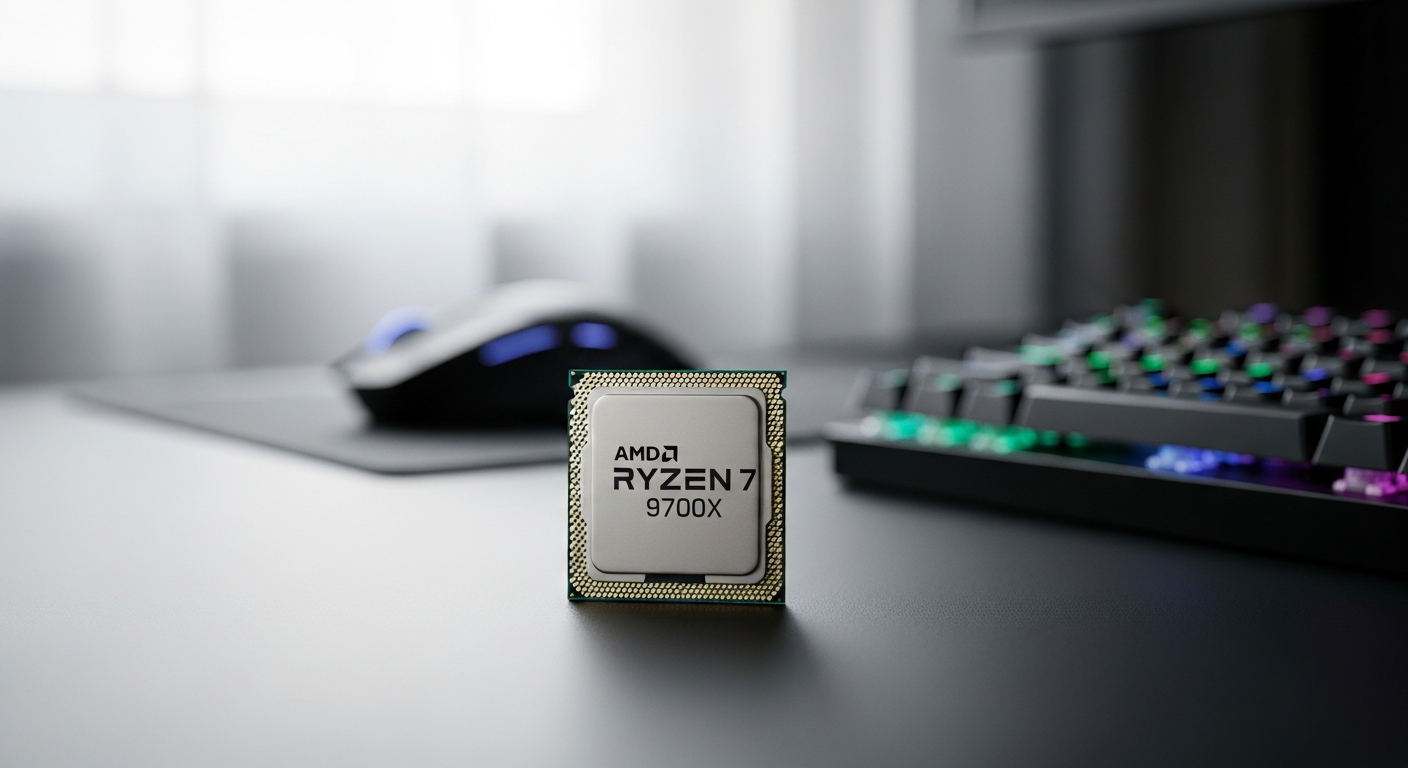
The Power-Efficient Beast: Why the AMD Ryzen 7 9700X Dominates 2024's CPU Market
What if you could build a high-performance gaming PC without watching your electricity bill skyrocket? The AMD Ryzen 7 9700X challenges the assumption that powerful processors require excessive power consumption. This CPU delivers serious computational muscle while maintaining a remarkable 65W TDP, a figure that seems almost impossible given its performance capabilities.
Launched in August 2024 as part of AMD's Ryzen 9000 series, the 9700X represents a significant leap in desktop computing technology. Built on the cutting-edge Zen 5 architecture using TSMC's 4nm manufacturing process, this processor has rapidly become a favorite among PC builders who refuse to compromise between performance and practicality.
Discover the AMD Ryzen 7 9700X and find the best deals today.
Understanding the Zen 5 Architecture Behind the 9700X
The 4nm Manufacturing Advantage
TSMC's 4nm manufacturing process isn't just a marginal improvement over previous generations—it fundamentally changes what's possible in CPU design. This advanced process allows AMD to pack more transistors into the same physical space while reducing power consumption. The efficiency gains manifest directly in lower heat output and reduced electricity draw, making the processor suitable for a broader range of system configurations.
Zen 5 (Granite Ridge) Evolution
Each generation of Ryzen architecture builds upon lessons learned from its predecessor. Zen 5 improves instruction-level parallelism and data throughput compared to Zen 4, meaning the processor accomplishes more work per clock cycle. This architectural refinement, combined with the 4nm process, enables the 9700X to achieve performance gains without proportional increases in power consumption—a rare achievement in processor design.
8 Cores, 16 Threads: The Perfect Workload Balance
The 9700X's configuration of 8 cores and 16 threads positions it ideally between pure gaming processors and hardcore workstation CPUs. For gaming, the 8 cores provide ample headroom without excess, while the 16 threads handle content creation, streaming, and multitasking with equal competence. Each core operates independently, allowing the processor to allocate resources dynamically based on application demands.
Clock Speed Performance: 3.8 GHz to 5.5 GHz
A 3.8 GHz base clock ensures consistent performance under sustained loads, while the 5.5 GHz boost frequency engages during single-threaded workloads and gaming scenarios. This wide frequency range reflects the processor's ability to adapt: maintaining lower clocks for efficiency during light tasks, then ramping up when applications demand maximum responsiveness. The boost behavior is intelligent and responsive, automatically engaging when thermal and power headroom allow.
The Efficiency Revolution: Why 65W TDP Changes Everything
Thermal Design Power Explained
Thermal Design Power (TDP) represents the maximum heat a processor generates under full load. The Ryzen 7 9700X's 65W TDP is almost half that of its direct predecessor, the Ryzen 7 7700X, which consumed 105W. This dramatic reduction fundamentally alters system design possibilities—builders can use significantly smaller CPU coolers, reducing overall system cost and noise.
Temperature Management in Real-World Scenarios
The low thermal output translates directly to manageable temperatures across different cooling solutions. Even modest air coolers keep the 9700X well within safe operating ranges, while liquid cooling solutions enable sustained boost clocks with minimal throttling. Users report temperatures in the 45–55°C range during gaming on mid-range air coolers, and 35–45°C with quality AIO systems—remarkably cool figures for a processor this powerful.
Electricity Cost Implications Over Time
Consider the financial impact: operating a 65W processor versus a 105W processor across a 5-year system lifespan results in meaningful electricity savings. At $0.12 per kilowatt-hour (US average), running the 9700X for 8 hours daily costs approximately $19 annually, compared to $32 for a 105W processor. This compounds significantly when considering entire system power draw, where the CPU's reduced consumption cascades through PSU efficiency and ambient cooling load.
Compact Builds and Small Form Factor Systems
The low power envelope opens possibilities for small form factor PCs, HTPCs, and compact gaming builds that would otherwise require expensive, specialized cooling solutions. The 9700X fits seamlessly into ITX cases with standard tower coolers, maintaining thermal safety in confined spaces where larger processors would struggle.
Check out current pricing and availability of the Ryzen 7 9700X now.
Gaming Performance That Rivals Intel's Top Tier
Single-Core Performance Advantages
Games remain fundamentally dependent on single-core processor performance, particularly for frame rate consistency and minimum FPS. The 9700X's Zen 5 architecture delivers substantial single-core gains that directly translate to smoother gaming experiences. In CPU-limited scenarios, frame rates improve noticeably compared to previous-generation processors, creating the smooth, responsive feel that separates competent gaming platforms from exceptional ones.
Firmware and OS Updates Transformed Performance
Early reviews noted that the 9700X showed less dramatic improvements in multi-core tasks than expected, but this narrative shifted significantly through 2024. AMD released microcode updates and Windows optimizations that enhanced performance, particularly in gaming workloads. These improvements validated the processor's design, proving that initial benchmark impressions underrepresented its true capabilities.
Competitive Positioning Against Intel Core i7
The 9700X competes directly with Intel's Core i7-14700K and similar processors, often matching or exceeding them in gaming performance. Where Intel processors traditionally held sway, the 9700X now delivers comparable or superior frame rates while consuming significantly less power. This shift represents a meaningful change in the competitive landscape, making AMD's offering increasingly difficult to overlook.
Ray Tracing and DLSS Capabilities
Modern gaming demands ray tracing and upscaling technology support. The 9700X handles both efficiently, with driver optimizations ensuring smooth performance in DLSS 3 titles and ray-traced games. The processor's strong single-core performance enables high frame rates even in demanding scenarios, without requiring excessive GPU specifications.
Pricing Strategy and Value Proposition Analysis
From $359 MSRP to Market Reality
The 9700X launched with a $359 MSRP, positioning it as a premium option. However, market dynamics have substantially altered pricing reality. Currently finding prices as low as $229.99, the processor has shifted from aspirational to genuinely accessible for most builders. This pricing evolution reflects competitive pressure and strong supply, benefiting consumers immensely.
Historical Price Fluctuations and Optimal Buying Windows
Tracking the 9700X's price history reveals patterns: launch window pricing around $359, gradual reductions through fall 2024, aggressive sales during Black Friday and holiday periods (dropping to $289), and current sustained pricing in the $229–$299 range. Seasonal patterns suggest similar sales opportunities will emerge around major retail events and holiday shopping periods.
Cost-Per-Performance Against Intel Alternatives
Calculating performance per dollar reveals the 9700X's exceptional value. Matched against Intel's similarly-positioned processors, the 9700X typically offers 10–15% better performance per dollar while consuming significantly less power. This efficiency advantage becomes even more pronounced when factoring in long-term electricity costs.
Strategic Timing for Purchases
Current pricing makes the 9700X an excellent purchase timing opportunity. The processor remains current, has demonstrated real-world performance improvements since launch, and benefits from mature driver and BIOS support. Waiting for future generations would delay performance gains without guaranteeing better value, making immediate purchase sensible for anyone planning a system build.
How the 9700X Stacks Up Against Intel's Current Lineup
Specification Comparison: 9700X vs Core i7-14700K
The Intel Core i7-14700K offers 20 cores (8 P-cores, 12 E-cores) versus the 9700X's 8 cores, suggesting Intel superiority on paper. However, this oversimplifies processor architecture. AMD's uniform core design differs fundamentally from Intel's hybrid approach. For gaming, the 9700X's 8 high-performance cores often outperform Intel's configuration, while the i7-14700K excels in heavy multi-threaded workloads. The real advantage depends entirely on application requirements.
Gaming Performance Head-to-Head
In gaming benchmarks, the 9700X trades blows with the i7-14700K across various titles. High-refresh 1080p testing shows the AMD processor often pulling slightly ahead, while 4K scenarios minimize differences since GPU limitations become dominant. The gap between them is minimal—often within margin of error—making processor choice less critical than GPU selection for gaming performance.
Power Consumption and Thermal Efficiency Disparity
Here the 9700X's advantage becomes substantial. The i7-14700K consumes roughly 190W under sustained load, more than triple the 9700X's consumption. Real-world implications include smaller cooler requirements, lower system noise, reduced electricity costs, and simpler thermal management. For users prioritizing efficiency and practicality, this advantage carries significant weight.
Price-to-Performance Ratio Judgment
At current pricing, the 9700X delivers superior value for most use cases. A builder spending $250 on the 9700X versus $450+ for the i7-14700K gains remarkable gaming performance while saving money—performance that wouldn't be recouped in any realistic scenario. The value proposition tilts overwhelmingly toward AMD.
The Ryzen 7 9700X Verdict: A Smart Choice for 2026 Builders
The AMD Ryzen 7 9700X stands as a remarkably balanced processor that refuses to be pigeonholed. Whether you're chasing high frame rates, managing creative workflows, or optimizing system efficiency, this CPU delivers across the board. The 65W TDP alone sets it apart in a market where power consumption often spirals upward, yet AMD paired that efficiency with genuinely competitive performance that rivals Intel's premium offerings.
What truly impresses is how the processor has evolved since launch. Software updates addressed early criticisms about multi-core performance, proving that initial reviews underrepresented its true capabilities. Combined with aggressive pricing that has dropped significantly from the $359 MSRP, the 9700X represents exceptional value for anyone building a system today.
The AM5 platform ensures your investment remains relevant for years to come. DDR5 support, PCIe Gen 5 connectivity, and future processor compatibility mean the motherboard you purchase today will accommodate processor upgrades for generations. This longevity adds real value beyond the immediate performance equation.
If you're shopping for a processor that balances raw performance, thermal efficiency, and financial sensibility, the Ryzen 7 9700X deserves serious consideration. It doesn't just meet expectations—it consistently exceeds them, making it an excellent choice for 2026 and beyond.
Leave a Reply