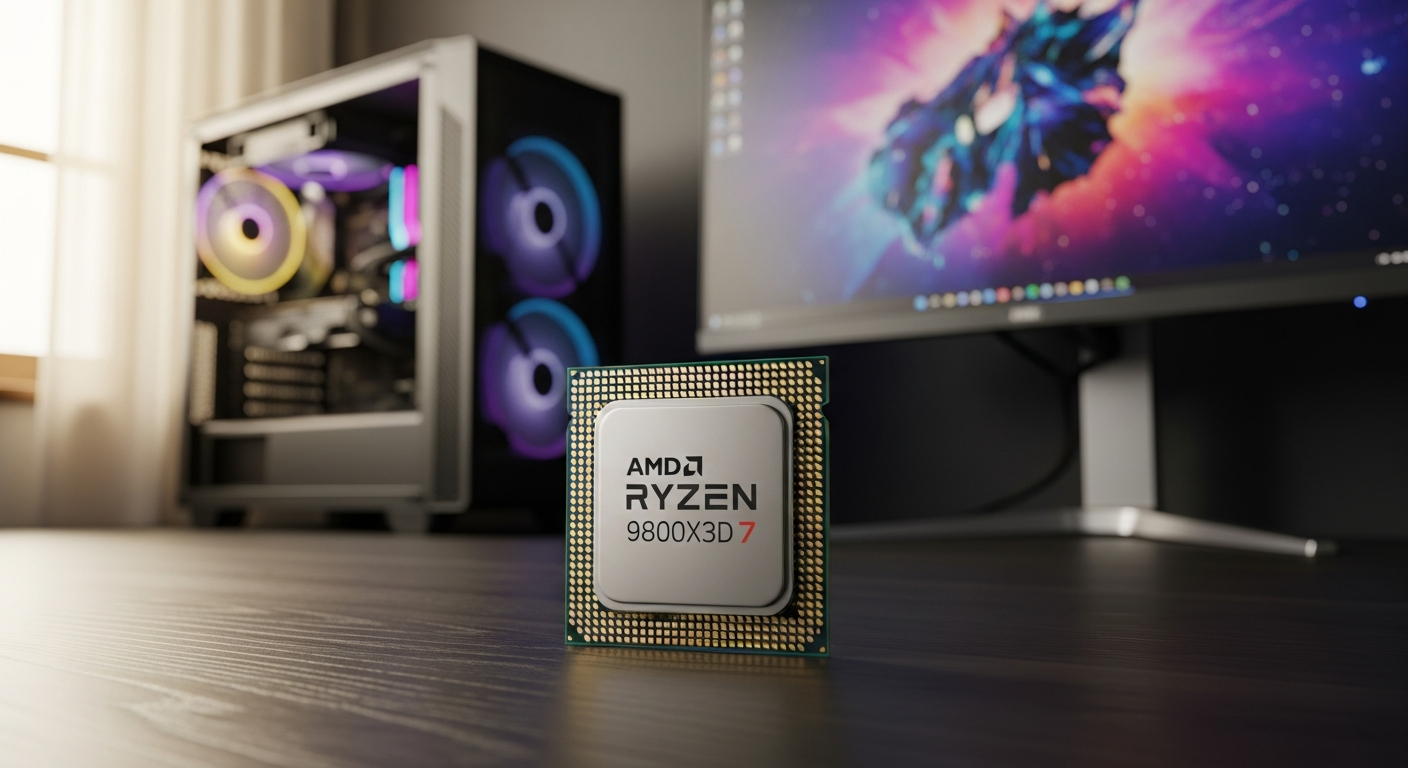
Competitive gamers spend thousands on their setups, yet the CPU often gets overlooked. A single processor choice can mean the difference between 120 fps and 180 fps in your favorite titles. That’s not hyperbole—it’s the reality of modern gaming hardware, where every millisecond of performance translates to competitive advantage and visual fluidity.
The AMD Ryzen 7 9800X3D has become the processor that serious gamers obsess over. This chip has earned its legendary status through relentless frame rate delivery, and the technology powering it represents a genuine innovation in CPU design. AMD’s revolutionary 3D V-Cache technology fundamentally changes how processors handle gaming workloads, creating performance advantages that competitors struggle to match.
Explore the Ryzen 7 9800X3D specs and current pricing today.
This exploration walks you through how the 3D V-Cache architecture works, real-world gaming performance gains, whether it fits your needs, and whether that €350–€450 price tag delivers genuine value.
Understanding 3D V-Cache Technology and Its Gaming Impact
The Ryzen 7 9800X3D’s secret weapon lies in its cache hierarchy. AMD engineered an additional layer of L3 cache directly onto the CPU die through a revolutionary stacking process. Rather than placing cache beside the processor cores in traditional designs, 3D V-Cache literally stacks 128MB of L3 cache on top, creating unprecedented memory bandwidth for data retrieval.
How AMD Stacked Additional Cache Directly Onto the Die
Traditional CPU design places cache components horizontally alongside processor cores, constrained by physical die limitations. AMD’s innovation involved a vertical approach—stacking a layer of cache directly above the processing cores using advanced manufacturing techniques. This vertical integration reduces the physical distance data must travel, cutting down latency significantly. The result is a processor that delivers cache hits more consistently, meaning fewer expensive trips to main system RAM.
Why Larger Cache Sizes Reduce Data Latency for Gaming Engines
Gaming engines continuously request texture data, shader information, and rendering instructions. Processors with larger caches can store more of this frequently-accessed data locally. When a game engine requests information that exists in the CPU cache rather than main memory, retrieval happens in nanoseconds instead of hundreds of nanoseconds. Across millions of requests per second during gameplay, this difference compounds into measurable frame rate improvements.
The 128MB L3 cache on the 9800X3D is roughly double what traditional non-X3D designs offer. This expanded capacity means game-critical data stays resident in the cache rather than requiring constant main memory access, reducing bottlenecks that typically limit frame rates.
Performance Advantage in Cache-Dependent Game Engines
Unreal Engine and proprietary engines from major studios are particularly cache-sensitive. These rendering pipelines process complex geometry, lighting calculations, and asset streaming—operations that demand rapid sequential data access. Engines built on these frameworks show the most dramatic performance gains with 3D V-Cache technology.
Games using deferred rendering, complex physics simulations, or streaming-heavy asset management show frame rate improvements of 10–20% compared to equivalent non-X3D processors. Titles like Starfield, Final Fantasy XVI, and Alan Wake 2 demonstrate these advantages clearly.
Cache Hierarchy Comparison: 128MB L3 vs. Traditional Designs
Standard high-end processors typically feature 32–64MB of L3 cache. The Ryzen 7 9800X3D’s 128MB represents a significant step forward. This expanded capacity creates a larger “working memory” that games can utilize without penalty. The hierarchy functions as a three-tier system: L1 and L2 caches handle immediate instruction processing, while the massive L3 cache absorbs game engine requests. Traditional designs show cache misses more frequently, forcing processor stalls while waiting for memory.
Real-World Impact on Frame Rates Across Game Genres
Frame rate improvements vary by game engine and design philosophy. Competitive esports titles optimized for raw performance see modest but consistent gains—5–10 fps improvements at 1080p. AAA titles with complex graphics show more dramatic differences, particularly at higher resolutions where CPU cache efficiency matters more.
At 1440p in demanding titles, the 9800X3D frequently delivers 15–25% higher frame rates than previous-generation high-end CPUs. At 4K, where GPU limitations become more pronounced, gains narrow but remain substantial—typically 10–15% improvements over competitive processors.
Why AAA Titles Benefit Most from 3D V-Cache
AAA games represent the cutting edge of graphics complexity, featuring intricate rendering pipelines that stress CPU cache systems. Games with ray tracing enabled, complex physics simulations, or high-resolution texture streaming all demand faster CPU data delivery. The 9800X3D’s expanded cache means less stuttering during these demanding operations and more consistent frame delivery.
Thermal and Power Efficiency Trade-offs
The 9800X3D features a 120W TDP, which is remarkably efficient for its performance class. The stacked cache design generates some additional heat, but thermal management remains straightforward. A quality tower cooler or all-in-one liquid cooler handles sustained gaming loads without difficulty. Power consumption remains controlled even under all-core workloads, making this processor practical for standard power supplies.
Gaming Performance Benchmarks Across Popular Titles
Real-world gaming performance tells the story better than specifications. The 9800X3D dominates competitive benchmarking across virtually every gaming category.
Frame Rates in Competitive Shooters
Esports titles like CS:GO, Valorant, and Apex Legends demand consistent high frame rates for competitive advantage. The 9800X3D achieves 300+ fps at 1080p in these titles, providing the frame rate headroom that competitive players demand. High refresh rate monitors become viable, and input lag decreases as frame rates climb. Against Intel’s best offerings, the 9800X3D maintains a 5–10% frame rate advantage in these titles.
1440p and 4K Gaming in Demanding AAA Titles
At 1440p with maximum settings, the 9800X3D delivers 120+ fps in most AAA titles when paired with RTX 4090 or RX 7900 XTX GPUs. Cyberpunk 2077, Starfield, and Alan Wake 2 all see 100–140 fps at these settings. At 4K, frame rates drop to 60–90 fps depending on the title and settings, but remain highly playable. The processor maintains lead positions over competing CPUs by 10–15% across these demanding scenarios.
Performance Consistency Across Different GPU Pairings
Whether paired with RTX 4090, RTX 4080, or RX 7900 XTX graphics cards, the 9800X3D maintains performance leadership. The processor doesn’t create CPU bottlenecks even with flagship GPUs, allowing graphics cards to reach their full potential. Pairing flexibility means this CPU works excellently across various budget tiers—from mid-range RX 7700 XT systems to enthusiast-level configurations.
Ray Tracing and DLSS/FSR Performance Metrics
Ray tracing performance sees meaningful gains with the 9800X3D. Games using Nvidia’s DLSS 3 or AMD’s FSR 3 show particularly strong results, as the enlarged cache helps shader processing. At 1440p with ray tracing enabled and DLSS set to “Quality,” most AAA titles deliver 80–120 fps—performance that was previously limited to DLSS “Performance” or lower settings.
Esports Optimization and Competitive Advantage
The 9800X3D’s consistent 300+ fps performance in esports titles creates tangible competitive advantages. Lower frame variance means more consistent input response, reducing perceived latency. Professional esports players and streamers gravitate toward this processor precisely because it eliminates CPU-related frame inconsistencies that could cost matches.
Thermal Performance Under Sustained Gaming Loads
Extended gaming sessions maintain stable temperatures with proper cooling. Stock performance doesn’t require exotic cooling solutions—a good 240mm AIO or high-end air cooler keeps thermals under control. Peak temperatures under sustained load remain in the 65–75°C range with quality cooling, ensuring longevity and thermal stability during marathon gaming sessions.
Check current availability and pricing for the Ryzen 7 9800X3D.
The Bottom Line: Is the Ryzen 7 9800X3D Worth Your Investment?
The AMD Ryzen 7 9800X3D isn’t a processor for everyone—and that’s exactly what makes it so valuable for those it’s designed for. If you’re a competitive gamer chasing every last frame, streaming gameplay, or an enthusiast demanding the absolute best gaming performance available, this chip delivers. The 3D V-Cache technology genuinely changes how your games perform.
However, if you’re building a budget gaming PC, primarily play esports titles at 1080p, or need serious productivity horsepower, you might find better value elsewhere. The €350–€450 price point is steep, and pairing it with quality components pushes your total investment higher.
What’s clear is that this processor represents a genuine leap forward in gaming CPU design. The technology works, the frame rates prove it, and the reputation is earned through consistent real-world performance. For anyone serious about maximizing gaming performance, the Ryzen 7 9800X3D is the fastest path to victory.
Get your Ryzen 7 9800X3D now and experience the gaming king for yourself.
Leave a Reply