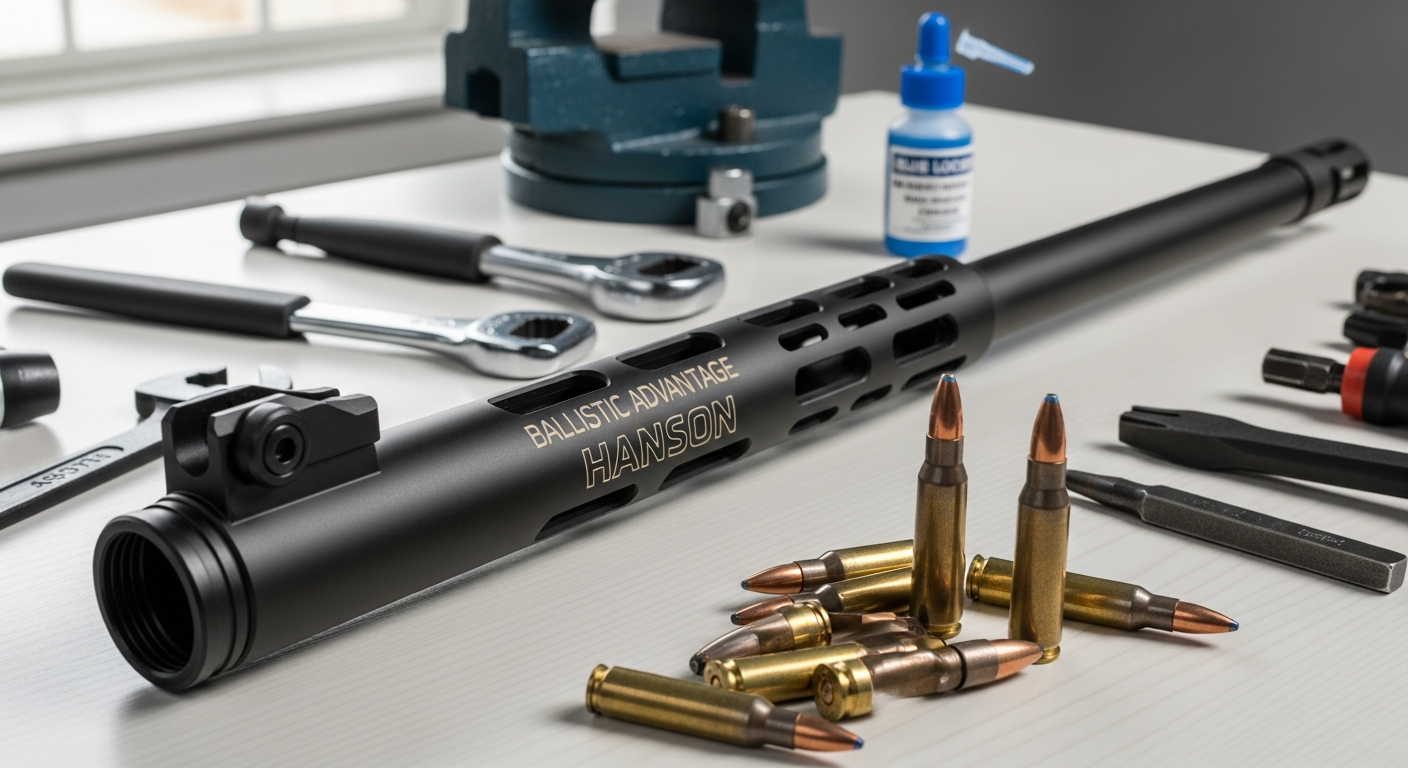
In competitive shooting, milliseconds separate champions from runners-up. The trigger press, sight picture, and follow-up speed all matter—but none of these factors perform optimally without the right foundation. Your barrel choice directly impacts split times, accuracy recovery, and overall reliability when it counts most. The Ballistic Advantage Hanson AR-15 barrel has earned its reputation as the preferred choice for competitors who demand lightweight handling without sacrificing precision.
Named after co-founder Clint Hanson, this barrel series introduces a shoulderless taper design that defies conventional wisdom about barrel profiles. By combining innovative geometry with premium materials and rigorous manufacturing standards, the Hanson delivers performance that outpaces its price tag. The design philosophy centers on a simple principle: reduce weight intelligently without compromising structural integrity or rigidity.
Upgrade your competitive platform with a Ballistic Advantage Hanson barrel today.
The Engineering Behind the Shoulderless Taper Design
Geometry That Breaks the Mold
Traditional barrel profiles taper linearly from breech to muzzle, distributing material in ways that often work against performance goals. The Hanson's shoulderless taper introduces a smooth radius that eliminates abrupt transitions and stress concentrations. This geometric sophistication redistributes mass toward the chamber—where structural demands are highest—while progressively reducing diameter toward the muzzle. The result is a barrel that maintains rigidity at critical points while shedding unnecessary weight downstream.
Minimizing Barrel Whip and Vibration
Every shot introduces harmonics into the barrel structure. These vibrations travel from breech to muzzle, causing the barrel to flex and move at the exact moment the bullet exits. Traditional designs amplify these harmonics through geometric discontinuities. The Hanson's smooth radius design creates a continuous, gradual transition that dissipates harmonics more efficiently. Rather than fighting vibration with brute force (mass), the Hanson design works with the barrel's natural physics to control movement at the source. This translates to tighter shot-to-shot consistency and faster return to zero during rapid strings.
Rigidity Without the Weight Penalty
Advanced metallurgy plays a crucial role in achieving this balance. The barrel's material composition maintains structural integrity even as wall thickness decreases in the muzzle region. The engineering ensures that the barrel deflects less under firing loads compared to conventional lightweight profiles. Competition shooters notice this immediately: faster follow-up shots remain accurate because the barrel settles quicker between rounds. In a match where you're executing 10-round strings with sub-second splits, this advantage compounds across every stage.
Material Science and Finish Options That Matter
4150 Chrome Moly Vanadium Steel Specifications
The 4150 CMV steel specification represents the industry standard for AR-15 barrels. This alloy combines chromium, molybdenum, and vanadium to create a material that withstands repeated thermal cycling and mechanical stress. The 4150 designation refers to specific carbon content and alloying ratios that optimize hardness without sacrificing toughness. Many Hanson CMV barrels receive a QPQ nitride finish—a thermochemical treatment that creates a hardened surface layer. This process imparts superior corrosion resistance and reduces wear rates during normal use and intense competition cycles.
416R Stainless Steel for Precision Builds
Shooters pursuing maximum accuracy often prefer 416R stainless construction. Stainless steel offers inherent corrosion resistance without relying on additional finishes, and 416R specifically includes sulfur for improved machinability. The material's microstructure promotes consistent bullet exit conditions, which precision shooters value above all. While slightly heavier than CMV for the same profile, 416R barrels often ship with a bead-blasted finish that provides an aesthetically clean appearance alongside functional corrosion protection. Precision competitors building dedicated long-range platforms frequently select 416R Hanson barrels as their foundation.
QPQ Nitride Finishing Process
The QPQ (Quench Polish Quench) nitride process represents a significant advantage over traditional parkerizing or electroless nickel coatings. The treatment creates a hardened case on the barrel's surface without substantially altering dimensions—critical for maintaining headspace specifications. The process involves heating the steel in a nitrogen-rich environment, allowing nitrogen atoms to diffuse into the surface layers. This creates a wear-resistant layer typically 0.015 to 0.025 inches deep. The result is superior protection against corrosion, reduced friction during cleaning, and extended barrel life even under high-round-count scenarios. Competitors shooting dozens of matches annually notice the longevity advantage firsthand.
Thermal Characteristics and Heat Cycling
Material selection directly impacts how the barrel manages heat during sustained firing strings. CMV and stainless steel exhibit different thermal expansion rates. CMV typically expands slightly more with temperature changes, while 416R stainless maintains more consistent dimensions across thermal cycles. This distinction matters during competitions where you're executing multiple stages with minimal cooling time. Shooters selecting CMV barrels accept marginally faster heat buildup in exchange for slightly lower cost. Those choosing 416R stainless prioritize thermal stability during back-to-back stages. Both materials perform reliably across typical match scenarios.
Pre-Installed Gas Block: Simplifying Your Build Process
Factory-Pinned Low-Profile Gas Blocks
One of the most practical advantages of many Hanson barrels is the factory-installed, pinned low-profile gas block. Rather than purchasing a separate component and managing installation yourself, this barrel arrives with gas system alignment already handled by Ballistic Advantage's manufacturing process. The gas block sits pinned securely—meaning it won't shift or rotate during firing. This factory integration eliminates a critical potential failure point in the assembly process. New builders particularly benefit from this approach, as gas block installation requires specific tools and knowledge to execute correctly.
Proper Gas Alignment and Reliable Cycling
Gas system alignment directly determines cycling reliability. If the gas block port misaligns with the barrel's port hole by even a small amount, gas flow becomes asymmetrical, creating erratic cycling behavior. Factory-pinned blocks guarantee proper alignment from day one. This translates to consistent lock-back on empty magazines, reliable function across ammunition types, and minimal short-stroking issues. Competitive shooters cannot afford malfunctions during matches. The factory solution removes this variable entirely, allowing you to focus on your build's other components rather than troubleshooting gas system problems.
Time and Frustration Saved
Building an AR-15 upper involves numerous small assembly steps, each a potential source of delay or frustration. Gas block installation typically requires a roll pin, specific alignment techniques, and verification tools. With the Hanson's pre-installed solution, you skip this entire process. The time savings matter less than the certainty it provides—you know the gas system is correct rather than hoping your installation was accurate. First-time builders particularly appreciate this simplification, while experienced builders recognize it as intelligent engineering that respects the builder's time investment.
Compatibility With Receivers and Handguards
Standard low-profile gas blocks maintain compatibility with virtually all modern AR-15 upper receivers and free-floating handguard systems. The pinned design ensures the block sits precisely where it should relative to the barrel's gas port. Compatibility considerations remain minimal, though shooters should verify their specific handguard doesn't create clearance issues with the gas block. Most modern free-float handguards accommodate low-profile blocks without difficulty. The factory configuration ensures you're starting from a known-good baseline for component selection.
Simplify your build with a precision-engineered Hanson barrel featuring a pre-installed gas block.
Accuracy Performance Across Ammunition Types and Distances
Real-World MOA Groupings With Standard Ammunition
Field testing consistently demonstrates that Hanson barrels deliver 1 to 1.5 MOA groupings with quality commercial ammunition. This level of precision places them squarely in the practical-shooter category—accurate enough for competitive stages at all distances, yet realistic about the limitations of factory ammunition. At 100 yards, 1.5 MOA translates to approximately 1.6-inch groups, entirely adequate for tactical rifle competition where target sizes demand precision but not benchrest-level accuracy. Shooters regularly achieve these results across different ammunition brands, indicating the barrel's inherent consistency rather than ammunition-dependent performance.
Sub-MOA Performance With Match-Grade Ammunition
Transition to quality match-grade ammunition or hand-developed precision reloads, and Hanson barrels consistently print sub-MOA groups. Many shooters report 0.75 to 1 MOA with carefully selected ammunition and optimized loads. This capability opens possibilities for precision rifle competition and long-range shooting disciplines. The barrel's design minimizes variables that cause dispersion, allowing ammunition quality to become the limiting factor. Precision competitors developing load recipes often discover their Hanson barrel is their most reliable component for achieving repeatable sub-MOA accuracy.
Premium Version Guarantees
Ballistic Advantage offers Premium versions of the Hanson line with explicit sub-MOA performance guarantees. These barrels undergo additional quality control scrutiny during manufacturing. The sub-MOA guarantee typically covers five consecutive 3-round groups at 100 yards using match-grade ammunition under controlled conditions. This guarantee represents confidence in the engineering and manufacturing process. Should a Premium barrel fail to meet this standard, Ballistic Advantage stands behind the product. For shooters investing in precision builds, this guarantee provides assurance that they're receiving a barrel manufactured to exacting specifications.
Accuracy Across Caliber Offerings
The Hanson line includes 5.56 NATO, .223 Wylde, and .300 Blackout configurations. Each maintains the same design philosophy and accuracy characteristics across calibers. The 5.56 NATO version suits general-purpose applications and standard NATO ammunition. The .223 Wylde chamber accepts both 5.56 NATO and .223 Remington ammunition while maintaining tighter tolerances than standard 5.56 NATO, benefiting precision shooters. The .300 Blackout variant serves subsonic and supersonic applications. Accuracy performance remains consistent—precision remains a defining characteristic regardless of caliber selection.
Weight Savings and Handling Advantages in Competition
Precise Weight Specifications
A 16-inch Hanson barrel weighs approximately 22 ounces—substantially lighter than conventional profiles of the same length. This specific weight figure represents the practical result of the shoulderless taper design applied to a profile optimized for balance. For context, a standard Government profile 16-inch barrel typically weighs 28 to 32 ounces. The Hanson's 6 to 10-ounce advantage might seem modest until you consider that this weight reduction concentrates in the front of the rifle, lowering rotational inertia. The result is a rifle that handles noticeably quicker during transitions and positional changes.
Reduced Shooter Fatigue During Extended Competitions
Three-gun matches, multi-stage tactical competitions, and long training sessions tax physical endurance. Every ounce matters when you're executing 50 to 200 rounds across multiple stages with equipment shouldered, transitioned, and repositioned repeatedly. The lightweight Hanson barrel reduces cumulative fatigue compared to heavier alternatives. Shooters report noticing the difference by the final stages of a match—their shoulders and arms remain fresher, and their ability to execute precise movements stays sharper. Over a competitive season spanning multiple matches, fatigue management becomes a legitimate performance factor. The lightweight advantage compounds across matches and years.
Recoil Impulse and Felt Recoil Management
Reduced muzzle mass directly impacts recoil dynamics. A lighter barrel means less rotating inertia at the front of the rifle, which translates to quicker recoil recovery. The bolt carrier group returns to battery faster, and the muzzle settles more rapidly. During rapid-fire strings where you're executing sub-second splits, faster recoil recovery enables faster follow-up sight pictures. Competitive shooters immediately recognize this advantage when transitioning from heavier barrels to the Hanson profile. The felt recoil reduction varies depending on ammunition power levels, but the consistent theme is faster return-to-zero and improved split times.
Maneuverability in Tactical Positions
Competition stages often require movement through confined spaces—shooting around barrels, through windows, or from behind barricades requiring tight positioning. A lighter rifle responds quicker to directional changes and responds more easily when moving through obstacle courses. The Hanson's low mass up front translates directly to improved handling characteristics in these scenarios. Competitors notice the difference immediately when executing stage plans involving multiple positions and rapid transitions. The barrel's contribution to overall rifle balance means your movements feel less labored and more responsive.
Heat Management and Thermal Performance Under Stress
Heat Buildup During Sustained Firing
Lighter barrels inevitably heat faster than heavier designs during sustained fire. The Hanson's reduced mass means less thermal capacity to absorb heat generated by friction and explosive pressure. During a 25-round rapid string, the Hanson barrel surface temperature rises faster than a heavier conventional profile would. This represents the primary tradeoff inherent to the lightweight design. However, competitive matches rarely demand 25-round continuous strings. Typical stages involve 3 to 10-round strings with breaks between stages, allowing the barrel to cool between efforts. Understanding this limitation helps shooters manage expectations and plan accordingly.
Thermal Expansion and Temporary Accuracy Drift
As the barrel heats, steel expands slightly. This thermal expansion can create temporary changes in chamber pressure and projectile exit conditions, causing slight accuracy shifts during a hot string. Shooters executing 20-shot strings might observe the last few rounds impacting slightly higher or lower than the first shots. The effect remains subtle—typically 0.5 to 1 MOA—but noticeable to precision-focused competitors. The drift occurs predictably and recovers fully once the barrel cools. Understanding this characteristic allows shooters to manage thermal effects through pacing, barrel cooling between strings, and load development strategies accounting for heat cycling.
Recovery Time and Accuracy Restoration
The Hanson's low mass is a two-edged sword: it heats quickly but also cools quickly. A moderately heated barrel returns to ambient temperature within 5 to 15 minutes, depending on ambient conditions. During competitions with breaks between stages or divisions, this natural cooling cycle works in your favor. The barrel responds predictably to heat cycling because the design itself is consistent. Shooters who develop loads and practice understanding their barrel's thermal characteristics can actually use this knowledge strategically—managing pace during early shots and allowing barrel heat to settle during intentional pauses.
Best Practices for Thermal Management
Professional competitors manage barrel temperature proactively. Pacing shots to allow brief cooling intervals between rapid strings helps maintain consistency. Carrying extra rifles allows complete barrel cooling between stages. Avoiding unnecessary prolonged strings during practice sessions extends barrel life. Using a chronograph to observe velocity variations across multiple shots reveals thermal effects in your specific setup. Developing loads with mild velocities reduces heat generation compared to maximum-velocity loads. These practices collectively demonstrate that understanding thermal characteristics transforms a potential limitation into a manageable aspect of competition preparation.
Pricing, Value Proposition, and Comparison Shopping
Standard Price Range and Model Variations
Ballistic Advantage Hanson barrels typically retail between $150 and $250, depending on specific configurations. The base Performance tier represents the lower end, while Premium versions with sub-MOA guarantees occupy the higher range. Length variations, caliber selections, and material choices (CMV versus stainless) create price differentiation within the lineup. A 16-inch 5.56 NATO CMV Hanson barrel in the Performance tier typically costs around $180 to $200. Premium versions of the same configuration often command $50 to $75 additional investment. Specialty calibers like .300 Blackout and longer lengths occasionally exceed $250. Comparing actual specifications and features across models reveals the pricing reflects genuine engineering and material differences.
Performance vs. Premium Tier Distinctions
The Performance tier represents exceptional value, delivering the complete Hanson design philosophy at an accessible price point. These barrels undergo standard quality control and manufacturing processes. They consistently achieve the design's accuracy promise—1 to 1.5 MOA with standard ammunition, and sub-MOA with quality loads. Premium versions undergo additional scrutiny during manufacturing, with stricter tolerance control and post-production testing. The sub-MOA guarantee backing Premium barrels means Ballistic Advantage is confident enough to stake their reputation on specific performance standards. For most competitive shooters, the Performance tier delivers the engineering advantages they're seeking. Shooters pursuing dedicated precision platforms or those wanting guaranteed performance margins justify the Premium upgrade.
Cost Comparison With Competing Lightweight Barrels
Lightweight barrels from established manufacturers—Criterion, Ballistic Advantage's sister brand, Faxon, and others—typically occupy similar price ranges. A quality lightweight profile from competitors usually costs $180 to $250 as well. The distinction lies in design philosophy and manufacturing heritage. The Hanson's specific shoulderless taper design remains somewhat unique in the market. Competing lightweight designs often employ different geometries, sometimes sacrificing rigidity more than the Hanson does. Comparing sub-MOA accuracy results, weight specifications, and finish quality across competing products generally positions the Hanson competitively in terms of value. The real comparison isn't barrel to barrel but rather understanding what specific design characteristics align with your shooting discipline.
Value Analysis: Engineering and Quality
The Hanson represents genuine engineering work—the shoulderless taper design didn't emerge by accident but through intentional development and optimization. The pre-installed gas block alone saves $30 to $50 in component costs and eliminates assembly variables. The choice of 4150 CMV or 416R stainless reflects material selection optimized for specific use cases. The manufacturing precision required to create the smooth radius design represents quality above budget-tier manufacturers. Pricing analysis reveals you're investing in Ballistic Advantage's reputation for consistent performance, their commitment to quality control, and a design philosophy refined through competitive shooting experience. The value proposition becomes clear when comparing the actual cost of precision, reliability, and weight savings against the barrel's price.
Installation, Compatibility, and Build Considerations
Installation Overview for Standard AR-15 Uppers
Installing a Hanson barrel on a standard AR-15 upper receiver involves straightforward procedures. The barrel threads into the upper's journal, typically requiring a barrel wrench and appropriate torque specification (usually 30-40 foot-pounds). The pre-installed gas block arrives pinned and secured, eliminating that installation step entirely. A mid-length or rifle-length gas tube connects to the gas block, routing combustion gases to the bolt carrier group. The installation process remains identical to any other AR-15 barrel swap. First-time builders should not feel intimidated by barrel installation—the process is mechanical and repeatable, with numerous online resources providing detailed guidance.
Headspace Verification and Safety
After barrel installation, headspace verification ensures the barrel and bolt work together within safe tolerances. Headspace refers to the distance between the bolt's firing pin recess and the barrel's chamber. Excessive headspace risks unsafe pressure conditions and potential case failures. Insufficient headspace prevents the bolt from fully closing. Most shooters use go/no-go gauges to verify headspace in their specific chamber. For factory-manufactured barrels like the Hanson, headspace typically arrives within specifications. However, verification represents a critical final check before firing any new build. Headspace gauges cost $15 to $30 and provide essential peace of mind.
Compatibility With Handguards and Accessories
The Hanson's 16-inch length and low-profile gas block remain compatible with modern free-floating handguard systems. Free-float designs suspend the handguard entirely from the upper receiver, never touching the barrel. This compatibility removes potential pressure points that could affect accuracy. The low-profile gas block requires approximately 0.75 inches of top-rail clearance. Most modern handguards accommodate this spacing without issue. Some drop-in handguards designed for full-perimeter mounting might require verification. Specific handguard manufacturer specifications confirm compatibility. The overwhelming majority of contemporary AR-15 handguards work seamlessly with Hanson barrels and pre-installed gas blocks.
Upper Receiver Considerations
Standard M4 flat-top upper receivers accommodate Hanson barrels without issue. Billet uppers, forged uppers, and specialized receiver designs typically provide excellent compatibility. The only consideration involves confirming the upper's barrel journal dimensions match the barrel's thread specifications. The vast majority of AR-15 uppers use standard 1/2×28 barrel threads designed for standard barrels, including the Hanson. Specialized receiver designs (left-handed uppers, ambidextrous controls, etc.) remain fully compatible. The engineering consistency of AR-15 platform standardization means you can confidently match a Hanson barrel to virtually any modern upper receiver.
Real-World Performance: What Shooters Are Actually Experiencing
Competitive Match Results
Competitors running Hanson barrels across multiple disciplines consistently report positive results. Three-gun competitors note improved split times during rifle stages due to reduced recoil impulse and faster barrel recovery. Precision rifle competitors report tight groups and reliable performance across sustained competitions. Tactical rifle shooters appreciate the lightweight advantage combined with consistent accuracy. While individual shooter skill remains paramount, numerous competitors attribute performance improvements to barrel upgrades, with the Hanson frequently cited as the catalyst for personal records and competitive advancement. The consensus across competitive communities remains strong—Hanson barrels deliver measurable performance improvements.
Accuracy Feedback From Precision Shooters
Long-range precision shooters conducting sustained testing report sub-MOA consistency with match ammunition. Shooters developing custom loads specifically for their Hanson barrels achieve remarkable precision. The barrel's thermal characteristics, once understood and accounted for, become reliable variables rather than frustrating inconsistencies. Precision shooters appreciate the straightforward manufacturing quality—no surprises, just consistent performance. Load development with Hanson barrels proceeds smoothly because the barrel's inherent consistency becomes the baseline. Shooters report that once they settle on a preferred load, the barrel maintains that level of precision indefinitely.
Reliability Data From High Round Count Testing
Competitive shooters firing thousands of rounds annually through their Hanson barrels report exceptional reliability. Wear patterns develop predictably, and barrels maintain accuracy for extended periods before requiring replacement. The QPQ nitride finish proves durable through harsh competitive environments involving mud, sand, and rapid temperature changes. Shooters pushing barrels to 15,000 to 20,000 rounds report minimal accuracy degradation. The engineering focus on thermal stability and reduced vibration translates directly to extended barrel life. Reliability testing across competitive communities consistently validates the engineering—these barrels survive intense use.
Feedback From Competitive Disciplines
Across 3-gun, IPSC rifle divisions, precision rifle competitions, and tactical rifle events, Hanson barrel users report satisfaction with performance characteristics. Three-gun shooters appreciate the lightweight handling. Precision competitors value the accuracy guarantees. Tactical competitors benefit from the balance of features. The barrel's versatility across disciplines reflects its fundamental design philosophy—optimize for practical shooting scenarios. The common theme in feedback across communities remains consistent: the Hanson represents genuine engineering that delivers promised performance without excessive cost.
Maximizing Your Hanson Barrel's Potential
Ammunition Selection Strategies
Optimizing ammunition selection directly impacts achieved accuracy. Quality commercial ammunition from established manufacturers (Federal, Hornady, Winchester) provides reliable performance and consistency. For competitive applications, standard match-grade ammunition delivers excellent results across Hanson barrels. Developing hand-loaded precision ammunition fine-tuned to your specific barrel characteristics unlocks sub-MOA potential. Bullet selection matters—heavier bullets (75 to 77 grains in 5.56 NATO) often stabilize more reliably and produce tighter groups. Powder selection influences both accuracy and velocity consistency. Testing different ammunition types through your specific barrel reveals which combinations produce optimal results. Maintaining detailed records of ammunition performance guides future purchasing and development decisions.
Load Development Techniques
Systematic load development involves incrementally adjusting powder charge, primer selection, and bullet seating depth while measuring velocity and recording groupings. Starting loads typically begin 10% below published maximums, with 0.3 to 0.5-grain increments between test rounds. Chronograph measurements reveal velocity consistency—lower standard deviations correlate with tighter groupings. Seating depth adjustments of 0.010 inches sometimes yield surprising accuracy improvements. The goal involves finding the combination that produces the lowest velocity standard deviation and tightest groups. This process requires patience, but the investment pays dividends through enhanced accuracy. Many shooters discover that their Hanson barrel performs best with specific load combinations, and maintaining those loads becomes standard practice.
Maintenance Schedules and Cleaning Protocols
Regular cleaning preserves barrel longevity. Cleaning intervals depend on ammunition type and volume. Shooters firing 200 rounds typically clean before significant accuracy degradation occurs. Proper cleaning procedures involve breech-to-muzzle direction, quality solvents, and bronze or nylon brushes (never steel). The QPQ nitride finish on CMV barrels resists corrosion but still benefits from protective oil layers after cleaning. Stainless barrels similarly require post-cleaning oiling. Dry, protected storage prevents oxidation. Shooters maintaining consistent cleaning schedules typically achieve maximum barrel life without requiring replacements. The barrel's inherent durability extends further when maintained proactively.
Complementary Upgrades
The Hanson barrel performs optimally when paired with quality components throughout the build. A premium two-stage trigger (Larue, Geissele) enables more precise shot placement during competition. A quality optic—whether precision scope or red dot—allows you to fully utilize the barrel's accuracy potential. A free-floating handguard isolates the barrel from pressure points, maintaining the engineering's intended accuracy characteristics. A properly tuned gas system works in concert with the barrel's harmonics. Muzzle devices suited to your discipline (compensators for 3-gun, suppressors for some applications) complete the system. The Hanson barrel represents an excellent foundation for comprehensive rifle building.
The Hanson Advantage: Bringing It All Together
The Ballistic Advantage Hanson AR-15 barrel represents genuine innovation in practical rifle engineering. The shoulderless taper design addresses real performance requirements—weight reduction without rigidity compromise, accuracy maintained while improving handling, and reliability ensured through thoughtful design. Whether you're building your first competition rifle or refining an existing platform, the Hanson delivers measurable performance gains. The pre-installed gas block eliminates assembly variables, the material options accommodate different build philosophies, and the price point makes premium performance accessible.
The engineering philosophy underlying the Hanson reflects years of competitive shooting experience translated into manufacturing specifications. This isn't marketing-driven design but rather purpose-built engineering. Competitors trust Hanson barrels because they perform consistently across disciplines, ammunition types, and environmental conditions. The thermal characteristics, once understood, become predictable variables rather than frustrating inconsistencies. The accuracy potential, whether 1 to 1.5 MOA with standard ammunition or sub-MOA with match loads, matches the design's promise.
Your path forward involves identifying your primary shooting discipline and selecting the appropriate caliber and length. A 5.56 NATO 16-inch configuration suits general-purpose competition and training. The .223 Wylde chamber serves precision shooters prioritizing tight tolerances. The .300 Blackout opens subsonic shooting possibilities. Once installed, focus your efforts on ammunition development and understanding your barrel's thermal characteristics. Practice with consistency, and your skills will determine how effectively you harness the barrel's potential.
The Hanson's reputation stems from delivering performance without forcing compromises. Light enough for competitive maneuverability yet rigid enough for precision accuracy. Durable enough for thousands of competitive rounds yet precise enough for specialized applications. Affordable enough for serious shooters yet engineered with uncompromising standards. Your next personal record might genuinely be one barrel upgrade away.
Order your Ballistic Advantage Hanson barrel and experience competition-grade performance.
Leave a Reply