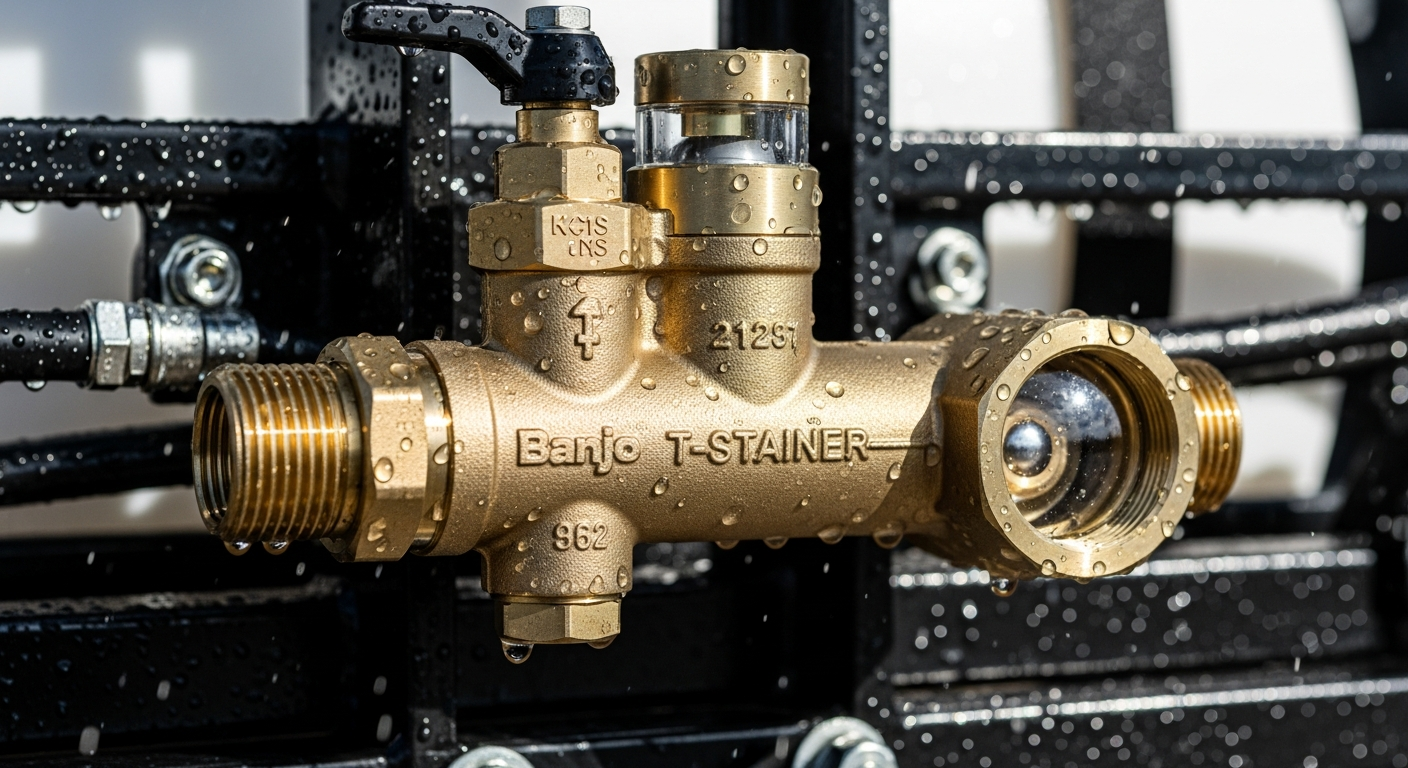
Clogged nozzles and pump failures cost agricultural and industrial operators thousands of dollars annually. A single particle-induced blockage can halt your entire spraying operation, waste valuable product, and force expensive emergency repairs. The Banjo 1″ Manifold T-Strainer represents a straightforward yet powerful solution to this widespread problem. This component sits quietly in your spray system, working behind the scenes to catch debris before it reaches your pumps and nozzles.
Understanding where contamination originates is the first step toward protecting your equipment. Agricultural and industrial spraying systems face constant exposure to particles from multiple sources—dust from field preparation, degraded tank linings, mineral deposits from water supplies, and residual chemical particles from previous applications all find their way into spray tanks. These seemingly insignificant contaminants accumulate quickly and create significant operational challenges.
Protect your spray system with the Banjo 1″ Manifold T-Strainer today.
Common Sources of Debris in Agricultural and Industrial Spraying Systems
Your spray tank accumulates contamination from multiple pathways. Tank filling introduces sediment from water sources, old tank coatings flake during agitation, and previous chemical residues persist despite rinsing. Field dust enters during mixing and loading operations. Worn hoses and fittings shed plastic particles into the system. Each contaminant carries the potential to wreak havoc downstream.
The Cascade Effect: How Small Particles Cause Pump Wear and Nozzle Clogs
A single grain of sand smaller than a human hair can scratch precision pump components or lodge inside nozzle openings. When particles reach your pump, they increase internal friction, accelerate wear on impellers, and force the pump to work harder, generating heat and reducing lifespan. Nozzles suffer similar consequences—tiny particles lodge in the internal passages that regulate spray patterns, creating blockages that force operators to increase pressure or remove nozzles for manual cleaning.
Real-World Consequences of Operating Without Adequate Filtration
Operators who skip filtration face escalating problems. Initial symptoms include inconsistent spray patterns and reduced coverage. Pressure fluctuations become noticeable as particles partially block flow passages. Eventually, complete blockages force shutdown for emergency cleaning or nozzle replacement. Pump repairs or replacements represent major expenses, often exceeding $1,000 or more depending on system size and complexity. Application windows close, crops remain unprotected, and product sits unused in tanks—all preventable through proper filtration.
Why 50-Mesh Filtration Captures the Right Particle Size for Most Applications
The 50-mesh screen represents the optimal balance for most agricultural and industrial applications. Mesh rating indicates holes per linear inch—50 mesh creates approximately 304 openings per square inch, allowing particles larger than 297 microns to be captured. This size range catches debris that damages pumps and nozzles while maintaining sufficient flow rates to prevent backpressure and system stress. Coarser screens miss harmful particles; finer screens restrict flow and require more frequent cleaning.
The Relationship Between Contamination Levels and Equipment Downtime
Higher contamination rates directly correlate with increased downtime. Systems operating in dusty environments or using untreated water sources experience rapid filter saturation. Clogged strainers reduce flow, triggering pressure alarms and forcing operators to pause applications for cleaning. This cycle repeats multiple times during a single growing season if contamination sources remain unaddressed. Effective filtration breaks this pattern, enabling uninterrupted spray cycles and maximizing productive operating hours.
The Engineering Behind the Banjo 1″ Manifold T-Strainer
The Banjo 1″ Manifold T-Strainer derives its reliability from thoughtful engineering and material selection. Every component serves a specific purpose in creating a filtration barrier that withstands demanding chemical and physical environments.
Glass-Reinforced Polypropylene Construction and Chemical Resistance Capabilities
Heavy-duty, glass-reinforced polypropylene forms the strainer body, delivering exceptional durability while remaining lightweight. This material resists degradation from mineral acids, salt solutions, and common agricultural chemicals. Polypropylene maintains structural integrity across temperature variations without becoming brittle or developing stress cracks. The glass reinforcement increases tensile strength, allowing the body to withstand internal pressure and external impacts without failure. Operators can confidently use this strainer with virtually any crop protection chemical or liquid fertilizer formulation.
316 Stainless Steel Mesh Screen Durability and Longevity
The 50-mesh screen utilizes 316 stainless steel, offering superior corrosion resistance compared to standard stainless grades. This material withstands prolonged exposure to saltwater, acidic chemicals, and corrosive mineral compounds without pitting or deterioration. The mesh weave maintains consistent opening sizes throughout the screen’s service life, ensuring reliable filtration without gaps that allow particles to slip through. High-quality construction means screens retain their filtering capability across multiple seasons of use.
EPDM Gasket Performance in Demanding Chemical Environments
EPDM rubber gaskets seal connection points and prevent fluid leakage around the screen and clean-out plug. EPDM demonstrates outstanding chemical compatibility with agricultural chemicals, mineral acids, and petroleum-based products. These gaskets compress reliably under system pressure, creating watertight seals that prevent bypass filtration—a critical failure mode where unfiltered fluid leaks around a failing gasket. EPDM maintains flexibility across temperature ranges, remaining effective in both cold storage conditions and heated summer operations.
Manifold Flange Connection Design and Compatibility with Standard Systems
The 1-inch manifold flange connection integrates seamlessly into standard agricultural and industrial spray systems. This universal connection design allows the strainer to fit directly onto existing manifold blocks without requiring adapters or custom fabrication. The flange surface receives standard fasteners, providing secure installation that prevents vibration-induced loosening. Compatibility with existing infrastructure means operators upgrade filtration without redesigning entire systems or purchasing new manifold assemblies.
How the T-Strainer Configuration Optimizes Fluid Flow While Filtering
The T-shaped design channels fluid through the screen chamber while maintaining internal flow paths that minimize pressure drop. Unlike straight-through designs where all fluid must pass perpendicular to the screen surface, the T configuration uses the full screen area efficiently. Fluid enters from one port, spreads across the maximum screen surface, and exits through another port with minimal turbulence. This geometry reduces the frequency of cleaning cycles while maintaining the high flow rates necessary for efficient spray operations.
Discover how the Banjo 1″ Manifold T-Strainer optimizes your spray system efficiency.
Pressure Ratings and Performance Specifications
Understanding the technical specifications ensures you select appropriate equipment for your operating conditions. The Banjo 1″ Manifold T-Strainer handles the pressure demands of both standard and high-pressure applications.
Standard Operating Pressure Range (150 PSI at 70°F)
The strainer operates reliably at pressures up to 150 PSI at 70°F under standard conditions. This rating encompasses the vast majority of agricultural spray applications, where typical operating pressures range from 20 to 100 PSI. Most boom sprayers, hand-held nozzles, and chemigation systems function within this pressure envelope, making the standard rating perfectly adequate for conventional operations.
High-Pressure Variant Capabilities (Up to 300 PSI)
Specialized applications requiring elevated pressures benefit from high-pressure variants capable of handling pressures up to 300 PSI. Aerial spraying operations, industrial coating systems, and precision injection equipment often demand these elevated pressures. High-pressure variants utilize reinforced polypropylene formulations and thicker wall construction to safely contain greater internal forces without deformation or failure.
Compact Dimensions and Space-Saving Design Benefits
Measuring approximately 8.89 inches in height, 3.25 inches in width, and 4.41 inches in length, the strainer fits into tight installation spaces where larger equipment cannot accommodate. Its compact footprint integrates into existing manifold assemblies and tank-mounted systems without requiring extensive structural modifications. Space-constrained operations benefit significantly from this efficient design, which delivers full filtration capability without demanding valuable equipment real estate.
Weight Specifications and Installation Considerations
Weighing approximately 0.765 to 0.78 lbs, the strainer adds minimal weight to spray systems. The light construction reduces stress on mounting brackets and tank connections. During installation, the modest weight means operators can position and secure the unit without mechanical assistance or specialized equipment. This characteristic also simplifies maintenance—removing the strainer for cleaning or screen replacement requires no heavy lifting or complex procedures.
Temperature and Pressure Limits for Safe Operation
Temperature ratings extend across seasonal operating ranges, maintaining seal integrity and material flexibility from freezing conditions to summer heat. The 70°F baseline for pressure ratings accounts for standard operating temperatures; higher ambient temperatures may require reduced pressure operation to ensure component safety. Operators working in extreme environments should consult manufacturer documentation for specific temperature derating curves and safe operating envelopes.
Maintenance and Cleaning: Keeping Your Strainer Operating Efficiently
Regular maintenance determines whether your strainer delivers years of reliable service or becomes a source of operational headaches. The straightforward design facilitates quick cleaning procedures that minimize system downtime.
The Clean-Out Plug Design and Its Role in Quick Maintenance
A convenient clean-out plug provides rapid access to the screen chamber. Rather than disconnecting the entire strainer from the manifold, operators simply remove the plug, allowing easy screen inspection and cleaning. This design choice represents substantial time savings during maintenance cycles. The plug seals securely under system pressure, preventing leaks while remaining easy to remove by hand without specialized tools. Some operators keep spare plugs on hand to enable plug rotation during extended cleaning sessions.
Step-by-Step Cleaning Procedures for the 50-Mesh Screen
Begin by ensuring system pressure has vented completely before removing the clean-out plug—never work on pressurized components. Remove the plug and carefully extract the screen. Rinse the screen under clean flowing water, directing water perpendicular to the mesh surface to dislodge trapped particles. For heavily soiled screens, soak in warm water containing mild detergent for 15-30 minutes before rinsing. A soft-bristled brush can gently remove stubborn deposits without damaging the mesh weave. Inspect for tears or damage before reinstallation. Once clean, carefully reinsert the screen into the chamber and hand-tighten the clean-out plug. Pressure test the system before resuming operations to verify proper sealing.
Frequency Recommendations Based on Application Type and Contamination Levels
Applications drawing from untreated water sources or operating in dusty field conditions may require cleaning every 5-10 operating hours. Systems using filtered or treated water sources can extend intervals to 20-40 hours between cleanings. Operators should establish baseline cleaning intervals through field observation, noting when pressure drop first becomes noticeable. Increase cleaning frequency if contamination levels spike during specific seasons or operations. Seasonal changes in water source quality or field dust conditions often necessitate interval adjustments.
Screen Replacement Options and Availability of Spare Parts
Replacement 50-mesh screens remain readily available through SpraySmarter.com, ensuring operators can quickly address worn screens without searching multiple suppliers. Over time, repeated cleaning and chemical exposure gradually degrade mesh integrity. Once a screen exhibits tears, reduces flow noticeably despite thorough cleaning, or fails pressure testing, replacement becomes necessary. Keeping spare screens on hand prevents extended downtime when screening reaches end-of-life. The relatively low replacement cost ($15-$25 per screen) makes proactive replacement economically justified.
Downtime Minimization Strategies During Maintenance Cycles
Operators managing multiple spray systems can rotate equipment during cleaning intervals, keeping at least one system operational while others undergo maintenance. Pre-staging clean screens before the current screen reaches saturation enables quick swaps without extended system shutdown. Scheduling maintenance during naturally low-use periods (early morning, after-spray wind-down) preserves peak operating hours for productive application. Documenting cleaning dates and intervals helps identify patterns that optimize scheduling around predictable application windows.
Cost-Effectiveness and Return on Investment
The true value of the Banjo 1″ Manifold T-Strainer emerges through its ability to prevent catastrophic equipment failures. A straightforward cost analysis demonstrates why this component delivers exceptional returns.
Pricing Structure ($40-$55 Range) Compared to Equipment Repair Costs
The strainer retails in the $40-$55 range, representing a modest investment compared to the cost of repairs it prevents. Pump replacement for a mid-size spray system typically costs $400-$1,500 depending on pump type and complexity. Nozzle sets range from $100-$300 for complete boom assemblies. A single blockage-related failure pays back the strainer investment 10-15 times over. Operators purchasing equipment protection insurance at these rates would jump at the opportunity—yet many skip basic filtration, the most cost-effective form of equipment protection available.
Long-Term Savings from Preventing Pump and Nozzle Damage
Over a five-year period, operators using effective filtration avoid an average of one major pump repair or replacement. This single prevented failure typically saves $500-$1,200 in parts and labor. Add the value of prevented nozzle damage (multiple repair cycles each season average $200-$400 annually), and five-year savings easily exceed $2,000. The strainer costs less than 3% of these prevented expenses, making it perhaps the best-value component in the entire spray system.
Reduced Product Waste Through Consistent Spray Patterns
Partially clogged nozzles or pressure fluctuations caused by debris reduce spray accuracy and coverage uniformity. Operators unknowingly miss portions of fields or apply inconsistent chemical concentrations. This inefficiency wastes product through over-application in covered areas and reduces effectiveness in under-application zones. Effective filtration maintains consistent nozzle performance, ensuring uniform coverage and optimal product utilization. Over a season, product waste reduction from improved spray patterns often exceeds the strainer’s purchase price.
Replacement Screen Availability and Affordability
Unlike some agricultural equipment where replacement parts remain scarce and expensive, strainer screens for the Banjo unit stay readily stocked at competitive prices. This availability ensures operators can affordably maintain their strainers indefinitely. Systems without accessible replacement parts eventually become abandoned when initial components wear out—not a concern with well-established products offering robust aftermarket support.
Total Cost of Ownership Across Multiple Seasons
Calculating total cost of ownership over 10 years includes the initial strainer purchase ($50), estimated screen replacements ($150 for 6-8 screens), and minimal maintenance labor. Total investment approaches $200-$250. Compare this against a single major equipment failure requiring $800-$1,500 in repairs. The cost comparison becomes overwhelming—effective filtration costs pennies per operating hour while preventing failures costing dollars per hour of operation.
Applications Across Agricultural and Industrial Sectors
The Banjo 1″ Manifold T-Strainer serves diverse operational contexts, from large-scale agricultural enterprises to specialized industrial applications. Its versatility reflects the universal nature of the filtration challenge across spray system types.
Agricultural Spraying Operations and Crop Protection Requirements
Field crop spraying represents the primary application domain. Corn, soybean, wheat, and specialty crop operations rely on effective spray equipment to deliver herbicides, insecticides, and fungicides precisely when needed. Equipment downtime during critical application windows costs thousands in lost yield. The strainer’s role in preventing failures becomes especially critical during compressed spray windows when weather cooperation is limited.
Industrial Chemical Application Systems
Manufacturing facilities, water treatment plants, and chemical processors employ spray systems for coating applications, dust control, and equipment maintenance. Industrial applications often involve more aggressive chemical formulations than agricultural products. The strainer’s chemical compatibility becomes essential for long-term reliability in these demanding environments. Industrial downtime costs often exceed agricultural expenses, elevating the importance of preventive filtration investment.
Herbicide and Pesticide Distribution Networks
Applicators mixing and distributing chemicals to multiple customer locations face intense pressure to maintain operational reliability. A single strainer failure causing spillage or application delays creates liability and reputational consequences. Professional applicators recognize that strainer investment represents essential risk management, not optional equipment.
Fertilizer Application Equipment Compatibility
Liquid fertilizer applications present unique filtration challenges due to mineral content and potential for scale formation. The Banjo strainer’s chemical resistance enables reliable operation with liquid nitrogen solutions, phosphate formulations, and complex multi-nutrient products. Operators applying foliar nutrients through spray equipment benefit from the protection against mineral deposits and chemical incompatibility issues.
Custom Spray System Integration Considerations
Integrating the strainer into existing systems requires only basic manifold connection knowledge. Most operators can install the unit during routine system maintenance. Its universal 1-inch flange accommodates diverse manifold configurations, simplifying standardization across equipment fleets.
Selecting the Right Mesh Size and Configuration
Mesh selection determines filtration effectiveness and system performance. Understanding the relationship between mesh rating and particle capture enables operators to optimize their specific applications.
Understanding Mesh Ratings and Filtration Particle Capture
Mesh ratings directly translate to particle size capture. A 50-mesh screen captures particles approximately 297 microns and larger. Calculating exact particle capture requires understanding that mesh openings are slightly larger than the nominal micron rating, but the screen wire itself prevents particles smaller than the opening size from passing through. Higher mesh numbers (100-mesh, 200-mesh) capture progressively smaller particles but increase pressure drop and cleaning frequency.
When 50-Mesh Provides Optimal Protection Versus Finer Alternatives
For most agricultural and standard industrial applications, 50-mesh represents the optimization sweet spot. It captures particles that damage pumps and nozzles while maintaining flow rates suitable for spray equipment. Finer meshes (100-mesh or higher) become necessary only when working with extremely fine nozzles or precision injection equipment. For conventional boom sprayers, hand-applied equipment, and most industrial coating systems, 50-mesh delivers adequate protection without unnecessary flow restriction.
Balancing Filtration Efficiency with Flow Rate Requirements
Finer mesh screens increase filtration efficiency but proportionally increase pressure drop across the strainer. As pressure drop increases, pump workload increases, reducing efficiency and increasing heat generation. System operators must balance contamination capture against operational performance. In high-flow applications, finer mesh screens may require oversized strainers or dual-unit configurations to maintain adequate flow. The 50-mesh rating balances these competing demands effectively for most applications.
Compatibility with Different Fluid Types and Chemical Compositions
The Banjo strainer’s polypropylene and stainless steel construction enables compatibility with virtually all agricultural chemicals, liquid fertilizers, and industrial fluids. Some specialty applications involving organic solvents or hydrocarbon-based products may warrant investigation into material compatibility, but standard crop protection chemicals and fertilizers pose no compatibility concerns. Operators switching between different product types can use the same strainer confidently.
Upgrade Paths and Scaling Options for Expanding Operations
As operations grow, spray equipment systems expand to include additional pumps, tanks, and nozzle arrays. The strainer scales easily with these expansions. Adding additional 1-inch Banjo units to secondary systems maintains uniform filtration across the expanded fleet. Operators can gradually upgrade filtration infrastructure without requiring simultaneous replacement of entire systems.
Installation and System Integration Best Practices
Proper installation ensures the strainer functions as designed and prevents leaks or pressure issues that undermine its effectiveness.
Manifold Flange Connection Procedures
The 1-inch manifold flange connection requires only basic bolt fastening. Clean the flange surfaces thoroughly before connection to remove dust or chemical residue that might prevent proper sealing. Position the strainer on the manifold, aligning the flange bolt holes. Install bolts hand-tight initially, then gradually tighten in a crossover pattern (opposite sides alternately) to ensure even pressure distribution. Final tightness should be firm but not excessive—over-tightening can crack the polypropylene body or damage the gasket seal. Use a torque wrench set to manufacturer specifications (typically 15-25 ft-lbs) if available.
Proper Orientation and Positioning Within Spray Systems
Mount the strainer in a location where gravity aids sediment settling into the reservoir below the screen. Horizontal mounting is preferred when possible. The strainer should sit at the lowest point of the fluid pathway, capturing particles before they reach pumps and nozzles. Ensure adequate clearance around the clean-out plug for easy access during maintenance. Position the unit securely to prevent vibration or movement during system operation.
Integration with Existing Pump and Nozzle Configurations
The strainer should connect immediately downstream of the primary fluid source and upstream of the pump intake. This positioning protects the pump from contamination while allowing gravity settlement of particles in the tank. For systems with suction-side strainers, ensure the primary strainer works in concert with the manifold unit. Most operators use a coarse primary filter (100-mesh or larger) at tank level and the 50-mesh Banjo unit as a secondary protection layer for critical components.
Pressure Testing After Installation
Before resuming normal operations, pressurize the system gradually while observing for leaks around the strainer connections. Minor weeping can be addressed by slightly increasing bolt tightness. Verify that pressure builds smoothly without excessive stress on the strainer body. Check the clean-out plug carefully for leaks—if leakage occurs, remove the plug and verify proper gasket seating. Resume normal operations only after confirming zero leaks under full operating pressure.
Troubleshooting Common Installation Issues
Leakage around the flange connection usually indicates either insufficient bolt tightness or gasket damage. Progressive tightening in the crossover pattern typically resolves minor weeping. If tightening fails to stop leakage, disconnect the strainer and inspect the gasket for debris or damage. Clean the flange surfaces thoroughly and reinstall. Leakage from the clean-out plug suggests improper seating or gasket issues—remove the plug, clean all surfaces, and reinstall carefully. Excessive pressure drop immediately after installation indicates debris lodging in the new screen. This typically clears after the initial flush cycle removes manufacturing particles.
Why Operators Choose the Banjo Brand for Filtration
The Banjo brand’s prominence in spray system markets reflects decades of consistent performance and operator satisfaction.
Reputation for Reliability in Demanding Agricultural Environments
Banjo equipment has withstood the harsh realities of agricultural operations for generations. Farmers and professional applicators share a culture of honest equipment evaluation. Unreliable components disappear from their operations quickly through word-of-mouth reputation damage. Banjo’s sustained market presence demonstrates proven reliability across diverse agricultural conditions and product formulations.
Consistent Product Quality and Manufacturing Standards
Quality consistency translates directly to operator confidence. Products manufactured to rigorous standards deliver reliable performance across production runs and across multiple years of operation. This consistency enables operators to standardize on Banjo equipment across equipment fleets, knowing each unit will perform identically to others already in service.
Availability and Customer Support from SpraySmarter.com
SpraySmarter.com maintains robust inventory of Banjo strainers and replacement screens, ensuring operators can obtain components when needed. Reliable supply chains eliminate the frustration of downtime extensions caused by parts unavailability. Customer support staff understand agricultural equipment and can guide operators toward appropriate solutions for their specific applications.
Comparison with Alternative Strainer Options
Comparable strainers from other manufacturers exist, but few combine durable construction, reliable sealing, and consistent availability at competitive pricing. Some alternatives offer specialized features for extreme applications but sacrifice the universal compatibility that makes the Banjo unit suitable for diverse operations. Others emphasize cost reduction through thinner construction or lesser material grades, ultimately compromising durability. The Banjo strainer occupies the sweet spot where cost-effectiveness meets long-term reliability.
Long-Term Performance Track Record
Field longevity data from thousands of installed units demonstrates consistent service life exceeding 10 years for the strainer body under normal conditions. Screens typically remain serviceable for 2-5 years before degradation suggests replacement. This proven longevity enables operators to plan equipment maintenance budgets confidently and avoid unexpected failure surprises.
Making the Banjo 1″ Manifold T-Strainer Work Harder for Your Operation
Maximizing strainer effectiveness requires integrating it into comprehensive system maintenance and monitoring practices.
Preventive Maintenance Schedules That Extend Equipment Life
Establishing regular cleaning intervals based on field contamination monitoring prevents excessive pressure drop and extends screen lifespan. Document each cleaning, noting the degree of debris accumulation and any changes from previous cycles. Seasonal preparation before intensive application periods should include thorough system flushing and screen inspection. Pre-season cleaning ensures the strainer begins the busy season in peak condition.
Monitoring Techniques to Detect Early Screen Clogging
Pressure gauges installed immediately upstream and downstream of the strainer enable operators to monitor pressure differential. Increasing differential pressure indicates progressive screen clogging. Many operators establish a differential pressure limit (typically 5-10 PSI) as their cleaning trigger. When differential pressure approaches the limit, they schedule cleaning before complete blockage occurs. Visual inspection of flow rate can supplement gauge monitoring—noticeably reduced flow suggests imminent clogging.
Pairing the Strainer with Complementary Filtration Components
While the 50-mesh Banjo unit provides excellent protection, pairing it with coarser primary filtration at the tank level improves overall system protection. A 100-mesh primary strainer removes larger debris at the source, allowing the Banjo unit to focus on fine particle capture. This layered approach extends the service life of all components while providing robust protection across the contamination spectrum.
Documentation and Record-Keeping for System Performance
Maintain logs recording cleaning dates, debris accumulation observations, and any anomalies noted during operation. Over time, these records reveal contamination patterns and equipment wear trends. Operators can identify problem areas (certain water sources, tank conditions) that generate excessive contamination. Documentation also supports equipment warranty claims and justifies maintenance budget requests to farm management or corporate leadership.
Seasonal Preparation and Storage Considerations
Before end-of-season equipment storage, thoroughly flush the system and clean the strainer. Remove accumulated debris and allow all components to dry completely. During off-season storage, the strainer requires no special treatment beyond a protective cover that prevents dust accumulation. Before resuming seasonal operations, inspect the strainer for any signs of damage or degradation. Clean or replace the screen if necessary before pressurizing the system.
Invest in Protection, Not Repairs
Your spray equipment represents a significant capital investment. The Banjo 1″ Manifold T-Strainer stands as an affordable, highly effective barrier between your expensive pumps and nozzles and the debris that would destroy them. With its robust glass-reinforced polypropylene construction, stainless steel mesh, and reliable EPDM seals, this component delivers consistent protection across agricultural and industrial applications. The real value emerges over time with fewer clogs, more consistent spray patterns, and dramatically reduced downtime. At $40-$55, you’re looking at equipment that pays for itself many times over by preventing even a single catastrophic pump failure. Stop gambling with your spray system’s reliability and add the Banjo 1″ Manifold T-Strainer to your equipment lineup today.
Leave a Reply