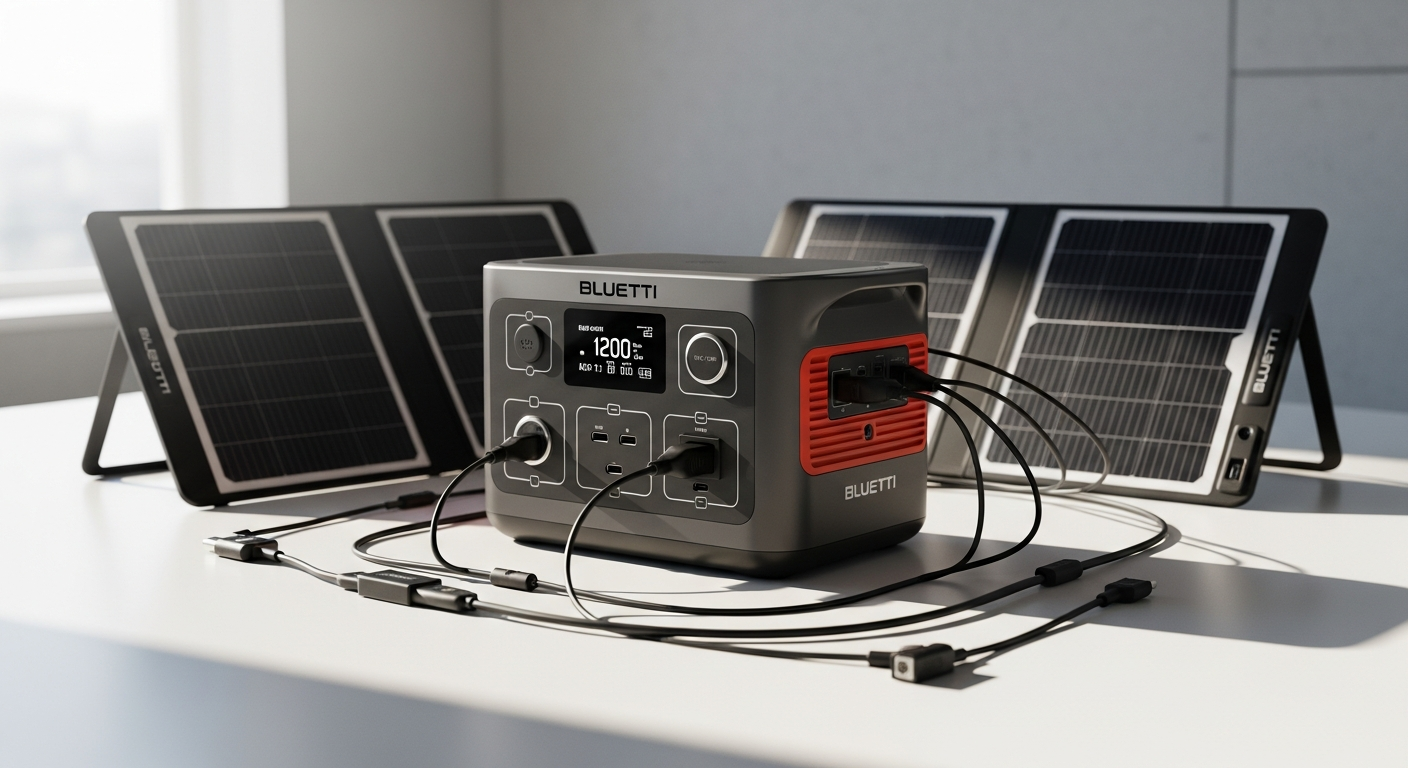
Over 3,500 charging cycles—that's the longevity most power station buyers only dream about, and it's exactly what the BLUETTI AC200MAX delivers. This expandable power station grows with your needs, scaling from 2,048Wh to 8,192Wh with modular battery expansion. Whether you're facing grid outages, planning RV adventures, or building an off-grid setup, the AC200MAX combines robust LiFePO4 battery architecture with multiple charging methods and extensive output options.
The power station market has fragmented into three tiers: budget units that cut corners on battery chemistry, mid-range options that balance capacity and cost, and premium systems designed for serious users. The AC200MAX occupies the practical end of mid-to-high tier territory, offering features typically found in much larger or more expensive systems without the excessive bulk of industrial setups.
Explore the BLUETTI AC200MAX and discover how modular expansion transforms your power strategy.
The Modular Battery Expansion System Explained
How the base 2,048Wh capacity serves as your foundation
The AC200MAX ships as a standalone 2,048Wh unit capable of handling most emergency backup scenarios and moderate off-grid applications. This base capacity provides genuine utility—enough to run a refrigerator for roughly 8–10 hours, a microwave for 15–20 cycles, or charge multiple devices simultaneously for extended periods. The foundation approach means you don't overpay for capacity you might not need immediately.
Adding B230 modules to reach 6,144Wh total storage
Each B230 expansion battery adds 2,048Wh to your system, doubling capacity with a single module or bringing you to 6,144Wh total with two modules. These stack beside the main unit, creating a modular configuration that grows as your power demands evolve. The connection process uses Bluetti's proprietary interconnect system—straightforward without requiring technical expertise.
Upgrading to B300 modules for maximum 8,192Wh capacity
For users planning serious off-grid living or permanent RV residency, the B300 modules represent the ultimate scaling option. Each B300 adds 3,072Wh, allowing dual modules to push total capacity to 8,192Wh. At this scale, you're running household appliances for days rather than hours, fundamentally shifting from emergency backup thinking to semi-autonomous power generation.
Cost breakdown of expansion batteries and when to add them
B230 modules cost approximately $1,399 each, while pricing for B300 modules reflects their larger capacity proportionally. A single-module expansion doubles your system cost but extends runtime substantially. Two modules approach or exceed the price of the base unit itself, requiring honest calculation of whether that expansion will actually power devices you'll regularly use.
Real-world scenarios where expansion makes financial sense
Full-time RV users running air conditioning, refrigeration, and entertainment systems benefit immediately from expansion, justifying the investment within months of heavy use. Off-grid cabin owners with seasonal occupancy might purchase one expansion module initially, adding a second later as their property develops. Emergency backup users typically find the base 2,048Wh sufficient unless they're powering multiple household devices or require multi-day autonomy during extended outages.
LiFePO4 Battery Chemistry: Longevity You Can Actually Count On
Why LiFePO4 outperforms traditional lithium-ion in power stations
Lithium iron phosphate chemistry differs fundamentally from standard lithium-ion found in phones and older power stations. LiFePO4 exhibits superior thermal stability, meaning it generates less heat during charge cycles and resists degradation from temperature fluctuations. This stability translates directly to longevity—the AC200MAX's 3,500+ cycle rating reflects genuine chemical resilience rather than aggressive marketing.
The 3,500+ life cycle rating and what it means for nine-year longevity
A 3,500-cycle rating assumes daily charge-discharge patterns. If you use the AC200MAX five times weekly on average, you're looking at roughly nine years before capacity drops meaningfully. Most power station users don't charge daily, meaning realistic lifespan often extends beyond the nominal nine-year estimate. This creates genuine value compared to power stations with 1,000–2,000 cycle ratings, which degrade noticeably within 3–5 years.
Degradation patterns: maintaining 80% capacity after thousands of charges
The 3,500-cycle specification measures degradation to 80% capacity—meaning the unit retains four-fifths of its original power after that threshold. Beyond 3,500 cycles, degradation continues but at a gradual pace. Users report functional capacity even at 5+ years of heavy use, suggesting LiFePO4's chemistry resists the cliff-drop failures common in older lithium systems.
Safety advantages of LiFePO4 chemistry over other battery types
LiFePO4 resists thermal runaway—the combustion risk that occasionally makes headlines with cheaper power stations. This chemistry is inherently more stable, requiring less aggressive thermal management than standard lithium-ion. For indoor use, emergency backup, or applications where the unit sits near living spaces, this safety margin justifies the premium cost alone.
Charging Speed Across Multiple Input Methods
AC charging: standard outlet speeds and what to expect
Plugging the AC200MAX into a standard household outlet provides approximately 700W input, requiring roughly 3 hours for a complete charge from empty. This speed suits overnight charging for daily use or emergency situations where you have 8+ hours before deploying the system.
Solar input capability: maximum 900W with compatible panels
The AC200MAX accepts up to 900W of solar power, requiring approximately 2,000 watts of installed panel capacity to reach maximum input under strong sunlight. This high solar acceptance rate makes the unit genuinely practical for off-grid living or extended RV travel without relying on generator fuel or grid electricity.
Dual charging advantage: combining solar + AC for 1,400W total input
The real capability emerges when charging simultaneously from both solar and AC inputs. This dual-charging mode reaches 1,400W combined input, meaning full charge from empty in under two hours. For users with flexible schedules or emergency scenarios where speed matters, this capability eliminates hours of downtime.
Full charge timeline: achieving 100% in under two hours
Under optimal conditions—900W solar + 700W AC combined—you're looking at roughly 90 minutes from completely depleted to 100%. Realistically, solar input fluctuates with cloud cover and sun angle, so 2–3 hours remains a practical estimate for daily use cycles.
Output Ports and Simultaneous Power Delivery
Five AC outlets with 2,200W continuous and 4,800W surge capacity
Five standard AC outlets provide continuous 2,200W output, sufficient to run two or three appliances simultaneously. The 4,800W surge capacity accommodates startup loads from compressors, refrigerators, and power tools that briefly exceed continuous ratings. This headroom prevents system shutdowns when starting high-demand equipment.
USB charging ecosystem: 100W USB-C, 18W USB-A, and multiple ports
A single 100W USB-C port charges laptops and tablets at full speed, eliminating the need for separate power adapters. Multiple 18W USB-A ports handle phone and standard device charging. This comprehensive USB ecosystem means the AC200MAX functions as your primary device charging hub during trips or outages, reducing the need for multiple wall adapters.
NEMA TT-30 RV socket: why RV owners specifically prefer this unit
The RV-specific TT-30 socket directly powers standard RV electrical systems without adapters. This single feature drives significant RV adoption because it enables the AC200MAX to seamlessly integrate with existing RV infrastructure. RV owners recognize this compatibility, making the AC200MAX particularly attractive compared to generic power stations requiring adapter cables.
12V DC outputs: RV (30A), car (10A), and DC5521 specifications
Beyond standard outlets, the DC outputs support direct 12V loads. The 30A RV outlet handles marine and RV electrical devices, while 10A car and DC5521 outputs serve specialized equipment. This flexibility means the AC200MAX works as both an AC inverter and a DC power source, covering multiple power delivery scenarios.
Real-World Appliance Compatibility and Runtime Expectations
Which household appliances the 2,200W inverter can handle
The 2,200W continuous rating powers most household appliances individually: refrigerators (600–800W), microwaves (1,000–1,200W), coffee makers (1,000–1,500W), and most power tools (500–1,800W). Running multiple devices requires attention to combined wattage, though typical usage patterns don't exceed the continuous rating.
Running refrigerators, microwaves, and power tools simultaneously
A refrigerator running alongside a microwave consumes roughly 2,000W combined—within continuous rating. Adding a power tool at startup would trigger surge capacity. The AC200MAX handles this scenario without stress because microwave runtime is brief, and typical refrigerators cycle rather than run continuously. Real-world simultaneous loads rarely hit the theoretical ceiling.
Runtime calculations: how long you'll actually power common devices
A 2,048Wh base unit powers a 600W refrigerator for roughly 3.4 hours of actual runtime (accounting for efficiency losses). A 1,000W microwave runs for approximately 2 hours of actual use. These calculations assume single devices—real-world scenarios involve shorter usage periods and lower average draw. Most users find base capacity sufficient for 4–6 hours of mixed-use emergency backup.
Surge capacity advantage: starting high-draw appliances like compressors
Compressors and similar equipment draw 2–3 times rated power during startup. The AC200MAX's 4,800W surge capacity handles these loads without system shutdown, a critical advantage over cheaper units that shut down when startup current spikes. This feature determines whether the unit reliably powers air compressors, large power tools, or HVAC equipment.
Smart App Control and Remote Monitoring Features
Bluetooth app functionality: real-time power monitoring and statistics
The Bluetti app provides real-time status including current draw, battery percentage, voltage, and estimated time remaining. Users monitor power consumption patterns, identify which devices consume excessive energy, and optimize usage accordingly. This visibility transforms the AC200MAX from a passive backup to an active power management tool.
Remote control capabilities: turning outlets on/off from your phone
Individual AC outlets can be toggled on/off via the app, enabling remote shutdown of specific devices without physical access. This feature prevents vampire drain from standby devices, reduces power waste, and adds convenience for RV users managing systems from inside their vehicle.
Battery status tracking: voltage, temperature, and health metrics
The app displays detailed battery telemetry: cell voltage balance, internal temperature, charge cycles completed, and estimated health percentage. This transparency helps users predict when degradation might warrant expansion modules or understand their current capacity realistically.
Scheduled charging and discharge features for optimization
Advanced users schedule charging during off-peak hours or when solar generation peaks, optimizing cost and energy flow. Discharge scheduling allows devices to run automatically during preset windows, useful for scheduled appliance operation or time-of-use electricity management.
Portability vs. Power: Navigating the Weight Trade-Off
61.9 lbs reality check: what portable actually means at this capacity
At 61.9 lbs (28.1 kg), the AC200MAX occupies the boundary between portable and stationary equipment. One person can move it short distances, but extended carrying is impractical. This weight reflects the fundamental trade-off in power station design—capacity requires battery mass, and LiFePO4 chemistry is heavier than lithium-ion alternatives.
Dimensions (16.5 x 11 x 15.2 inches) and how they fit in vehicles
The rectangular footprint (16.5 x 11 inches) fits under most RV beds, truck seats, or van storage spaces. Height of 15.2 inches accommodates most enclosed storage areas. These dimensions represent practical compromise between capacity and vehicle integration—larger than portable models but smaller than stationary systems requiring dedicated installations.
Handle design and ergonomics during movement
The integrated carry handle supports the weight adequately for short repositioning, though extended carrying becomes fatiguing. The handle placement centers weight reasonably, preventing awkward balance during movement. Users typically position the unit permanently rather than moving it frequently.
Comparing weight-to-capacity ratio against competitors
The AC200MAX delivers approximately 33Wh per pound (0.073 lbs per Wh), which exceeds many competitors in efficiency. Smaller capacity units often have worse ratios due to fixed overhead (inverter, electronics), while much larger units match or slightly exceed this ratio but weigh substantially more in total.
Pricing Strategy and Value Proposition for Different Budgets
Base unit pricing: $1,199 to $2,099 depending on sales and bundles
Standard retail pricing gravitates toward $1,399–$1,799 for the base unit, with sales and bundle promotions occasionally reducing this to $1,199. High-season demand or promotional periods sometimes push pricing toward $2,099. Timing purchases around promotional cycles can yield $300–$500 savings.
B230 expansion battery costs: around $1,399 per module
Expansion modules cost nearly as much as the base unit itself, making expansion decisions significant financial commitments. Users purchasing two modules are essentially tripling initial investment to achieve 6,144Wh capacity. This cost structure rewards careful assessment of whether expansion will actually serve your power needs.
Total system cost scenarios: base, single expansion, dual expansion
Base unit alone: $1,199–$2,099. Base + one B230: $2,598–$3,498. Base + two B230s: $3,997–$4,897. Base + two B300s: pricing varies but exceeds $5,000 total. Each tier represents distinct use cases, from emergency backup to full-time off-grid living.
ROI calculation for emergency backup vs. off-grid living
Emergency backup users might recover costs through avoided hotel stays, food spoilage prevention, and avoided generator expenses during extended outages. Off-grid users justify expansion through eliminated propane/generator expenses, generating meaningful returns over 5+ years. RV users value portability and RV integration at premium prices, justifying higher costs through convenience.
Ideal Use Cases and Who Should Actually Buy This Unit
RV and van life enthusiasts: why the NEMA TT-30 socket matters
The TT-30 compatibility transforms the AC200MAX from a generic power station into an integrated RV system component. Full-time RV users running air conditioning, refrigeration, and entertainment systems benefit immediately. The seamless integration with existing RV electrical architecture, combined with portability and capacity, makes this the preferred choice for RV communities.
Emergency home backup during grid outages: realistic coverage scenarios
The base 2,048Wh provides 4–6 hours of mixed household usage or 8–10 hours powering critical devices like refrigerators and medical equipment. During multi-day outages, this covers critical loads while you run a generator minimally, conserving fuel and reducing noise. Single-module expansion extends this to 8–12 hours of continuous critical loads.
Off-grid cabin or property power: expansion potential for growing needs
Seasonal cabin users begin with base capacity, adding expansion modules as occupancy increases. This phased approach avoids upfront overinvestment while allowing future scaling. Off-grid properties with modest initial demand can grow the system alongside property development without replacing the entire foundation.
Content creators and remote workers: reliability for extended trips
Laptop and camera charging demands remain modest compared to household loads, but the AC200MAX provides reliable backup during location changes or remote work scenarios. The app-based monitoring, multiple USB options, and pure sine wave output ensure clean power delivery for sensitive electronics—critical for professional work.
Honest Limitations and What You're Trading for Capacity
Bulky AC adapter: size and cable management challenges
The AC charger brick is substantial—larger than typical laptop chargers and considerably bulky. Travel with the unit requires dedicated cable space, and the adapter generates heat during charging, limiting placement options in small spaces. Users report managing this by leaving the charger installed semi-permanently rather than frequently disconnecting.
Noise during operation: fan and inverter sounds in quiet environments
The internal cooling fan activates during moderate-to-heavy loads, generating audible noise around 60 decibels—comparable to typical office background sound. In silent environments like libraries or quiet bedrooms, this becomes noticeable. Inverter operation adds subtle background hum. Users planning indoor deployment should verify noise tolerance before purchasing.
Initial investment barrier: high upfront cost for budget-conscious buyers
$1,200+ represents significant capital for emergency backup, especially when comparing to cheaper power stations at one-third the price. The LiFePO4 chemistry and longevity justify costs for heavy users, but occasional backup users might struggle to justify the expense. Budget alternatives exist but sacrifice longevity dramatically.
Weight factor: genuine mobility concerns for frequent relocation
The 61.9 lbs weight prevents casual relocation. Users planning to move the unit weekly or transport it frequently should consider smaller alternatives. The AC200MAX assumes semi-permanent placement with occasional repositioning rather than constant movement between locations.
Making the AC200MAX Work for Your Power Strategy
The BLUETTI AC200MAX is a scalable platform that starts at 2,048Wh and grows to whatever capacity your life demands, backed by battery chemistry engineered for a decade of reliable performance. With dual charging reaching 100% in under two hours, NEMA TT-30 RV compatibility, and 3,500+ life cycles, it delivers genuine value for RV owners, emergency backup needs, and off-grid living. However, the 61.9 lbs weight, operational noise, and expansion costs require honest assessment of your actual usage patterns.
The decision hinges on matching the system to realistic power consumption. Map out what devices you'll actually power, calculate combined wattage, estimate runtime needs, and determine whether base capacity suffices or expansion makes sense. RV owners gain immediate value from the TT-30 socket and portability. Emergency backup users should calculate coverage for their most critical loads during typical outage durations. Off-grid users should project power consumption realistically rather than overestimate needs.
If you'll genuinely use the expandability and can justify the $1,199 to $2,099 initial investment, the AC200MAX scales with your power needs without cutting corners. Compare it against your real power consumption, factor in realistic expansion plans, and decide if long-term reliability justifies the upfront cost for your specific situation.
Start building your power independence with the BLUETTI AC200MAX today.
Leave a Reply