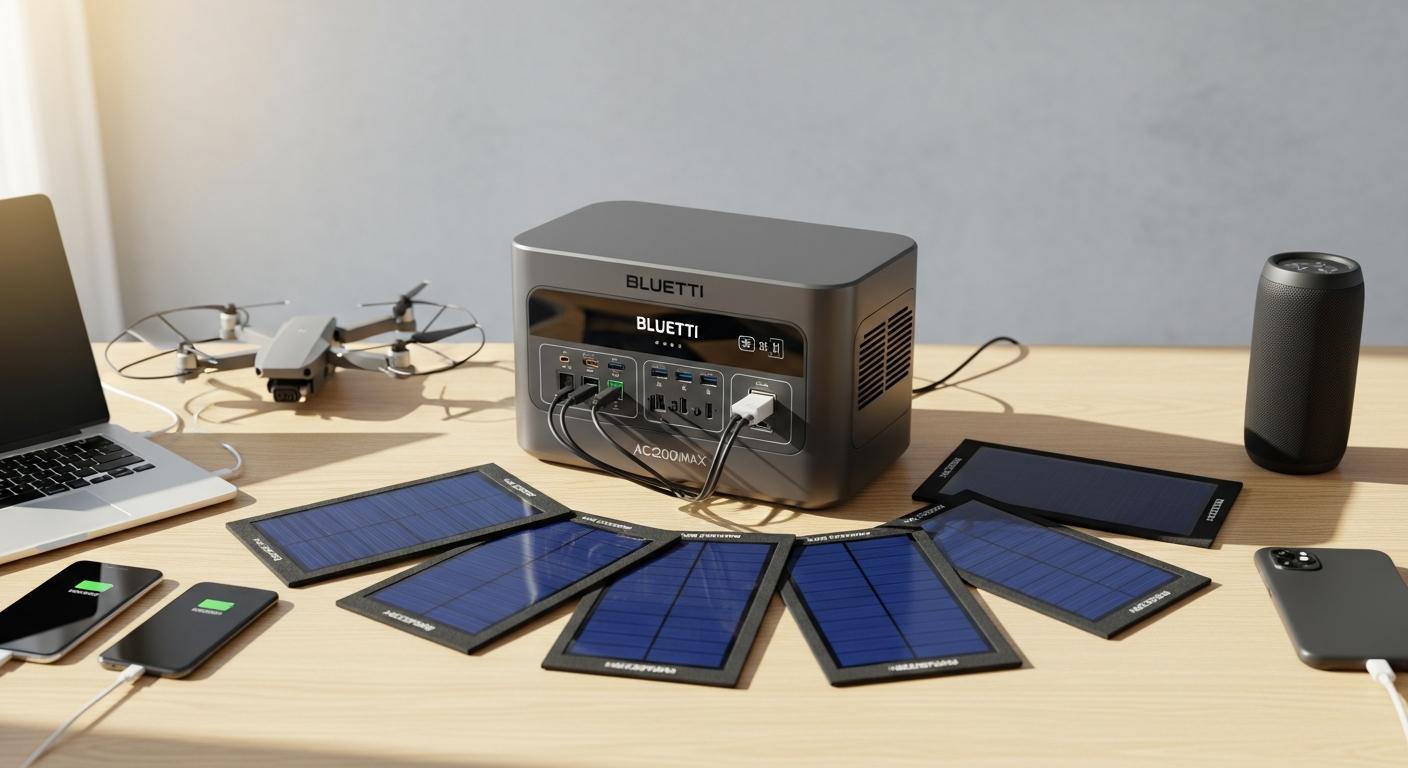
Power outages, off-grid adventures, and RV trips reveal one uncomfortable truth: most portable power stations fail when you need them most. Over 3,500 life cycles and nine years of reliable power separate genuine investments from temporary fixes—exactly what the BLUETTI AC200MAX delivers. When serious about energy independence for off-grid living, RV power, or emergency backup, mediocre power stations simply won't suffice.
The AC200MAX stands as BLUETTI's flagship expandable power station, engineered around a massive 2,048Wh LiFePO4 battery that expands up to 8,192Wh through modular additions. This architecture bridges the gap between portable convenience and home-scale energy storage, offering flexibility that single-capacity units cannot match. Unlike competitors locked into fixed capacities, the AC200MAX grows with your needs—adding battery modules only when your energy demands justify the investment.
This comprehensive review examines what makes the AC200MAX a top-tier choice for serious users. We'll break down the expandable battery system, analyze all seven charging methods, evaluate real-world off-grid performance, and determine whether this substantial investment aligns with your energy independence goals.
Explore the BLUETTI AC200MAX and configure your ideal power setup today.
Expandable Battery Architecture: Scaling Power Without Replacing Equipment
Base 2,048Wh LiFePO4 Battery Capacity and What It Realistically Powers
The foundation of the AC200MAX rests on a 2,048Wh LiFePO4 battery—a substantial starting point that powers most household essentials simultaneously. With a 2,200W continuous output and 4,800W surge capability, this base configuration runs refrigerators, well pumps, CPAP machines, laptops, and lighting systems without strain. A typical scenario: during a 12-hour power outage, the AC200MAX maintains a refrigerator (150W average), several LED lights (50W combined), and charges devices, consuming roughly 2,400Wh—comfortably within its capacity.
For RV applications, the base capacity handles water heaters, microwaves, and entertainment systems for extended trips. Off-grid cabin users find the 2,048Wh sufficient for seasonal use or as a supplement to solar generation. The realistic assessment: the base unit covers emergency backup and supplementary power needs without expansion.
Expansion Options: B230 Modules (Up to 6,144Wh Total) Versus B300 Modules (Up to 8,192Wh Total)
Expansion transforms the AC200MAX's utility. The B230 battery module ($600–700 range) adds 2,048Wh, bringing total capacity to 4,096Wh with two units. The B300 module ($900–1,100 range) adds 3,072Wh per unit, allowing expansion to 8,192Wh with two B300s. The B300 delivers 50% more capacity at roughly 40% higher cost per unit.
Practical differences emerge in extended off-grid scenarios. With B300 expansion, an off-grid homeowner powers heated spaces through winter nights without depleting batteries below functional levels. RV travelers can run air conditioning and heating simultaneously for longer periods. The trade-off: B300s add weight and physical footprint.
Cost-Benefit Analysis of Expanding Versus Buying a Second Unit
A single AC200MAX with two B300 modules totals roughly $4,000–4,300, providing 8,192Wh of expandable capacity in one system. Two separate AC200MAX units cost $3,800–4,600 but consume double the physical space, require separate monitoring apps, and complicate load management. Expansion wins for space-constrained installations.
However, redundancy matters in mission-critical scenarios. Two units mean one functions independently if the other fails—valuable insurance for permanent off-grid installations. For most users, single-unit expansion offers better economics and simplicity.
Modular Design Advantages for Future-Proofing Your Investment
The modular architecture protects against obsolescence. If energy needs triple over five years, adding B300 modules costs significantly less than replacing the entire system. Future BLUETTI innovations in battery modules become compatible upgrades rather than forcing complete replacement. This design philosophy transforms the AC200MAX into a platform rather than a fixed product.
Seven Charging Methods Explained: Finding the Right Recharge Strategy for Your Lifestyle
AC Charging: Wall Outlet Speeds and Typical Full-Charge Timelines
Standard wall outlet AC charging draws 500W maximum, requiring approximately 4 hours for a full charge on the base 2,048Wh capacity. With expansion batteries, dual AC ports enable simultaneous charging at 1,000W combined, cutting expanded system charge times roughly in half. Standard AC charging offers convenience but suits scenarios where grid power remains available—less relevant for true off-grid independence.
Solar Input Capabilities: 900W Maximum and Panel Recommendations
The AC200MAX accepts up to 900W of solar input, meaning a typical 400W solar array (three standard residential panels) charges the base unit in approximately 5–6 hours under optimal conditions. Higher wattage panels directly reduce charge time; a 800W system charges in roughly 2.5–3 hours. The inverter auto-detects solar input, requiring no manual configuration. For off-grid users, this capability becomes the primary charging method during daylight hours.
Hybrid Charging: Combining AC + Solar for Under 5-Hour Full Charges
The AC200MAX's standout feature combines 500W AC input with 900W solar input simultaneously, reaching 1,400W combined charging power. This hybrid approach enables true rapid charging—a full 2,048Wh charge completes in under 3 hours with adequate solar generation and grid access. Expanded systems still charge fully in under 5 hours with optimal conditions. For users with periodic grid access and solar panels, hybrid charging balances speed with sustainability.
Vehicle Charging: Car and Generator Charging for Mobile Scenarios
The unit charges from standard 12V vehicle outlets (slow process, approximately 24 hours for a full charge) or vehicle DC outputs. Generator charging provides flexibility when neither grid nor solar is available, typical for emergency preparedness scenarios. These methods fill gaps but remain secondary to AC and solar for serious users.
Compare charging strategies and find the best BLUETTI AC200MAX configuration for your energy needs.
Output Versatility: Powering Everything from Appliances to USB Devices
Five AC Outlets with 2,200W Continuous and 4,800W Surge Capacity
Five traditional AC outlets provide the connectivity users expect from home backup systems. The 2,200W continuous rating handles multiple mid-range appliances: refrigerator (150W) + microwave (1,200W) + coffee maker (1,500W) simultaneously—three power-hungry devices at once. The 4,800W surge capacity accommodates motor-driven appliances like well pumps, compressors, and air conditioning units during startup. This output capacity distinguishes the AC200MAX from compact competitors limited to 1,000W or less.
What Appliances You Can Realistically Run Simultaneously
Simultaneous operation requires calculating total continuous draw. A refrigerator (150W), LED lighting (50W), laptop (65W), and water heater (3,000W startup, 1,500W running) total 1,815W continuous—well within the 2,200W limit once the water heater passes startup. Critical appliances run together reliably. However, running a space heater (1,500W) alongside a microwave (1,200W) approaches the limit, leaving minimal capacity for other devices. Realistic planning prevents overload situations.
USB-C (100W) and USB-A (18W) Port Configurations for Device Charging
The 100W USB-C port handles laptops, tablets, and fast-charging phones simultaneously. A single USB-C port replaces the need for separate wall chargers for modern computing devices. Six USB-A ports (18W each) provide compatibility with older devices and simultaneous charging for multiple phones. This port variety eliminates the "which charger do I bring?" problem entirely.
Wireless Charging Pads: Convenience Factor and Charging Speeds
Two wireless charging pads built into the top surface provide 10W charging for compatible phones. The convenience factor shines during emergencies when locating charging cables feels impossible. However, 10W charging speeds roughly match lower-tier wired USB options—a convenience feature rather than a primary charging method.
LiFePO4 Battery Technology: Why Longevity Matters More Than You Think
LiFePO4 Chemistry Versus Traditional Lithium-Ion: Key Durability Differences
LiFePO4 (lithium iron phosphate) replaces the cobalt-based chemistry found in standard lithium-ion batteries, fundamentally changing lifespan expectations. Standard lithium-ion degrades significantly after 500–1,000 cycles; LiFePO4 maintains functionality beyond 3,500 cycles. The chemistry swap prioritizes longevity over energy density—the AC200MAX weighs more than similarly-capacitied lithium-ion competitors, but lasts 3–5 times longer.
3,500+ Life Cycles to 80% Capacity Explained in Practical Terms
A single cycle represents one complete charge-discharge sequence. At 3,500 cycles to 80% capacity, the AC200MAX delivers nine years of daily charging and discharging. Real usage varies: a backup power system charged quarterly reaches 3,500 cycles in 35+ years. An RV using daily charging reaches the same milestone in 9–10 years. An off-grid system with constant cycling hits 3,500 cycles faster. The guarantee commits to 80% capacity retention—meaning after 3,500 cycles, the 2,048Wh unit still delivers 1,638Wh reliably.
Nine-Year Lifespan Projection and What Happens Beyond That Threshold
The nine-year projection assumes average daily cycling. Beyond that threshold, degradation continues gradually—a common characteristic of battery chemistry. At 10 years, users typically see 70–75% capacity retention. At 12 years, capacity drops to 60–65%. This degradation doesn't mean failure; it means slightly reduced runtime for equivalent discharge. Many users continue operating AC200MAX units beyond nine years at reduced capacity, extending value indefinitely.
Temperature Performance and How Climate Affects Battery Longevity
LiFePO4 chemistry tolerates wider temperature ranges than lithium-ion alternatives. Operating temperatures from 32°F to 104°F maintain full performance; the unit functions to -4°F but with reduced efficiency. Cold climates degrade LiFePO4 slightly faster than temperate regions—roughly 10–15% faster cycle degradation. Hot climates (above 86°F continuous) also accelerate degradation. For users in extreme climates, proper ventilation and thermal management extend lifespan significantly.
Real-World Performance in Off-Grid & RV Applications
Running Essential Home Systems During Extended Power Outages
A typical home's essential systems during outages include: refrigerator (150W), heating (if electric, 3,000W+ continuous), water pump (1,200W running), and lighting (50W). Without heating, the AC200MAX powers refrigeration, pumping, and lighting for 12–15 hours continuously. With expansion batteries (8,192Wh total), the same setup runs 2–3 days without draining completely. Adding solar panels enables indefinite operation during daylight. The reality: a single unit provides 1–2 days of confidence; expanded systems deliver genuine backup power for serious storms.
Off-Grid Cabin Power: Realistic Runtime for Heating, Lighting, and Appliances
Off-grid cabins with no grid connection require seasonal planning. Winter scenarios demand heating—the AC200MAX cannot sustain electric space heaters (1,500W continuous) for extended periods from battery alone. Hybrid systems combining 2–3kW solar arrays with the AC200MAX enable winter living. A realistic winter setup: the AC200MAX handles heating during daylight hours when solar charges it simultaneously, while nighttime heating relies on alternative sources (wood stove, propane). Summer cabins operate indefinitely with solar generation alone. Fall/spring scenarios work comfortably with proper solar sizing.
RV Integration: NEMA TT-30 Compatibility and Full-Time Travel Scenarios
The NEMA TT-30 socket connects directly to RV pedestal hookups, enabling stationary power when parked at campgrounds. For full-time RV travel without hookups, the AC200MAX powers water heaters, refrigeration, and entertainment indefinitely through solar charging. The 2,048Wh base capacity handles typical RV nighttime loads (LED lighting, refrigerator, CPAP machines) on a single charge. Higher-demand scenarios (air conditioning) require expanded capacity or generator supplementation. RV users consistently report the AC200MAX transforms camping from "campground dependent" to "solar independent."
Seasonal Performance Variations and Winter/Summer Usage Patterns
Summer usage benefits from 14+ hours of daily sunlight; solar input reaches peak capacity consistently. Winter shrinks daylight to 9–10 hours and reduces solar angle efficiency by 30–40%. Users in northern climates (40°+ latitude) experience 50% lower winter solar generation than summer—a critical planning factor. Off-grid users in such regions typically oversize solar arrays (double or triple summer requirements) to maintain winter capacity. The AC200MAX functions identically year-round; the constraint is solar generation, not battery performance.
The Bottom Line: Building Reliable Energy Independence
The BLUETTI AC200MAX isn't just another power station—it's a commitment to energy autonomy that delivers on its promises. The combination of expandable capacity, robust charging options, and genuine LiFePO4 longevity creates a system that grows with your needs instead of forcing replacement cycles. Yes, it's heavy (61.9 lbs base unit) and costly upfront ($1,899–2,320 for the base), but when running essential systems during outages, powering off-grid cabins, or maintaining RV independence for months, those trade-offs become footnotes to reliability and peace of mind.
The real question is whether your situation justifies the investment. If serious about backup power for a home, off-grid living, or extended RV adventures, this unit earns its place in your setup. The expandable architecture means starting smaller and growing capacity only when genuine needs emerge—a more economical path than oversizing immediately. The nine-year battery lifespan means the AC200MAX becomes more valuable the longer you own it, contrasting sharply with disposable power stations failing after 2–3 years.
If casually camping twice yearly or seeking a lightweight portable charger, you're paying for unused capabilities and carrying unnecessary weight. Budget-friendly alternatives serve occasional users better. Honest assessment of actual energy needs determines if the AC200MAX is the right power station for your energy independence journey.
Start your energy independence journey with the BLUETTI AC200MAX today.
Leave a Reply