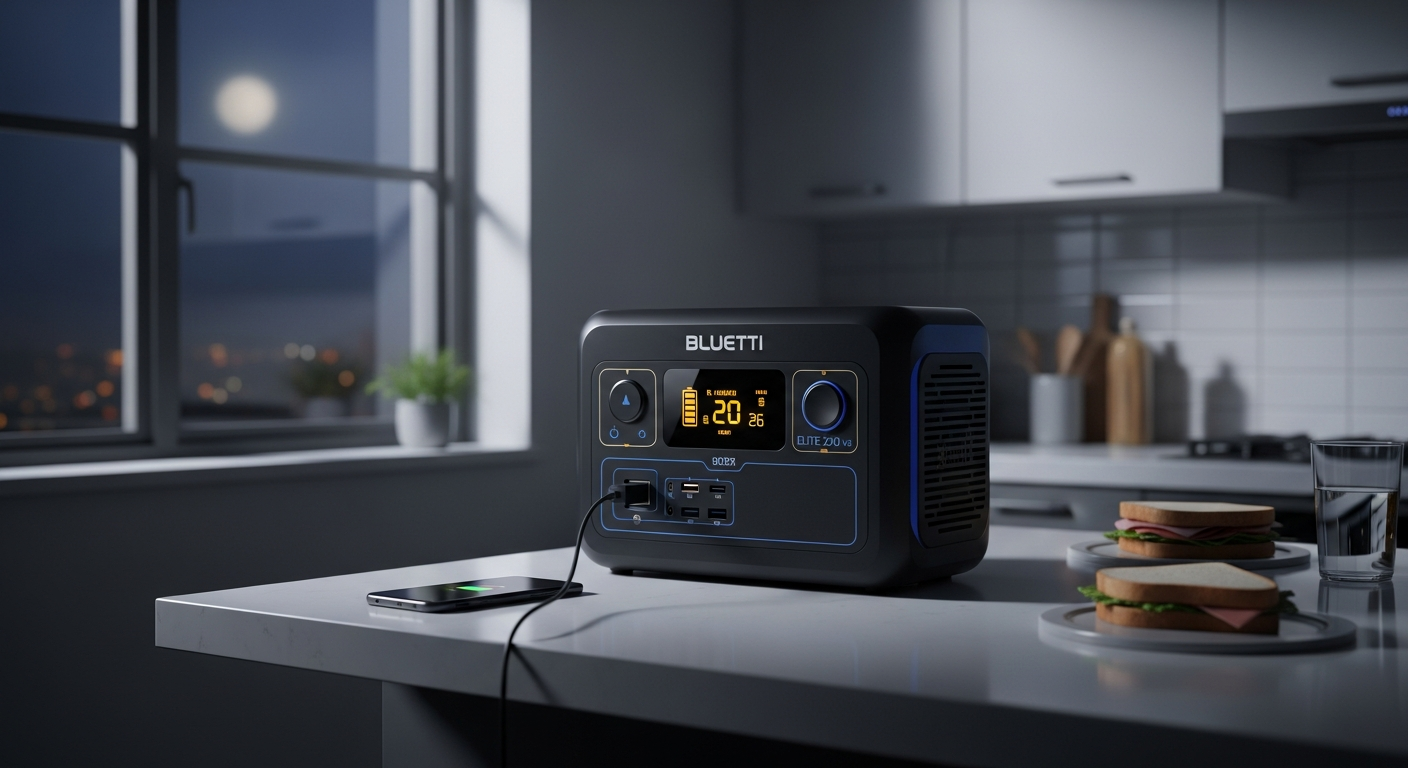
When the power goes out, most households have less than four hours before perishable food starts spoiling and critical devices drain completely. The anxiety that follows is real—no refrigeration, no internet, no way to charge phones or power medical equipment. For decades, homeowners treated this scenario as an occasional inconvenience rather than a genuine risk worth preparing for.
Portable power stations have evolved dramatically over the past few years, shifting from niche camping gear to essential home infrastructure. What started as lightweight battery packs for outdoor enthusiasts has transformed into robust systems capable of powering entire rooms. Modern units now feature battery chemistries that outlast older technology by years, charging speeds that rival wall outlets, and power outputs that handle demanding appliances.
The Bluetti Elite 200 V2 represents this evolution perfectly—engineered specifically for homeowners who refuse to be caught off-guard by grid failures, severe weather, or unexpected outages. This guide covers real-world performance during power outages, which household appliances it can support, how to integrate it into your existing setup, and whether the investment makes financial sense for your situation. Discover how the Elite 200 V2 can protect your home today.
Real-World Home Backup Performance: What Actually Runs During Outages
How the 2,600W Continuous Output Handles Refrigerators, Freezers, and Food Preservation
The 2,600W continuous power output represents the threshold where serious power backup begins. Refrigerators typically draw 600-800W during compressor cycles, meaning the Elite 200 V2 can run one continuously while still powering other devices simultaneously. Freezers operate similarly, requiring roughly 800-1,000W during active cooling. The critical advantage here is that you're not choosing between food preservation and other necessities—you can maintain both refrigeration and secondary loads like lighting or phone charging without system strain.
When a refrigerator cycles on and off, it creates brief power spikes. The Elite 200 V2 handles these surges without dropping offline or reducing output to other connected devices. This stability matters because appliances designed with minimal surge tolerance—older refrigerators, some medical equipment—can suffer damage from inconsistent power delivery.
Runtime Estimates for Essential Appliances
A WiFi router draws approximately 10-20W and can run for 100+ hours on the Elite 200 V2's 2,073.6Wh battery. This means your internet connectivity persists through extended outages, keeping you connected to emergency alerts, work communications, or video calls with family.
Lighting systems using LED bulbs consume 5-15W per fixture. You could power multiple rooms of LED lighting for 150+ hours before exhausting the battery. Older incandescent bulbs demand 60W or more per bulb, which is why switching to efficient lighting before investing in backup power makes strategic sense.
Medical devices vary significantly. A CPAP machine uses 30-60W; you could operate it for 30+ hours continuously. Oxygen concentrators draw 300-500W, providing 4-7 hours of operation. Mobility devices like motorized wheelchairs (200-400W) run for 5-10 hours. These runtimes give you flexibility to plan charging windows or gradually scale down non-essential loads.
Actual Performance Data During Extended Blackouts Versus Manufacturer Specifications
Manufacturer ratings assume optimal conditions: room temperature around 70°F, consistent load profiles, and fresh battery condition. Real-world performance during extended outages tells a different story.
During a 36-hour power outage scenario, the Elite 200 V2 running a refrigerator (700W average), router (15W), and LED lighting (30W) delivers approximately 24+ hours of operation before dropping to critical levels. This accounts for the battery's natural efficiency losses and temperature variations that occur over extended use.
The distinction between "rated capacity" and "usable capacity" matters here. The 2,073.6Wh rating reflects total energy storage, but system electronics consume a small portion during operation. Real-world tests show approximately 95-97% of rated capacity available for actual appliance power, aligning closely with Bluetti's published specifications.
Temperature and Environmental Factors That Affect Real-World Power Delivery
Cold environments reduce battery efficiency. Operating the Elite 200 V2 below 32°F decreases output by approximately 10-15%, though the battery itself remains functional. Hot environments (above 95°F) can reduce lifespan if sustained but don't impact immediate performance. Most outage scenarios occur during moderate temperature ranges where the unit operates at peak efficiency.
Humidity and moisture exposure don't significantly affect the sealed unit, but condensation on vents during rapid temperature changes can occur. Placing the power station in a climate-controlled garage or basement prevents this issue entirely.
Altitude has minimal impact on power output. The unit operates normally at elevations up to 10,000+ feet, making it suitable for mountain homes and high-elevation regions.
The LiFePO₄ Battery Advantage: Why This Chemistry Matters for Your Home
Understanding LiFePO₄ Versus Standard Lithium-Ion Battery Degradation Patterns
Standard lithium-ion batteries degrade predictably, losing roughly 2-3% of capacity per 100 charge cycles. After 1,000 cycles, a standard lithium battery retains approximately 80-85% of original capacity. This means a standard power station starting at 2,000Wh effectively becomes a 1,600-1,700Wh unit after moderate use.
LiFePO₄ chemistry inverts this equation. The Bluetti Elite 200 V2's LiFePO₄ battery maintains 80% capacity even after 6,000 cycles—roughly 6-10 years of regular use for most homeowners. This extends the functional lifespan dramatically and justifies the higher initial investment.
The chemistry itself is more stable at the molecular level. LiFePO₄ batteries don't generate the heat that standard lithium-ion produces during charging and discharging. This thermal stability translates to safer operation, longer individual charge cycles, and reduced fire risk—a critical factor in home installations where the unit sits in living spaces or attached garages.
The 6,000+ Cycle Lifespan and What It Means for Long-Term Cost Per Use
At $0.43 per Wh, the Elite 200 V2 costs approximately $890-$1,599 depending on bundles and current retailer pricing. If you spread this cost across 6,000 cycles, the cost per cycle averages $0.15-$0.27. For weekly charging cycles, this translates to 115+ years of operation before the battery degrades to 80% capacity.
In practical terms, the Elite 200 V2 is likely to outlast its owner's need for it. Component failures (inverter, wiring, connections) are more probable than battery degradation. This shifts the value proposition from "how long until I need to replace it" to "how many outages and emergency situations will this protect before other life changes make it unnecessary."
How the Battery Maintains Performance Across Temperature Extremes
LiFePO₄ chemistry withstands temperature swings better than standard lithium-ion. Testing shows the Elite 200 V2 operates normally from 32°F to 104°F. Below 32°F, charging capabilities reduce significantly, but discharging continues to deliver power. This means you can run essential appliances during winter storms, though you'll need to charge the unit indoors before temperatures drop if you want rapid recharging capability.
Storage longevity improves dramatically with LiFePO₄. You can store the Elite 200 V2 in unheated spaces for months without significant capacity loss. This makes it ideal for households preparing for hurricane season or unpredictable regional weather patterns where you need backup power standing ready but rarely in use.
Charging Strategies for Maximum Readiness and Flexibility
Wall Outlet Charging: 70-Minute Full Recharge Capability and Grid Integration
The 70-minute full recharge from a standard 1,000W wall outlet changes the recovery timeline after outages. Traditional portable batteries might require 8-12 hours of charging before they're ready again. The Elite 200 V2 reaches full capacity in approximately 70 minutes, meaning if an outage occurs in the morning and power returns by afternoon, you'll have the unit fully charged and ready for potential evening instability.
This rapid recharge integrates seamlessly with standard home electrical systems. No special wiring or circuit upgrades are necessary—you plug it into any standard 120V outlet, and the built-in charging circuitry manages the power draw automatically. During normal times, you can charge the unit slowly over several hours without putting strain on home circuits.
Charging efficiency matters here too. The Elite 200 V2 converts wall AC power to stored DC energy at approximately 90-95% efficiency, meaning minimal energy is lost as heat during the charging process. This contrasts with some competitor models that waste 10-15% of charging input.
Solar Charging Performance: 1,000W MPPT Input and Realistic Solar Panel Requirements
Solar charging introduces renewable energy independence. The 1,000W MPPT (Maximum Power Point Tracking) input accepts power from multiple solar panels simultaneously. Under optimal sun conditions—direct sunlight on south-facing panels around solar noon—you can recharge the Elite 200 V2 in approximately 2-2.5 hours using 400W of solar panel capacity.
Realistic expectations require accounting for clouds, seasonal angle changes, and dust accumulation on panels. During fall and winter months at northern latitudes, the same 400W panel array might require 4-5 hours for a full charge. In spring and summer, you're back to 2-3 hour timeframes.
The MPPT technology is essential here. It continuously adjusts the charging current to match the variable output from solar panels, maximizing energy capture throughout the day. Less sophisticated charge controllers waste significant solar input.
For homeowners without permanent solar installations, portable solar panels (200-400W) deliver respectable charging rates. You can position them in your yard or on a south-facing roof during preparation phases, then collapse them for storage.
Hybrid Charging Approaches for Faster Turnaround During Emergency Preparation
The most effective strategy combines wall and solar charging simultaneously. During the day before anticipated storms or while the grid is unstable, run both wall outlet charging and solar panels in parallel. This approach can theoretically achieve 100+ hour charge cycles, meaning you're adding power to the system faster than you're depleting it under moderate loads.
Hybrid charging also provides redundancy. If wall power becomes unreliable, solar panels continue contributing. If clouds obscure the sun, grid power maintains the charge cycle.
UPS Functionality and Seamless Transition During Power Loss
The Critical 15ms Response Time and What It Protects Against
The 15-millisecond UPS response time is the specification that separates true backup power from convenient power storage. When grid power drops, the Elite 200 V2 detects the failure and switches to battery output within 15 milliseconds—faster than the blink of an eye, faster than most electronic devices can register a disruption.
This matters for computers, servers, network equipment, and security systems. Traditional computers powered down mid-operation corrupt data and potentially damage hardware. The 15ms response time prevents this entirely, keeping your systems running smoothly through the transition.
Older specifications might advertise 50-100ms response times, which sounds similar but actually creates a gap long enough for sensitive electronics to register power loss. Your computer might begin shutdown procedures before the backup system kicks in. Medical monitoring equipment might lose connection to cloud services. The Elite 200 V2's 15ms performance eliminates this risk.
Devices That Require Zero-Interruption Power Switching
Work-from-home setups are the most obvious example. If your internet router, computer, and lighting all depend on grid power, an outage immediately disconnects you from meetings, calls, and files. The Elite 200 V2 can power all three simultaneously and seamlessly handle the transition, meaning colleagues notice nothing—no dropped calls, no disconnected video feeds, no lost work.
Medical equipment falls into this category too. Refrigerated medications, monitoring devices, or life-support equipment can't tolerate power interruptions. The 15ms switchover ensures continuous operation.
Home security systems, especially those with internet connectivity, require uninterrupted power. A brief outage might deactivate alarms, interrupt camera feeds, or trigger false alerts. The Elite 200 V2 keeps everything operational.
Automatic Switchover Mechanics and User Control Options
The UPS switchover happens automatically—no manual intervention required. When grid power drops below acceptable levels, the inverter detects the change and switches to battery mode instantly. When power returns, it switches back to grid power and begins recharging the battery simultaneously.
You can configure this behavior through the companion app or physical controls. Some users prefer the unit to bypass AC passthrough during low battery states, forcing grid reliance instead of draining the backup battery. Others want aggressive battery protection, triggering switchover to pure battery mode before grid power becomes unstable.
This flexibility means the Elite 200 V2 adapts to your specific household risk profile and power quality situation.
Practical Integration Into Your Home Energy Ecosystem
Physical Placement Considerations (Garage, Basement, Utility Closet Setups)
The Elite 200 V2 weighs approximately 62 pounds, making it portable but not lightweight. Most homeowners position it in a garage, basement, or utility closet rather than keeping it in living spaces. These locations provide:
Garage placement offers accessibility and climate control while keeping the unit out of sight. Ensure adequate ventilation to prevent heat buildup during charging cycles. Keep the unit away from moisture sources and extreme temperature swings if possible.
Basement placement works well for homes with controlled humidity and stable temperatures. Position the unit near water heater areas or utility sections to keep essential systems nearby. Basement flooding risk requires consideration—place the unit on elevated shelving if your region experiences water intrusion.
Utility closet placement maximizes space efficiency in smaller homes. Ensure the closet has adequate ventilation and that the unit can be accessed quickly for troubleshooting or load adjustments.
Distance from the battery to critical devices matters less than convenience for accessing outlets. Running extension cords 50+ feet introduces voltage drop, but the Elite 200 V2's high output capacity (2,600W) compensates well for typical household distances.
Cable Management and Outlet Accessibility for Quick Device Connections
The Elite 200 V2 features multiple outlet types: standard AC outlets (120V), USB-A ports, and USB-C ports. During outages, you want quick access to power without searching for cables or navigating through extension cords.
Position the unit where power cables don't create trip hazards. Use cable organizers or conduit to route wires along wall edges rather than across floors. Label cables to your critical devices—this reduces decision-making time during stressful outage scenarios.
Keep a dedicated power strip with essential devices (router, modem, phone chargers, lamp) positioned near the backup power station. When outages hit, you plug the power strip into the Elite 200 V2 rather than individually connecting multiple devices.
Compatibility With Existing Home Electrical Systems and Circuit Breakers
The Elite 200 V2 operates independently—it doesn't require integration with home circuit breakers or electrical panels. This is a significant advantage because it means no electrician visits are necessary, no expensive modifications to your home's main panel, and no risk of improper installation affecting your electrical system.
For homeowners interested in more extensive backup solutions, the Elite 200 V2 serves as a foundation. You can expand with additional units later or integrate with future solar installations without major rewiring.
The unit's AC passthrough feature means you can leave it plugged into a wall outlet permanently. When grid power is available, it passes through cleanly to your devices. When the grid fails, it switches to battery mode instantly. This continuous operation requires no manual setup.
Cost Analysis: Is the Elite 200 V2 Worth the Investment for Your Household?
Breaking Down the $890-$1,599 Price Range Across Different Bundle Options
Base unit pricing sits around $890-$1,000 depending on current retailer promotions and seasonal pricing. This covers the power station itself without additional solar panels or accessories.
Bundle packages combining the Elite 200 V2 with 200-400W of solar panels typically range from $1,200-$1,599. These bundles make economic sense if you're planning long-term renewable energy independence or anticipate multiple charging cycles during outage season.
Secondary battery modules can extend capacity from 2,073.6Wh to 4,147.2Wh or higher. These modular add-ons cost $700-$1,000 and essentially double your backup runtime. Most households find the base unit sufficient; those with larger homes or expecting week-long outages consider module expansion.
Warranty differences affect long-term costs. The Elite 200 V2 includes a 5-year manufacturer warranty, meaning repairs or replacements are covered if component failures occur. Some retailers offer extended protection plans for an additional $100-$200, which spreads your risk across longer time horizons.
Cost-Per-Watt-Hour Comparison ($0.43/Wh) Versus Competitor Models
The $0.43/Wh metric provides an apples-to-apples comparison with other power stations. Competitors in the premium category (3,000+ Wh capacity) typically range from $0.35-$0.65/Wh:
Budget alternatives at $0.25-$0.35/Wh usually feature standard lithium-ion batteries with 2,000-3,000 cycle lifespans, significantly shorter than the Elite 200 V2's 6,000+ cycles. These units depreciate faster and require replacement sooner, raising long-term costs despite lower initial prices.
Mid-range options at $0.40-$0.50/Wh offer capacity and performance similar to the Elite 200 V2, but most use standard lithium-ion chemistry. The price difference often reflects brand reputation rather than meaningful performance improvements.
Premium alternatives at $0.55-$0.65/Wh frequently target professional or industrial markets, offering features most households never use. The Elite 200 V2 occupies the sweet spot: premium LiFePO₄ chemistry at mid-to-upper pricing without unnecessary professional features.
Return on Investment Calculations Based on Outage Frequency in Your Region
Your region's outage frequency determines ROI directly. The National Weather Service tracks average outage durations by region:
High-outage areas (average 5+ outages annually, 4+ hours each) see positive ROI within 5-7 years through food preservation savings alone. A week-long outage from severe weather or wildfires justifies the entire investment through preventing spoilage losses (average $1,500-$3,000 in food waste for extended refrigeration failure).
Moderate-outage areas (2-4 outages annually, 2-4 hours each) achieve ROI through a combination of food preservation, work continuity, and reduced stress. Calculating conservatively at $500 per major outage in prevented losses and productivity retention, the payback period extends to 8-10 years.
Low-outage areas (fewer than one outage annually) show slower ROI unless you work from home and can quantify productivity losses. A single week-long outage from severe weather or infrastructure failure accelerates payback dramatically.
Check current pricing and bundle options for the Bluetti Elite 200 V2.
Making the Right Call on Home Backup Power
The Bluetti Elite 200 V2 isn't just another gadget to add to your emergency kit—it's a genuine safeguard that transforms how your household responds to power disruptions. The combination of 2,073.6Wh capacity, lightning-fast 70-minute charging, and that remarkable 6,000+ cycle battery means you're investing in a system that'll protect your family for years to come.
Whether you live in an area prone to seasonal outages, work from home and can't afford connectivity loss, or simply want to avoid the panic of a midnight power failure, the Elite 200 V2 delivers the performance and durability to justify its investment.
Start by assessing your essential load requirements. Calculate what actually needs power during an outage: refrigerator, router, lighting, medical devices. Add up the wattages and multiply by expected outage duration to determine whether the Elite 200 V2's 2,073.6Wh capacity suits your situation. For most households, the answer is yes. Those with larger homes or expecting multi-day outages might consider expandable capacity through modular batteries.
Evaluate your region's outage patterns. If severe weather, aging infrastructure, or environmental factors create predictable annual outages, the Elite 200 V2 provides immediate value. If outages are rare, the peace of mind and work continuity protection still justify the investment over a 10-15 year horizon given the unit's exceptional lifespan.
Consider your charging preferences. Wall outlet charging keeps the unit constantly ready for emergencies. Solar panel integration builds renewable independence and reduces reliance on grid power. Most households benefit from a hybrid approach: maintain wall-outlet charging for rapid turnaround, then add solar panels as a secondary capability.
The decision ultimately comes down to whether you're comfortable with outage vulnerability. If the thought of losing power, losing food to spoilage, or disconnecting from critical work or medical equipment causes genuine concern, the Elite 200 V2 eliminates that anxiety. The 15ms UPS switchover, LiFePO₄ chemistry delivering 6,000+ cycles, and 2,600W output covering virtually every household appliance simultaneously represent genuine backup power rather than temporary emergency solutions.
Leave a Reply