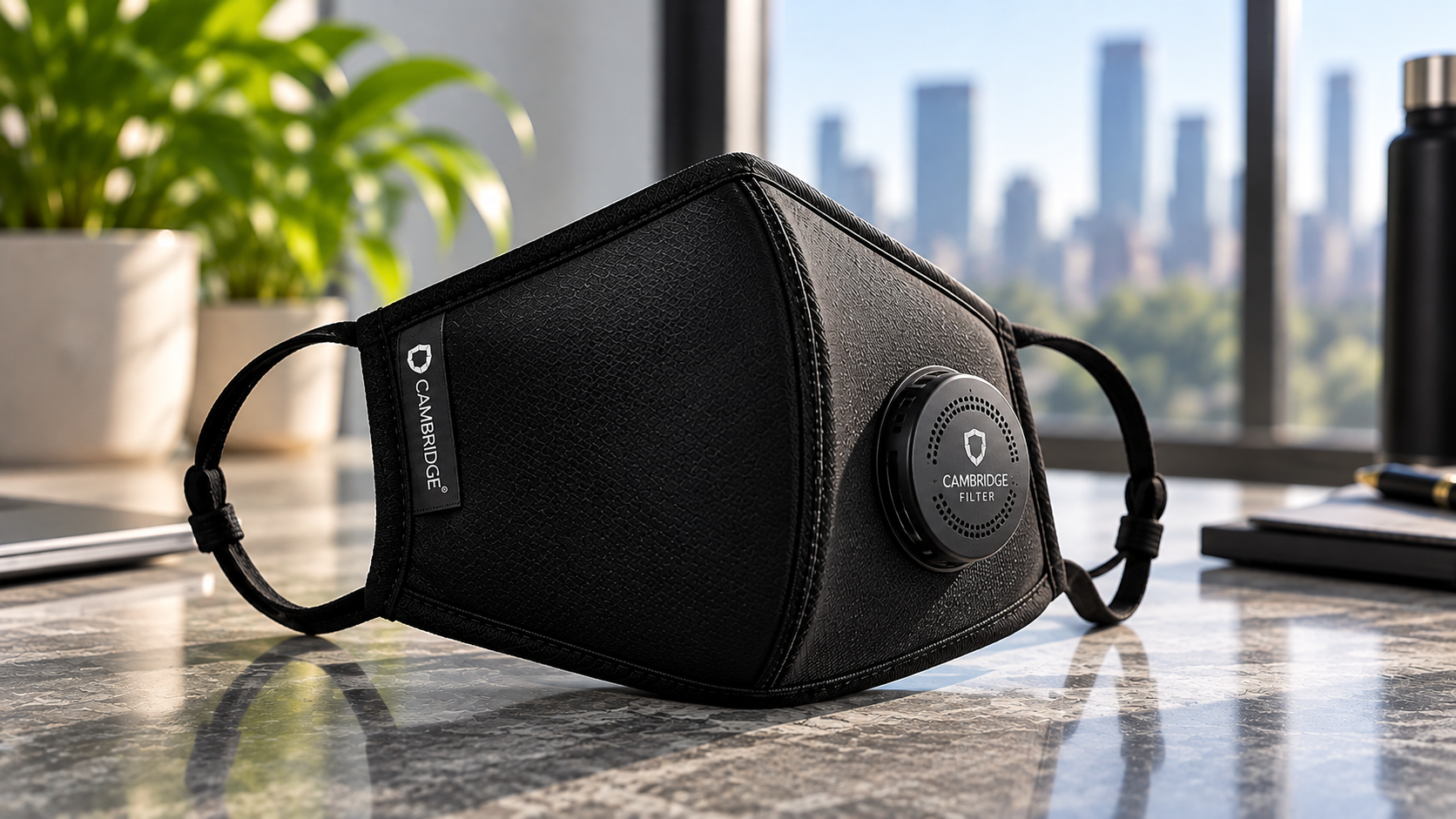
If you regularly deal with traffic pollution, smoke, airborne particles, or poor air quality, the Cambridge Mask Pro may be one reusable mask worth researching. It combines particulate filtration with activated carbon cloth and comes in several sizes and designs.
Unlike a basic fabric face covering, it is built specifically around filtration technology intended to reduce exposure to several types of airborne contaminants.
Before buying, though, you need to look beyond filtration percentages. Fit, expected service life, valve design, cleaning requirements, replacement cost, and your intended use can all affect how suitable the mask is for you.
This guide examines the product’s design, manufacturer-reported testing, everyday practicality, and buying factors without treating marketing claims as independently proven medical outcomes.
Cambridge Mask Pro Filtration Technology Explained
The Cambridge Mask Pro uses a three-layer filtration construction. According to Cambridge Mask, the system consists of an outer primary filter, a three-ply microparticulate layer, and an inner activated carbon cloth layer.
The outer layer is intended to capture larger particles, including dust and PM10. Beneath it sits a three-ply nonwoven melt-blown polypropylene layer designed for smaller particulate matter, including PM2.5 and particles down to approximately 0.3 microns.
The third layer separates the Pro from the company’s Basic model. Cambridge Mask says this inner layer uses 100% activated carbon cloth based on material originally developed by the UK Ministry of Defence.
Activated carbon is used for adsorption of certain gaseous pollutants rather than relying solely on mechanical particle filtration.
This construction makes the product relevant if you are specifically researching a reusable pollution mask rather than an ordinary fabric covering.
Manufacturer-Reported Filtration Results
Cambridge Mask publishes results from testing conducted by Nelson Labs USA. According to the company, testing reported:
- 99.6% viral filtration efficiency
- 99.7% bacterial filtration efficiency
- particulate filtration efficiency above 98%
Cambridge Mask also states that testing has shown filtration performance for particles down to 0.3 microns.
These percentages describe laboratory filtration testing reported by the manufacturer. They should not be interpreted as a guarantee that wearing the mask reduces your personal risk of infection or exposure by the same percentages in everyday conditions. Actual protection can be affected by fit, facial hair, incorrect sizing, gaps around the face, condition of the mask, and how it is worn.
What Does the Activated Carbon Layer Do?
One reason shoppers may compare this product with a standard particulate respirator is its carbon component.
Cambridge Mask says its Pro model contains activated carbon cloth made from fine carbon filaments. Activated carbon works through adsorption, allowing certain molecules to attach to its porous surface. The company positions this layer as useful against some gaseous pollutants and odors in addition to particulate pollution.
That distinction can matter if your primary concern involves urban traffic or pollution rather than particles alone.
When comparing an activated carbon mask, check what the manufacturer actually tests. A carbon layer by itself should not be treated as proof that a mask protects against every gas, chemical, vapor, or hazardous environment.
How Does It Handle PM2.5 and Smaller Particles?
PM2.5 refers to particulate matter with a diameter of 2.5 micrometers or smaller. Traffic emissions, combustion, wildfire smoke, and other sources can contribute to airborne particulate pollution.
Cambridge Mask says its microparticulate layer targets PM10, PM2.5, and particles around 0.3 microns. Its published filter information reports particle filtration efficiency above 98%.
That makes the product relevant when researching a PM2.5 mask for everyday pollution exposure.
Fit still matters. Air passing through gaps around your cheeks, nose, or chin bypasses the filtration material entirely. High filtration performance of the material therefore does not automatically equal the same level of protection when the mask is worn.
Fit and Sizing Deserve Serious Attention
Sizing may be one of the biggest buying considerations.
Cambridge Mask advises measuring your face rather than relying entirely on body weight. Its sizing guidance recommends measuring from the middle of your nose to below your chin and across your cheekbones. The company also recommends checking for gaps while inhaling.
Signs that the mask may be too small can include your ears being pulled forward or the mask moving above your chin.
Adjustable ear-loop toggles are included on current Pro product listings, while Cambridge Mask states that its Pro masks include a head strap and nose foam. These accessories can assist with positioning and may help reduce air escaping around the nose.
If you wear glasses, fit becomes especially noticeable. Fogging can indicate that exhaled air is escaping around the upper edge. Adjusting the nose area and straps may help.
Facial hair is another concern. Cambridge Mask acknowledges that a thick beard can interfere with achieving a good seal.
How Long Can Cambridge Mask Pro Be Used?
The Pro is designed as a reusable face mask, so you do not discard it after every outing.
Cambridge Mask currently states that Pro models can provide up to 340 hours of active use. It gives approximately three to six months as a general timeframe, depending partly on environmental pollution levels and usage.
That figure is a manufacturer guideline rather than a universal replacement interval.
Someone wearing the mask for long periods in heavily polluted conditions may reach its effective service limit differently from someone who wears it occasionally.
The filtration media are built into the mask. You therefore replace the complete mask when its usable filtration period has been reached rather than inserting a fresh disposable filter.
Can You Wash It?
Yes, with limitations.
Cambridge Mask says its masks can be hand washed to remove surface dirt, makeup, and dust. The company warns that washing does not restore or extend the filter’s usable life because captured pollution remains within the filtration material.
Machine washing and machine drying should be avoided according to its published care instructions.
That distinction matters when evaluating an anti pollution face mask for long-term ownership. “Washable” refers mainly to cleaning its external surfaces, not resetting its filtration capacity.
What About the Exhalation Valve?
Standard Pro models are sold with an exhalation valve. Cambridge Mask explains that the valve opens during exhalation and closes during inhalation. Its purpose is to release exhaled air and help manage moisture and breathing comfort.
A valve deserves attention because requirements can differ depending on where you plan to wear the mask.
An exhalation valve does not filter outgoing breath in the same manner as filtration material covering both inhalation and exhalation pathways. If you need source control or must comply with workplace, healthcare, airline, local, or organizational mask requirements, check the applicable rules before choosing a valved model.
Cambridge Mask also sells Non-Valve versions using the same filtration technology, according to the company.
Cambridge Mask Pro vs. Cambridge Mask Basic
The main technical difference is the filtration construction.
The Pro uses three layers, including activated carbon cloth. Cambridge Mask describes the Basic as using an outer layer plus its particulate filtration layer without the Pro’s activated carbon cloth.
The company currently gives the Pro a service-life guideline of up to 340 active-use hours, compared with up to 90 hours for the Basic.
If your main priority is occasional particulate protection, comparing the Basic may make sense. If you specifically want Cambridge Mask’s carbon filtration system and longer stated service period, the Pro is the model designed around those requirements.
How Much Does Cambridge Mask Pro Cost?
Pricing depends on region, design, and current promotions.
At the time this article was checked, Cambridge Mask’s UK and worldwide store listed many Pro designs at £24.95, with certain designs discounted to £14.95 or £19.95. Its U.S. Pro collection listed several models at $32, with selected designs carrying lower sale prices.
Because those figures can change, treat them as a current reference rather than a permanent price.
For value comparison, account for expected usage hours rather than purchase price alone. A cheaper mask that requires substantially earlier replacement may produce a different long-term cost.
You can check the current Cambridge Mask Pro styles and pricing on the manufacturer’s website before deciding which size and configuration fits your intended use.
Where This Mask May Make Sense
An air pollution mask of this type may interest you if you regularly encounter traffic emissions, smoke, dust, pollen, or elevated particulate pollution and prefer a reusable design.
Potential situations include:
- commuting in areas with elevated traffic pollution
- walking in environments affected by smoke or dust
- cycling through polluted streets
- traveling in locations with poor air quality
- outdoor activities during periods of elevated particulate matter
- everyday situations where you prefer reusable filtration
Your intended environment matters. This product should not automatically be substituted for occupational respiratory protective equipment required by an employer or regulator.
What Should You Check Before Buying?
Start with fit. A technically capable filter has limited value when significant amounts of air enter around the edges.
Measure your face according to the manufacturer’s sizing directions rather than selecting a size based solely on your usual clothing size or body weight.
Next, decide if a valve suits your intended setting. A valved Pro can differ functionally from a non-valved design because exhaled air exits through the valve.
Then assess replacement frequency. Up to 340 hours sounds substantial, yet actual service life depends partly on your environment and usage conditions according to Cambridge Mask.
Finally, compare the Pro against alternatives according to the contaminant you are concerned about. A pollution-focused reusable product and a certified occupational respirator can serve different purposes.
Is Cambridge Mask Pro Worth Buying?
The Cambridge Mask Pro has several characteristics worth researching: a three-layer integrated filtration system, activated carbon cloth, reusable construction, several sizes, adjustable ear loops, and manufacturer-published third-party laboratory test results.
There are tradeoffs. The filter cannot simply be replaced after it reaches the end of its service period, cleaning does not renew filtration capacity, correct sizing is important, and the valve may not suit every environment.
If you are comparing this product with disposable respirators or other reusable masks, focus on verified filtration data, fit, certification relevant to your intended use, valve configuration, replacement schedule, and total ownership cost.
Those factors give you a much better basis for deciding if the Cambridge Mask Pro suits how and where you plan to wear it.
Leave a Reply