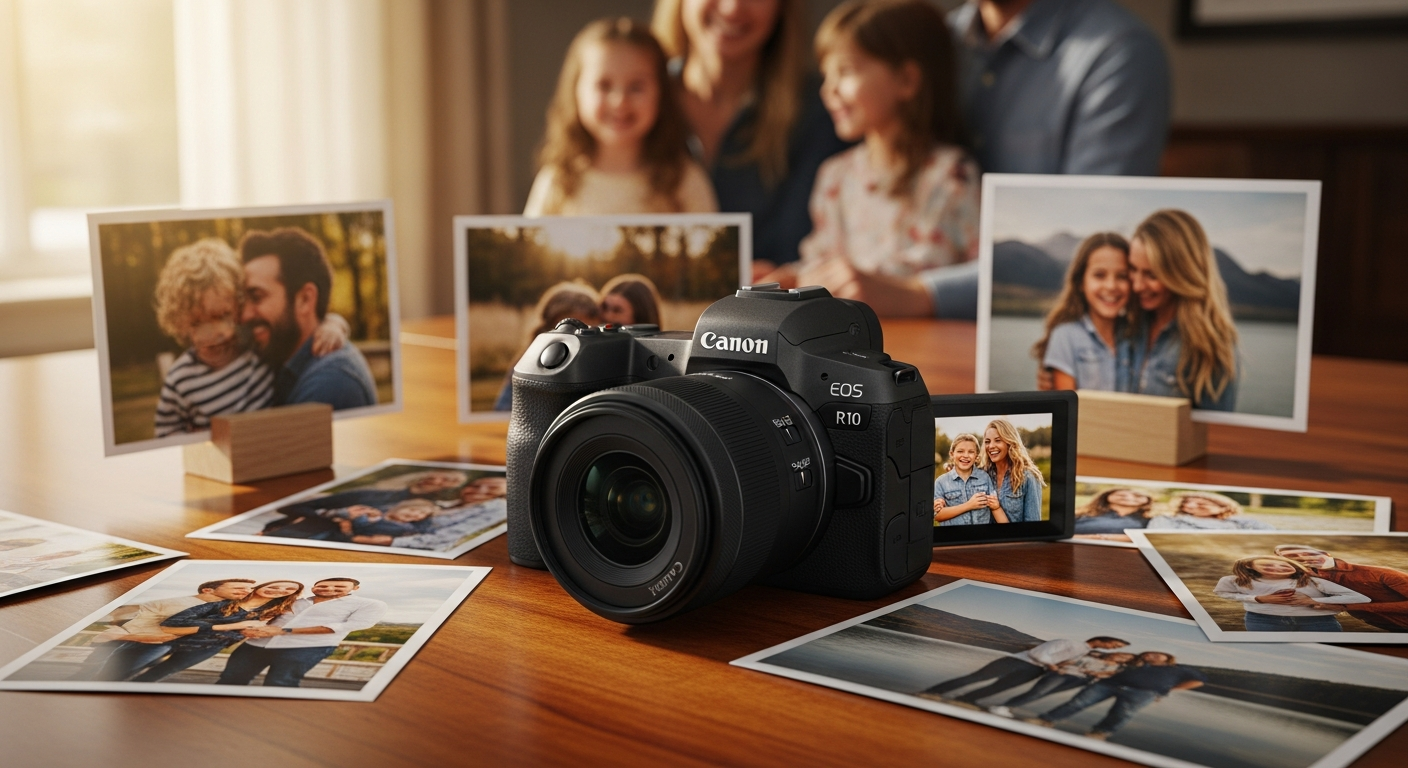
Smartphone cameras have gotten incredibly good—but they still can't match the magic of a dedicated mirrorless camera. If you've ever felt frustrated watching a blurry photo of your child mid-laugh or your pet mid-sprint, you're not alone. The moment you realize your phone's computational photography has reached its limits is when real camera ownership suddenly makes sense.
The Canon EOS R10 paired with the RF-S 18-150mm lens represents a turning point for family photographers everywhere. This isn't some intimidating professional rig that requires a film school degree to operate. Instead, it's a thoughtfully designed mirrorless camera that understands what modern families actually need: speed, reliability, and the ability to capture life as it happens.
Discover how the Canon EOS R10 can transform your family photography today.
Throughout this guide, you'll understand how the R10's intelligent autofocus system locks onto your kids' faces in a fraction of a second, why the versatile 18-150mm lens eliminates the need for multiple lenses, and how its vari-angle screen transforms everyday moments into frame-worthy shots.
Beyond Smartphones—What Makes the Canon EOS R10 Perfect for Family Photography
Why smartphone cameras struggle with fast-moving subjects and low-light environments
Your phone's camera performs miracles in daylight. Give it a dimly lit gymnasium during your daughter's recital, or ask it to track your son sprinting across the soccer field, and those computational tricks fall apart. Smartphone sensors are physically small, which means each pixel captures less light. When the camera tries to compensate by amplifying that weak signal, noise creeps in, and detail vanishes. Fast-moving subjects overwhelm the autofocus system because smartphone AF is designed for convenience, not continuous tracking of unpredictable motion.
The jump in image quality when upgrading from phone to mirrorless
The Canon EOS R10 features a 24.2-megapixel APS-C CMOS sensor—roughly nine times larger than a typical smartphone sensor. That physical size difference is everything. More sensor area means each pixel captures substantially more light, resulting in cleaner images with richer color depth and smoother tonal transitions. The dynamic range jumps dramatically too. Where a phone might blow out the sky in a group family photo or lose detail in shadowed faces, the R10 preserves information across both bright and dark areas simultaneously. You'll notice it immediately: skin tones look natural, colors feel alive, and the overall image has a three-dimensionality that phone photos simply can't match.
How the R10 bridges the gap between beginner-friendly and feature-rich
The camera doesn't demand technical mastery. The touchscreen interface feels familiar if you've used any modern smartphone. Autofocus modes are logical and clearly labeled. Yet all the advanced features are there when you're ready—manual exposure controls, customizable buttons, RAW capture, and professional-grade video specs. You can shoot in automatic mode at a family gathering and get excellent results, or you can spend months learning manual exposure and never exhaust what the camera offers. This scalability means the R10 grows with you rather than limiting your progression.
The psychological shift that happens when you hold a real camera
Something changes when you pick up a camera with genuine heft and a real viewfinder. Suddenly you're not just documenting moments—you're actively composing them. The optical finder (an electronic one here, but still) shows you exactly what the sensor will capture. The manual focus ring and aperture dial invite intentionality. You slow down, notice light quality, frame your daughter's expression more carefully. Parents report that this shift alone improves their photography within the first week, because the tool itself encourages thoughtfulness that smartphones discourage.
Autofocus Magic—Tracking Kids, Pets, and Unpredictable Moments
Dual Pixel CMOS AF II technology explained in practical terms
Canon's Dual Pixel system works by splitting each pixel on the sensor into two light-detecting elements. This allows the camera to analyze focus information from almost every part of the image simultaneously and adjust focus with remarkable speed and precision. The technology updates focus continuously while you're composing, so by the time you press the shutter, the camera has already locked onto your subject. For family photography, this means fewer out-of-focus moments and more keepers.
651 AF zones and what that means for capturing moving subjects
With 651 focus zones, the R10 can lock onto your subject virtually anywhere in the frame. You're not restricted to focusing on the center and then recomposing. Your kid can be off to the side, and the camera will track them with equal reliability. This freedom transforms how you compose family shots. You can place subjects naturally rather than centering them, resulting in more dynamic and engaging photographs.
Eye and face detection: how the camera prioritizes your family members automatically
Enable the Eye AF function, and the R10 intelligently detects human faces and locks focus directly onto eyes. It works across multiple people in frame and can prioritize specific individuals. For family portraits, this is revelatory. Shoot a group photo, and the camera automatically ensures that faces are sharp while you concentrate on overall composition. Even in action situations—kids running toward you at full speed—the eye detection tracks their face and keeps focus locked. This feature alone has revolutionized how family photographers approach capturing moving subjects.
Real-world performance: continuous shooting at 15 fps (mechanical) or 23 fps (electronic shutter)
Mechanical shutter shooting delivers 15 frames per second—fast enough to catch any expression or moment in a sequence. Switch to the electronic shutter, and the rate jumps to 23 fps. At that speed, you're guaranteed to capture the perfect expression: the genuine laugh, the moment of concentration, the mid-jump peak. Buffer capacity is generous, so you can hold the shutter button and capture long bursts without the camera pausing to process.
Experience the power of professional autofocus in your family photography with the Canon EOS R10.
The 18-150mm Lens—Why One Lens Covers Your Entire Family Story
Understanding the focal length range and what it means for framing
The 18mm wide angle captures expansive scenes—entire rooms, landscape backgrounds, group photos where you need context. The 150mm telephoto isolates subjects, compresses backgrounds, and lets you photograph from farther away. That 18-150mm range covers roughly 95% of real-world family photography scenarios. Wide for establishing shots and family groups. Telephoto for intimate portraits of individuals. Everything in between for environmental portraiture that tells a complete story.
Versatility across different shooting scenarios
At a children's birthday party, you begin with 18mm to capture the whole chaotic scene and cake decorations, then zoom to 50mm for individual portraits, then to 100mm+ for candid shots of kids playing without them constantly aware of the camera. During a family vacation, the same lens frames wide landscapes, group photos at landmarks, and detailed close-ups of your child's expression as they discover something new. The versatility means you're never limited by focal length choices, which is especially valuable when you're managing children and can't easily change lenses.
Optical stabilization (IS) built into the lens for handheld shooting
The RF-S 18-150mm includes Canon's IS (Image Stabilization) system, which compensates for camera shake. This stabilization allows you to shoot at slower shutter speeds while maintaining sharpness—crucial for low-light family events like indoor birthday celebrations or evening gatherings. Without this built-in stabilization, you'd need to increase ISO or open the aperture wider, both of which introduce compromises. The IS makes handheld shooting reliable across a wide range of lighting conditions.
Why this lens eliminates the need to swap equipment while chasing toddlers
Parents know the reality: you have one hand holding a toddler, one eye on your preschooler, and maybe a phone in your back pocket. You don't have a third hand for lens changing. The 18-150mm stays on the camera at all times. You frame and shoot without ever removing your eyes from your children. This practical consideration alone justifies the kit lens choice for family photographers who value staying present in the moment over obsessing over optimal focal lengths.
Video Capabilities That Capture Your Family's Story in Cinema Quality
4K 30p uncropped video from 6K oversampling
The R10 captures 4K video by sampling from a 6K image area and downsampling it to 4K. This process, called oversampling, results in extraordinary detail and clarity. Every frame contains more information than standard 4K capture would provide. For family videos—birthday parties, holiday celebrations, first steps—this means your footage retains stunning detail even when zoomed in during editing.
4K 60p cropped option for slower-motion playback of action moments
Choose 4K at 60 frames per second, and the camera crops slightly to maintain performance, but you gain the ability to slow footage to half-speed for dramatic effect. Your child jumping on the bed, splashing in the pool, or running through the yard plays back in smooth, cinematic slow motion. This creative option adds production value to family videos without requiring specialized equipment.
Full HD 120p for dramatic slow-motion effects
Record at Full HD resolution and 120 fps, then slow it to quarter-speed during editing for ultra-slow-motion. Watch your child's joy in detail as they open their birthday present, or capture the physics of a jump at 480 frames per second equivalent. These moments, when played back slowly, reveal details your eye misses in real time.
Vari-angle touchscreen: why this changes everything for vlogging and family videos
The 3.0-inch screen flips, tilts, and rotates to face forward, perfect for vlogging or recording family videos where you want to see yourself on camera. For traditional family videography, the vari-angle screen lets you record from ground level (kids' perspective), over-the-shoulder angles, or high overhead shots without awkward contortions. Tap the screen to set focus and exposure, or use face detection to keep yourself in focus while recording.
Hands-On Design Features That Make Daily Use Effortless
The 3.0-inch vari-angle touchscreen and why it's transformative for family photographers
The articulating touchscreen is game-changing. Shoot over your head to capture a group photo without hoisting the camera high. Flip it down to photograph your child at ground level. Angle it forward for self-portraits or family vlogs. The touchscreen interface lets you tap to focus, swipe to adjust settings, and navigate menus intuitively. After years of camera button interfaces, touchscreen control feels remarkably natural if you've used a smartphone.
Intuitive menu system and customizable buttons for quick adjustments
The camera's menu is organized logically, and the touchscreen makes navigation feel familiar. More importantly, you can customize function buttons to assign your most-used settings—ISO, white balance, drive modes—to single-press access. During a birthday party, you might have one button for continuous AF and high-speed shooting, another for face detection mode. Customization ensures that frequently-needed adjustments stay within reach.
Ergonomics: how the camera feels in smaller hands or extended shooting sessions
The R10 is compact and lightweight—roughly the size of a large smartphone. It doesn't fatigue your hands during extended shooting. The grip is contoured and feels secure, even for photographers with smaller hands. Battery life is sufficient for a full day of family photography, typically 340 shots per charge, though an extra battery during vacation is sensible planning.
Built-in Wi-Fi and Bluetooth for instant sharing to phones and tablets
Connect the camera to your phone or tablet via Wi-Fi or Bluetooth, and images transfer automatically. Share photos directly to family members in real time. Kids love seeing their photos on the big tablet screen minutes after they're captured. Bluetooth connectivity is low-power and always-on, eliminating the need to manually trigger transfers.
Image Quality Deep Dive—The 24.2MP APS-C Sensor Performance
Megapixel count and real-world printing sizes for family photos
24.2 megapixels is more than sufficient for family photography. You can print beautiful 16×20 inch prints (common for family portraits) with no quality loss. You can print 20×30 inch enlargements if you want a family portrait dominating your living room wall. You can crop photos aggressively during editing and still maintain sharpness. For digital sharing and typical printing sizes, this megapixel count is ideal—high enough for flexibility without being excessive.
Dynamic range: capturing detail in bright skies and shadowed faces simultaneously
The APS-C sensor captures approximately 14 stops of dynamic range, meaning it preserves detail in both bright and dark areas simultaneously. Photograph your child against a sunny window, and the R10 holds detail in their face while maintaining sky color. Photograph a group in mixed lighting (some in shade, some in sun), and the camera balances exposure across the frame. This dynamic range performance, combined with RAW capture capability, gives you tremendous flexibility during post-processing.
Color accuracy and how the R10 renders skin tones naturally
Canon sensors are renowned for natural skin tone rendering. Faces look healthy and lifelike without requiring heavy color correction. This is especially valuable for family photography where getting people's complexions right is essential. The camera's internal color profiles lean toward warmth without being artificial, and RAW files contain even more color information for precise adjustment if needed.
ISO performance from 100-32000 (expandable to 51200) for indoor family events
Native ISO range extends from 100 to 32,000, with expandable range up to 51,200. This performance means you can photograph indoor birthday parties, holiday gatherings, and evening family events with handheld shutter speeds. At ISO 3,200, images remain clean and usable. Push to 6,400 and noise is barely visible. Even at 12,800, the noise is film-like and acceptable for family photos. This high-ISO performance is crucial for indoor family photography where natural light is limited.
Addressing the Limitations—What You Should Know Before Buying
No in-body image stabilization (IBIS) and how lens-based IS compensates
The R10 lacks in-body stabilization, meaning stabilization depends entirely on the lens. The bundled 18-150mm includes IS, which effectively compensates for this limitation. If you later purchase non-stabilized lenses, you'll need to use faster shutter speeds or higher ISO in low light. For the kit configuration, this limitation is largely irrelevant because the kit lens handles stabilization admirably.
The impact of cropped 4K 60p on wide-angle family group shots
When shooting 4K at 60 fps, the camera crops the sensor slightly, narrowing the effective focal length. Your 18mm becomes slightly less wide. For typical family photography, this crop is hardly noticeable, but if you're shooting in tight spaces or need maximum width, the uncropped 4K 30p option is preferable.
Single SD card slot: backup strategies for important family events
The R10 has one SD card slot, which is the primary limitation for professional use. For family photography, the strategy is simple: use a high-capacity, high-speed card (256GB UHS-II minimum), and back up files to your phone or cloud storage immediately after shooting. Many photographers use two smaller cards and swap them throughout the day, ensuring that no single card contains all irreplaceable footage from a major event.
When you might outgrow the R10
The R10 is genuinely capable, but it has boundaries. If your photography ambitions grow toward professional work requiring backup gear redundancy or specialized features (extensive weatherproofing, in-body stabilization, dual card slots), you'll eventually want a higher-end body. The R10 is built for passionate amateurs and family photographers who take their craft seriously—not for working professionals. Recognize this limitation honestly before purchasing.
Investment Value—Is the R10 Worth the Price for Your Family?
Mid-range pricing (AUD $1,500-$2,000) and what you get for the investment
The Canon EOS R10 with the 18-150mm kit lens typically costs AUD $1,500-$2,000, positioning it in the mid-range for mirrorless cameras. At this price point, you're investing in a complete system: the body, a versatile lens, and access to Canon's extensive RF-mount ecosystem. You're not paying premium prices for professional redundancy features you don't need, nor are you compromising on sensor quality or autofocus performance.
Cost comparison: R10 kit versus premium smartphones plus accessories
A flagship smartphone costs AUD $1,500+. Add a quality tripod (AUD $100-300), additional storage, backup solutions, and editing software, and you're approaching R10 territory. The R10 offers dramatically superior image quality, genuine creative control, and longevity. A phone becomes outdated in three years; a camera body remains capable for a decade.
Longevity: how long this camera remains relevant for family use
The R10 will serve family photography needs reliably for 10+ years. Sensor technology improves gradually. A camera from 2023 will feel outdated for professional work by 2033, but it will still produce beautiful family photos. Canon's RF-mount ecosystem will continue expanding, meaning your lens investment remains valuable. Unlike consumer electronics that become incompatible or slow, cameras simply continue working.
The intangible value: confidence in capturing irreplaceable moments
The real investment isn't the AUD $1,500-$2,000. It's the confidence that when your child's expression reaches perfection, when your grandchild takes their first steps, when your family gathers for the last time in this house, the camera will deliver. You won't have a blurry photo because the autofocus failed. You won't have underexposed darkness because the sensor couldn't handle low light. You'll have images that faithfully represent the moment, sharp and beautiful enough to preserve those feelings for decades.
Getting Started—Your First Steps with the Canon EOS R10
Unboxing and initial setup walkthrough
Your R10 arrives with the camera body, 18-150mm lens, battery, charger, USB cable, and documentation. Mount the lens (align the red dots and twist clockwise), insert the battery, format an SD card, and you're ready to shoot. The camera powers on with a reassuring beep. Navigate to the menu, select your language and region, and set the date and time. Within 10 minutes, you'll be taking photos.
Essential accessories that enhance family photography
A spare battery ensures you're never without power during extended shooting. A sturdy tripod lets you capture family group photos where everyone, including the photographer, appears in frame. An ND (neutral density) filter on the lens lets you use wider apertures in bright sunlight. A quick-release plate makes mounting and removing the camera from the tripod effortless. Quality 256GB UHS-II SD cards ensure fast writing and reliability. None of these are mandatory, but each genuinely improves your experience.
Recommended camera settings for different family scenarios
For everyday family photography, enable Eye AF with face detection, set the camera to aperture priority (Av mode), choose f/4 to f/5.6 to balance sharpness with subject isolation, and let the camera manage shutter speed and ISO automatically. During indoor events, increase ISO ceiling to 6,400 and enable continuous AF. For video, select 4K 30p as your default, leaving 4K 60p for action sequences. These starting points work for 95% of family photography situations.
Learning resources: Canon's tutorials, YouTube channels, online communities
Canon's official YouTube channel includes dedicated R10 tutorials. Photography communities like Reddit's r/canon offer real-world advice from R10 owners. YouTube creators like Peter McKinnon and Matt Granger produce comprehensive guides. Start with Canon's basic tutorials, then explore creators who specialize in family or travel photography—the scenarios most similar to your own use case.
The Family Photographer's Game-Changer
The Canon EOS R10 with the RF-S 18-150mm lens isn't just another camera—it's a commitment to preserving your family's story with the clarity and detail it deserves. From the moment your toddler's face locks into focus to the instant you press record on a 4K birthday celebration, this mirrorless system delivers the performance and reliability that busy families need. The learning curve is gentle, the results are stunning, and the versatility of that 18-150mm lens means you're covered for everything from intimate portraits to full family gatherings. At AUD $1,500-$2,000, you're investing in a system that'll grow with your photography ambitions and give you the confidence to capture life's most precious moments exactly as you remember them. Your family's story deserves better than a smartphone.
Leave a Reply